All news
May 29, 2026
Study Abroad 101
How Korean Students Navigate Cultural Transitions at US Private Boarding Schools
How Korean students navigate cultural transitions at US private boarding schools: classroom adjustment, boarding life, and Amerigo's Korean-language support.
How Korean Students Navigate Cultural Transitions at US Private Boarding Schools
Last Updated: May 2026
Cultural transitions for Korean international students at US private boarding schools involve adapting to significant differences in classroom expectations, social dynamics, and daily living that contrast sharply with Korean high school culture. According to IIE Open Doors (2025), South Korea is one of the top five source countries for international students at US secondary schools, with thousands of Korean students enrolled annually at private boarding schools across the US.
Amerigo Education partners with 40 Niche A+/A rated schools across the US, Canada, and the UK, supporting 3,500+ students from 55+ countries. The Class of 2025 achieved 97% admission to Top 100 US universities. South Korea is one of Amerigo's primary markets, and the on-campus international department at each US Signature School provides structured support for Korean students navigating academic and cultural adjustment.
This guide covers how Korean school culture differs from US private boarding school expectations, which adjustment challenges Korean students face most often in their first semester, how boarding life changes daily routines, and how Amerigo supports Korean students and families through each stage of the transition.
Key Takeaways
- Classroom participation requires new habits: Korean students trained for the Suneung (CSAT) must build verbal discussion and opinion-sharing skills unfamiliar from lecture-based Korean classrooms.
- Boarding school life is community-driven: Extracurriculars, school events, and peer relationships are integral to US private boarding school culture, not supplementary.
- Korean families receive native-language updates: Amerigo's in-country staff communicate with Korean families in Korean before and after key events and reporting periods.
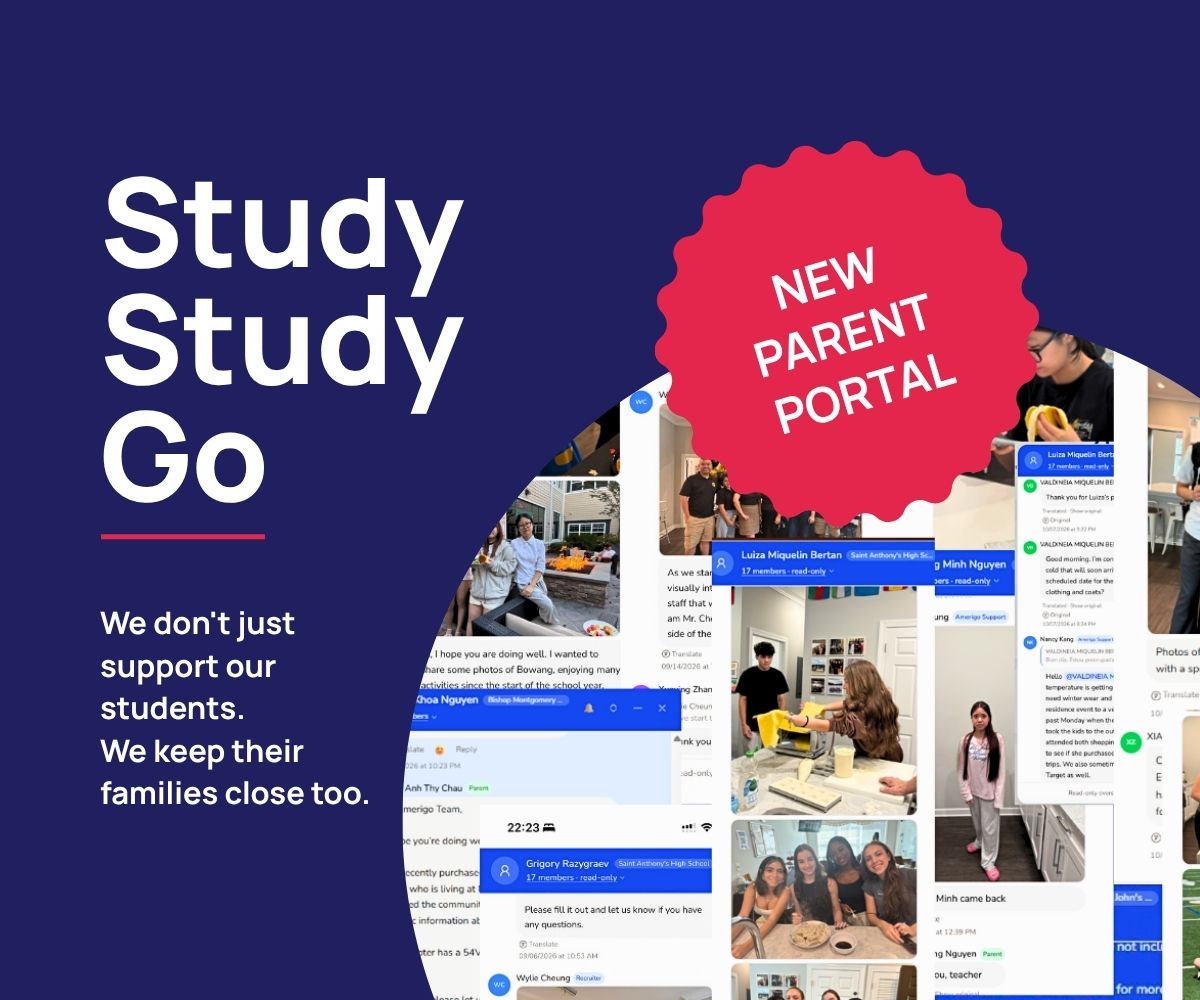
- Academic planning starts immediately: Monthly progress reports, school activity calendars and event announcements help families track development through StudyStudyGo from semester one.
- Social integration deepens in year two: Most Korean students at Amerigo partner schools report their strongest cultural confidence in their second year of enrollment.
How Does Korean School Culture Differ from US?
Korean high schools preparing students for the Suneung (CSAT, College Scholastic Ability Test) operate primarily around structured lecture delivery, focused note-taking, and standardized examination preparation. Teachers hold formal authority over academic content, and student participation in classroom debate or unsolicited questioning is less culturally expected than in US private school settings. According to NAIS (2025), US private schools consistently report higher rates of student participation in classroom discussion and extracurricular engagement than comparable international school systems.
US private boarding schools assign significant value to verbal participation, discursive writing, and collaborative projects as formal assessment components. Korean students who enter having spent years in Suneung-focused preparation often find the shift to continuous assessment and teacher-student informality the steepest initial adjustment.
What Adjustment Challenges Appear First for Korean Students?
The first semester at a US private boarding school typically surfaces four primary adjustment challenges for Korean students:
- Verbal participation: Korean students often find it difficult to volunteer opinions in class discussions, raise counterarguments with teachers, or present personal views in debate formats.
- Discursive writing: US private schools require essays that present and defend an argument. Korean students strong in mathematics and science may need time to develop the analytical essay style US teachers expect.
- Social English: Informal peer conversation, including humor and cultural references, develops more slowly than academic English. Korean students may initially feel more comfortable with other Korean speakers.
- Multi-subject workload: Unlike the Suneung's concentrated subject structure, US private school coursework distributes simultaneous deadlines across multiple subjects and project types.
According to NACAC (2024), US universities increasingly evaluate applicants on evidence of classroom engagement and intellectual curiosity, making strong participation skills a practical university admission requirement for Korean students.
How Does Boarding School Life Change Daily Expectations?
Moving into a boarding environment introduces structural changes that are independent of academic adjustment. Korean students who have lived at home throughout secondary school must develop independence in managing daily schedules, resolving peer conflicts, and maintaining personal wellness without parental mediation on site.
Amerigo's off-campus residences are the primary accommodation model, 20-30 minutes from partner schools with single-gender units and 24/7 staff. On-campus residences are available at select schools. Both models provide campus coordinator support throughout the transition. Families reviewing student accommodations can select the living arrangement that best matches their child's independence level.
Boarding school life integrates extracurricular participation, school events, and student government into the expected student experience. Varsity sports eligibility for international students varies by school and state; some students may need to wait at least one year before varsity tryouts. Amerigo also hosts its own social events for students and their friends separate from school-organized activities, giving Korean students additional opportunities to build peer relationships in a supported setting.
How Does Amerigo Support Korean Students on Campus?
The on-campus international department at each US Signature School provides daily academic and welfare support for Korean students. The team is led by a Director of Campus Operations and includes an Academic Director, Senior Campus Coordinators, Campus Coordinators, and an ELL (English Language Learning) Teacher. Amerigo's in-country staff communicate with Korean families in Korean before and after key events including parent-teacher conferences and semester reporting periods.
Families receive monthly progress reports, school activity calendars and event announcements through StudyStudyGo, Amerigo's parent communication platform launching Fall 2026. Campus coordinator availability during structured study hours provides academic support for residential students throughout the week. At US Signature Schools, Life360 or Reach location-sharing technology gives Korean families real-time safety visibility.
Academic planning for Korean students includes identifying prerequisite courses for AP (Advanced Placement) enrollment, tracking cumulative GPA (Grade Point Average), and building the academic and extracurricular profile connected to the university-guaranteed admission pathway.
How Does Social Integration Develop Over Time?
South Korea is one of the primary markets in the Amerigo network, and Korean students are enrolled across the US Signature School partner campuses. The presence of Korean peers at each campus provides cultural familiarity during the first semester. The program structure encourages students to integrate with the full school community rather than self-segregate within same-country peer groups.
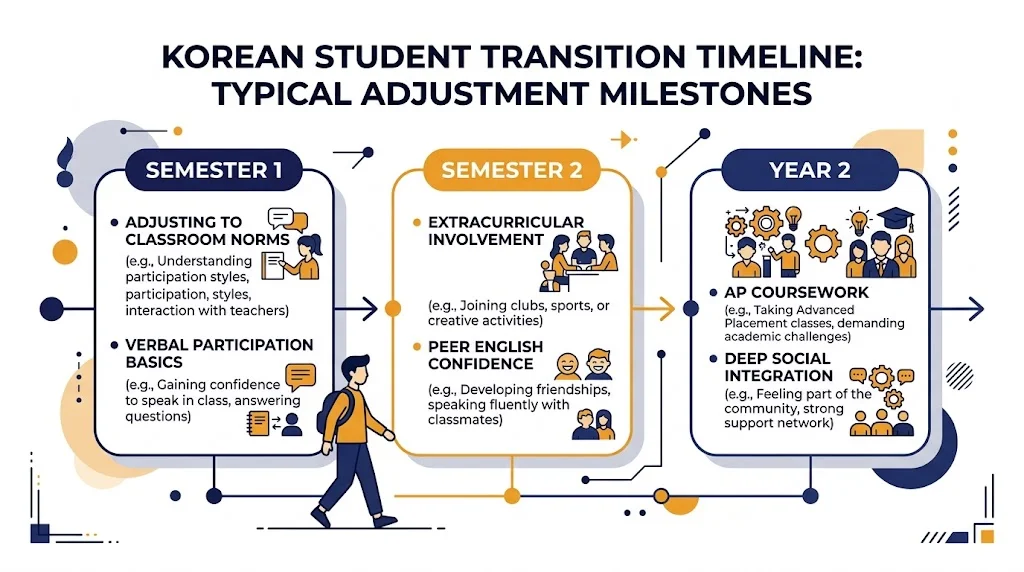
Social integration at US private boarding schools typically develops across four stages:
- Orientation week: In-person after arrival, introducing campus culture through structured activities and peer group introductions.
- Semester 1: Classroom norm adjustment; social confidence in English begins developing through structured participation.
- Semester 2: Extracurricular involvement increases; peer friendships outside the Korean student community begin to form.
- Year 2: Most Korean students report deepest social and academic integration, with stronger verbal confidence and established broader friend groups.
Students who join extracurricular clubs and school teams in their first semester consistently report faster social integration by the end of year one. Families can review How International Students Make Friends at US High Schools for additional integration guidance.
What Role Do Korean Parents Play in the Transition?
Korean families typically maintain close involvement in their children's academic progress throughout secondary education. Monthly progress reports, school activity calendars and event announcements are delivered via StudyStudyGo, with Amerigo's in-country staff communicating key findings to Korean families in Korean following major reporting events. When updates require immediate attention, real-time outreach from the campus team supplements the standard monthly reporting cycle.
According to IIE Open Doors (2025), family support structures significantly influence international student outcomes, and programs with active parent communication consistently produce higher student satisfaction and academic engagement. Families can also review How Parents Track Their Child's Progress at US High Schools for a detailed overview of how the reporting and communication model works in practice.
Frequently Asked Questions
How Long Does the Cultural Transition Take for Korean Students?
Most Korean students find that primary academic adjustments, including classroom participation, discursive writing, and peer English communication, stabilize over one full semester. Social integration deepens through the first year, and most Korean students report their strongest cultural confidence in their second year of enrollment. Students who enter in Grade 9 or 10 have the longest adjustment runway and typically show the most complete integration profile by Grade 12.
Is Korean-Language Support Available at US Partner Schools?
Amerigo's in-country staff communicate with Korean families in Korean before and after key events, including parent-teacher conferences, orientation sessions, and semester reporting periods. On-campus communication at US Signature Schools is conducted in English. The on-campus international department provides academic and welfare support in English, and campus coordinators can assist Korean students in navigating school processes and academic documentation.
Do Korean Students Have to Give Up Their Study Habits?
Not entirely. Korean students' strengths in mathematics, science, and structured study discipline transfer well to US private school environments. The adjustment involves adding new skills, including verbal participation, analytical writing, and collaborative project work, rather than replacing existing ones. ELL support at Amerigo US Signature Schools helps Korean students develop English academic language alongside their existing subject strengths.
How Does the Campus Team Support Struggling Korean Students?
Campus Coordinators at Amerigo US Signature Schools monitor student welfare and are available during structured study hours for academic support. Real-time outreach protocols allow the campus team to contact families when a student is struggling, so issues are addressed before they compound. Amerigo's in-country staff communicate welfare updates to Korean families in Korean following any significant campus concern.
Are There Korean Student Communities at US Partner Schools?
Yes. Korean students are enrolled across the US Signature School network, and a Korean peer community is present at most campuses. The program encourages full school integration rather than same-country self-segregation, as limiting social interaction to Korean-only groups typically slows English development and integration into the broader school community. Campus coordinators actively encourage Korean students to participate in extracurriculars and school events from the first semester.
What Are Parent-Teacher Conferences Like for Korean Families?
Parent-teacher conferences at US partner schools follow each school's standard schedule. Amerigo's in-country staff communicate key findings to Korean families in Korean following conferences and major reporting periods. On-campus conference meetings are conducted in English, with campus coordinators attending to provide summaries afterward. Some schools may offer remote participation options; families should confirm the specific format with the campus team per school.
How Do Korean Students Handle Extracurricular Requirements?
Korean students often enter US private boarding schools with less extracurricular experience than American peers, as Suneung preparation typically dominates non-academic time at home. US private schools and US university admissions offices view extracurricular participation as evidence of character and leadership. Campus coordinators help Korean students identify clubs, sports, and activities aligned with their interests during the first semester to build an early extracurricular record.
What English Proficiency Is Required for Korean Students?
Amerigo accepts TOEFL (Test of English as a Foreign Language), IELTS, Duolingo English Test, and Eltis as English proficiency assessments. Most Signature School partner campuses accept students with B1 English proficiency, with ELL coursework supporting progression toward AP-level classes. Korean students with lower English proficiency benefit from enrolling in Grade 9 or 10, which provides more time for ELL progression before university application deadlines in senior year.
Conclusion
Korean students at US private boarding schools adapt to a learning environment that differs significantly from Suneung-focused Korean high school culture in classroom format, assessment model, and social expectations. The on-campus international department team, in-country Korean-language staff communication, and structured parent reporting through StudyStudyGo provide a framework for managing this transition. Most Korean students at Amerigo partner schools achieve their deepest social and academic integration in the second year of enrollment.
Find Your Amerigo Partner School
To learn more about studying in America at an Amerigo partner school, contact us to speak with a program advisor, or apply now to take the first step toward enrollment.
People Also Read
- Korean Students in US High Schools Guide 2026
- Korean Families' Guide to Amerigo Education: Enrollment, Support, and Outcomes
- How to Overcome Culture Shock: A Guide for International High School Students Ages 14-18
About the Author
This guide was written by the Amerigo Education content team, drawing on program data from staff operating the on-campus international department at 40 Niche A+/A rated US, Canadian, and UK partner schools. Learn more about Amerigo Education.
Disclaimer: This article provides general information for educational purposes only. Families should conduct independent research, request current program data from providers, and consult with program representatives regarding specific circumstances. Contact us with questions.