All news
May 29, 2026
Study Abroad 101
Boston College International Admissions: What High School Students Need to Submit
Boston College's ~17% acceptance rate, liberal arts tradition, and international aid policy explained. Amerigo's Top 50 Track prepares students to apply.
Last Updated: May 2026
Boston College, located in Chestnut Hill, Massachusetts, admitted approximately 17% of applicants for its Class of 2028, placing it in the highly selective tier of northeastern US universities. International students who plan to study on an F-1 (student visa for US academic programs) must enroll in SEVIS (Student and Exchange Visitor Information System) and maintain full-time status throughout their program. According to IIE Open Doors (2023), international undergraduate enrollment at highly selective US universities has grown consistently, with New England campuses among the most sought-after destinations for students from Asia, Europe, and Latin America.
Amerigo Education partners with 40 Niche A+/A rated schools (independent academic rankings based on school-reported curriculum quality, faculty credentials, student outcomes, and college matriculation data) across the US, Canada, and the UK, supporting 3,500+ students from 55+ countries. The Class of 2025 achieved 97% admission to Top 100 US universities - and of those who applied to Top 30 universities, 25% gained admission.
This guide explains what Boston College expects from international applicants, how its financial aid model works for non-US students, and how an Amerigo partner school placement can strengthen a student's application trajectory toward Boston College.
Key Takeaways
- Acceptance Rate: Boston College's Class of 2028 acceptance rate was approximately 17%, placing it in the highly selective northeastern US tier.
- Need-Aware Aid: BC is need-aware for international applicants; institutional grant funding is limited and the CSS Profile is required for aid consideration.
- Academic Benchmark: Admitted students typically present a 3.9+ GPA and strong performance in AP (Advanced Placement) and Honors-level coursework.
- EA Option: Boston College offers non-binding Early Action with a November 1 deadline; decisions are released in mid-December.
- Amerigo Outcomes: Of Amerigo students who applied to Top 50 universities, 60% gained admission - and of those who applied to Top 30 universities, 25% were admitted.
What Is Boston College's Acceptance Rate?
Boston College's overall acceptance rate for the Class of 2028 was approximately 17%. While BC does not publish a separate acceptance rate for international applicants, international students compete in the same applicant pool and are evaluated under the same comprehensive review process as domestic applicants.
BC enrolled approximately 2,300 first-year students in the Class of 2028. International students account for roughly 10% of BC's undergraduate population, representing countries including the Taiwan Region, South Korea, mainland China, India, Canada, and nations across Europe, Latin America, and Southeast Asia.
Boston College's selectivity has increased steadily over the past decade, driven by growing global recognition of its Jesuit liberal arts tradition, its location in a major metropolitan research hub, and the strength of its professional schools. Students from Amerigo partner schools who apply to BC compete with a well-documented academic record and faculty recommendations from NAIS-member institutions that BC admissions representatives recognize. Families can explore Amerigo's study-in-America program to learn how partner school placements are structured.
What Documents Do International Applicants Need?
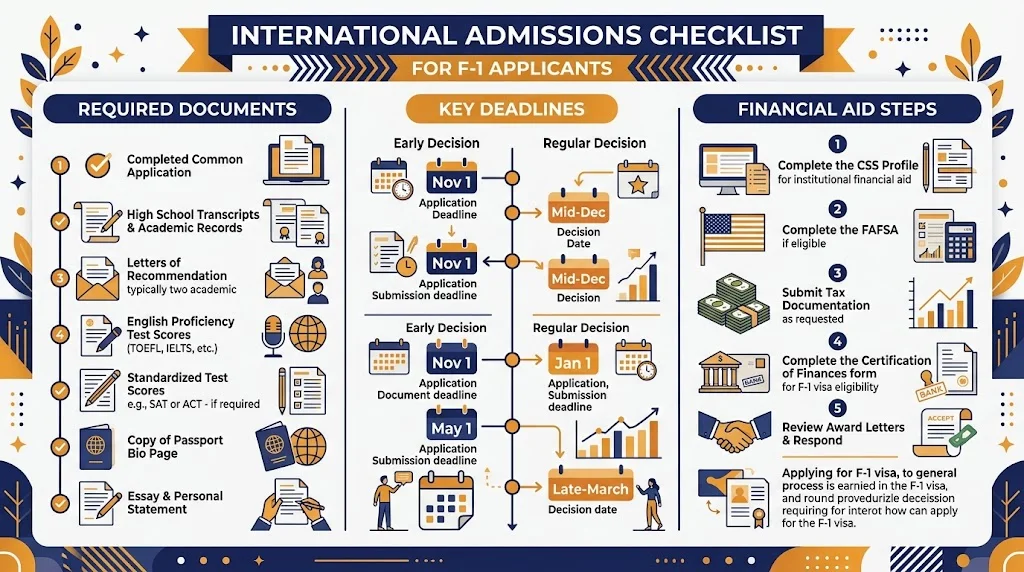
Boston College uses the Common Application. International applicants must submit the same core materials as domestic applicants, along with several international-specific requirements.
Required materials include:
- Common App and BC Supplement: The BC-specific essay asks applicants to reflect on the Jesuit liberal arts mission and how it connects to their academic and personal goals.
- Official Academic Transcripts: Records from all secondary schools attended, with certified English translations if originals are not in English.
- School Report and Counselor Recommendation: Completed by the applicant's current school counselor or college advisor.
- Two Teacher Recommendations: Preferably from core academic subjects taught in 11th or 12th grade.
- SAT or ACT Scores (Optional): BC is test-optional through the Class of 2029.
- English Proficiency Documentation: TOEFL, IELTS, or Duolingo English Test required for applicants whose primary language of secondary instruction is not English.
Students enrolled at Amerigo partner schools submit these materials with on-campus college counselors who understand BC's expectations and maintain familiarity with its supplemental essay requirements. Families receive monthly progress reports, school activity calendars and event announcements throughout the application cycle, ensuring parents stay informed at every stage.
Does BC Meet International Student Financial Aid?
Boston College is need-aware for international applicants. This means that a student's demonstrated financial need may be considered as part of the admissions review, and institutional grant funding for international students is more limited than for domestic applicants.
International students who require financial assistance must submit the CSS Profile by the relevant application deadline. BC works to meet the demonstrated need of admitted international students to the extent its institutional resources allow, but it does not guarantee to meet 100% of demonstrated need for every admitted international applicant. This distinguishes BC from need-blind institutions such as MIT or Amherst.
Families should review current financial aid policies directly on BC's financial aid office website, as funding levels and policy terms can change between admissions cycles. International students ineligible for US federal aid should plan a comprehensive funding strategy that includes home-country government scholarships, private foundations, and BC's external scholarship database well before the November 1 EA or January 1 RD deadline.
Which BC Programs Attract International Students?
Boston College's academic structure includes four undergraduate schools built around a required Jesuit Core Curriculum that all students complete regardless of major:
- Morrissey College of Arts and Sciences: The largest undergraduate school, housing pre-medicine preparation, economics, political science, computer science, psychology, and natural sciences.
- Carroll School of Management: Consistently ranked among the top 30 undergraduate business schools in the US, with strong pipelines into consulting, investment banking, and accounting.
- Lynch School of Education and Human Development: A nationally recognized program in education research, counseling psychology, and international education policy.
- Connell School of Nursing: One of the most respected undergraduate nursing programs in the northeastern US, with direct clinical placement in Boston-area hospitals.
International students are most concentrated in Morrissey College and Carroll School, particularly in economics, computer science, pre-medicine, and finance tracks. BC graduates in these programs have strong placement records in consulting, healthcare, and financial services sectors in the US and internationally.
How Does Boarding School Strengthen a BC Application?
Boston College's admissions process uses contextual review - evaluating each student's record within the context of what was available at their school. Students at academically rigorous boarding schools demonstrate capacity for independent learning, sustained academic effort, and meaningful community contribution, all of which align with BC's Jesuit mission.
Students in Amerigo's US Signature Schools - a network of partner schools in the United States where Amerigo provides dedicated on-campus international support, including residential accommodation, an on-campus international department - a dedicated team at each US Signature School consisting of a Director of Campus Operations, Academic Director, Senior Campus Coordinators, Campus Coordinators, and an ELL teacher, who provide daily academic support, residential supervision, university counseling, and welfare oversight for enrolled international students, university counseling, and the Top 100 Guarantee - a refund of up to $50,000 USD in senior year tuition fees for US Signature School students who complete two consecutive years of enrollment, maintain a cumulative GPA of 3.2 or higher, achieve a TOEFL score of 85 or above, complete at least one AP, IB, or Honors course, and apply to Top 100 US universities but do not gain admission for eligible students work with on-campus college counselors who begin BC supplement preparation in 11th grade and review academic performance in core subjects that BC evaluates most carefully. Amerigo's partner schools are selected for their Niche A+/A ratings and SEVIS-certified enrollment offices, which support accurate I-20 issuance and F-1 visa preparation timelines. According to NAIS (2023), students at NAIS-member independent schools are accepted at highly selective universities at rates well above the national average for all US secondary school graduates.
Frequently Asked Questions
What is BC's acceptance rate for international students?
Boston College does not publish a separate acceptance rate for international applicants. The overall Class of 2028 acceptance rate was approximately 17%. International students are reviewed in the same individualized review process as domestic applicants, with attention given to academic achievement, extracurricular depth, the BC supplemental essay, and demonstrated alignment with the university's Jesuit mission. Students from academically rigorous boarding schools tend to present well-prepared application materials and strong faculty recommendations.
Does Boston College offer financial aid to international students?
BC is need-aware for international applicants and provides limited institutional grant funding relative to US domestic applicants. Students requiring financial support must submit the CSS Profile by the application deadline. BC works to meet demonstrated need for admitted international students but does not guarantee full-need coverage for every admitted applicant. International students should also investigate home-country government scholarships, private foundations, and any external scholarships listed in BC's financial aid database.
What GPA and test scores does Boston College expect?
Admitted students typically present a weighted GPA of 4.0 or higher and strong performance in AP and Honors-level coursework. Boston College adopted a test-optional policy through the Class of 2029. Students who choose to submit SAT or ACT scores are expected to present results in the 1400-1560 SAT range or 32-35 ACT range, based on recent admitted class profiles published by BC's admissions office.
Is there an Early Action deadline at Boston College?
Yes. Boston College offers non-binding Early Action with a November 1 deadline. EA decisions are released in mid-December, giving admitted students more time to compare financial aid packages and plan enrollment. According to NACAC (2022), early application rounds have grown in strategic importance across highly selective US universities, and BC's EA process reflects that broader trend. Regular Decision applications are due January 1, with decisions released in late March or early April.
What English proficiency tests does BC accept?
Boston College accepts TOEFL, IELTS, and the Duolingo English Test for international applicants whose primary language of secondary instruction is not English. Minimum score requirements are published on BC's admissions website and may be updated between admissions cycles. Students who have completed two or more years of full-time study at an English-medium secondary institution in the US, UK, Canada, or Australia may be eligible for a waiver. Applicants should confirm current waiver criteria directly with BC's admissions office before applying.
What schools make up Boston College's undergraduate colleges?
Boston College has four undergraduate schools: Morrissey College of Arts and Sciences, the Carroll School of Management, the Lynch School of Education and Human Development, and the Connell School of Nursing. Students apply to a specific school within BC. Transferring between schools after enrollment is possible under certain conditions. Carroll School and Connell School each have additional prerequisite coursework and GPA expectations that students should review when selecting their intended school on the application.
How many international students does Boston College enroll?
International students represent approximately 10% of BC's undergraduate student body, or roughly 1,100 to 1,200 students across all four years. The most represented countries include the Taiwan Region, South Korea, mainland China, India, Canada, and several Western European nations. BC's Office for International Students provides dedicated orientation programming and advising for newly arrived F-1 students managing SEVIS check-in and initial academic registration requirements.
Can students from the Taiwan Region apply to Boston College?
Yes. The Taiwan Region is among Boston College's most consistently represented international student communities. Students from the Taiwan Region follow the same application process as all international applicants - Common App, BC supplement, English proficiency documentation, and CSS Profile if applying for financial aid. BC's admissions office has substantial experience evaluating secondary school transcripts from the Taiwanese education system and understanding the academic context of achievement within Taiwanese high schools.
What extracurriculars does Boston College value in applicants?
Boston College values depth, community contribution, and alignment with Jesuit values rather than a long list of unconnected activities. Students who have held meaningful leadership roles in student government, a community service organization, athletic teams, or faith-based initiatives - and who can demonstrate measurable impact - present more compellingly than applicants with a wide but shallow activity list. Research projects, creative pursuits, and entrepreneurial work are also valued when they show genuine commitment over multiple years.
How does Boston College compare to Georgetown or Fordham?
All three are Jesuit institutions with strong liberal arts traditions. Georgetown is generally more selective (acceptance rate ~13-15%), with a particular emphasis on international relations, politics, and government careers. Boston College's Class of 2028 acceptance rate was approximately 17%, with particular strength in business, pre-medicine, and nursing programs. Fordham is less selective (~54% acceptance rate) and serves a broader applicant pool. Families considering all three should match school selection to academic interest area as well as selectivity tier.
Conclusion
Boston College offers a distinctive Jesuit liberal arts education with competitive programs in business, health professions, and the social sciences. For international students on an F-1 visa, early preparation on the English proficiency documentation, CSS Profile, and BC supplement is the primary factor distinguishing well-prepared from incomplete applications.
Plan Your Application to Boston College With Amerigo
To learn more about studying in America at an Amerigo partner school, contact us to speak with a program advisor, or apply now to take the first step toward enrollment at a school that builds a competitive BC application.
People Also Read
- How Students Get Into Top 50 US Universities
- Early Decision vs Early Action for International Students
- College Application Essays for International Students
About the Author
This guide was written by the Amerigo Education content team, drawing on program data from staff operating the on-campus international department at 40 Niche A+/A rated US, Canadian, and UK partner schools. Learn more about Amerigo Education.
Disclaimer: This article provides general information for educational purposes only. Families should conduct independent research, request current program data from providers, and consult with program representatives regarding specific circumstances. Contact us with questions.