All news
April 24, 2026
Study Abroad 101
Korean Families' Guide to Amerigo Education: Enrollment, Support, and Outcomes
Korean families' guide to Amerigo Education: 97% Top 100 outcomes, Korean-language staff, B1 English support, Top 100 Guarantee, and enrollment process explained.
Last Updated: April 2026
A US high school pathway program for Korean students is a structured educational arrangement that places Korean students aged 14 to 18 in accredited American high schools, providing them with the academic foundation, language development, and university counseling needed to gain admission to top-ranked US universities. According to the Institute of International Education's Open Doors Report, South Korea has consistently ranked among the top five source countries for international students in the United States, with families prioritizing university outcomes and institutional prestige above most other decision factors.
Amerigo Education partners with 40 Niche A+/A rated schools across the US, Canada, and the UK, supporting 3,500+ students from 55+ countries. The Class of 2025 achieved 97% admission to Top 100 US universities. Korean-language staff are available to support Korean students and their families throughout enrollment and the entire program.
Key Takeaways
- 97% of Amerigo's Class of 2025 were admitted to Top 100 US universities: For Korean families where university prestige is a primary goal, this outcome rate significantly exceeds the national average for international applicants.
- Korean-language staff are available: Amerigo has native-language staff supporting Korean families throughout the program, from enrollment to graduation.
- 96% of B1-level English students reached Top 100 universities: Korean students who arrive with intermediate English can achieve competitive university outcomes through Amerigo's structured academic support.
- The Top 100 Guarantee provides up to $50,000 USD in financial protection: Eligible students who meet all program requirements but do not receive a Top 100 offer can receive a refund of up to $50,000 USD in tuition fees.
- All four accommodation types are available: Korean families can choose from homestay, off-campus residences, on-campus residences at select schools, or self-provided accommodation based on their child's needs and preferences.
Why Do Korean Families Choose US High School?
Korean families choose US high school education primarily because of the direct pathway it creates to top-ranked American universities, which carry significant prestige in South Korean professional and social culture. A US high school diploma from a recognized, highly rated school gives Korean students a genuine academic foundation that is directly comparable to the domestic applicant pool when applying to US universities, rather than requiring transcript conversion or explanation that foreign credentials typically demand.
The academic culture of US high schools also provides Korean students with skills that complement their existing strengths. Korean students typically arrive with strong mathematics and science foundations. What US high school adds is classroom participation, confidence, English academic writing, independent research skills, and extracurricular engagement, all factors that US university admissions officers weigh heavily. Students who spend two to four years in an authentic American high school environment arrive at university applications with a profile that is demonstrably stronger than students who remain in their home country for secondary school and then apply internationally. For Korean families, this combination of academic preparation and institutional credibility is the core value proposition.
What University Outcomes Do Korean Students Achieve?
The Amerigo Class of 2025 achieved 97% admission to Top 100 US universities, 60% to Top 50 universities, and 25% to Top 30 universities. These outcomes apply across the student body, including students who entered the program with developing English proficiency. For Korean families where the specific university name on a degree determines employment access, these rates represent a meaningful probability of the outcome they are investing toward.
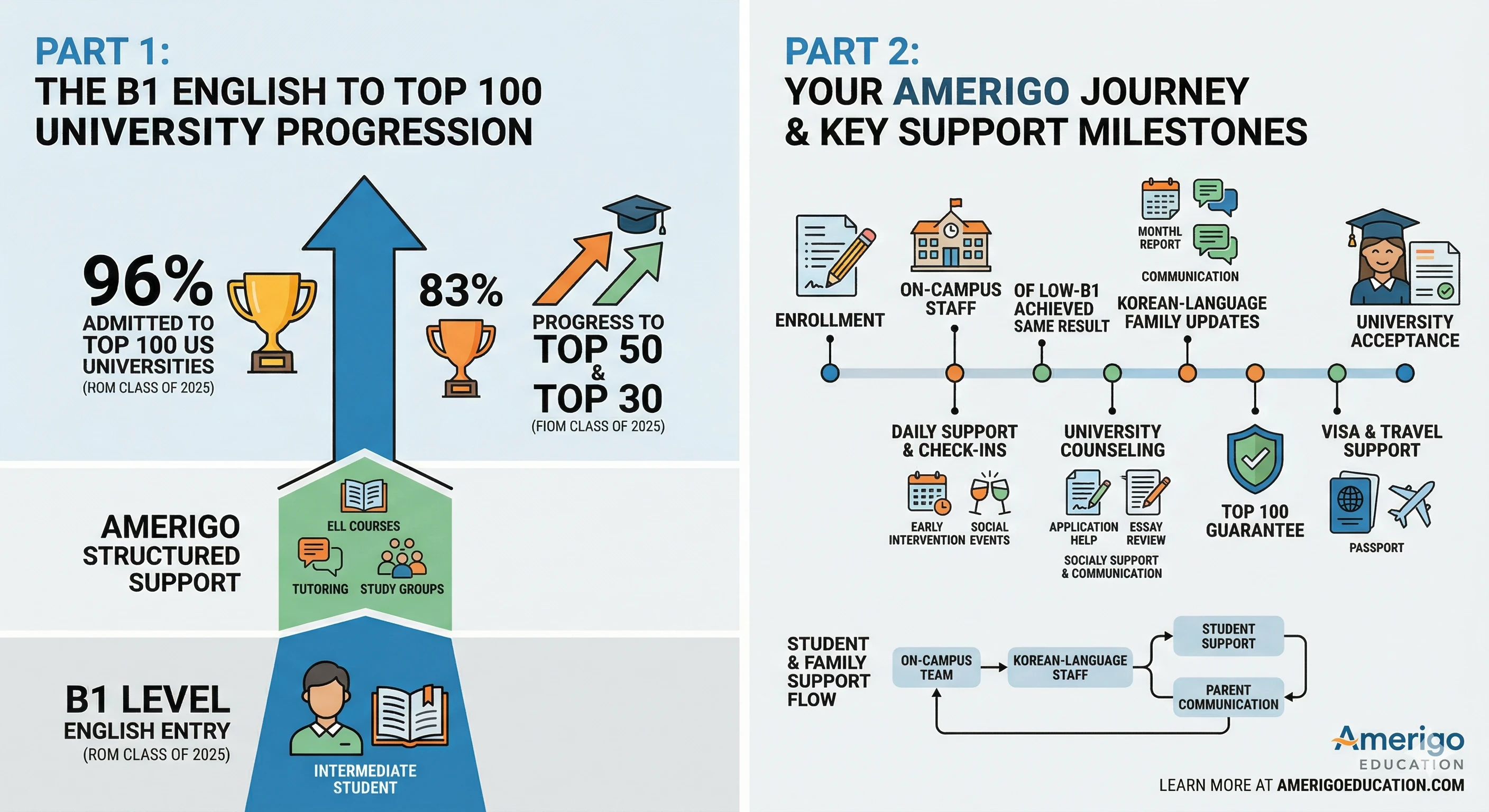
The English proficiency data is particularly relevant for Korean families. Many Korean students enter US high school programs with B1-level English, a common starting point given that Korean secondary school English education focuses heavily on written grammar rather than spoken fluency. In the Amerigo Class of 2025, 96% of B1-level students were admitted to Top 100 universities, and 83% of low-B1 students achieved the same result. This demonstrates that the structured academic support environment, including ELL courses, subject-specific tutoring (additional costs may apply depending on subject and frequency), evening study groups, and on-campus staff, converts a common starting disadvantage into a competitive university outcome at a high rate. The outcome data is above what the national average of roughly 40 to 50% for international applicants would suggest is possible without that support structure.
How Does Amerigo Support Korean Students on Campus?
Amerigo's support model for Korean students is built around the on-campus international department, which places Amerigo staff directly at each of its 40 partner schools. These staff members are present during the school day and interact with students in their actual learning environment, not remotely or through periodic check-ins. This daily on-campus presence is what allows Amerigo to identify academic difficulties early, provide immediate intervention, and maintain consistent family communication.
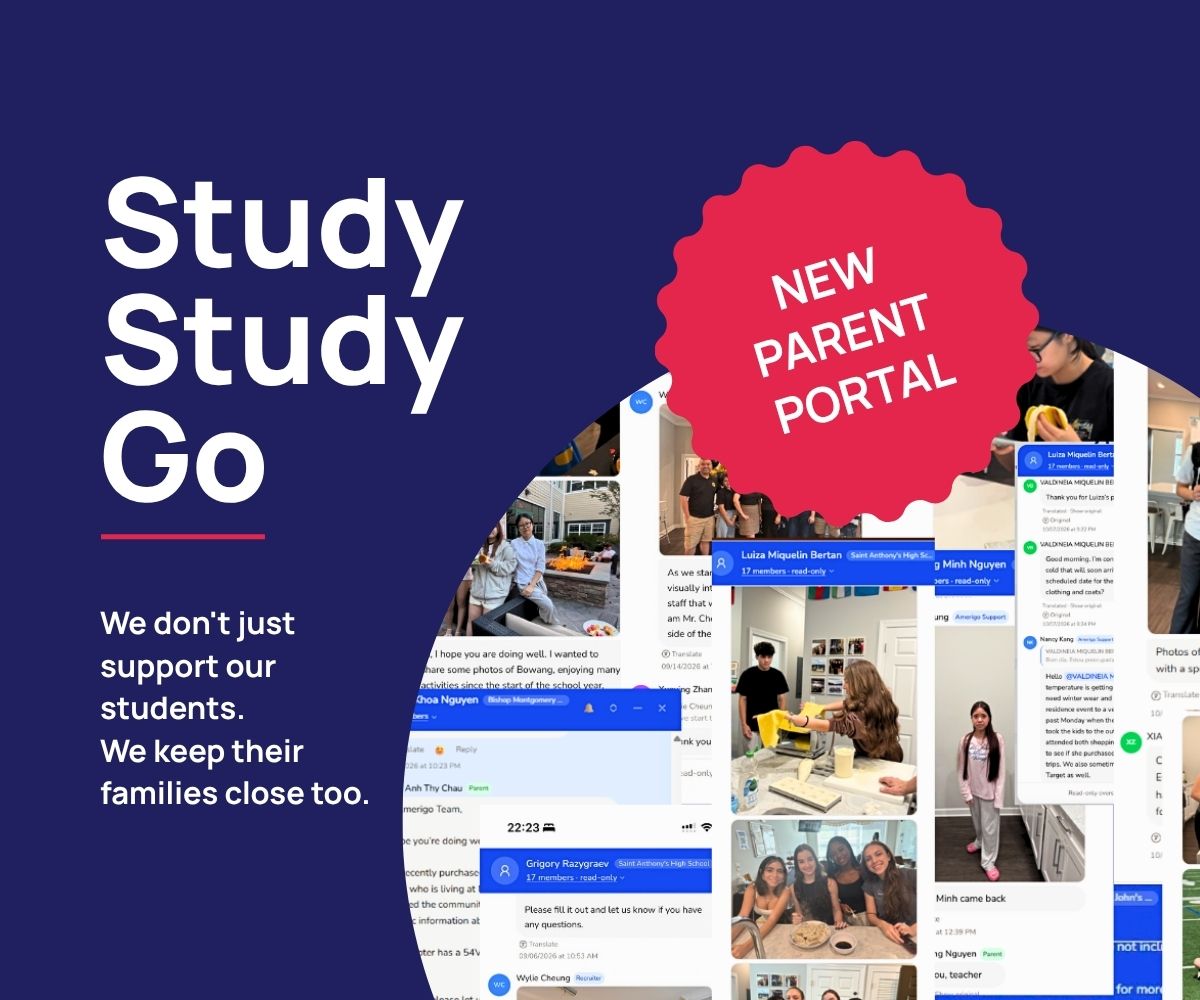
Amerigo has native-language staff in China, Vietnam, Korea, Mexico, the Taiwan Region, and more, so parents anywhere in these markets can receive updates and raise concerns in their native language without depending on their child to translate or interpret. Amerigo sends monthly progress reports and school activity calendars and event announcements to all families, with real-time outreach when a situation requires immediate attention. Safety tracking through Life360 or Reach allows Korean parents to monitor their child's location in real time from their phone. Amerigo also organizes social events for students and their friends, separate from school-organized activities, to support social development and reduce isolation, something that is particularly important for Korean students in the early months when cultural adjustment is at its most intense. For students requiring additional academic support, subject-specific tutoring is available, though families should be aware that additional costs may apply depending on frequency and subject area.
What Accommodation Options Are Available for Korean Students?
Korean families can choose from four accommodation types, each suited to different student needs and family preferences. All four options receive the same standard of academic and pastoral support from the Amerigo on-campus team, regardless of housing type.
Homestay places students with local host families and offers the most immersive cultural experience, with the additional benefit of being more affordable than residential options. Homestay students receive academic support at the on-campus international department office at school. Off-campus residences are the primary model for most Amerigo students, these are purpose-built residential facilities located a 20 to 30 minute drive from partner schools, with single-gender units, 24/7 staff supervision, and dedicated common areas where students can study in groups and access staff support. This off-campus model is a strategic advantage, not a limitation: it enables access to top US day schools that do not offer on-site boarding. On-campus residences are available at select partner schools where on-site housing exists, though availability is limited. Self-provided accommodation is available for students whose families have relatives in the US or wish to arrange independent housing. At select campuses, on-site chefs prepare meals for residential students, including home-country dishes to help with homesickness. Students have access to shared kitchen facilities but are not permitted to cook independently for safety reasons; supervised cooking sessions take place as occasional special events.
How Does the Enrollment Process Work for Korean Families?
The Amerigo enrollment process is designed to be straightforward for Korean families. A single application covers multiple top-ranked US high schools at the same time, with no extra cost for applying to more than one school. Most Amerigo Signature schools do not require recommendation letters, and they accept flexible English proficiency tests including TOEFL, IELTS, the Duolingo English Test, and Eltis, not just the TOEFL that many families assume is required. Most Signature schools also offer rolling admissions, meaning families do not need to wait for a fixed intake date and can apply at various points in the year.
Korean families work with Amerigo directly or through their local education agency. Over 90% of Amerigo's enrollments come through agency partners, who are well-positioned to guide Korean families through the process and advise on school selection based on the student's academic profile and university goals. Visa support is available through Amerigo's third-party visa partner, though these services are billed separately and are not included in Amerigo's tuition or housing fees. Students are enrolled on F-1 student visas and, as they are under 18, are not permitted to work while on the program. Families should budget for visa services, travel, personal expenses, and health insurance in addition to program fees. Korean families should also note that students enrolling directly into Grade 12 are not eligible for the Top 100 Guarantee, the Foundation Year Program is the relevant pathway for Grade 12 students and provides conditional offers from Amerigo partner universities. For high-achieving students, the Top 50 Track is an enhanced academic program targeting Top 50 university admission, though it does not carry a refund guarantee, that protection applies to the Top 100 Guarantee only.
How Does Amerigo Compare Korean Families' Priorities?
Korean families typically evaluate US high school programs on four criteria: university outcomes, school academic quality, safety and supervision, and program credibility. The table below shows how Amerigo's model addresses each of these priorities directly.
| Korean Family Priority | What Amerigo Provides | Evidence |
|---|---|---|
| Top university outcomes | 97% Top 100, 60% Top 50 admission | Class of 2025 verified outcome data |
| School academic quality | All 40 partner schools rated Niche A+/A | Niche.com 2024-2025 ratings |
| Safety and supervision | 24/7 staff, Life360 or Reach tracking, single-gender residences | Program standard for all US students |
| Financial protection | Top 100 Guarantee: up to $50,000 USD refund | Official refund policy for eligible students |
| Native-language communication | Korean-language staff available | Confirmed Amerigo service |
| English entry flexibility | Eltis, Duolingo, TOEFL, IELTS all accepted | Most Signature school requirements |
| B1 English outcomes | 96% B1 students admitted to Top 100 | Class of 2025 verified outcome data |
Frequently Asked Questions
What university outcomes do Korean students achieve through Amerigo?
The Amerigo Class of 2025 achieved 97% admission to Top 100 US universities, 60% to Top 50, and 25% to Top 30. These figures include students who entered with B1-level English. For Korean families where the ranking of the university is a primary success measure, these rates represent a strong and documented track record.
Is Korean-language support available throughout the program?
Yes. Amerigo has staff in Korea who communicate with Korean families in their native language. This applies to monthly progress reports, school activity calendars and event announcements, enrollment support, and any urgent communications that arise during the program. Parents do not need to rely on their child to translate updates or flag concerns.
What if my child arrives with only B1-level English?
In the Amerigo Class of 2025, 96% of B1-level students were admitted to Top 100 US universities. Amerigo's structured academic support, including ELL courses, subject-specific tutoring (additional costs may apply), and evening study groups, is specifically designed to build English proficiency and academic confidence progressively, so B1 entry does not prevent a Top 100 outcome.
Does Amerigo accept Duolingo or Eltis for Korean applicants?
Yes. Most Amerigo Signature schools accept Duolingo, Eltis, TOEFL, and IELTS as English proficiency evidence. Most Signature schools also do not require recommendation letters, which makes the application process faster and more accessible than traditional boarding school admissions in the US. A single Amerigo application covers multiple schools at no extra cost.
How much does an Amerigo program cost for Korean families?
Amerigo's all-inclusive program fees range from $40,000 per year for entry-level programs to $75,000 to $110,000+ per year for premium Signature programs. Korean families typically enroll in premium-tier programs. Costs not included in program fees are visa services (third-party partner, billed separately), travel, personal expenses, and health insurance. Subject-specific tutoring may involve additional costs.
What is the Top 100 Guarantee and does it apply to Korean students?
The Top 100 Guarantee applies to all eligible students at Amerigo US Signature Schools, including Korean students. Eligibility requires a minimum of two consecutive academic years at the same Signature School, a minimum 3.2 GPA, TOEFL 85 or equivalent, and completion of at least one AP, IB, or Honors course. Eligible students who meet all requirements but do not receive a Top 100 university offer can receive up to $50,000 USD back in tuition fees.
Are Amerigo residences safe for Korean students?
Amerigo's primary residential model uses off-campus residences with single-gender units, 24/7 staff supervision, and dedicated common areas for study and social time. Amerigo uses Life360 or Reach safety tracking technology, which allows Korean parents to monitor their child's location in real time from their phone. For Korean families who prioritize structured, supervised living environments, this model is designed specifically with that need in mind.
Can Korean students apply mid-year or for late Fall enrollment?
Most Amerigo Signature schools offer rolling admissions throughout the year. For late Fall enrollment specifically, select partner schools including FEIA and SAHS accept arrivals until October with I-20 issuance and visa processing support available for late applicants. Korean families should contact Amerigo directly to confirm timing options for their specific enrollment year.
How does Amerigo handle homesickness for Korean students?
Homesickness intervention is a formal part of Amerigo's support program. On-campus staff maintain daily contact with students and are trained to identify early signs of distress. Amerigo organizes social events for students and their friends to build community and reduce isolation. Residences at select campuses have on-site chefs who occasionally prepare home-country dishes. Korean-language staff are available for both the student and the family throughout.
What happens during Spring Break for Korean students staying in the US?
Amerigo residences do not close during Spring Break. Students who remain in the US during Spring Break join Amerigo-organized trips and activities rather than staying independently. Korean parents planning visits around Spring Break should contact the Amerigo team in advance to align with the student's scheduled activities during that period.
Conclusion
For Korean families, the core question when evaluating a US high school program is whether it will deliver a Top 100 university outcome with a credible academic foundation and a supervised, safe environment. Amerigo's Class of 2025 data, on-campus Korean-language support, and Top 100 Guarantee answer each of those concerns directly.
Ready to explore enrollment options for your child? Start your application or contact the Amerigo team for a conversation in Korean.
People Also Read
- Korean Students in US High Schools: Guide 2026
- University Admission Results by English Level: How B1 Students Achieve Top 100 Acceptance (Class of 2025 Data)
- Amerigo Class of 2025: University Placement Results
About the Author
This guide was written by the Amerigo Education content team, drawing on program data from staff operating the on-campus international department at 40 Niche A+/A rated US, Canadian, and UK partner schools. Learn more about Amerigo Education.
Disclaimer: This article provides general information for educational purposes only. Families should conduct independent research, request current program data from providers, and consult with program representatives regarding specific circumstances. Contact us with questions.