All news
March 22, 2026
Study Abroad 101
How International Students Make Friends at US High Schools
How international high school students build friendships in the US through extracurriculars, shared housing, school culture, and structured support programs in 2026.
How International Students Make Friends at US High Schools
Last Updated: March 2026
A social adjustment period is the time during which a student adapts to new cultural norms, communication styles, and peer group dynamics after relocating to a different country. According to IIE Open Doors data, over 60,000 international secondary students attended US schools in the most recent reporting year. Research from the American Psychological Association indicates that adolescents who form at least two close friendships within the first semester of a school transition report higher academic motivation and lower rates of homesickness compared to peers who remain socially isolated.
Amerigo Education operates on-campus international departments at 40 Niche A+/A rated partner schools across the US, Canada, and UK, supporting 3,500+ students from 55+ countries. The Class of 2025 achieved 97% Top 100 university admission. Social adjustment is monitored alongside academic progress, with on-campus staff observing peer integration and reporting through monthly progress reports to families.
Key Takeaways
- Extracurricular activities are the primary friendship catalyst: Students who join at least one sport, club, or performing arts group within the first month form peer connections significantly faster than those who do not.
- Residential settings accelerate social bonding: Students in on- and off-campus supervised residences or homestay placements interact with peers during evening study groups, meals, and weekend activities outside the classroom.
- English proficiency shapes but does not determine social success: Students at all English levels form friendships, though activity-based bonding (sports, art, music) bridges language gaps more effectively than conversation-dependent settings.
- The first 90 days are the critical social window: Orientation events, first-semester activities, and initial class groupings establish the social patterns that typically persist through the school year.
- On-campus staff monitor social adjustment: Amerigo Education's on-campus international departments track social integration as part of the monthly progress reports sent to families, intervening when students show signs of isolation.
Why Is Friendship Important for Academic Success?
Friendship directly affects academic performance for international high school students. Students with peer support networks attend class more consistently, participate more actively in discussions, and seek help from teachers more willingly than socially isolated peers. According to NCES (National Center for Education Statistics) research, social belonging is one of the strongest predictors of academic persistence among students in new school environments, outweighing factors like prior academic achievement in forecasting first-year outcomes.
For international students, friendships also serve as informal language practice, cultural translation, and emotional support during the adjustment period. A student who can ask a classmate to explain an assignment in simpler English or clarify an American cultural reference adjusts to academic expectations faster. These peer interactions supplement the formal ELL (English Language Learning) coursework and academic tutoring that Amerigo Education provides at every US and Canadian partner school.
- Students with at least two close friendships report higher academic motivation across subjects
- Peer study groups improve retention of material compared to solo study for most learners
- Social confidence in the classroom increases willingness to ask questions and participate in discussion
- Friendships reduce homesickness, which is a leading cause of academic disengagement in the first semester
- Teacher recommendation letters reflect social engagement and interpersonal qualities alongside academic performance
- University applications benefit from leadership positions in clubs and activities that require social integration
How Do Extracurriculars Drive Friendships?
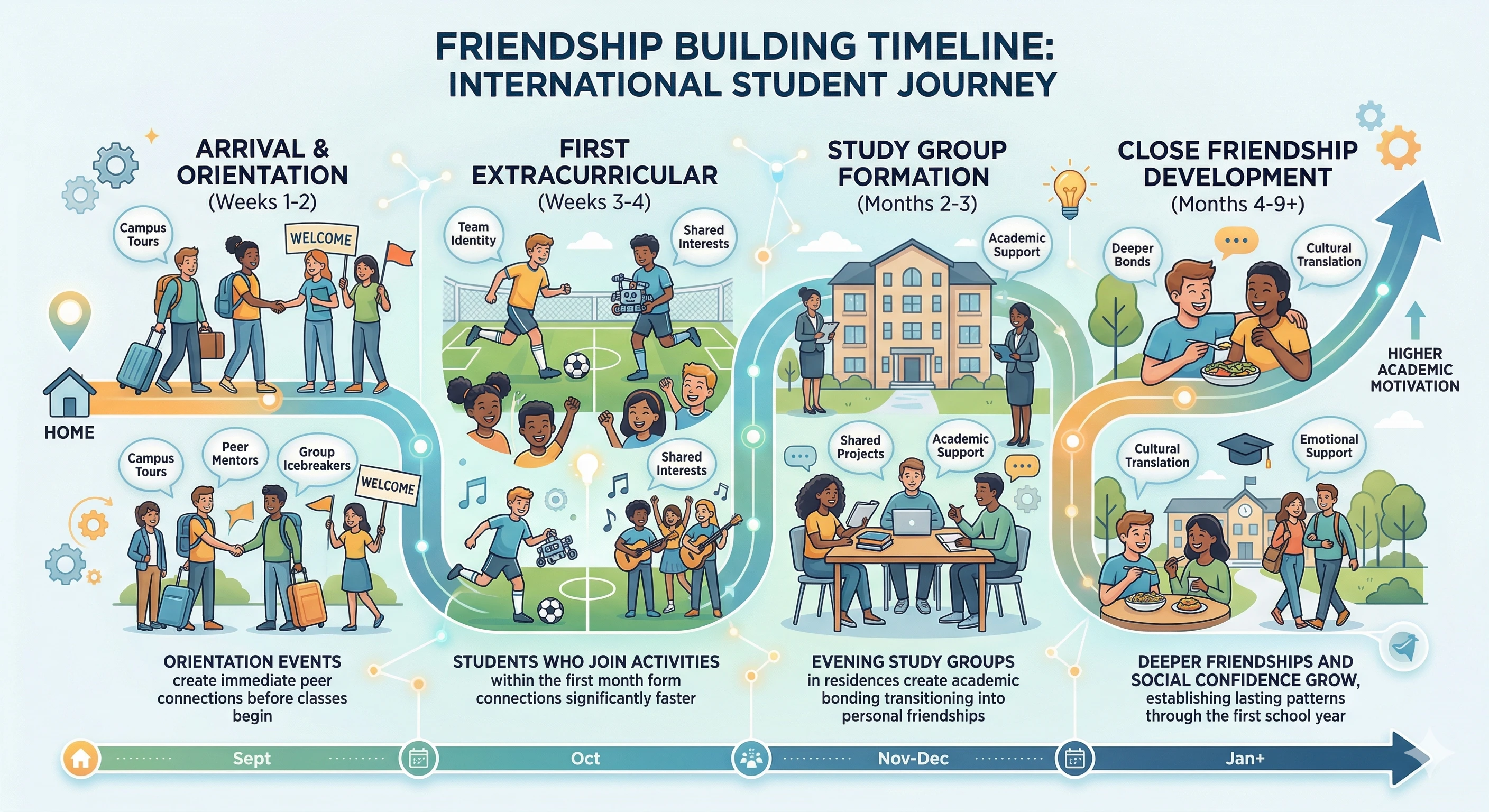
Extracurricular activities create repeated, structured interactions around shared interests, which is how most lasting high school friendships form. Unlike classroom settings where interaction follows teacher-directed patterns, clubs and sports allow students to collaborate, compete, and create together in less formal environments. International students who join activities in the first two weeks of school enter existing social groups at the same time as other new members, reducing the dynamic of being an outsider joining an established group.
Team sports are particularly effective for students still developing English proficiency because physical activity communicates cooperation without requiring advanced vocabulary. Academic clubs like robotics, Model UN (Model United Nations), and debate create collaborative project experiences where contribution matters more than perfect grammar. Performing arts, including theater, band, and choir, build bonds through rehearsal schedules and shared performance goals.
How Does Housing Type Affect Social Life?
The accommodation model significantly influences when and how international students build friendships outside the classroom. Students living in on- and off-campus supervised residences share living spaces with other international students, creating natural social time during meals, evening study groups, and weekend activities. Homestay students build relationships with their host family and develop a different type of cultural integration through daily family interactions.
Both models provide social opportunity, though the timing and context differ. Residential students form bonds quickly through shared routines and proximity. Homestay students may take longer to build school-based friendships but gain deeper cultural immersion through family participation in American daily life. Self-provided accommodation, where families arrange housing independently, requires more intentional effort to create social time outside school hours. Amerigo Education provides homestay placements directly and operates single-gender off-campus residences with 24/7 staff and dedicated study areas with teacher availability.
- Residential students typically form initial peer groups within the first week through shared meals and orientation
- Homestay students build school friendships through extracurriculars and class projects during the first month
- Evening study groups in residences create academic bonding that transitions into personal friendships
- Weekend activities organized by on-campus staff provide social time outside academic pressure
- Host family relationships give homestay students practice with American social customs and conversation
- Both housing models provide access to 24/7 emergency assistance and staff monitoring of student wellbeing
What Role Does English Level Play?
English proficiency influences the speed of friendship formation but does not determine whether an international student will successfully build social connections. Students entering at B1 (intermediate) English levels form friendships through activity-based interaction where actions matter more than vocabulary. Students at B2 (upper intermediate) or higher levels can initiate conversations more easily and participate in discussion-heavy activities like debate or student government. Both groups build meaningful peer networks within the first year.
Amerigo Education provides in-school customized ELL courses at every US and Canadian partner school, building conversational confidence alongside academic English. Subject-specific tutoring and evening study groups in residential settings create natural peer interaction that combines language practice with social bonding. Students who view social interaction as language practice rather than a test tend to initiate conversations more willingly and recover faster from communication misunderstandings.
- B1 English students form friendships effectively through sports, art, music, and hands-on activities
- B2 and above students can access conversation-heavy activities like debate, journalism, and student council
- ELL classroom groups create peer bonds among students at similar language levels who share the learning experience
- American classmates generally respond positively to effort and friendliness regardless of grammar accuracy
- Social media communication (text-based, visual) allows international students to maintain connections between in-person interactions
- Native-language communication support from Amerigo Education helps families understand their child's social progress
How Do Schools Support Social Integration?
Schools with dedicated international student support structures facilitate social integration more effectively than schools where international students manage the adjustment independently. Orientation programs that pair new international students with returning students or American peer mentors create immediate social connections before classes begin. Schools that assign international students to diverse class sections rather than grouping them together encourage cross-cultural interaction from day one.
Amerigo Education's on-campus international departments at every US and Canadian partner school organize orientation activities, cultural exchange events, and group outings that introduce international students to both American peers and students from other countries. Staff members who interact with students daily observe social dynamics and can intervene early when a student shows signs of withdrawal or isolation. Monthly progress reports to families include social adjustment observations, providing parents visibility into their child's peer integration alongside academic data.
- Orientation programs pair new international students with returning students or American peer mentors
- Cultural exchange events create structured opportunities for international and American students to interact
- Class placement strategies distribute international students across sections to encourage diverse friendships
- On-campus staff observe social dynamics daily and flag early signs of isolation
- Monthly progress reports include social adjustment observations for families
- Weekend trips and holiday activities provide extended bonding time outside academic settings
- Native-language support for families from China, Vietnam, Korea, Mexico, the Taiwan Region, and more helps parents understand and support their child's social adjustment from abroad
What Social Challenges Should Families Expect?
International students typically experience predictable social challenges during the first semester. The first two weeks bring excitement and novelty. Weeks three through eight often include a dip in social confidence as the novelty fades and cultural differences become more apparent. By the end of the first semester, most students have established a core friend group and social routine. Understanding this pattern helps families avoid overreacting to temporary social difficulty during the adjustment dip.
Common challenges include navigating American humor and sarcasm, understanding unwritten social rules about personal space and conversation topics, and managing the time zone gap between school social events and family calls home. Students who maintain excessive contact with home-country friends through video calls during peak social hours (evenings and weekends) may miss opportunities to bond with local peers. A balanced approach supports both existing and new relationships.
How Do Friendships Benefit University Applications?
Social integration creates tangible university application advantages beyond emotional wellbeing. Students with strong peer networks hold leadership positions in clubs, organize community service projects, and collaborate on academic competitions. These activities produce the extracurricular depth that admissions officers at Top 50 and Top 100 universities evaluate alongside grades and test scores. A student who served as soccer team captain or debate club president demonstrates the leadership and interpersonal skills that distinguish competitive applicants.
Teacher recommendation letters also reflect social integration. Teachers who observe a student engaging with peers, contributing to class discussion, and collaborating on group projects write stronger, more specific recommendations than those who can only comment on test performance. Amerigo Education's university counseling, which begins in Grade 9 or 10 at every US and Canadian partner school, helps students select activities strategically so that their social engagement builds a cohesive application narrative. The Top 100 Guarantee at US Signature partner schools provides a $50,000 USD refund if requirements are met, reinforcing the program's commitment to comprehensive student development beyond academics alone.
- Leadership positions in clubs and sports demonstrate interpersonal skills valued by admissions offices
- Community service participation shows civic engagement and ability to work across cultural boundaries
- Collaborative academic projects produce portfolio items and competition results for applications
- Teacher recommendations reflect classroom social engagement and contribution quality
- Interview skills improve through daily social practice with American peers and teachers
- 97% of the Class of 2025 gained admission to Top 100 US universities, reflecting outcomes from students fully integrated socially and academically
Frequently Asked Questions
How long does it take international students to make close friends?
Most international students form initial friendships within the first two to four weeks through shared classes and activities. Deeper friendships typically develop over the first semester as students find common interests and establish routines. Students who join extracurricular activities and attend school events in the first month form connections faster than those who limit social interaction to classroom settings.
Do international students mostly befriend other international students?
International students often form initial connections with peers from similar backgrounds because of shared language and cultural reference points. Over time, extracurricular activities, classroom projects, and residential settings create natural opportunities to build friendships with American students and international peers from other countries. Programs with on-campus international departments help facilitate this broader integration.
Does English proficiency affect friendship building?
English proficiency influences the speed of friendship formation but does not prevent it. Students with higher English levels may initiate conversations more easily, while students developing their English form bonds through shared activities where verbal communication is secondary, such as sports, art, and music. ELL coursework at Amerigo Education partner schools builds conversational confidence alongside academic skills.
How do extracurricular activities help with making friends?
Extracurricular activities create structured social environments where students interact around shared interests rather than relying solely on conversation. Team sports require cooperation regardless of language level. Academic clubs create collaborative project experiences. Performing arts bring students together through rehearsal schedules. These activities provide consistent, repeated interaction that builds familiarity and trust.
Do homestay students have fewer friendship opportunities than residential students?
Homestay students build friendships through the school day, extracurriculars, and weekend activities rather than through shared residential settings. Some homestay students form close bonds with their host family's children or neighborhood peers. Residential students benefit from evening study groups and shared living spaces. Both models provide adequate social opportunity, though the pathways differ.
What if my child is naturally introverted?
Introverted students often form fewer but deeper friendships, which is a healthy social pattern. Smaller class sizes at Niche A+/A rated private schools help introverted students connect in low-pressure academic settings. Clubs with focused activities like art, chess, or coding provide structured interaction without requiring high social energy. On-campus international department staff can suggest activities that match the student's comfort level.
How does social media affect friendships for international students?
Social media helps international students maintain home-country friendships while building new ones in the US. Platforms like Instagram and Snapchat are common social connectors among American high school students. However, excessive screen time or constant contact with home-country friends can slow local social adjustment. A balanced approach supports both existing and new relationships.
Can parents help their child make friends from abroad?
Parents can encourage social engagement by supporting extracurricular participation, asking about school social events, and avoiding overscheduling calls during peak social hours. Monthly progress reports from Amerigo Education include social adjustment observations alongside academic data. Parents who express interest in their child's new friendships reinforce the importance of social integration.
Are there organized social events for international students?
Schools with on-campus international departments typically organize orientation activities, cultural exchange events, and group outings designed to help international students meet peers. These events supplement natural social opportunities from classes and extracurriculars. Holiday gatherings and weekend trips provide additional bonding time, particularly during school breaks when residential students spend extended time together.
Does friendship building affect university applications?
Strong social integration benefits university applications through leadership positions in clubs, community service participation, and collaborative projects. Students with broad social networks are more likely to hold leadership roles that admissions officers value. Teacher recommendation letters reflect classroom engagement and interpersonal qualities, both of which improve with social confidence developed through peer relationships.
Conclusion
International students build friendships at US high schools through extracurricular participation, residential proximity, shared academic experiences, and structured support from on-campus staff. English proficiency shapes the timeline but does not determine social success. Schools with dedicated international student support infrastructure provide the orientation events, staff monitoring, and activity programming that accelerate friendship formation during the critical first semester.
Help Your Student Build Lasting Friendships
International families evaluating schools for social fit can explore US partner schools, view Canadian options, or learn about Brentwood School in the UK. Apply now to begin the enrollment process, or contact us for guidance on which school environment and accommodation model best supports your student's social adjustment.
People Also Read
- Homestay vs Residence for High School International Students: How to Choose the Right Accommodation
- Why High School Is the Best Time to Study Abroad: The Science Behind Ages 14-18
- How to Choose a US High School for International Students: Complete Selection Guide 2026
About the Author
This guide was written by the Amerigo Education content team, drawing on program data from staff operating the on-campus international department at Amerigo Education's partner schools across the US, Canada, and UK. Learn more about Amerigo Education.
Disclaimer: This article provides general information for educational purposes only. Families should conduct independent research, request current program data from providers, and consult with program representatives regarding specific circumstances. Contact us with questions.