All news
April 16, 2026
Study Abroad 101
How Parents Track Their Child's Progress at US High Schools
How international parents track their child's progress at US high schools: Amerigo's monthly reports, real-time outreach, Life360 and Reach tracking, online grade portals, and communication tools.
Last Updated: April 2026
Student progress reports are formal academic documents that summarize a student's grades, attendance, behavior, and overall performance over a defined period, typically distributed monthly or at semester intervals. According to the National Center for Education Statistics (NCES, 2024), more than 85% of US schools use some form of regular progress reporting as a standard communication tool between schools and families. For international parents whose children study abroad, receiving accurate and timely student progress reports is one of the most important factors in choosing a high school pathway program.
Amerigo Education partners with 40 Niche A+/A rated schools across the US, Canada, and the UK, supporting 3,500+ students from 55+ countries. The Class of 2025 achieved 97% admission to Top 100 US universities. Amerigo's model includes monthly progress reports for all students - both residential and homestay - along with real-time outreach when updates require immediate attention, giving parents overseas a clear and consistent window into their child's academic life.
Key Takeaways
- Monthly reporting: Amerigo sends monthly progress reports covering grades, attendance, and academic standing for all students
- Real-time outreach: When a situation requires immediate attention, Amerigo staff reach out to families without waiting for the next monthly cycle
- Location tracking: Parents can use Life360 or Reach for real-time student location monitoring as a safety layer
- Native-language support: Amerigo provides native-language communication support for families from China, Vietnam, Korea, Mexico, the Taiwan Region, and more
- School grade portals: Most US partner schools also give families access to online grade portals for direct school-level reporting
What Are Student Progress Reports in US High Schools?
Student progress reports in US high schools are periodic summaries of a student's academic standing, including subject grades, GPA (Grade Point Average), attendance records, and teacher notes on behavior or participation. They differ from full-year transcripts in that they are issued more frequently and focus on near-term performance trends rather than cumulative records. For international families, they serve as the primary window into day-to-day academic progress.
US private high schools typically issue formal grades at semester or quarter intervals, but many schools also provide online grade portals where parents can check individual assignment scores at any time. Amerigo's layer of support adds monthly progress reports and direct counselor outreach on top of whatever the school itself provides. This dual-channel approach - school-level data plus Amerigo's program-level summary - gives families a more complete picture of their child's performance. Explore Amerigo's support model in detail.
- Subject grades per class updated regularly in school portals
- GPA calculation shown at quarter and semester intervals
- Attendance records flagging absences or tardiness
- Teacher comments on participation and in-class behavior
- ELL (English Language Learning) course progress for language learners
- Amerigo's monthly summary report covering the above in consolidated form
- Real-time outreach from Amerigo staff when issues require immediate attention
- University counseling milestones at applicable grade levels
| Report Type | Frequency | Source | Language Support |
|---|---|---|---|
| School grade portal | Real-time / ongoing | School directly | English only at most schools |
| Semester transcript | Twice per year | School directly | English only |
| Amerigo monthly report | Monthly | On-campus department | Native-language support available |
| Real-time outreach | As needed | Amerigo staff | Native-language support available |
How Does Amerigo Send Progress Reports to Parents?
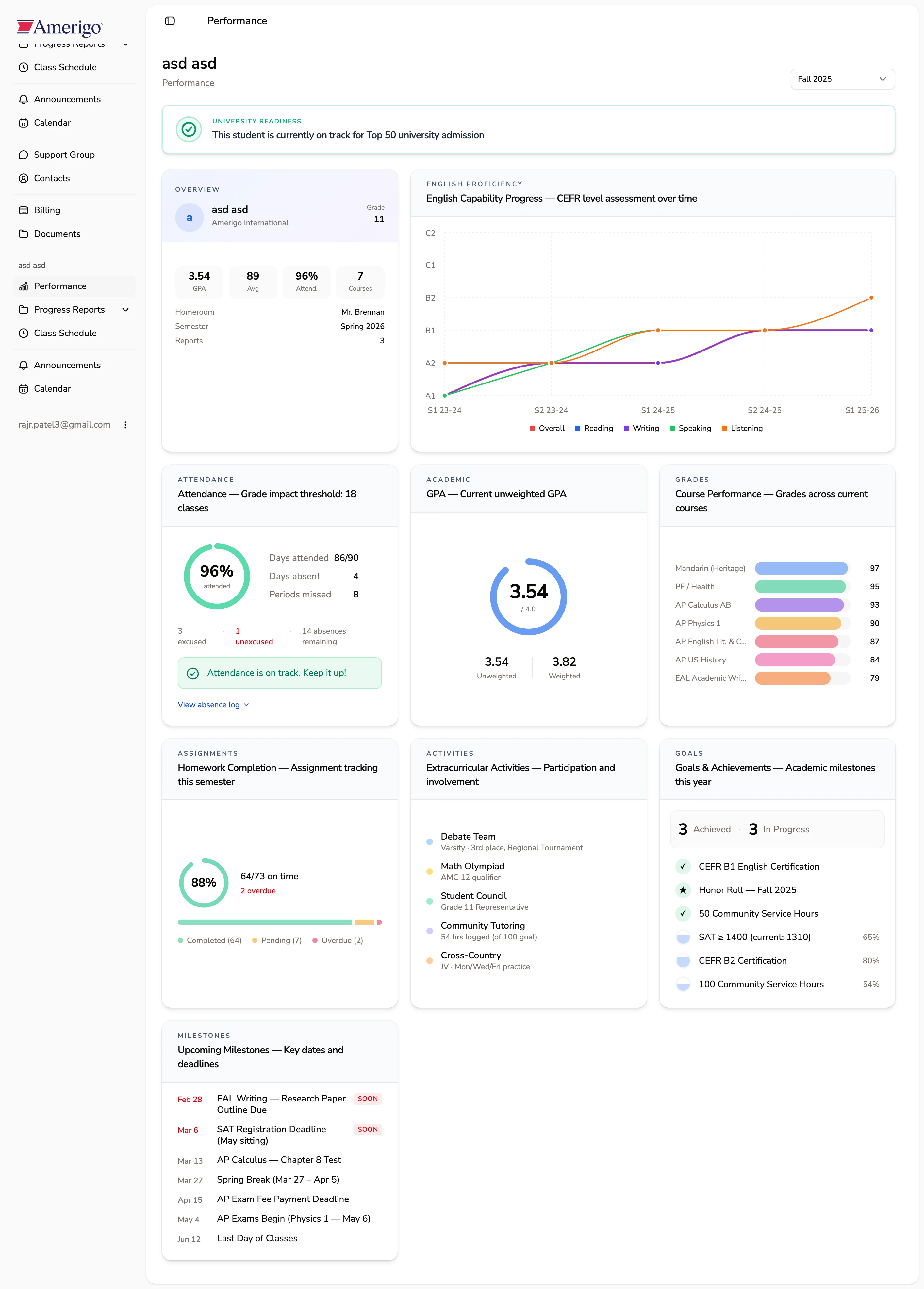
Amerigo sends monthly progress reports and school activity calendars to all families - both residential students and homestay students - as part of the standard program offering. These reports cover academic grades, attendance, and any notable developments in the student's school life. When a situation arises that requires immediate attention before the next monthly cycle, Amerigo staff contact families directly in real time rather than waiting.
Amerigo Education provides native-language communication support for families from China, Vietnam, Korea, Mexico, the Taiwan Region, and more, meaning parents receive updates they can fully understand without needing to translate complex academic terminology themselves. This is particularly valuable for families from primary Amerigo markets, where English may be a second language at home. Parents should confirm specific communication preferences and frequency with their assigned program contact at enrollment. Learn more about Amerigo's student services here.
- Monthly progress reports distributed to parents via email or program portal
- Real-time outreach via phone or message when immediate attention is needed
- Native-language communication available for supported family markets
- Parents can also request scheduled calls with Amerigo academic counselors
- School activity calendars and event announcements shared separately
- University counseling progress updates included at relevant academic stages
What Can Parents See Through School Online Portals?
Most Niche A+/A rated partner schools in the Amerigo network use online grade management systems such as PowerSchool, Veracross, or similar platforms that give parents direct, ongoing access to their child's grades and attendance. These portals are updated as teachers enter scores and attendance data, meaning parents with portal access can view individual assignment results between formal report periods.
School portals are typically accessed through an account set up at enrollment, with login credentials sent to parents. Because these portals are school-managed, they display information in English and reflect the school's own grading timeline. Amerigo's monthly progress reports complement portal data by summarizing trends and adding program-level context, especially where language barriers might make raw portal data difficult to interpret without explanation.
| Portal Feature | Available | Notes |
|---|---|---|
| Individual assignment grades | Yes | Updated by teachers as entered |
| GPA calculation | Yes | Calculated per grading period |
| Attendance records | Yes | Absence and tardy tracking |
| Teacher comments | Sometimes | Varies by school policy |
| English language only | Yes | School portals are English-medium |
| Native-language summary | No - portal only | Amerigo provides translated summaries |
How Do Parents Track Student Safety and Location?
For international parents whose children live in Amerigo's on- and off-campus residences, location safety is supported through Life360 or Reach, two technology platforms that allow parents to monitor their child's real-time location via a shared family app. This safety layer gives parents peace of mind about their child's whereabouts outside of school hours, particularly during evenings and weekends.
Residential students in Amerigo's program live in single-gender residences staffed 24 hours a day, located 20 to 30 minutes from partner school campuses. Dedicated study areas with staff available and structured evening routines mean students are accounted for throughout the day. Homestay students live with Amerigo-provided homestay families and have access to academic support at the on-campus international department office. Both include consistent adult supervision, and Amerigo also provides 24/7 emergency assistance for all enrolled students. A fourth option, self-provided accommodation, is available for students with nearby family in the US.accommodation models
- Life360 or Reach apps for real-time location tracking (parent-installed)
- 24/7 staffed residences for residential students
- Homestay family oversight for homestay students
- 24/7 emergency assistance for all Amerigo students
- Amerigo staff real-time outreach when safety concerns arise
- School attendance records visible through grade portals
- Amerigo shares school event calendars and activity announcements with parents
How Are Academic Concerns Communicated to Parents?
When a student's grades drop, attendance falls, or a behavioral issue emerges, Amerigo's on-campus department staff initiate direct contact with the family rather than waiting for the next scheduled monthly report. This real-time outreach protocol ensures parents are informed quickly and can respond with guidance or adjusted expectations. It also allows Amerigo counselors to coordinate interventions such as subject-specific tutoring before problems compound.
For students whose GPA (Grade Point Average) falls below the threshold needed for Amerigo's Top 100 Guarantee at US Signature schools, early intervention is especially important. The Top 100 Guarantee requires students to maintain a cumulative GPA of 3.2 or higher, achieve a TOEFL (Test of English as a Foreign Language) score of 85 or above, complete two consecutive years of enrollment, and take at least one AP (Advanced Placement), IB, or Honors course. Monthly progress reports and real-time outreach both serve as early warning systems to keep students on track toward these four requirements.
Families can also review university admission outcomes and understand how the Guarantee works alongside the progress monitoring system.
What Progress Tracking Looks Like at Each Grade Level?
Progress tracking needs differ depending on the student's year in the US program. A 9th grade student entering with B1 English proficiency needs more frequent language progress monitoring alongside academic grades. A 12th grade student is not eligible for the Top 100 Guarantee but can enroll through the Foundation Year Program to earn a US diploma and receive conditional admissions support from partner universities.
Progress reports at all grade levels include core subject grades and ELL advancement where applicable. At Signature campuses, Amerigo also facilitates sending transfer transcripts directly to US universities on behalf of students, which adds a university counseling dimension to the progress tracking conversation with families. Families considering the Foundation Year Program for Grade 12 students should discuss tracking and support expectations with their Amerigo program representative at enrollment.
| Grade Level | Key Tracking Focus | Guarantee Eligible |
|---|---|---|
| Grade 9 (Freshman) | ELL progress, course adjustment, GPA baseline | Yes, if 2 consecutive years planned |
| Grade 10 (Sophomore) | AP prerequisite readiness, GPA maintenance | Yes |
| Grade 11 (Junior) | AP enrollment, TOEFL prep, university list | Yes - FEIA Canada students added at Junior year |
| Grade 12 (Senior) | Foundation Year Program only, no Guarantee | No - Foundation Year Program available |
Frequently Asked Questions
How often do parents receive progress reports from Amerigo?
Amerigo sends monthly progress reports for all students - both those in on- and off-campus residences and those in homestay arrangements. These reports cover academic grades, attendance, and any notable updates from the on-campus international department. In addition to the monthly schedule, Amerigo staff contact families directly in real time when a situation requires immediate attention, ensuring parents are never waiting for critical information.
What is included in Amerigo's monthly progress report?
Amerigo's monthly progress reports include a summary of current grades across enrolled subjects, attendance records, and notes from the on-campus department staff on the student's overall progress and wellbeing. Where relevant, ELL course advancement and academic planning milestones are also noted. The report is communicated in a way that families can understand, with native-language support available for families from China, Vietnam, Korea, Mexico, the Taiwan Region, and more.
Can parents access the school's grade portal directly?
Yes. Most Amerigo partner schools provide parents with access to their online grade management portal at enrollment. Through these portals, parents can view individual assignment grades, GPA calculations, and attendance records in real time. School portals are managed by the school and display information in English. Amerigo's monthly reports provide a complementary summary that adds program-level context and language accessibility for international families.
What happens if a student's grades drop suddenly?
If a student's grades fall or a concern arises between monthly reporting cycles, Amerigo staff reach out to the family in real time rather than waiting for the next scheduled report. They may also coordinate additional academic support such as subject-specific tutoring, additional study sessions, or a meeting between the student and an Amerigo academic counselor. Early intervention is a core principle of the on-campus international department model.
Do homestay students receive the same progress monitoring as residential students?
Yes. Amerigo's monthly progress reporting applies to all enrolled students regardless of accommodation type. Homestay students receive the same monthly academic summaries, and Amerigo staff provide real-time outreach for any issue requiring immediate attention. Homestay students access academic support at the on-campus international department office rather than through in-residence homework help, but the monitoring frequency and communication structure remain consistent.
How does Life360 or Reach work for student safety tracking?
Life360 and Reach are mobile apps that allow parents and students to share real-time location with each other. Parents install the app and connect to their child's device, enabling them to see where the student is at any given time. This is particularly useful for international parents who cannot be physically present in the US. Amerigo supports the use of Life360 or Reach as a safety technology layer for enrolled students in the US and Canada programs.
What language is used in Amerigo's communications with parents?
Amerigo Education provides native-language communication support for families from China, Vietnam, Korea, Mexico, the Taiwan Region, and more, meaning these families can receive program communications and progress updates in their home language. This support is provided through Amerigo's home-country communications model. For families from other countries, English is the primary communication language, and families are encouraged to work with their enrollment agency if additional language assistance is needed.
Is the Top 100 Guarantee connected to monthly progress reports?
Yes. Amerigo's Top 100 Guarantee at US Signature schools requires students to maintain a cumulative GPA of 3.2 or higher, complete two consecutive years of enrollment, achieve a TOEFL score of 85 or above, and take at least one AP, IB, or Honors course. Monthly progress reports and real-time outreach from the on-campus department both serve as tools to keep students on track toward these four requirements. If a student's GPA falls below 3.2, early action is critical.
Can parents visit the school to discuss their child's progress?
Yes. Parents are welcome to visit their child's school and meet with Amerigo's on-campus international department staff during the academic year. Many families visit once or twice per year, often around major school events or holidays. Amerigo staff can help arrange parent meetings with school teachers or counselors during such visits. Parents who cannot travel can request scheduled video calls with Amerigo academic counselors to discuss progress in detail.
What progress tracking is available for students at the UK campus?
Brentwood School in Essex operates through Brentwood's established boarding program with university counseling support from Amerigo. The progress tracking model at Brentwood differs from US program campuses: there are no monthly progress reports, no 24/7 Amerigo staff on site, and no Life360 or Reach tracking through Amerigo. Amerigo home-country staff are available to support Brentwood students. Families considering the UK campus should discuss communication and reporting expectations directly with Amerigo before enrollment.
Conclusion
International parents tracking their child's academic progress at US high schools have access to multiple communication channels, including school-managed online grade portals, Amerigo's monthly progress reports, and real-time outreach from on-campus department staff when situations require immediate action. Safety monitoring tools such as Life360 or Reach provide an additional location-tracking layer for residential students. Together, these systems give overseas families consistent, accessible information about their child's academic standing and daily wellbeing throughout the school year.
Connect with Amerigo to Learn More
If your family wants to understand exactly how progress is tracked and communicated before enrolling your child, contact Amerigo Education to speak with a program representative. When you are ready to take the next step, submit your application here to access 40 Niche A+/A rated partner schools across the US, Canada, and the UK with built-in academic monitoring and family communication support.
People Also Read
- International Student Support Services: Complete Guide 2026
- First Year in America: Month-by-Month Timeline for International High School Students
- What GPA Do International Students Need for Top US Universities?
About the Author
This guide was written by the Amerigo Education content team, drawing on program data from staff operating the on-campus international department at 40 Niche A+/A rated US, Canadian, and UK partner schools. Learn more about Amerigo Education.
Disclaimer: This article provides general information for educational purposes only. Families should conduct independent research, request current program data from providers, and consult with program representatives regarding specific circumstances. Contact us with questions.