All news
February 27, 2026
Study Abroad 101
Korean Students in US High Schools Guide 2026
Korean families' guide to US high school: costs, F-1 visa process, English requirements, Korean-language support, and how to enroll in 2026.
Korean Students in US High Schools Guide 2026
Last Updated: March 2026
A Korean student US high school program is a structured pathway that places Korean teenagers aged 14 to 18 at accredited American secondary schools, covering enrollment, F-1 (student visa for academic programs) visa support, English proficiency development, and university preparation. According to the Institute of International Education's Open Doors report (2024), South Korea ranks among the top five countries of origin for international students in the United States. This demand reflects Korean families' interest in the US university admissions advantage that American high school coursework provides.
Amerigo Education, founded in 2016, operates across 40 Niche A+/A rated partner schools in the US, Canada, and the UK. The program serves 3,500+ students from 55+ countries, with 97% of the Class of 2025 gaining admission to Top 100 US universities. Korea is one of those 55+ countries, and Amerigo Education provides native-language communication support for Korean families throughout enrollment and beyond.
Key Takeaways
- 97% Top 100 university admission (Class of 2025): Approximately 3,500+ students from 55+ countries achieved this rate, with 60% gaining Top 50 and 25% gaining Top 30 admission.
- $40,000 to $110,000+ per year program cost: Tuition, accommodation, and the on-campus international department support package are included. Visa services are billed separately through a third-party partner.
- B1 English entry accepted with 96% Top 100 outcomes: Korean students do not need advanced English to begin. TOEFL, IELTS, Duolingo, and ELTIS (English Language Testing and Identification System) are all accepted.
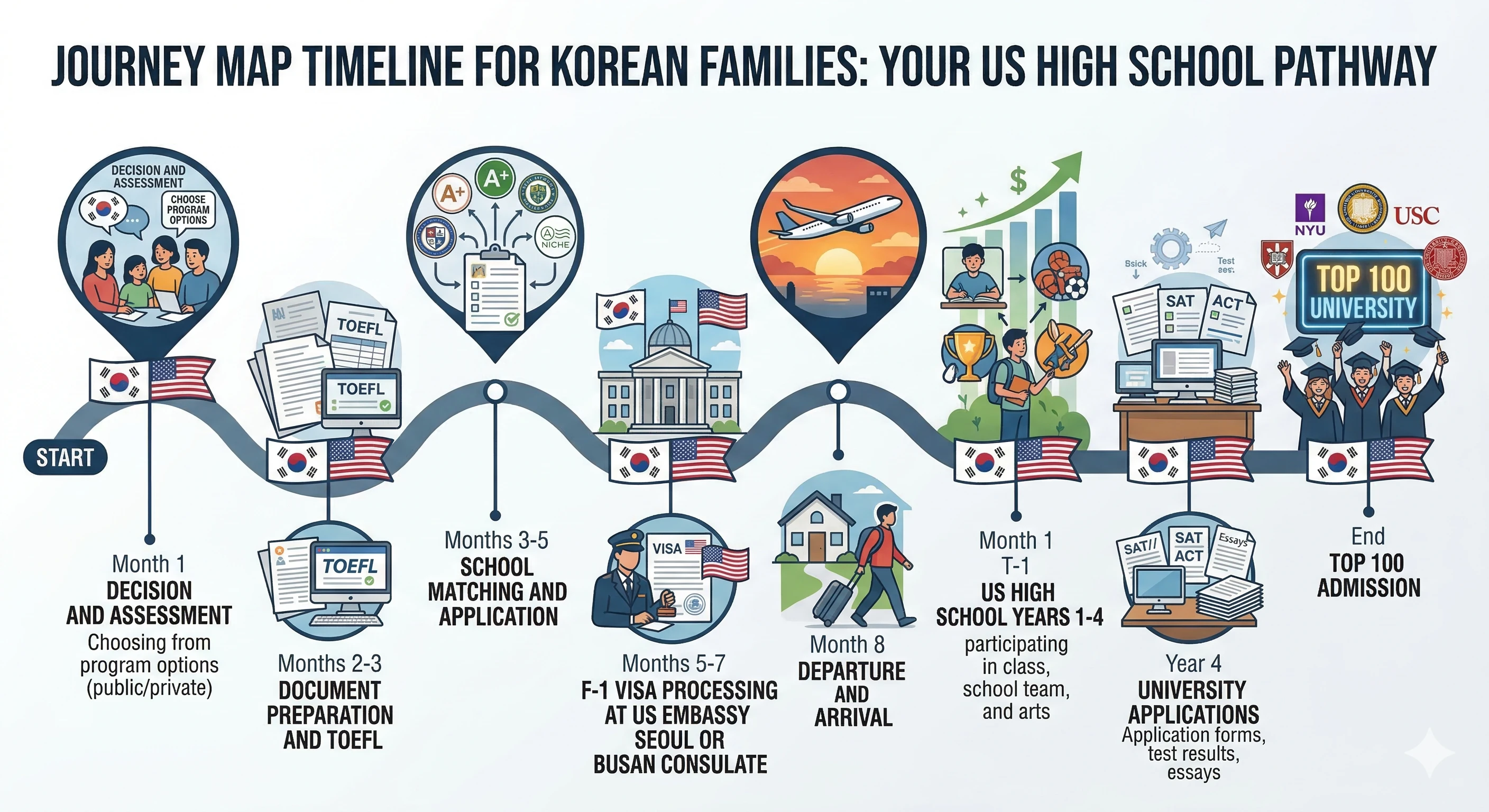
- F-1 visa required with 4 to 8 week processing: Applications are submitted at the US Embassy in Seoul or the US Consulate General in Busan after I-20 issuance.
- up to $50,000 USD refund guarantee for eligible students: Amerigo's Top 100 Guarantee requires two consecutive years, a 3.2 GPA (Grade Point Average), TOEFL 85 or above, and at least one AP (Advanced Placement), IB, or Honors course at US Signature Schools.
What Should Korean Families Know Before Applying?
Korean families considering a US high school pathway should know that programs serve students aged 14 to 18, applications typically begin 9 to 12 months before enrollment, and an English proficiency test is the first practical step. Korea is one of 55+ countries represented in the program, and Amerigo Education provides native-language communication support for Korean families throughout enrollment.
According to IIE Open Doors (2024), Korean students continue to enroll at US secondary schools in significant numbers, attending SEVP-certified institutions nationwide. Korean students transitioning from the CSAT (College Scholastic Ability Test)-focused national curriculum to the US system benefit from early guidance on GPA, AP courses, extracurriculars, and essays. Most Amerigo Signature Schools do not require recommendation letters, and students can apply to multiple schools through one application at no extra cost.
How Much Does US High School Cost?
The cost of US high school for Korean students ranges from $40,000 per year at entry-level programs to $75,000 to $110,000 or more per year for Amerigo Signature Schools. These figures include tuition, accommodation, and the full support infrastructure: the on-campus international department, monthly progress reports, Life360 or Reach parent tracking, and university counseling.
Additional costs include visa services (provided through a third-party visa consulting partner and billed separately), flights (typically two to three round trips per year), personal expenses, and health insurance (required for F-1 students). The program fee covers not just tuition and housing but the entire structured support system, including the Top 100 Guarantee.
Program Fee: What Is Included vs Additional Costs
Note: Amerigo Education's program fee includes all items listed in the "Included" column.
What Are the English Requirements?
English proficiency tests accepted for enrollment include TOEFL, IELTS, Duolingo English Test, and ELTIS. Korean students do not need advanced English scores to begin. The program supports students starting at B1 English level or below, with structured ELL (English Language Learning) courses built into the curriculum.
According to ETS (Educational Testing Service), TOEFL testing centers are available across Korea in Seoul, Busan, Incheon, and Daegu. The Duolingo English Test offers an online alternative. Class of 2025 data from Amerigo Education confirms that entry English level does not determine final university outcomes: students who entered at B1 achieved a 96% Top 100 university admission rate, and students at low-B1 achieved 83%.
English Entry Level and University Outcomes
How Does the F-1 Visa Process Work?
Korean students attend US high schools on an F-1 student visa. After a student is accepted and receives an I-20 form from a SEVP-approved institution, the F-1 visa application begins at the US Embassy in Seoul or the US Consulate General in Busan. Processing typically takes 4 to 8 weeks.
According to Study in the States (US Department of Homeland Security), all schools in the Amerigo Education network hold SEVP certification, which is required to issue I-20 forms. Visa services, including interview coaching and document review, are provided through a third-party visa consulting partner and billed separately from tuition. Korean families should schedule the visa appointment as early as possible after receiving the I-20, as interview wait times vary by season.
F-1 Visa Application Steps for Korean Students
- Complete an English proficiency test (TOEFL, IELTS, Duolingo, or ELTIS)
- Apply to partner schools through one application at no extra cost
- Receive school acceptance and I-20 form from the SEVP-approved school
- Pay the SEVIS (Student and Exchange Visitor Information System) I-901 fee
- Schedule and attend the visa interview at the US Embassy in Seoul or US Consulate in Busan
- Receive F-1 visa approval (4 to 8 weeks typical processing)
- Complete pre-departure planning and travel to the US
How Do Korean Parents Stay Connected?
Parents receive monthly progress reports covering academic performance, attendance, and student wellbeing through Amerigo Education's reporting system. For urgent matters, the on-campus international department provides real-time communication. Life360 or Reach technology allows parents in Korea to track their child's location at any time.
Amerigo Education provides native-language communication support for Korean families across the 13 to 16 hour time zone difference. Monthly reports replace the uncertainty of informal updates. Parents know when reports arrive, what they cover, and who to contact between reporting periods.
Korean Curriculum (CSAT) vs US High School System
What Support Do Students Receive on Campus?
Korean students enrolled through Amerigo Education receive a structured support system including the on-campus international department, monthly academic and wellbeing reports to parents, Life360 or Reach location tracking, SAT/ACT registration support and transportation, and AP course planning aligned with university goals.
Amerigo Education's accommodation options include off-campus supervised residences - single-gender facilities 20 to 30 minutes from partner schools with 24/7 staff supervision and dedicated study areas. Homestay placements offer cultural immersion at a more affordable cost, with academic support at the school's on-campus international department office. On-campus housing is available at select schools, and self-provided housing is available for qualifying families.
Support Services Available to Korean Students
- Individualized academic planning including AP course prerequisites
- In-residence homework help for residential students
- Academic support at the on-campus international department office for homestay students
- In-school customized ELL courses with progression to AP coursework
- Subject-specific tutoring and evening study groups
- SAT/ACT test scheduling, registration support, and transportation
- University counseling from Grade 9/10 through application submission
- Pre-departure planning and webinars for Korean families
What Are the University Admission Outcomes?
The Class of 2025 achieved 97% Top 100 university admission across 3,500+ students from 55+ countries. Sixty percent gained Top 50 admission and 25% gained Top 30 admission. These outcomes span students at varying English entry levels, including Korean students transitioning from the CSAT-based system.
Amerigo's Top 100 Guarantee provides an up to $50,000 USD refund for eligible students who do not gain admission to a Top 100 university. The Top 100 Guarantee requires two consecutive years at a US Amerigo Signature School, a cumulative GPA of 3.2 or higher, TOEFL 85 or above, and at least one AP, IB, or Honors course. Grade 12 direct entry students are not eligible.
Frequently Asked Questions
Can Korean students apply to US high school in 2026?
Yes. Korean students aged 14 to 18 can apply for September 2026 enrollment. Rolling admissions at most Amerigo Signature Schools mean qualified students can apply now. Most schools do not require recommendation letters. Students apply to multiple schools through one application at no extra cost. Contact a Korean-speaking enrollment advisor to check availability.
What English level do Korean students need?
The program accepts students at B1 English level or below. TOEFL, IELTS, Duolingo, and ELTIS are all accepted. Students at or below B1 participate in structured ELL courses as part of the curriculum. Class of 2025 data shows 96% of B1 entrants achieved Top 100 university admission by graduation.
How do Korean parents stay connected from Korea?
Parents receive monthly progress reports covering academics, attendance, and wellbeing through Amerigo Education's reporting system. For urgent matters, the on-campus international department provides real-time communication. Life360 or Reach technology allows location tracking from Korea at any time. Native-language communication support for Korean families helps facilitate communications across the 13 to 16 hour time zone difference.
What visa does a Korean student need?
Korean students study in the US on an F-1 student visa. After school acceptance and I-20 issuance from a SEVP-approved school, the application is submitted at the US Embassy in Seoul or the US Consulate General in Busan. Visa services are provided through a third-party partner and billed separately. Families should plan for 4 to 8 weeks of processing time.
How much does US high school cost for Korean students?
Program costs range from $40,000 per year at entry level to $75,000 to $110,000 or more per year for Amerigo Signature Schools. This includes tuition, accommodation, and the on-campus international department support package. Visa services, flights, personal expenses, and health insurance are additional costs billed separately.
Is it safe for a Korean teenager to study in the US?
Amerigo Education's safety systems include Life360 or Reach parent tracking, single-gender residences with 24/7 staff supervision, monthly parent reports, and real-time emergency communication. The on-campus international department serves as the primary contact for any student welfare concern. Native-language communication support for Korean families helps facilitate urgent communications.
Do Korean students get a university guarantee?
The Top 100 Guarantee provides an up to $50,000 USD refund for eligible students who do not gain admission to a Top 100 university. Requirements include enrollment at a US Amerigo Signature School before Grade 12, two consecutive years at the same school, a cumulative GPA of 3.2 or higher, TOEFL 85 or above, and at least one AP, IB, or Honors course.
What schools accept Korean students?
Amerigo Education's network includes 40 Niche A+/A rated partner schools across the US, Canada, and the UK. School types span college preparatory, Catholic, private independent, and specialized academic campuses. Korea is one of 55+ countries represented in the program. Students apply to multiple schools through one application at no extra cost. View the full list at amerigoeducation.com/our-schools.
How does the Korean CSAT compare to the American SAT?
The Korean national curriculum centers on the CSAT as the primary university admissions benchmark. The US system evaluates continuous GPA across four years, AP course completion, SAT or ACT scores, extracurricular involvement, and application essays. Amerigo Education's on-campus international department advises Korean students on this transition, covering GPA management and AP subject selection.
Can Korean students enter in Grade 10 or 11?
Yes. Students can enter from Grade 6 through Grade 12. Grade 10 or Grade 11 entry is common for Korean families. Grade 12 entry is not eligible for the Top 100 Guarantee, which requires two consecutive years at the same Amerigo Signature School. Students entering in Grade 11 qualify if they remain through Grade 12 at the same school.
Conclusion
Korean students aged 14 to 18 can enroll in US high school pathway programs with native-language communication support, structured academic guidance through the on-campus international department, and a financial guarantee backed by an up to $50,000 USD refund. The Class of 2025 achieved 97% Top 100 university admission, and B1 English entrants achieved 96% Top 100 admission.
Start Your Child's US High School Journey
Korean families ready to explore school options can view US partner schools and download program brochures. Apply now or contact us to speak with a Korean-speaking enrollment advisor about school options, accommodation, and the Top 100 Guarantee.
People Also Read
- F-1 Visa Changes for High School Students 2025-2026: What Parents Need to Know
- Parent Guide: How to Support Your Child Studying Abroad in High School 2026
About the Author
This guide was written by the Amerigo Education content team, drawing on program data from staff operating the on-campus international department at 40 Niche A+/A rated US and Canadian partner schools. Learn more about Amerigo Education.
Disclaimer: This article provides general information for educational purposes only. Families should conduct independent research, request current program data from providers, and consult with program representatives regarding specific circumstances. Contact us with questions.