All news
May 7, 2026
Study Abroad 101
Why Korean Families Choose California Schools Over the East Coast (and When the Reverse Is True)
Korean families guide to US high school location: why California schools attract Korean students and when East Coast programs are the stronger choice.

Why Korean Families Choose California Schools Over the East Coast (and When the Reverse Is True)
Last Updated: May 2026
The decision between California and East Coast schools for Korean high school students involves real trade-offs across time zones, Korean community access, academic environment, and university pathway goals. According to IIE Open Doors (2025), South Korea is consistently among the top five countries sending students to US institutions, with a significant share of Korean high school students enrolling in structured US pathway programs from Grade 9 or 10 when families begin planning earlier in secondary school.
Amerigo Education partners with 40 Niche A+/A rated schools across the US, Canada, and the UK, supporting 3,500+ students from 55+ countries, with South Korea among the primary student markets. The Class of 2025 achieved 97% admission to Top 100 US universities of those who applied. Amerigo's partner school network spans California, Boston, New York, and the Midwest, giving Korean families practical options in both coastal regions within the same program structure.
This guide examines why California schools attract the majority of Korean families, what makes East Coast programs the stronger fit for specific student profiles, and how families can weigh regional differences using academic, logistical, and cultural criteria before committing to a location.
Key Takeaways
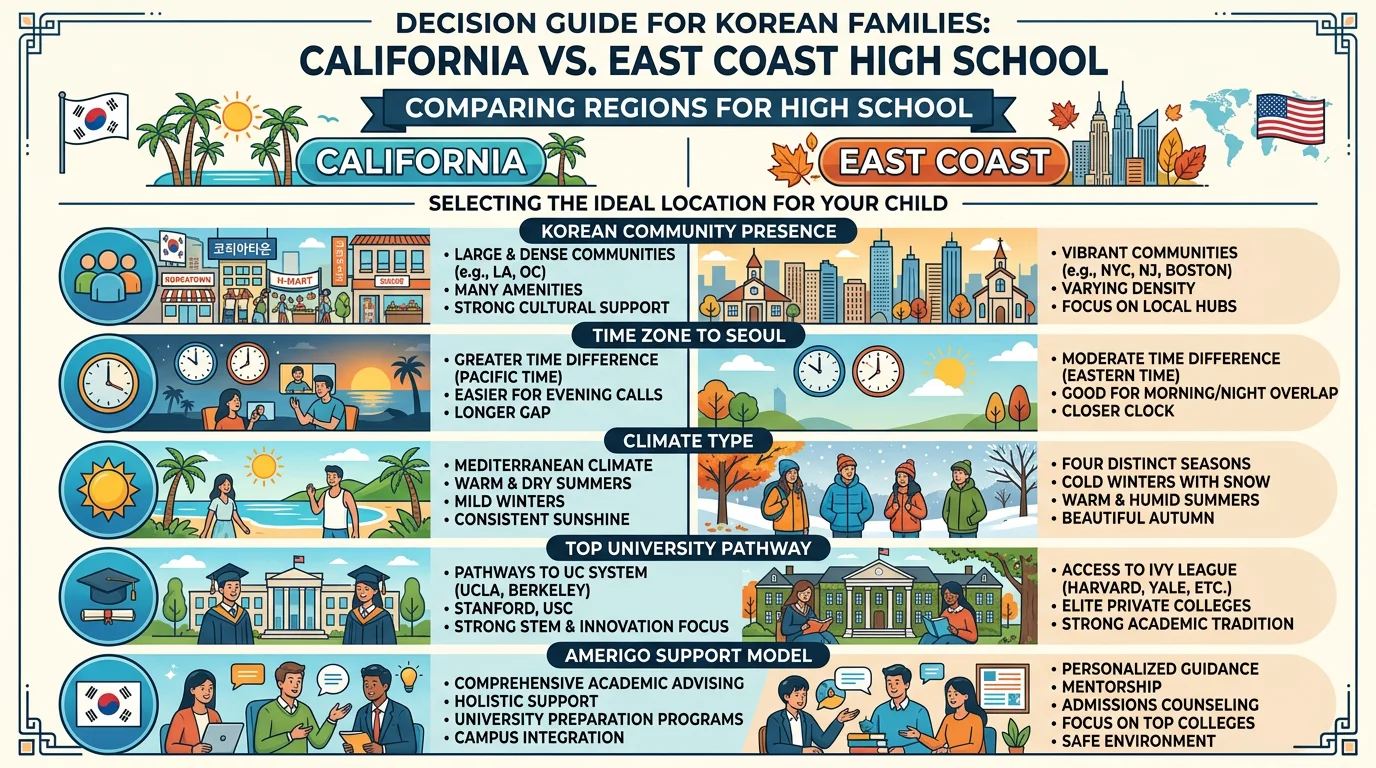
- Korean community access: California - particularly the Greater Los Angeles area - has one of the largest Korean communities outside Korea, offering cultural continuity for incoming students.
- Time zone advantage: East Coast schools are approximately 3 hours closer to Korean Standard Time than California, making daily family communication more practical.
- University pathway alignment: California's UC system appeals to STEM-focused Korean families; East Coast proximity to Ivy League and finance programs suits different academic goals.
- Consistent support model: Amerigo provides native-language Korean communication and monthly progress reports, school activity calendars and event announcements at all US Signature Schools regardless of location.
- Individual fit matters: Neither coast is universally better - the right choice depends on the student's academic profile, social preferences, and family priorities.
Why Do Korean Families Choose California Schools?
California attracts the majority of Korean families for a combination of cultural proximity, climate, and academic reasons. The Greater Los Angeles area is home to one of the largest Korean communities outside the Korean Peninsula, giving students immediate access to Korean-speaking peers, restaurants, cultural events, and community organizations during holidays and school breaks. According to NAIS (2025), California's private secondary school market is among the most competitive in the US, with strong AP (Advanced Placement) and Honors course availability across top-rated private institutions.
The Pacific coastal climate also resonates with Korean families from cities like Busan and Incheon, where winters are cold but not extreme. Students managing the psychological adjustment of their first year abroad often find California's climate, diverse Asian student population, and Korean community presence reduce the cultural distance compared with more isolated East Coast campuses.
Amerigo's partner school network includes California locations among its 40 Niche A+/A rated schools, and Korean families can use the find-your-school tool or contact the recruitment team to compare California partner school profiles against their student's academic needs and budget.
- Korean community access: LA Koreatown and Bay Area Korean communities provide cultural continuity, Korean language options, and peer networks outside school.
- Asian student diversity: California schools typically enroll high proportions of Asian international students, reducing early social adjustment friction.
- Mild Pacific climate: Lower seasonal contrast compared to East Coast winters suits students from Korea's southern coastal cities.
- UC and STEM university pipeline: Strong pathway alignment to UC Berkeley, UCLA, UC San Diego, and Silicon Valley-connected programs.
What Advantages Do East Coast Schools Offer?
East Coast schools in Boston and New York offer a distinct academic environment that suits specific Korean student profiles - particularly those whose university goals center on Ivy League institutions, finance, pre-law, or economics. According to NACAC (2024), university counselors at New England and mid-Atlantic high schools often have established relationships with admissions teams at Harvard, Yale, MIT, and Columbia, which can benefit students whose applications target those specific institutions.
New York's finance ecosystem and Boston's concentration of research universities create different extracurricular, internship, and alumni networking environments than those available in California. Korean students who know by Grade 10 that they want to pursue finance, international relations, or the humanities may find East Coast school environments more directly aligned with their post-secondary goals.
The on-campus international department at each US Signature School - whether on the East Coast or in California - operates the same academic planning, ELL (English Language Learning) instruction, and university counseling structure. Academic quality and support consistency do not vary by coast.
How Does Time Zone Affect Korean Family Contact?
Time zone difference is one of the most practical factors Korean families evaluate. Seoul operates at UTC+9 (Korean Standard Time). California (Pacific Standard Time) runs at UTC-8, meaning Seoul is 17 hours ahead of Los Angeles. New York (Eastern Standard Time) runs at UTC-5, meaning Seoul is 14 hours ahead. This 3-hour difference matters in daily scheduling.
For a Korean parent calling at 9am in Seoul, it is 4pm the previous day in Los Angeles and 7pm the previous day in New York. East Coast students are thus reachable after school for Korean morning calls, while California students are still mid-afternoon. Families who prioritize routine daily contact generally find East Coast scheduling more practical without compromise to academic quality.
Amerigo supports Korean families through its in-country staff who communicate in Korean remotely before and after key events - including enrollment milestones, academic updates, and emergency situations. Monthly progress reports, school activity calendars and event announcements keep families informed between calls. On-campus staff at each Signature School attend parent-teacher events and provide summaries that in-country staff relay to Korean families in their native language.
What Academic Differences Should Families Compare?
The core academic structure - AP and Honors course availability, ELL instruction, individualized academic planning, and university counseling - is consistent across Amerigo's 40 Niche A+/A rated partner schools regardless of region. Regional academic differences are school-specific rather than coast-wide.
California schools in STEM-strong districts may have more established computer science and engineering course tracks aligned with UC application requirements. East Coast schools in Boston and New York more often feature business, economics, and law-related academic clubs and competition programs. According to College Board (2024), AP exam outcomes correlate strongly with school-level academic support - which Amerigo provides consistently across the network through the on-campus international department.
Families should request the AP course catalog, ELL progression timeline, and recent university placement data for any specific school under consideration. The our schools page and Amerigo's recruitment team can provide school-level information before enrollment.
- AP course list: Request per-school AP course availability and the prerequisite timeline for international students.
- University placement by school: Ask for Top 100 and Top 50 outcomes of those who applied at the specific school, not just the network average.
- Extracurricular alignment: Compare club offerings, academic competitions, and internship programs against the student's intended university major.
- ELL transition timeline: Confirm the average time for ELL (English Language Learning) students to transition into standard-track coursework at that school.
When Is the East Coast the Better Fit?
East Coast programs are the stronger choice for Korean students whose academic goals, social preferences, or family logistics align with specific East Coast advantages. Three primary signals suggest East Coast is the right fit:
Students targeting Ivy League, near-Ivy, or top finance and law programs benefit from the regional university recruitment ecosystem concentrated in New England and the mid-Atlantic. Teachers writing recommendation letters at East Coast schools carry contextual familiarity with those institutions that may be relevant during review.
Students who thrive in environments with four distinct seasons - and who find the absence of seasonal contrast in California disorienting - often adapt more smoothly to East Coast school culture. Korean students with prior study experience in China, northern Europe, or colder Korean cities (Seoul in January averages -6°C) may find East Coast winters familiar rather than extreme.
Families who need consistent daily contact with their child find the time zone difference of 14 hours (East Coast to Seoul) more manageable than 17 hours. Evening calls from Korea reach East Coast students after school; the same call reaches California students in the early afternoon before homework and activities.
How Does Amerigo Support Korean Families in Both Regions?
Amerigo's support model is identical at all US Signature Schools regardless of coast. Each campus operates an on-campus international department staffed by a Director of Campus Operations, Academic Director, Senior Campus Coordinators, Campus Coordinators, and an ELL teacher. Campus Coordinators manage welfare, accommodation logistics, and native-language family communication relays. Academic Directors handle both pre-departure transcript review and ongoing academic management throughout the enrollment year.
Korean students enrolled in Amerigo programs access four accommodation options regardless of location: homestay, off-campus residences (the primary model, located 20-30 minutes from partner schools with single-gender units and 24/7 staff), on-campus residences at select schools, and self-provided accommodation for students with family nearby. The student accommodations page outlines each option in detail.
The university guaranteed admission pathway - available for students completing two consecutive years, maintaining a GPA (Grade Point Average) of 3.2 or higher, reaching TOEFL 85+, and completing at least one AP, IB, or Honors course - applies at US Signature Schools on both the East Coast and in California. Location does not affect eligibility.
Frequently Asked Questions
Why do most Korean students choose California for US high school?
California's established Korean community - particularly in Los Angeles and the Bay Area - reduces cultural adjustment for Korean teenagers new to the US. The mild Pacific climate, dense Asian student population at many schools, and alignment with UC-system and STEM university pipelines also appeal to Korean families. Amerigo's Niche A+/A rated partner schools in California provide the same on-campus international department support and university counseling available across the full network.
Is the East Coast better for Korean students aiming at Ivy League universities?
East Coast high schools sit closer to the university recruitment circuits for Ivy League and near-Ivy institutions, which may benefit students whose applications specifically target those schools. However, Amerigo's university counseling supports Top 100 and Top 50 outcomes regardless of school location. Of students who applied to Top 50 universities in the Class of 2025, 60% of those who applied gained admission - a result achieved across the full network, not only East Coast schools.
How do Korean families manage the California time zone difference?
With California running 17 hours behind Seoul, Korean parents calling at 9am in Korea reach California students at around 4pm the previous day - just after school ends. Most families schedule regular weekly video calls at consistent times. Amerigo's in-country staff in Korea communicate with families in Korean around key events, and monthly progress reports, school activity calendars and event announcements keep parents informed between calls without requiring daily contact.
Do Amerigo schools in California and the East Coast offer the same support?
Yes. Every US Signature School operates the same on-campus international department structure: Director of Campus Operations, Academic Director, Campus Coordinators, and an ELL teacher. Native-language Korean communication support, monthly progress reports, school activity calendars and event announcements, 24/7 emergency assistance, and Life360 or Reach safety technology are all standard at US Signature Schools regardless of location. Regional differences affect community and climate, not support quality.
Is the Korean community large enough on the East Coast for students?
New York and Boston have established Korean and Korean-American communities, though smaller and less concentrated than Los Angeles's Koreatown. Korean students on the East Coast typically integrate into broader international student groups and urban multicultural peer networks. Students who need strong Korean community support during their first semester generally find it more readily in California; East Coast Korean students build community through school programs and city resources over time.
What accommodation options are available for Korean students at Amerigo schools?
Amerigo offers four accommodation options: homestay, off-campus residences (the primary model, located 20-30 minutes from partner schools with single-gender units and 24/7 staff), on-campus residences at select schools, and self-provided accommodation for students with family nearby. Both California and East Coast Signature Schools offer homestay and off-campus residence options subject to availability. Accommodation selection occurs before the enrollment deposit, and Amerigo's team advises Korean families on the best fit.
How does Amerigo communicate with Korean-speaking parents?
Amerigo provides native-language communication support for families from China, Vietnam, Korea, Mexico, and the Taiwan Region through in-country staff who work remotely and communicate in the family's native language before and after key events. On-campus staff attend conferences and provide English-language summaries; in-country Korean-language staff relay these to families. Monthly progress reports, school activity calendars and event announcements are delivered via StudyStudyGo, Amerigo's parent communication platform launching Fall 2026.
When is California the wrong choice for a Korean student?
California may be a less suitable choice for Korean students targeting Ivy League or top finance programs concentrated on the East Coast, students who prefer four distinct seasons, or families who need daily communication during Seoul morning hours when California students are still in afternoon school hours. Students who have previously studied in colder climates - northern China, northern Europe, or Seoul - may find East Coast winters more familiar than California's mild, seasonless environment.
Do Amerigo partner schools have Korean student communities on both coasts?
Most Amerigo US Signature Schools enroll Korean students as part of broader international cohorts. California schools tend to have higher Korean and Asian student concentrations due to regional demographics. East Coast Amerigo schools typically enroll more geographically diverse international cohorts. Regardless of location, Amerigo hosts its own social events for students and their friends separate from school-organized activities, helping Korean students build peer connections from their first weeks on campus.
How should Korean families decide between California and East Coast?
The decision should center on three factors: the student's target university type (UC system and tech programs vs Ivy League and finance), the student's need for Korean community access versus multicultural exposure, and family communication preferences given the time zone difference. Families who remain uncertain after comparing these factors should request a consultation with Amerigo's recruitment team, who advise on specific Signature School partners best matched to each student's academic profile and goals.
Conclusion
California and East Coast schools each suit distinct Korean student profiles, and the stronger choice depends on the individual student's university goals, social adjustment needs, and family communication preferences. California schools offer Korean community access, Pacific climate, and UC pathway alignment. East Coast schools offer Ivy League proximity, urban academic culture, and a time zone 3 hours closer to Seoul. Amerigo provides the same on-campus support and native-language Korean communication across both regions.
Find Your Amerigo Partner School
To learn more about studying in America at an Amerigo partner school in California or on the East Coast, contact us to speak with a program advisor, or apply now to start the enrollment process.
People Also Read
- Korean Families' Guide to Amerigo Education: Enrollment, Support, and Outcomes
- Korean Students in US High Schools Guide 2026
- Best US Locations for International Students 2026
About the Author
This guide was written by the Amerigo Education content team, drawing on program data from staff operating the on-campus international department at 40 Niche A+/A rated US, Canadian, and UK partner schools. Learn more about Amerigo Education.
Disclaimer: This article provides general information for educational purposes only. Families should conduct independent research, request current program data from providers, and consult with program representatives regarding specific circumstances. Contact us with questions.