All news
March 2, 2026
Study Abroad 101
Best US Locations for International Students 2026
Best US locations for international high school students: compare regions by climate, school quality, university access, and student life for 2026.

Best US Locations for International Students 2026
Last Updated: March 2026
A US location for international high school students is the geographic region - including state, city, and campus setting - where a student enrolls for secondary education on an F-1 (student visa for academic programs) visa. According to IIE Open Doors (2024), international students attend high schools and universities in all 50 US states, with California, New York, Texas, and Massachusetts hosting the largest concentrations. The right location affects climate, daily life, cultural adjustment, and proximity to target universities.
Amerigo Education operates across 40 Niche A+/A rated partner schools in the US, Canada, and the UK, serving 3,500+ students from 55+ countries. The Class of 2025 achieved a 97% Top 100 university admission rate across all school locations. This guide compares US regions by school quality, climate, university access, accommodation, and student life - and explains why individual school fit outweighs state selection.
Key Takeaways
- School quality outweighs state reputation: All 40 Amerigo partner schools hold Niche A+/A ratings regardless of region; school-level fit matters more than geographic prestige.
- University outcomes are location-independent: Class of 2025 achieved 97% Top 100 and 60% Top 50 admission across every partner school state and province.
- Climate shapes daily adjustment: Northern states require 1-2 semesters for tropical-climate students to adapt; southern and West Coast options offer easier transitions.
- Consistent support at every Signature campus: The on-campus international department, monthly progress reports, and Life360 or Reach tracking operate identically at all Amerigo Signature partner schools.
- Accommodation flexibility across regions: Homestay for cultural immersion and on- and off-campus residences with 24/7 staff are available at partner schools nationwide.
What Makes a US Location Right for Students?
The right US location depends primarily on the quality and fit of the specific school rather than the state or city. A Niche A-rated school in the Midwest with strong AP (Advanced Placement) course access and a dedicated international department will produce better outcomes than a school in a popular coastal city with weaker support. School-level program quality, the accommodation model, and on-campus support matter more than state reputation.
Climate affects daily routines - students from tropical countries may need months to adjust to northern winters. Proximity to research universities affects campus visit options during application season. Community size shapes social life: smaller towns often produce closer bonds, while cities offer greater cultural variety. According to the National Center for Education Statistics (2024), private high school quality varies more by individual institution than by region.
Families should evaluate the following factors when comparing locations:
- School academic quality, AP access, and Niche rating
- On-campus international department support and staffing model
- Accommodation type - homestay, on- and off-campus residence, or self-provided accommodation
- Regional climate compared to the student's home country
- Distance from home and flight connection availability
- Proximity to universities the student plans to apply to
- Community demographics and presence of other international students
What Are the Best US Cities for Students Abroad?
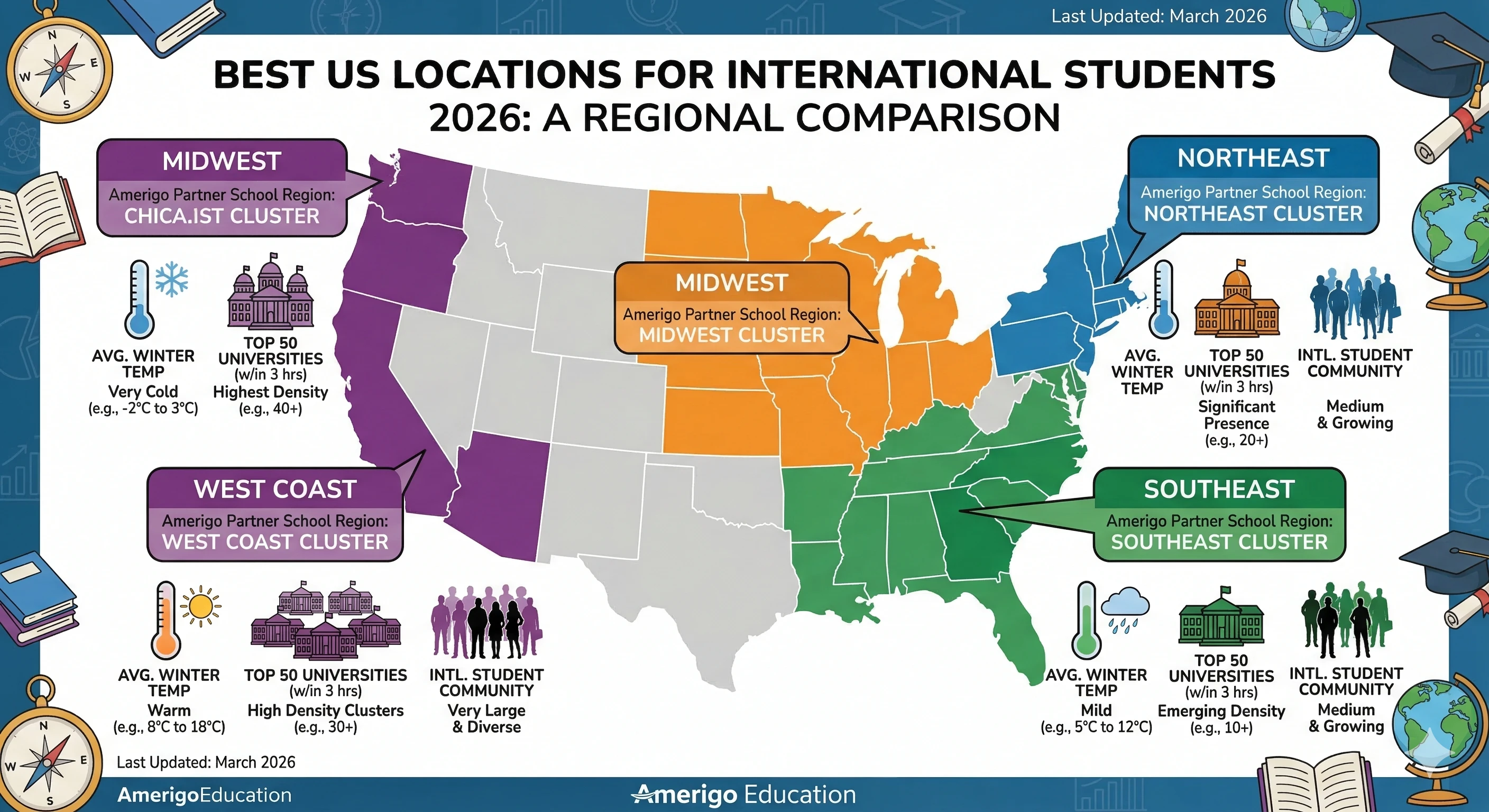
US regions differ for international students in climate, cultural environment, university density, and community character. The Northeast - including Massachusetts, New York, and Connecticut - offers proximity to prestigious universities and internationally experienced communities. The Midwest - including Illinois, Minnesota, and Wisconsin - provides lower cost of living, four-season weather, and close-knit school communities.
Each region presents trade-offs. Midwest campuses often produce stronger community bonds. The Southeast offers milder winters and growing international student populations. West Coast locations - particularly California - provide cultural familiarity for students from East Asian countries due to larger Asian-American communities and Pacific Rim connections.
How Should Families Choose a School Location?
Families should start with individual school profiles rather than filtering by state. Evaluate school academic quality, AP course availability, the on-campus international department model, and accommodation options first. Regional factors like climate and university proximity become decision points only after narrowing to schools that match the student's academic level and English proficiency.
Amerigo Education allows families to view partner schools by location and submit a single application to multiple schools at no extra cost. Rolling admissions at most Signature schools mean earlier applications secure more flexibility. Consulting with an enrollment advisor helps match options to the student's GPA (Grade Point Average), English level, and intended university pathway.
Key steps in the location selection process:
- Review individual school profiles for academic programs and AP access
- Confirm the accommodation model available - homestay, on- and off-campus residence, or both
- Assess regional climate against the student's home country conditions
- Check proximity to universities the student may target for applications
- Consider flight connections and travel time from the family's home country
- Speak with an enrollment advisor to discuss specific school matches
What Should Students Expect at US High Schools?
International students should expect US high schools to evaluate performance continuously across all four years through GPA rather than through a single national exam. Classroom participation, group projects, extracurricular involvement, and teacher relationships all factor into the experience. Students need structured guidance to manage GPA from day one.
Social life at US high schools centers around the school itself. Clubs, sports teams, arts programs, and student government operate on campus. International students who participate build the extracurricular profiles that universities evaluate. Amerigo Education's on-campus international department at each partner school guides students through this transition. ELL (English Language Learning) courses support students who need to strengthen English alongside regular coursework.
Accommodation shapes the daily routine. Students in homestay placements gain cultural immersion through interaction with an American host family, with academic support at the school's on-campus international department office. Students in on- and off-campus supervised residences live in single-gender housing with 24/7 staff, dedicated study areas, and modern facilities located 20 to 30 minutes from campus. Both models include safety monitoring through Life360 or Reach parent tracking technology.
Does Location Affect University Admissions?
US high school location does not directly determine university admissions outcomes. Admission to Top 50 and Top 100 universities depends on individual GPA, AP course performance, standardized test scores like TOEFL (Test of English as a Foreign Language) and SAT, extracurricular profile, and application essays. According to US News & World Report (2025), Top 50 universities are found across Massachusetts, California, Illinois, North Carolina, and many other states.
The Class of 2025 results confirm this. Students at Amerigo Education partner schools across all locations achieved 97% Top 100 and 60% Top 50 university admission rates. Amerigo Education's Top 100 Guarantee offers an up to $50,000 USD refund for eligible students who meet the program requirements - two consecutive years of enrollment, a cumulative GPA of 3.2 or higher, a TOEFL score of 85 or above, and at least one AP, IB, or Honors course - available at US Signature Schools only.
What Climate Factors Should Families Consider?
Climate is one of the most tangible regional differences families should weigh. Students from tropical or warm-climate countries in Southeast Asia, Central America, or the Caribbean may find northern winters in Minnesota, Wisconsin, or Massachusetts physically challenging for their first year. Adjustment includes wardrobe changes, shorter daylight hours, and limited outdoor activity during winter months.
Southern states and California generally offer milder winters, easing the initial transition. However, climate should not override school quality as a decision factor. Students adjust to cold weather within one to two semesters in most cases. Amerigo Education provides native-language communication support for families from China, Vietnam, Korea, Mexico, and the Taiwan Region, and more. This support helps address climate adjustment and other transition concerns.
How Do Students Compare Specific School Options?
Students compare school options most effectively by reviewing individual profiles that list academic programs, AP offerings, accommodation types, and campus features. Amerigo Education's school directory allows families to browse all 40 partner schools and apply to multiple locations through one application. SEVIS-certified schools issue the I-20 forms required for F-1 visa applications.
Beyond academics, families should compare extracurricular options, the surrounding community, and distance from the nearest airport with connections to the student's home country. Students from China, South Korea, and Vietnam may prefer West Coast locations for shorter flight times, while students from Mexico may find southern or central US locations more accessible. All partner schools offer the same Amerigo Education support structure regardless of geographic location.
Frequently Asked Questions
What is the best US state for international high school students?
No single US state is best for every international high school student. The right choice depends on school quality, academic goals, climate preference, and proximity to target universities. Strong private high schools with international student support exist across the Northeast, Midwest, Southeast, and West Coast. School-level fit matters more than state reputation.
How do I choose a US location for high school?
Start by evaluating individual school quality, AP course access, and the on-campus support model rather than filtering by state. Then consider climate, distance from home, community demographics, and proximity to target universities. Applying to multiple schools across different locations through a single application increases placement flexibility.
Can international students attend US public high schools?
International students on F-1 visas can attend US public high schools for a maximum of one academic year and must reimburse tuition costs. Most international families pursuing a full four-year education enroll at private schools with SEVP (Student and Exchange Visitor Program) certification, which can issue I-20 forms for multi-year enrollment and provide dedicated international student support.
Does US location affect university admissions?
US location does not directly determine university admissions outcomes. Admission to Top 50 and Top 100 universities depends on GPA, AP course performance, standardized test scores, extracurricular activities, and application essays. Universities accept applicants from high schools in every state. Program quality and the student's individual record matter more than geography.
What climate differences matter for international students?
Climate differences affect daily routines, clothing needs, and comfort during the school year. Students from tropical countries may need time to adjust to northern winters in states like Minnesota, Wisconsin, or Massachusetts. Southern and West Coast locations offer milder weather. Families should consider whether seasonal variation will affect study habits or wellbeing during adjustment.
Which US regions have top-ranked private schools?
Top-ranked private high schools are distributed across all major US regions. According to Niche, A-rated and A-plus-rated schools operate in the Northeast, Midwest, Southeast, and West Coast. School quality is not concentrated in one area. International families should evaluate schools individually rather than assuming one region produces better outcomes.
How far are partner schools from major universities?
Partner school campuses are located across multiple US states, with many positioned within one to three hours of major research universities. This proximity allows campus visits during the application process. University visit planning is part of the counseling program offered through Amerigo Education's on-campus international department at each location.
What support do international students receive at US schools?
International students at Amerigo Education partner schools receive support through an on-campus international department. This includes academic planning, monthly progress reports, university counseling from Grade 9 or 10, ELL coursework, and 24/7 emergency assistance. Safety monitoring uses Life360 or Reach parent tracking technology. Services operate identically regardless of location.
What accommodation options exist for international students?
International students choose between homestay, on- and off-campus supervised residences, or self-provided accommodation for families with relatives near the school. Amerigo Education provides homestay placements offering cultural immersion, with academic support at the school's on-campus international department office. On- and off-campus residences are single-gender with 24/7 staff, dedicated study areas, and modern facilities located 20 to 30 minutes from campus. Both models are available across locations.
Do all US locations offer the same program quality?
All 40 Amerigo Education partner schools hold Niche A+ or A ratings regardless of geographic location. The on-campus international department, monthly parent reporting, Life360 or Reach tracking, and university counseling operate the same way at every Signature partner school. The Class of 2025 achieved 97% Top 100 university admission across all locations.
Conclusion
The best US location for an international high school student depends on the quality and fit of the specific school, not the geographic region alone. All 40 partner schools hold Niche A+/A ratings and deliver the same on-campus international department support, monthly parent reporting, and university counseling regardless of location.
Explore School Locations Across the US
International families ready to explore location options can view partner schools by location and compare regional options. Apply now to submit a single application to multiple schools, or contact us to speak with an enrollment advisor about which school locations match your student's academic profile and personal preferences.
People Also Read
- Top 10 Private Schools in the US for Foreign Students
- Safe High School Options for International Students in the US
About the Author
This guide was written by the Amerigo Education content team, drawing on program data from staff operating the on-campus international department at 40 Niche A+/A rated US and Canadian partner schools. Learn more about Amerigo Education.
Disclaimer: This article provides general information for educational purposes only. Families should conduct independent research, request current program data from providers, and consult with program representatives regarding specific circumstances. Contact us with questions.