All news
May 24, 2026
Study Abroad 101
How to Transfer Your F-1 Visa Between US High Schools Without Losing Status
How to transfer an F-1 visa between US high schools: SEVIS transfer steps, timing rules, visa stamp impact, and how Amerigo supports school changes.

How to Transfer Your F-1 Visa Between US High Schools Without Losing Status
Last Updated: May 2026
An F-1 (student visa for academic programs in the US) SEVIS transfer is the formal process by which a current F-1 visa holder moves their student record from one authorized school to another without leaving the US or applying for a new visa. The process is governed by SEVIS (Student and Exchange Visitor Information System), which is managed by SEVP under the Department of Homeland Security. According to IIE Open Doors (2025), school-to-school transfers represent a meaningful share of F-1 student movement within the US, particularly at the high school level where students may relocate between cities or change academic programs.
Amerigo Education partners with 40 Niche A+/A rated schools across the US, Canada, and the UK, supporting 3,500+ students from 55+ countries. The Class of 2025 achieved 97% admission to Top 100 US universities. All Amerigo US Signature School partner schools are SEVIS-authorized institutions. When students need to transfer between Amerigo partner schools, the on-campus international department coordinates with both schools' DSOs (Designated School Officials) to ensure the process is completed without a gap in F-1 status.
This guide covers when an F-1 transfer is permitted, the step-by-step process, timing requirements, the impact on visa stamps, credit transfer considerations, and how the process works for students at Amerigo US Signature Schools.
Key Takeaways
- No new visa required: A valid F-1 visa stamp remains usable at the new school as long as it has not expired.
- SEVIS record transfers: The DSO at the current school releases the SEVIS record to the new school on a set date.
- Timing is critical: Students must enroll at the new school within the program start window on the new I-20.
- Status is maintained: The student remains in valid F-1 status throughout a properly executed transfer.
- No travel during pending: Traveling internationally between the SEVIS release date and new school enrollment can trigger status issues.
What Is an F-1 SEVIS Transfer?
An F-1 SEVIS transfer is not a transfer of the visa stamp itself, but a transfer of the student's SEVIS record from one school's DSO system to another. The SEVIS record contains the student's biographical information, program details, and F-1 status history. When the transfer is completed correctly, the student's F-1 status is continuous, with no gap or interruption. The current school's DSO sets a transfer release date, and on that date the SEVIS record becomes accessible to the new school's DSO, who then issues a new I-20 reflecting the new institution.
According to NACAC (2024), students who transfer schools during their US academic program face specific timing and documentation requirements that differ significantly from the initial enrollment process. Understanding the mechanics of the SEVIS transfer prevents the most common errors, including traveling internationally while in "transfer pending" status or missing the program start date on the new I-20. Families can review How International Students Maintain F-1 Status in the US for a broader overview of F-1 status maintenance requirements.
When Can an F-1 Student Transfer Schools?
F-1 students can initiate a SEVIS transfer at any point during their program, provided their F-1 status is currently valid. A student who is out of status or who has had their SEVIS record terminated cannot complete a transfer without first seeking reinstatement through SEVP. The transfer must also be initiated before the student's current I-20 program end date. Attempting to transfer after the program end date requires the current DSO to extend the I-20 first, which may not always be possible.
The most common transfer triggers at the high school level include: relocation to a new city, a change in academic goals or program focus, a family decision to move to a school with a different support model, or a transition between schools within the same program network. According to NAIS (2025), mid-program school changes among international high school students have increased as families become more active in optimizing the placement choice after arrival in the US.
- Valid status required: The student must currently be maintaining F-1 status with a valid SEVIS record.
- Before program end date: Transfer must be initiated before the current I-20 expires.
- New school must be SEVIS-authorized: The receiving institution must be an active SEVIS-designated school.
- No pending immigration issues: Students with pending reinstatement requests or status violations should consult their DSO before initiating a transfer.
What Steps Does the Transfer Process Involve?
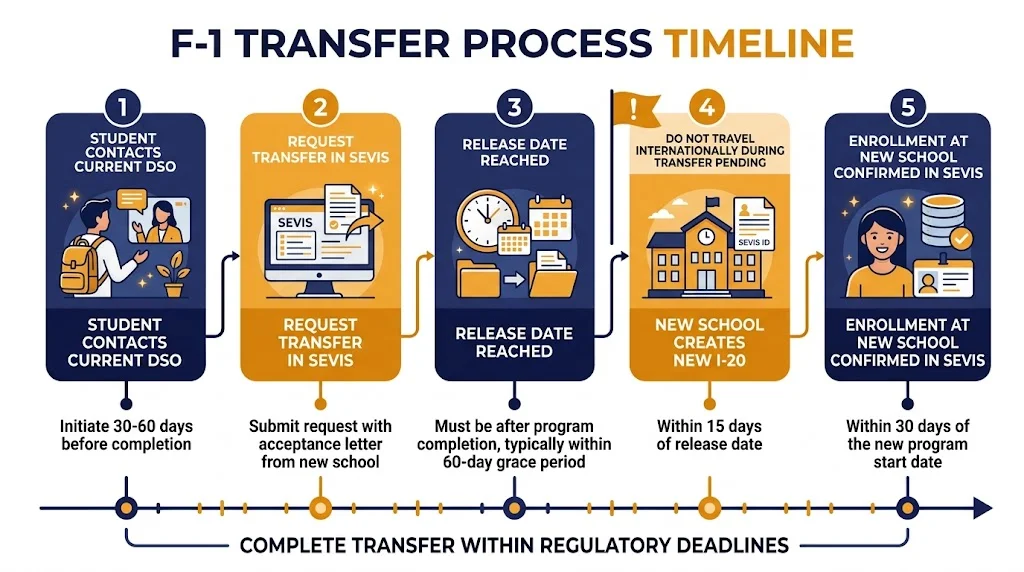
The SEVIS transfer process follows a defined sequence. The student obtains written acceptance from the new school, then contacts their current DSO to request the SEVIS transfer. The current DSO enters a transfer release date into SEVIS, typically the student's last day at the current school. Until that date, the SEVIS record remains with the current school and the student continues attending as normal.
On the release date, the new school's DSO accesses the SEVIS record and issues a new I-20 with updated institution information and program dates. The student must report to the new school and begin enrollment within 15 days of the program start date on the new I-20. Families can review F-1 Visa to Arrival Timeline for Students 2026 for context on SEVIS timing requirements.
- Obtain acceptance from the new school: Formal acceptance or enrollment confirmation is required before the DSO can initiate a transfer.
- Request transfer from current DSO: Submit a written request specifying the new school's SEVIS School Code and the requested release date.
- Transfer release date set: On that date, the record moves to the new school and the new I-20 is issued.
- Report to new school: Begin enrollment within 15 days of the program start date on the new I-20.
How Long Does the Transfer Process Take?
The administrative timeline depends primarily on coordination between the two schools' DSOs. Once the student submits a transfer request, the current DSO typically sets a release date within a few days. The new school issues a new I-20 as soon as the SEVIS record is accessible. In practice, the full process from request to new I-20 in hand takes as little as one to two weeks if both schools respond promptly.
Families should plan the transfer around the academic calendar at both schools. Some Amerigo partner schools have specific enrollment windows, so families should confirm timing with the on-campus international department at both the sending and receiving schools before finalizing the release date.
Does Transferring Affect the F-1 Visa Stamp?
A valid F-1 visa stamp from the original school remains valid for re-entry into the US after a properly executed SEVIS transfer. The visa stamp is issued by the US Department of State for entry into the US as an F-1 student; it is not school-specific. After the SEVIS transfer, the student uses the new I-20 issued by the new school for any travel requiring proof of F-1 status.
However, if the student's current F-1 visa stamp has already expired at the time of transfer, the student would need to apply for a new visa stamp before any international travel. For students from the Taiwan Region, visa applications are processed through the American Institute in the Taiwan Region (AIT) for the F-1 stamp. Students who need a new visa stamp should not attempt to re-enter the US on an expired stamp after traveling internationally. The landing-page/zf-visa service (ZF Visa, Amerigo's third-party visa partner) assists F-1 applicants with the visa stamp application process for eligible students.
Critically, students must not travel internationally between the SEVIS transfer release date and the date they report to and enroll at the new school. During this window, the student is in "transfer pending" status. Traveling internationally during transfer pending status can trigger complications with re-entry and status continuity.
How Does Amerigo Support School Transfers?
When a student needs to transfer between Amerigo partner schools, the on-campus international department at the current school coordinates with the receiving school's team to align on a release date that minimizes disruption to the student's program. Amerigo's in-country native-language staff can communicate with families in their home language throughout the process.
The campus team also supports credit transfer, ensuring academic credits from the sending school are documented correctly for the receiving school. Amerigo facilitates sending transfer transcripts directly from Signature campuses. Families can review What Happens If Your Child Needs to Return Home? Credit Transfer and Re-Enrollment Guide for details on credit continuity, and can use Amerigo's school finder to explore partner schools in the target location.
Frequently Asked Questions
Does a SEVIS Transfer Require a New Visa Application?
A SEVIS transfer does not require a new visa application if the student's current F-1 visa stamp is still valid. The transfer is an administrative record movement within SEVIS. The student receives a new I-20 from the new school, which replaces the old school's I-20 as the primary immigration document. A new visa stamp is only required if the current one has expired and the student needs to travel internationally.
Can a Student Attend the New School Before the Transfer Release Date?
No. A student cannot formally enroll or attend classes at the new school before the SEVIS transfer release date, as the new school's DSO cannot issue a valid I-20 until the SEVIS record is transferred. Attending classes before the transfer is finalized creates status complications. The student should remain enrolled at the current school until the transfer release date and then begin enrollment at the new school as specified on the new I-20.
What Happens If the Transfer Is Delayed?
If the transfer release date passes without the new school issuing a new I-20, students should contact both DSOs immediately. The most important step is to ensure the student does not miss the new school's program start window on the new I-20. DSOs can update program start dates in limited circumstances, but families should plan conservatively and not rely on last-minute adjustments.
Is the SEVIS Fee Paid Again for a Transfer?
No. The SEVIS fee (Form I-901) is a one-time payment made at the beginning of the student's first F-1 program in the US. A SEVIS transfer between schools does not require a new SEVIS fee, as the existing SEVIS record simply moves from one school to another. Students who have been terminated and are seeking reinstatement may have different requirements, and should confirm with SEVP and their DSO.
Can a Transfer Student Take a Break Between Schools?
There is no formal break period permitted between transfer release date and new school enrollment beyond what is specified on the new I-20. The student must begin attendance at the new school within 15 days of the program start date. Taking a lengthy break between schools while in transfer pending status risks triggering a status issue. Families considering a break period should discuss this directly with the DSOs at both schools before requesting a transfer.
What Documents Are Needed to Initiate a Transfer?
The core documents for a SEVIS transfer include: the student's current I-20, proof of acceptance or enrollment confirmation from the new school, and a written transfer request to the current school's DSO specifying the new school's SEVIS School Code and the requested transfer release date. Both schools may have internal transfer request forms. Families should confirm the specific document requirements with the current school's DSO at the time of the transfer request.
Does the Transfer Affect Top 100 Guarantee Eligibility?
Amerigo's Top 100 Guarantee requires two consecutive enrollment years at Amerigo US Signature Schools. A transfer between two Amerigo Signature Schools counts as consecutive enrollment, provided there is no break in the program. A transfer to a non-Amerigo school would break the requirement. Families should contact Amerigo's university-guaranteed admission team before initiating any transfer.
How Does the Transfer Work for the Taiwan Region Students?
F-1 students from the Taiwan Region follow the same SEVIS transfer process as all other international students. The F-1 visa stamp issued by the American Institute in the Taiwan Region (AIT) remains valid for re-entry if it has not expired. Students should confirm their visa stamp expiry before international travel and must not travel during transfer pending status. New visa stamps, if needed, are applied through AIT.
Conclusion
An F-1 SEVIS transfer allows international students to move between SEVIS-authorized US high schools without applying for a new visa or losing F-1 status, provided the process is coordinated correctly between both schools' DSOs. Timing, documentation, and compliance with enrollment windows at the new school are the critical variables that determine whether the transfer is completed without a status gap.
Find Your Next Amerigo Partner School
To learn more about studying in America at a new Amerigo partner school or to understand transfer options, contact us to speak with a program advisor, or apply now to begin the enrollment process at a new school.
People Also Read
- How International Students Maintain F-1 Status in the US
- What Is a DSO? How Designated School Officials Support F-1 Students
- F-1 Visa Changes for High School Students 2025-2026: What Parents Need to Know
About the Author
This guide was written by the Amerigo Education content team, drawing on program data from staff operating the on-campus international department at 40 Niche A+/A rated US, Canadian, and UK partner schools. Learn more about Amerigo Education.
Disclaimer: This article provides general information for educational purposes only. Families should conduct independent research, request current program data from providers, and consult with program representatives regarding specific circumstances. Contact us with questions.