All news
March 4, 2026
Study Abroad 101
F-1 Visa to Arrival Timeline for Students 2026
F-1 visa timeline from acceptance to US arrival: I-20 issuance, SEVIS fees, DS-160 filing, consular interviews, and pre-departure steps for 2026.

F-1 Visa to Arrival Timeline for Students 2026
Last Updated: March 2026
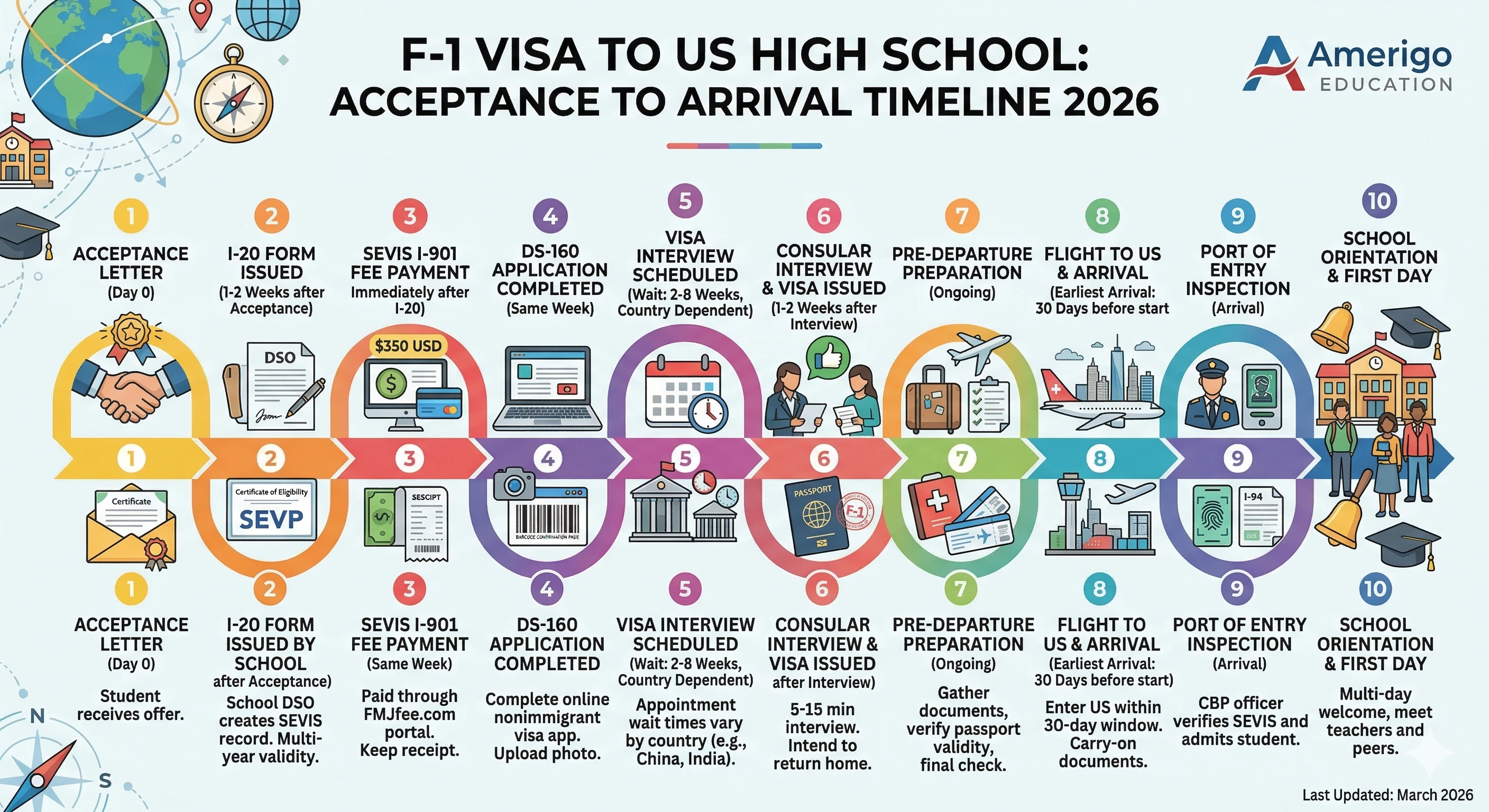
An F-1 visa timeline is the sequence of steps an international student completes between receiving a US high school acceptance and arriving on campus. The process includes I-20 (Certificate of Eligibility) issuance, SEVIS (Student and Exchange Visitor Information System) fee payment, DS-160 application, consular interview, and travel. Under SEVP (Student and Exchange Visitor Program) regulations, all F-1 students must hold a valid I-20 from an SEVP-certified school before applying for a visa.
Amerigo Education, founded in 2016 and backed by Avathon Capital, supports 3,500+ students from 55+ countries across 40 Niche A+/A rated partner schools in the US, Canada, and the UK. The Class of 2025 achieved a 97% Top 100 university admission rate. All Amerigo Signature Schools hold full SEVP certification and coordinate I-20 issuance for accepted students. Visa services are provided through a third-party partner and billed separately from program fees.
Key Takeaways
- SEVP certification required: All Amerigo Signature Schools hold full SEVP certification and coordinate I-20 issuance at 40 Niche A+/A rated partner schools in the US, Canada, and the UK.
- Visa appointment wait times vary: Consulates in China, India, and South Korea have historically had wait times of several weeks to months during peak enrollment.
- 30-day arrival rule: F-1 students may enter the US no earlier than 30 days before the program start date listed on the I-20.
- SEVIS I-901 fee is $350 USD: Paid through FMJfee.com before the visa interview, separate from the consulate visa application fee.
- Five-step process takes 2-4 months: I-20 issuance, SEVIS fee payment, DS-160 application, consular interview, and US arrival.
How Does I-20 Issuance Work After Acceptance?
After enrollment is confirmed, the school's designated school official (DSO) creates a SEVIS record and generates the I-20. This document contains the student's name, school name, program dates, and the SEVIS ID number required for all following visa steps.
Under SEVP regulations, the I-20 must be signed by both the DSO and the student before use in a visa application. Errors must be corrected before the visa appointment. All Amerigo Signature Schools issue I-20 forms for multi-year F-1 enrollment after enrollment and financial documentation are submitted to Amerigo Education's on-campus international department.
How Much Is the SEVIS I-901 Fee?
After receiving the I-20, the student must pay the SEVIS I-901 fee before scheduling a visa appointment. As of 2025, the fee for F-1 students is $350 USD, paid through the FMJfee.com portal. Payment must be completed at least three business days before the visa interview. The receipt confirms active SEVIS registration and must be printed for the consular interview.
According to US Immigration and Customs Enforcement (ICE, 2025), the SEVIS fee is separate from any visa application fee charged by the embassy or consulate. Both fees are required before the visa can be issued. Families should verify current fee amounts through official government sources, as amounts may change.
What Is the DS-160 Application Process?
The DS-160 is the online nonimmigrant visa application completed through the US Department of State's Consular Electronic Application Center. All F-1 applicants must complete it before scheduling a visa interview. The form collects biographical information, travel history, and education background. A digital photo meeting US visa requirements must be uploaded, and the confirmation page with barcode is required at the interview.
According to travel.state.gov (2025), applicants should save the DS-160 confirmation number and print the confirmation page. Every answer must match the student's official documents exactly. Allow one to two hours and double-check all entries before final submission.
- Access the DS-160 form through the Consular Electronic Application Center at ceac.state.gov.
- Select the embassy or consulate where the interview will take place.
- Enter biographical information matching the student's passport exactly.
- Provide education background, including the school name from the I-20.
- Upload a digital photo meeting US visa photo specifications (2x2 inches, white background).
- Review all entries for accuracy before submitting.
- Print the confirmation page with barcode for the visa interview.
What Happens at the F-1 Visa Interview?
The F-1 visa interview is conducted at the US embassy or consulate in the student's country of residence. The consular officer assesses whether the student intends to return home after completing studies. Appointment wait times vary by location and season.
The interview typically lasts 5 to 15 minutes. Students should arrive with all documents organized and be ready to explain their study plan. Visa services for students enrolling at Amerigo Signature Schools are coordinated through a third-party partner who provides interview coaching, document review, and application guidance, billed separately from program fees.
When Can F-1 Students Travel to the US?
F-1 students may enter the US no earlier than 30 days before the program start date listed on their I-20. Students must present their F-1 visa, valid passport, and I-20 to the US Customs and Border Protection (CBP) officer at the port of entry.
According to USCIS (2025), the CBP officer verifies SEVIS registration and admits the student in F-1 status. Students receive an I-94 arrival record electronically. Amerigo Education provides pre-departure webinars for families. Students living in Amerigo's on- and off-campus residences near partner schools or through homestay placements or through self-provided accommodation for families with relatives near the school receive orientation upon arrival.
- Confirm the program start date on the I-20 and calculate the earliest permitted arrival (30 days prior).
- Book flights within the 30-day window, allowing time for orientation before classes.
- Pack the I-20, passport, visa, SEVIS fee receipt, and acceptance letter in carry-on luggage.
- Complete any required customs declaration forms during the flight.
- Present all documents to the CBP officer at the US port of entry.
- Verify F-1 admission status and I-94 record online within 48 hours of arrival.
What Should Families Prepare Before Departure?
Pre-departure preparation involves gathering travel documents, understanding health requirements, setting up financial accounts, and establishing communication plans with the school. Families should verify that the student's passport remains valid for at least six months beyond the program start date.
Amerigo Education coordinates pre-departure webinars for enrolled families. The on-campus international department at each partner school provides arrival instructions and orientation schedules. Amerigo provides native-language communication support for families from China, Vietnam, Korea, Mexico, and the Taiwan Region, and more, with monthly progress reports. Safety technology including Life360 or Reach gives parents location tracking once the student arrives.
What Are the Key F-1 Visa Rules to Know?
F-1 students are admitted for duration of status (D/S), meaning they may remain in the US as long as they maintain full-time enrollment at their SEVP-certified school. The five-month rule terminates F-1 status if a student is absent from classes for more than five consecutive months without authorized leave.
Any changes to enrollment, school transfers, or program extensions require coordination with the school's DSO, who updates the SEVIS record. Amerigo Education's university counseling program, beginning from Grade 9 or 10, helps students plan their academic path while maintaining F-1 compliance.
Frequently Asked Questions
What are the requirements for a US F-1 visa?
F-1 visa requirements include a valid I-20 from an SEVP-certified school, a paid SEVIS I-901 fee receipt, a completed DS-160, a valid passport with at least six months of remaining validity, and financial documentation covering tuition and living expenses. The consular officer must determine the student intends to return home after completing the program.
What is the five-month rule for F-1 students?
The five-month rule terminates F-1 status if a student is absent from classes for more than five consecutive months without authorized leave. This applies to students already in the US who take an extended break. For new students, the relevant rule is the 30-day arrival window before the I-20 start date.
How long does the F-1 visa process take?
The full process from I-20 receipt to visa issuance typically takes two to four months. The biggest variable is interview appointment availability, which differs by country and season. Consulates in China, India, and South Korea have historically had wait times of several weeks to months during peak enrollment. Begin immediately after receiving the I-20.
How much is the SEVIS I-901 fee?
The SEVIS I-901 fee for F-1 students is $350 USD as of 2025, paid through the FMJfee.com portal. This fee is separate from the visa application fee charged by the embassy or consulate. Both must be paid before the visa can be issued. The SEVIS receipt confirms active registration and must be brought to the interview.
When can an F-1 student enter the US?
F-1 students may enter no earlier than 30 days before the program start date on their I-20. The start date is the first day of orientation or classes, not the first calendar day of the month. At the port of entry, students must present their F-1 visa, valid passport, and signed I-20 to the CBP officer.
What documents are needed for the visa interview?
Standard documents include the signed I-20, SEVIS fee receipt, DS-160 confirmation page with barcode, a valid passport, recent passport photos, the school acceptance letter, and financial documentation covering the full program cost. Some consulates also request transcripts or parental employment records.
Can an F-1 visa be denied?
Yes. Denials occur when the consular officer determines the applicant has not shown sufficient ties to their home country, cannot demonstrate adequate financial capacity, or has provided incomplete documentation. A denial does not permanently bar future applications, but the family must address the stated reason before reapplying.
How long can an F-1 student stay in the US?
F-1 students are admitted for duration of status, meaning they may remain as long as they are enrolled full-time at their SEVP-certified school. High school F-1 students cannot transfer to a public high school for more than one year. After graduation, students typically need a new visa category to continue studying.
How early should families start the F-1 process?
Begin as soon as the I-20 is received, ideally three to four months before the program start date. This allows time for SEVIS fee payment, DS-160 completion, and visa appointment scheduling. Starting early provides a buffer for document corrections or appointment rescheduling.
What happens if a student's passport expires?
A student may continue studying in the US on an expired passport if their F-1 visa and I-20 remain valid. However, a valid passport is required to re-enter the US after international travel. Families should begin the renewal process through their home country's embassy well before expiration if travel is planned.
What is the DS-160 form?
The DS-160 is the online nonimmigrant visa application completed through the US Department of State's Consular Electronic Application Center. It collects biographical data, travel history, and education background. A digital photo meeting US visa specifications must be uploaded, and the confirmation page with barcode is required at the interview.
Are visa services included in program fees?
No. Visa consulting at Amerigo Education is provided through a third-party partner and billed separately. Services include interview coaching, document review, and application guidance. Families can learn more through Amerigo's visa consulting partner page. All other enrollment steps, including I-20 issuance, are handled by the school.
Conclusion
The F-1 visa process follows five sequential steps: I-20 issuance, SEVIS fee payment of $350 USD, DS-160 application, consular interview, and travel to the US no earlier than 30 days before the program start date. The full timeline typically spans two to four months, with visa appointment availability being the largest variable.
Ready to Start the F-1 Visa Process?
Families ready to begin enrollment and visa preparation can explore Amerigo Education's 40 Niche A+/A rated partner schools across the US, Canada, and the UK. Apply now or contact us to speak with an enrollment advisor about I-20 issuance, pre-departure planning, and the 97% Top 100 university admission rate achieved by the Class of 2025.
People Also Read
- F-1 Visa Changes for High School Students 2025-2026: What Parents Need to Know
- Study Abroad Preparation Checklist: US High School Guide 2025-2026
About the Author
This guide was written by the Amerigo Education content team, drawing on program data from staff operating the on-campus international department at 40 Niche A+/A rated US and Canadian partner schools. Learn more about Amerigo Education.
Disclaimer: This article provides general information for educational purposes only. Families should conduct independent research, request current program data from providers, and consult with program representatives regarding specific circumstances. Contact us with questions.