All news
March 20, 2026
Study Abroad 101
What Happens If Your Child Needs to Return Home? Credit Transfer and Re-Enrollment Guide
What happens to credits, F-1 visa status, and re-enrollment if your international student needs to leave US high school? Complete exit and return guide for families.
What Happens If Your Child Needs to Return Home? Credit Transfer and Re-Enrollment Guide
Last Updated: March 2026
A student withdrawal is a formal exit from a US high school program before the expected graduation date, triggered by circumstances ranging from family emergencies to academic difficulty. According to IIE Open Doors data, over 60,000 international secondary students attend US schools in any given year, and SEVP enrollment data shows that a portion of these students withdraw before completing their full program. Understanding what happens to credits, visa status, and future enrollment options before a crisis occurs gives families the clarity to make informed decisions under pressure.
Amerigo Education partners with 40 Niche A+/A rated schools across the US, Canada, and UK, supporting 3,500+ students from 55+ countries. The Class of 2025 achieved 97% admission to Top 100 US universities. Amerigo's on-campus international department coordinates directly with families on withdrawal logistics, credit documentation, and re-enrollment planning - providing structured exit support that self-arranged placements rarely offer.
Key Takeaways
- Credits earned are not lost: US high school credits recorded on an official transcript from an accredited school remain valid regardless of when or why a student withdraws.
- F-1 status has specific rules: Under SEVP regulations, departing the US without coordination with the school's DSO can terminate a student's F-1 status permanently.
- Re-enrollment is possible: Students who leave in good standing can apply to return in a future semester through rolling admissions at most Amerigo Signature partner schools.
- Early intervention prevents most withdrawals: Monthly progress reports, academic tutoring, ELL support, and counseling address issues before they escalate to the point of departure.
- Structured programs provide better exits: On-campus international departments handle transcript preparation, SEVIS coordination, and family communication in the student's native language.
Why Do International Students Return Home?
International students return home for reasons that fall into six primary categories, and most are circumstances families did not anticipate when enrollment began. Understanding these triggers helps parents recognize early warning signs and take action before a situation becomes irreversible. Not every challenge requires withdrawal, and structured support programs resolve the majority of issues that surface during the first semester.
Family emergencies and health issues are the most common sudden triggers, requiring immediate travel that may or may not become permanent. Severe homesickness, academic difficulty, family financial changes, and safety concerns develop more gradually, giving families and school staff time to intervene. Programs with on-campus international departments track these factors through monthly progress reports shared with families, creating a documented record that allows staff to identify at-risk students weeks before a withdrawal conversation begins.
- Family emergency requiring the student's return to their home country
- Physical or mental health issues that cannot be adequately addressed at the school location
- Severe homesickness that persists beyond the normal adjustment period of 8-12 weeks
- Academic difficulty in core subjects or English language coursework
- Family financial changes that make continued enrollment unsustainable
- Safety concerns related to the school environment or surrounding community
- Changes in the student's long-term academic or career goals
What Happens to F-1 Visa Status?
Under SEVP regulations, a student's F-1 status is tied directly to their active enrollment at a SEVP-certified school. When a student withdraws, the school's Designated School Official must update the SEVIS record to reflect the change in enrollment status. If the student leaves the US and does not return before the I-20 program end date, their F-1 status terminates.
Students planning a temporary absence - for a family emergency or medical treatment, for example - should coordinate with the DSO before departing. The DSO can provide a travel signature on the student's I-20, which allows re-entry to the US within five months if the student intends to resume studies. Without this travel signature, the student's departure is treated as a permanent withdrawal. Amerigo's on-campus international department manages this coordination and communicates with families in their native language, available for students from China, Vietnam, Korea, Mexico, the Taiwan Region, and more. Families also have access to 24/7 emergency assistance for urgent situations requiring immediate travel.
Do US High School Credits Transfer Home?
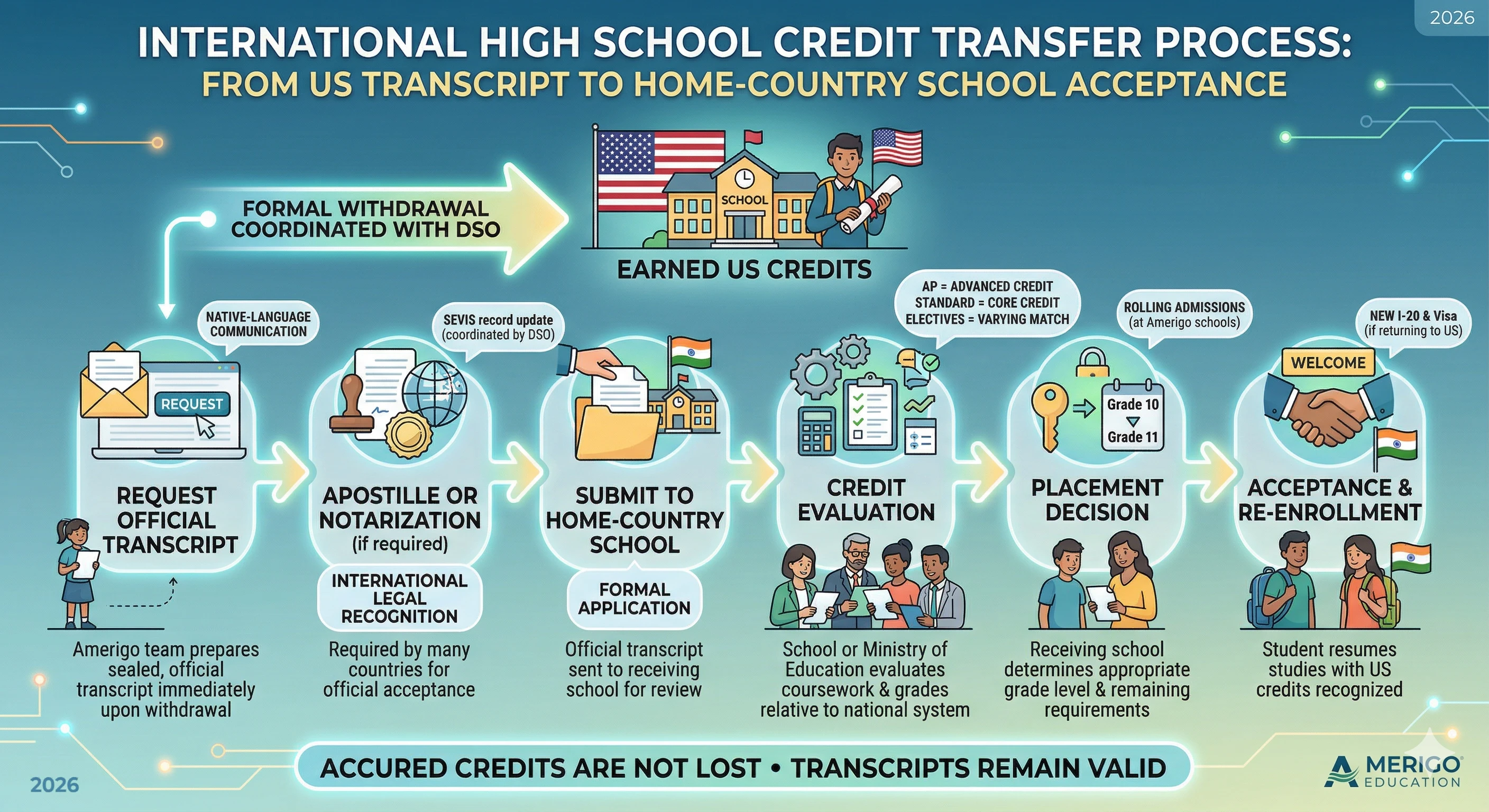
US high school credits earned at an accredited private school are documented on an official transcript that carries international recognition. Whether those credits transfer to a home-country school depends on the receiving country's education system and the specific school's transfer policies. In most cases, transcripts from accredited US institutions are accepted for credit or placement evaluation by secondary schools worldwide.
AP credits carry particularly strong international recognition. Universities and secondary schools in the UK, Canada, Australia, and parts of Asia routinely accept AP coursework as evidence of advanced academic preparation. For families considering withdrawal, requesting an official sealed transcript before the student departs ensures the documentation is ready for the home-country school's review process. Structured programs prepare these documents as part of the exit process, while self-arranged placements may require families to navigate transcript requests independently.
Can Students Re-Enroll After Leaving?
Students who left in good academic and disciplinary standing can apply for re-enrollment in a future semester. Rolling admissions at most Amerigo Signature partner schools allow flexible return timing, meaning families are not locked into a single annual application window. The re-enrollment process is simpler than the initial application because the student already has a US academic record and the school has existing documentation on file.
Re-enrollment does require a new I-20 and, if F-1 status was terminated, a new visa application. Visa services through ZF Visa, Amerigo Education's third-party partner, are available to assist families with the reapplication process and are billed separately. Students returning to the same school can often pick up where they left off academically, with previously earned credits applied toward graduation requirements. Students returning to a different school within the Amerigo network benefit from internal transcript transfer between partner institutions.
- Confirm the student left in good academic and disciplinary standing
- Contact the admissions team to discuss available seats and timing
- Submit a re-enrollment application with updated documentation
- Receive a new I-20 from the enrolling school
- Apply for a new F-1 visa if previous status was terminated
- Arrange accommodation - homestay, on- and off-campus supervised residences, or self-provided
- Complete orientation and resume coursework
What Early Steps Prevent Withdrawal?
Early intervention resolves the majority of challenges that would otherwise lead to a student leaving the program. Programs with structured support systems identify struggling students through monthly progress reports, attendance tracking, and regular communication between staff and families. By the time a problem is visible to parents at home, on-campus staff have often already begun addressing it.
Academic tutoring targets subject-specific difficulties, while ELL support helps students whose English proficiency is slowing their progress across multiple classes. Personal counseling addresses homesickness, social isolation, and cultural adjustment - the emotional factors that academic support alone cannot fix. Native-language family communication ensures parents from China, Vietnam, Korea, Mexico, the Taiwan Region, and more understand exactly what their child is experiencing without translation barriers. These layers of support, coordinated through the on-campus international department, represent a key difference between structured programs and self-arranged placements where families must identify and source help independently.
- Monthly progress reports flag academic, social, or behavioral changes early
- Academic tutoring addresses subject-specific grade declines
- ELL support builds English proficiency for students below grade-level language skills
- Personal counseling helps students process homesickness and cultural adjustment
- Native-language family communication keeps parents informed and involved
- Peer mentoring connects struggling students with adjusted classmates
- Schedule adjustments reduce course load pressure during the transition period
- 24/7 emergency assistance provides immediate support for urgent situations
What Are the Financial Considerations?
Financial implications of withdrawal include potential tuition refunds, unused program fees, return flight costs, and any outstanding balances. Most schools prorate tuition refunds based on the withdrawal date and the percentage of the semester completed, with earlier departures receiving larger refunds. Non-refundable fees such as registration deposits and housing placement fees typically are not returned.
Families should review the enrollment agreement's refund schedule before making a withdrawal decision. The on-campus international department walks families through the financial breakdown, including what has been paid, what is refundable, and what additional costs the family should expect. For families experiencing financial hardship, discussing the situation early may reveal options such as payment plans, partial scholarship adjustments, or a planned transfer to a lower-cost school within the network that avoids withdrawal entirely.
How Do Structured Programs Handle Exits?
Structured programs with on-campus international departments provide coordinated exit support that covers academic documentation, immigration compliance, family communication, and logistics. The difference between a managed exit and an unmanaged one is significant: families in structured programs receive step-by-step guidance in their native language, while families in self-arranged placements must coordinate between the school, immigration authorities, and airlines independently.
The exit process at an Amerigo partner school begins with a family conference - conducted in the family's preferred language - to discuss the situation, explore alternatives to withdrawal, and establish a timeline if withdrawal is the best option. The on-campus team then coordinates transcript preparation, DSO notification to SEVIS, accommodation checkout, and travel arrangements. If the family wants to keep the door open for re-enrollment, the team documents the student's departure status and flags the file for streamlined re-admission processing in a future semester.
- Family conference to discuss situation and explore alternatives
- Academic transcript preparation and credit documentation
- DSO notification and SEVIS record update
- Financial review and refund processing
- Accommodation checkout coordination
- Travel arrangement support
- Re-enrollment file flagging if the family may return
- Follow-up communication after departure
Frequently Asked Questions
Does my child lose all US credits if they withdraw?
No. Credits earned and recorded on an official US high school transcript remain valid. Accredited private schools issue transcripts that document completed coursework, grades, and credit hours. Whether a home-country school accepts those credits depends on that country's education ministry and the receiving school's transfer policies, but the US credits themselves are not erased by withdrawal.
What happens to F-1 status when a student leaves?
Under SEVP regulations, the school's Designated School Official must update the student's SEVIS record when they withdraw. If the student departs the US and does not return before the I-20 program end date, their F-1 status terminates. Students planning a temporary absence should coordinate with the DSO to obtain a travel signature on their I-20 before departing to preserve re-entry eligibility.
Can my child re-enroll after returning home?
Yes, students who left in good academic and disciplinary standing can apply for re-enrollment in a future semester. Rolling admissions at most Amerigo Signature partner schools allow flexible return timing. The student will need a new I-20 and must complete a new visa application if their previous F-1 status was terminated. Previous transcripts and records transfer directly within the same school network.
Are AP credits recognized internationally?
AP credits carry international recognition across many education systems. Universities in the UK, Canada, Australia, and parts of Asia accept qualifying AP scores for course credit or advanced standing. For high school transfer purposes, AP coursework documented on a US transcript demonstrates advanced academic preparation. Families should check their home-country university requirements for specific AP score thresholds.
How long can a student be away and still return?
There is no fixed time limit for re-enrollment at a new school, but the student must obtain a new I-20 and complete visa processing again if their SEVIS record was terminated. For temporary absences during scheduled breaks, a valid I-20 with a current travel signature allows re-entry within five months. Students absent for more than five months lose their F-1 status and must restart the visa process.
What financial refund can families expect?
Refund policies vary by school and program. Most schools prorate tuition based on the withdrawal date and the percentage of the semester completed. Families should review the enrollment agreement for specific refund schedules, deadlines, and any non-refundable fees such as registration or housing deposits. Amerigo Education's on-campus international department can walk families through the financial implications before a final decision.
Does withdrawal affect future US university admission?
A withdrawal does not create a negative mark on a student's record if they left in good standing. University admissions offices evaluate transcripts based on grades earned and courses completed, not the reason for departure. Students who return and complete at least two consecutive years at an Amerigo Education US Signature partner school with qualifying grades and test scores remain eligible for the Top 100 Guarantee.
Can a student transfer mid-semester?
Mid-semester transfers are possible but require coordination between both schools. The sending school issues a transcript reflecting work completed to date, while the receiving school determines which credits transfer. Some courses may not transfer if the student did not complete enough of the term to earn credit. Structured programs with on-campus international departments handle this coordination on behalf of families.
What support exists to prevent withdrawal?
Programs with on-campus international departments provide academic tutoring, English language learning support, personal counseling, and regular family communication designed to address problems before they reach the withdrawal stage. Monthly progress reports alert families and staff to declining grades, attendance issues, or social difficulties. Early intervention resolves most challenges that would otherwise lead to a student leaving the program.
Does my child need a new visa to return?
If the student's SEVIS record was terminated, they need a new I-20 from the enrolling school and must apply for a new F-1 visa at a US consulate. If they maintained valid status through a travel signature and returned within the allowed timeframe, they can re-enter on the existing visa. Visa services through Amerigo Education's third-party partner, ZF Visa, are available to assist families with the reapplication process.
Conclusion
Returning home does not erase the academic progress a student has made. Credits transfer, transcripts remain valid, and re-enrollment is available for students who left in good standing. The families who handle this transition most effectively are those enrolled in structured programs where exit support, credit documentation, and re-entry planning are built into the system.
Explore Your Family's Options
Families with questions about withdrawal, credit transfer, or re-enrollment can apply now or contact us to speak with an admissions counselor in your preferred language. Explore US partner schools, view Canadian options, or learn about Brentwood School in the UK.
People Also Read
- What Happens If My Child Struggles Academically Abroad? Prevention and Recovery Guide
- F-1 Visa Changes for High School Students 2025-2026: What Parents Need to Know
- Parent Guide: How to Support Your Child Studying Abroad in High School 2026
About the Author
This guide was written by the Amerigo Education content team, drawing on program data from staff operating the on-campus international department at Amerigo Education's partner schools across the US, Canada, and UK. Learn more about Amerigo Education.
Disclaimer: This article provides general information for educational purposes only. Families should conduct independent research, request current program data from providers, and consult with program representatives regarding specific circumstances. Contact us with questions.