All news
April 19, 2026
Study Abroad 101
What Is a DSO? How Designated School Officials Support F-1 Students
A DSO (Designated School Official) manages F-1 SEVIS records at US high schools. Learn what DSOs do and ho

What Is a DSO? How Designated School Officials Support F-1 Students
Last Updated: April 2026
A Designated School Official (DSO) is a certified school administrator authorized by the US Department of Homeland Security to maintain SEVIS (Student and Exchange Visitor Information System) records and advise F-1 (student visa for academic programs) students on visa compliance. According to SEVP guidelines, every Student and Exchange Visitor Program-certified school must designate at least one Principal Designated School Official (PDSO) and may appoint additional DSOs to manage F-1 student records and meet federal reporting requirements.
Amerigo Education partners with 40 Niche A+/A rated schools across the US, Canada, and the UK, supporting 3,500+ students from 55+ countries. The Class of 2025 achieved 97% admission to Top 100 US universities. Each Amerigo US Signature School works alongside a certified DSO, and Amerigo's on-campus international department coordinates directly with school DSOs to support F-1 compliance for international students aged 14-18.
This guide covers how DSOs are appointed, what they are legally required to do for F-1 students, how the I-20 document process works throughout high school enrollment, when students must contact their DSO, and how Amerigo's on-campus team coordinates with DSOs to protect students' F-1 status.
Key Takeaways
- DSO definition: A DSO is the only school official authorized to issue I-20 documents and update SEVIS records on behalf of F-1 students.
- SEVIS reporting: DSOs must report enrollment changes, address updates, and program extensions within SEVP-mandated timeframes or risk student status termination.
- I-20 requirement: The I-20 document is required for the F-1 visa application, US entry, and any program changes; it must remain current throughout enrollment.
- First 30 days: F-1 students must report to their DSO within 30 days of the I-20 program start date to activate their SEVIS enrollment status.
- Amerigo coordination: At US Signature Schools, Amerigo's on-campus international department works directly with DSOs to flag compliance risks before they affect F-1 status.
What Is a DSO at a US High School?
A DSO at a US high school is a staff member certified by SEVP to act as the official institutional contact between the school, the Department of Homeland Security (DHS), and enrolled F-1 students. Every SEVP-certified high school must have at least one PDSO (Principal Designated School Official), who bears primary responsibility for the school's federal compliance. Additional DSOs can be certified to support larger F-1 student populations.
DSOs at high schools are typically international student advisors, admissions coordinators, or school counselors who have completed SEVP's certification process. According to NAIS (2024), more than 58,000 international students attend NAIS member independent schools across the US, making DSO compliance a routine operational requirement at private high school programs. According to SEVP, DSOs must be US citizens or lawful permanent residents employed by the school as a federal eligibility condition.
- PDSO role: The Principal DSO holds primary authority for SEVIS reporting and SEVP compliance; each school maintains exactly one PDSO at any given time.
- Additional DSOs: Schools may certify multiple DSOs, giving F-1 students access to support from more than one authorized staff member.
- SEVP certification: DSOs are registered directly in SEVIS by the school's PDSO - certification is institution-specific, not transferable between schools.
What Does a DSO Do for F-1 Students?
A DSO's core function is issuing the I-20 (Certificate of Eligibility for Nonimmigrant Student Status) and maintaining accurate SEVIS records throughout F-1 enrollment. This includes processing program extensions, reporting enrollment status changes, and advising students on the practical requirements of maintaining valid F-1 status. DSOs also provide required travel signatures that F-1 students must carry when re-entering the US after international travel.
According to IIE Open Doors (2025), over 1.1 million international students were enrolled at US institutions. For each of them, the school's DSO is the primary institutional point of contact for all F-1 compliance matters throughout their program.
- I-20 issuance: DSOs issue the I-20 before the student applies for an F-1 visa; the document lists program start and end dates, SEVIS ID, and financial cost estimates.
- SEVIS updates: DSOs must update SEVIS within required reporting windows whenever enrollment status, address, or program dates change.
- Enrollment reporting: If a student falls below full-time enrollment or is academically dismissed, the DSO must report the change to SEVP, which can trigger status termination.
How Does the I-20 Work in US High School?
The I-20 is the foundational document for F-1 status at any SEVP-certified school. It is issued by the DSO before the student applies for an F-1 visa and must remain current throughout enrollment. The I-20 includes the student's SEVIS ID number, program start date, expected completion date, and an annual estimated cost of attendance figure provided by the school.
At US high schools, students receive their initial I-20 before the first year begins. The document covers the full expected enrollment period. If graduation is delayed, academic plans change, or the student transfers, the DSO must issue an updated I-20. Students should carry their current I-20 when traveling internationally, as US Customs and Border Protection may request it upon re-entry.
When Should You Contact Your DSO?
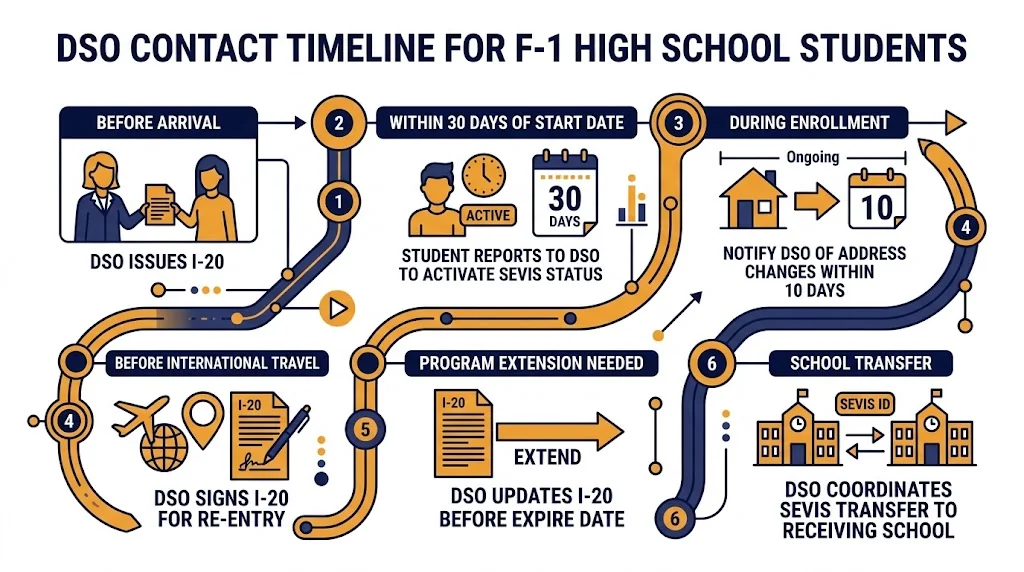
F-1 students should contact their DSO proactively, rather than waiting until a problem arises. SEVP regulations require reporting within specific windows, and delays can affect SEVIS status even when the underlying situation is minor. The most common contact points are before any planned international travel, when academic plans change, and when a program end date needs to be extended.
For international students aged 14-18, many of whom are navigating the US school system for the first time, identifying when DSO involvement is required is part of basic F-1 literacy. According to APA (2025), proactive communication with institutional support staff significantly reduces compliance-related stress for adolescents managing cross-cultural academic transitions. Amerigo's on-campus international department helps students and families recognize compliance triggers and assists with communication through in-country staff who relay information in families' native languages.
- Before international travel: Confirm the I-20 is current and request a DSO travel signature at least two weeks before departure.
- Enrollment changes: Any modification to course load, program structure, or graduation timeline requires DSO notification.
- Address changes: F-1 students must report US address changes to their DSO within 10 days per SEVP requirements.
How Does Amerigo Work With School DSOs?
At each US Signature School, Amerigo's on-campus international department works as a coordination layer between students, families, and the school's certified DSO. Amerigo staff track I-20 expiry dates, flag upcoming renewal requirements, and help students prepare documentation before DSO meetings. This coordination is particularly valuable for students who are new to F-1 requirements or whose families are communicating from abroad.
When a student's attendance or academic performance creates a risk to full-time enrollment status, Amerigo's team identifies the issue through monthly progress reports, school activity calendars and event announcements, then coordinates with the school DSO before the situation escalates to a SEVIS reporting threshold. For students on the Top 100 Guarantee track, continuous enrollment at a US Signature School is one of four eligibility conditions. Amerigo Education provides native-language communication support for families from China, Vietnam, Korea, Mexico, and the Taiwan Region through in-country staff, ensuring F-1 compliance information is clearly understood before any action is required.
- I-20 tracking: Amerigo monitors program end dates for enrolled students and alerts families when renewal or extension is approaching.
- DSO liaison: Amerigo's on-campus team accompanies students to DSO meetings when needed and helps translate compliance requirements into clear action steps.
- Parent communication: Amerigo's in-country staff relay DSO-related compliance updates to families in their native language, reducing miscommunication risk.
Frequently Asked Questions
What does DSO stand for in US education?
DSO stands for Designated School Official. It refers to a certified staff member at a Student and Exchange Visitor Program-certified school authorized to maintain SEVIS records and advise F-1 students on compliance requirements. Every school that enrolls F-1 students must have at least one PDSO (Principal Designated School Official), who holds primary responsibility for federal SEVP compliance and student record accuracy throughout enrollment.
Is the DSO the same as the international student advisor?
Not always. At some schools, the international student advisor and the DSO are the same person. At others, the DSO role is assigned to an admissions officer, registrar, or school counselor. Only a certified DSO can issue I-20 documents or update SEVIS records. Students should confirm which staff member holds the DSO role at their school, as contacting the wrong staff member for compliance questions can cause delays.
How do I contact my DSO at an Amerigo partner school?
Amerigo's on-campus international department at each US Signature School connects students and families with the school's certified DSO. Students receive DSO contact guidance at the start of enrollment. For urgent compliance questions, Amerigo's in-country staff assist families in their native language and coordinate with the on-campus team to confirm the required next steps without delay.
What is the difference between a DSO and PDSO?
The PDSO (Principal Designated School Official) is the primary certified official responsible for SEVIS compliance at the school level. A DSO is any additional staff member certified to perform the same functions. Both can issue I-20 documents and update SEVIS records. The PDSO also manages the school's SEVP certification, serves as the point of contact for federal audits, and is responsible for authorizing new DSOs at the institution.
Can a DSO help with F-1 visa applications?
DSOs issue the I-20 required for the F-1 visa application but do not apply for visas or prepare students for consular interview questions. Visa applications are submitted by students directly to the relevant US embassy or consulate. Amerigo coordinates optional visa support through ZF Visa as a third-party add-on for families who need additional guidance before departure.
What happens if I miss a reporting deadline with my DSO?
Missing a required SEVP reporting window, such as failing to update an address change within 10 days, can result in a SEVIS record flag. If the issue is not corrected promptly, SEVIS termination may follow. Students should contact their DSO immediately if a deadline has been missed. Amerigo's on-campus team helps enrolled students track compliance timelines and communicates alerts to families via monthly progress reports, school activity calendars and event announcements when action is needed.
Do I need a new I-20 every year in high school?
Not every year. The I-20 covers the full program duration listed on the document. If the expected program end date remains unchanged, students do not need an annual I-20 renewal. However, if graduation is delayed, academic plans change substantially, or the student transfers to a different school, the DSO must issue an updated I-20 reflecting the new program details. Amerigo monitors I-20 expiry dates for enrolled students and flags renewal requirements to families in advance.
Can parents contact the DSO directly?
Parents can contact the school's DSO, though policies vary by school. At Amerigo partner schools, families typically route questions through the on-campus international department first, which coordinates with the DSO and ensures accurate information is communicated. Amerigo's in-country staff relay DSO guidance in the family's native language for families from China, Vietnam, Korea, Mexico, and the Taiwan Region.
What does full-time enrollment mean for F-1 high school students?
Full-time enrollment for F-1 high school students means completing the school's standard course load, typically 5-7 courses per semester, as reported in the student's SEVIS record. Dropping below this threshold without DSO authorization is a reportable F-1 violation. Students with any concerns about their schedule should speak with their DSO before making changes to avoid unintended compliance issues.
What should I do before traveling internationally during the school year?
Before international travel, F-1 students must have a current I-20 and a valid DSO travel signature confirming good academic standing. Without it, re-entry to the US on an F-1 visa may be denied. Request the signature from your DSO at least two weeks before planned departure. Amerigo's on-campus team helps enrolled students manage travel documentation requests through the school's DSO office promptly.
Conclusion
A Designated School Official is the federally authorized institutional contact for F-1 compliance at every SEVP-certified US high school, responsible for issuing I-20 documents, maintaining SEVIS records, and reporting required enrollment changes to DHS. For international students aged 14-18 at Amerigo's US Signature Schools, the on-campus international department works alongside school DSOs to track compliance timelines, coordinate student documentation, and keep families informed before F-1 status is at risk.
Learn More About F-1 Support at Amerigo Partner Schools
To learn more about studying in America at an Amerigo partner school with dedicated on-campus F-1 compliance support, contact us to speak with a program advisor, or apply now to take the first step toward enrollment.
People Also Read
- International Student Visa Requirements: Complete Guide to Success
- How International Students Maintain F-1 Status in the US
- F-1 Visa to Arrival Timeline for Students 2026
About the Author
This guide was written by the Amerigo Education content team, drawing on program data from staff operating the on-campus international department at 40 Niche A+/A rated US, Canadian, and UK partner schools. Learn more about Amerigo Education.
Disclaimer: This article provides general information for educational purposes only. Families should conduct independent research, request current program data from providers, and consult with program representatives regarding specific circumstances. Contact us with questions.