All news
April 13, 2026
Study Abroad 101
How International Students Communicate With US Teachers
How international students communicate with US teachers: email norms, classroom participation, office hours, cultural differences, and how Amerigo's ELL program builds academic communication skills.

How International Students Communicate With US Teachers
Last Updated: April 2026
Knowing how to communicate with a teacher in a US high school setting is a skill that international students must develop alongside their academic coursework. According to IIE Open Doors (2025), more than 1.1 million international students studied in the US during the 2023-2024 academic year, many of them attending American high schools where teacher-student interaction norms differ significantly from those in home countries such as China, South Korea, Vietnam, Mexico, and the Taiwan Region. Learning to ask questions directly, use email professionally, and attend office hours are practical skills that shape both academic performance and university recommendation letters.
Amerigo Education partners with 40 Niche A+/A rated schools across the US, Canada, and the UK, supporting 3,500+ students from 55+ countries. The Class of 2025 achieved 97% admission to Top 100 US universities. Amerigo helps students build the communication skills needed to engage effectively with US teachers, supporting both academic progress and the relationship-building that leads to strong university recommendations. Amerigo accommodation options include homestay, on- and off-campus residences, and self-provided arrangements for students with nearby family in the US.
Key Takeaways
- Cultural difference: US teachers expect direct, respectful communication and active classroom participation from all students, including international students.
- Email norms: Most US high school teachers respond to student emails within one to two school days when the message is clear and professionally written.
- Office hours: Teachers in US high schools typically hold scheduled office hours or are available before and after class for individual questions.
- ELL support: Amerigo provides in-school customized ELL (English Language Learning) courses to help international students develop academic communication skills.
- University impact: Strong teacher-student relationships at US high schools are the foundation for high-quality letters of recommendation in college applications.
How Do US Teachers Expect Students to Communicate?
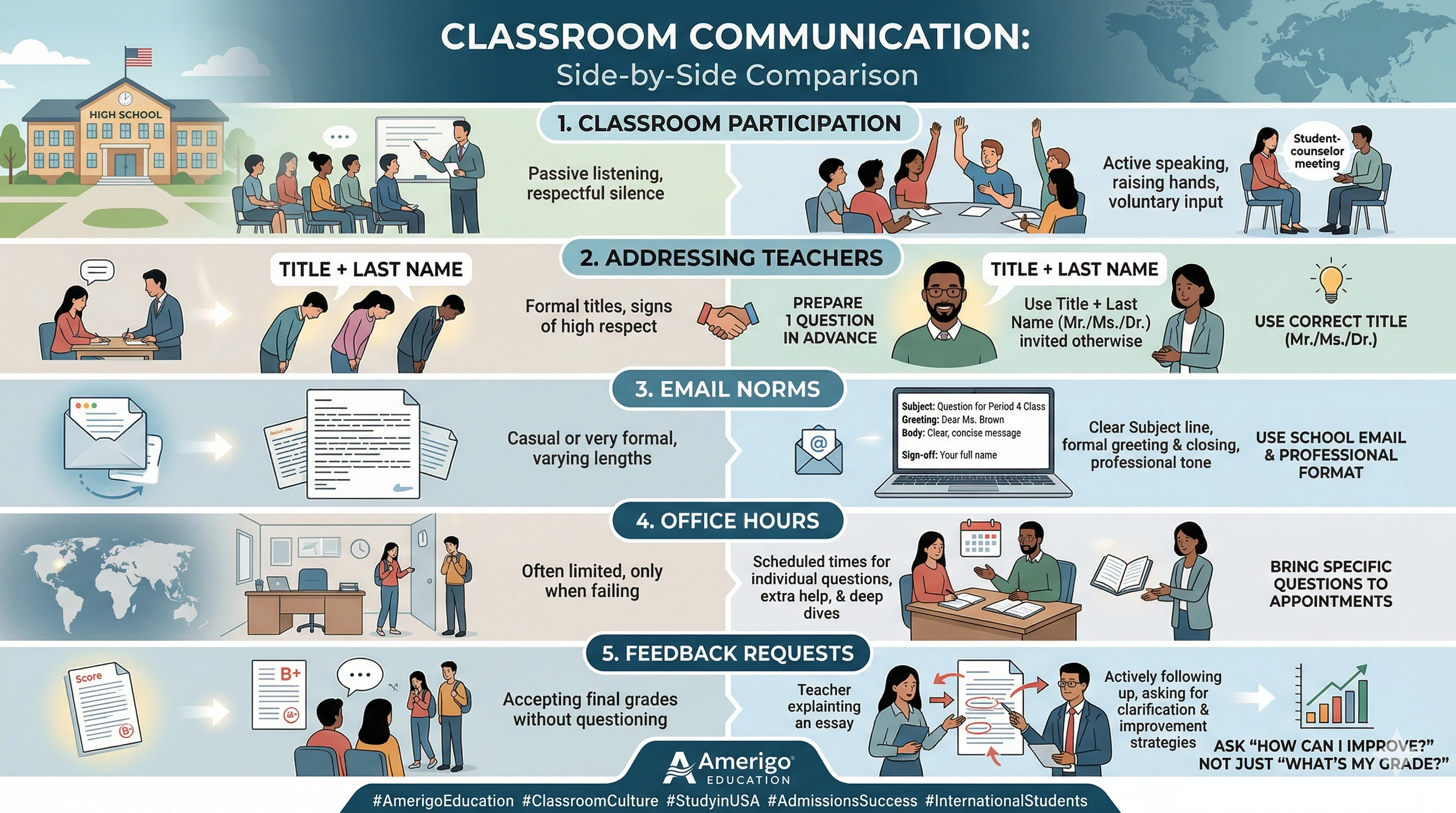
US teachers expect students to communicate directly, respectfully, and with a clear purpose. This is a notable difference from classroom cultures in many countries, where students are expected to listen quietly and ask questions only when explicitly invited. In US high schools, asking questions during class, visiting teachers individually, and expressing academic opinions are all considered signs of engagement rather than disrespect.
According to NAFSA: Association of International Educators (2024), international students who actively participate in classroom discussions and seek one-on-one teacher interaction achieve better academic outcomes than those who remain passive. The expectation for direct communication extends to written messages as well. A professional, clearly worded email to a teacher is considered normal at every grade level, and most teachers read and respond to student messages as a regular part of their workday.
Key expectations US teachers have for student communication:
- Students raise their hand to ask or answer questions during class
- Students address teachers by their title and last name (Mr., Ms., Dr.) unless told otherwise
- Students send emails that include a subject line, greeting, clear question, and sign-off
- Students arrive on time and notify teachers in advance of planned absences
- Students attend extra help sessions when they are struggling with course material
- Students respond to teacher feedback on assignments rather than ignoring it
- Students express disagreement with ideas, not with the person
How Should Students Send Emails to Teachers?
Students should write emails to teachers using a formal, professional structure that includes a subject line, a polite greeting with the teacher's correct title, a clear statement of the question or concern, and a respectful closing with the student's full name. Teachers receive many messages each day, and a well-organized email is more likely to receive a prompt and helpful response.
For international students still developing their academic English through ELL courses, writing a clear email is a useful low-pressure practice that builds confidence for verbal communication as well. Amerigo's on-campus international department staff help students draft professional written communication early in their enrollment, so students learn the correct format before they need it urgently.
Steps for writing an effective email to a teacher:
- Use your school-issued email address, not a personal account
- Write a subject line that describes the purpose (e.g., "Question about AP History Essay Due Friday")
- Open with "Dear Mr./Ms./Dr. [Last Name],"
- State your name and class period in the first sentence
- Write one or two sentences explaining your specific question or concern
- Keep the message under 150 words
- Close with "Thank you," or "Best regards,"
- Sign with your full name
How Does Classroom Participation Work in US Schools?
Classroom participation in US high schools involves speaking during class discussions, responding to teacher questions, contributing to group activities, and presenting assigned work verbally. Most teachers factor participation into the final course grade, typically accounting for 10-20% of the total. International students who remain silent may receive lower participation marks even if their written work is strong.
Active participation is also a direct way to build relationships with teachers who may later be asked to write university recommendation letters. A teacher who regularly sees a student contribute thoughtful ideas to discussion has concrete material to reference when describing that student's academic character. For students at Amerigo's partner schools, the on-campus international department staff coach students on how to prepare one or two talking points before each class, which reduces the pressure of spontaneous speaking.
Strategies for increasing classroom participation:
- Read the assigned material before class so you arrive with questions
- Write down one comment or question before class begins
- Raise your hand early in the discussion before the conversation moves on
- Use phrases like "I think," "In my opinion," or "I want to add to what [name] said"
- Answer even simple factual questions to practice speaking in class
- Sit near the front of the room to feel more accountable for engagement
- Ask for clarification when you do not understand something
- Volunteer to read aloud from textbooks or handouts
What Are Office Hours and How Do Students Use Them?
Office hours are scheduled times when a teacher is available for individual conversations with students outside of class. In US high schools, teachers typically hold office hours before school, after school, or during a designated period each week. Students do not need to be failing or in academic trouble to attend - office hours are equally appropriate for students who want to go deeper on a topic or get feedback before submitting a major assignment.
For international students from countries where seeking individual teacher help outside class carries social stigma, attending office hours may feel uncomfortable at first. However, US teachers generally view a student who comes to office hours as motivated and serious, not as someone who is struggling. Students in Amerigo's residential options - including on- and off-campus residences with dedicated study areas and teacher availability - have structured evening environments that help them identify questions to bring to office hours the following day.
How to prepare for and use office hours effectively:
- Check the teacher's office hours schedule at the start of each semester
- Arrive with a specific question written down, not just a vague concern
- Greet the teacher and briefly remind them of your name and class
- Ask your question clearly, and listen actively to the answer
- Take notes during the conversation so you can apply the feedback
- Thank the teacher at the end and mention how you plan to use the advice
- Follow up by email if you have additional questions after the session
How Do Language Barriers Affect Teacher Communication?
Language barriers are a real but manageable factor in teacher communication for international students who enter US high schools at a B1 English level or below. Teachers in schools that work with international students generally understand this context and are prepared to adjust their pace, repeat instructions, or direct students to written resources when verbal explanations are unclear.
Students who use Amerigo's in-school customized ELL courses build academic vocabulary and formal communication skills in parallel with their regular classes. According to the US Department of Education (2024), English language learners who receive structured language support within their academic curriculum show measurable gains in both English proficiency and content-area performance within two years. Amerigo also provides native-language communication support for families from China, Vietnam, Korea, Mexico, the Taiwan Region, and more, which helps parents stay informed through monthly reports and real-time updates.
Strategies for communicating effectively despite language barriers:
- Use Google Translate to check word choice before sending a teacher email
- Write questions down before speaking to reduce pressure during conversation
- Ask the teacher to repeat or rephrase if something is unclear
- Record key vocabulary from each class using a personal glossary
- Attend ELL support sessions to build academic English for specific subject areas
- Practice speaking by reading aloud from class materials each evening
- Ask a peer or Amerigo staff member to review draft emails before sending
How Can Students Repair Miscommunication With a Teacher?
Miscommunication between an international student and a teacher can occur due to cultural differences in tone, directness, or interpretation of instructions. When a misunderstanding happens, addressing it promptly and professionally is more effective than avoiding the teacher or hoping the situation resolves itself.
Students should approach the teacher as soon as possible after the misunderstanding, ideally in person during office hours or before or after class. A calm, direct explanation of the student's perspective - paired with a genuine question about what the teacher expected - usually resolves the issue quickly. If a cultural factor was involved, briefly acknowledging it without using it as an excuse often helps the teacher understand the context. Amerigo counselors at the on-campus international department can also help students prepare for these conversations when they feel unsure about the right approach.
Steps to resolve a miscommunication with a teacher:
- Reflect on what specifically was misunderstood before approaching the teacher
- Request a brief conversation at office hours or an agreed-upon time
- Begin with an acknowledgment: "I want to make sure I understand your expectations correctly"
- Describe your interpretation and ask how it differed from what was intended
- Listen to the teacher's explanation without interrupting
- Ask for clarification on the correct expectation going forward
- Thank the teacher for taking time to clarify
Frequently Asked Questions
Is it normal for students to question or disagree with a US teacher?
Yes, it is normal and expected in US high schools for students to respectfully question or offer a different perspective on academic content. The key is to address the idea rather than the teacher personally, and to use polite academic language such as "I read something that suggested a different explanation - could you help me understand the difference?" Teachers generally respect students who engage critically with course material, and this kind of interaction often strengthens the teacher-student relationship.
How do international students address teachers in the US?
International students should address teachers using their formal title and last name - Mr., Ms., or Dr. followed by the surname - unless the teacher specifically introduces themselves by first name. In some progressive school environments, teachers may invite students to use a first name or a preferred form of address. When in doubt, defaulting to the formal title is always appropriate and is never considered rude.
How soon should students expect a reply to a teacher email?
Most US high school teachers respond to student emails within one to two school days. If a teacher has not responded after two days, students may send a brief, polite follow-up email referencing the original message. Teachers are not typically expected to respond outside school hours or on weekends, though some do. Urgent questions about assignments due the next day are better addressed in person during class or office hours.
Can international students use their native language to ask questions in class?
No, class instruction and participation in US high schools is conducted in English. International students should use English when asking questions in class or speaking with teachers, even if their English is at a foundational level. Teachers in schools with ELL programs are accustomed to working with students who are still developing academic English and will adjust their explanations accordingly. Using a native language in class is generally not appropriate outside ELL instruction settings.
What should students do if they feel a teacher is unfair?
If a student feels a grade or classroom decision was unfair, the appropriate first step is to speak with the teacher privately during office hours and ask for an explanation of how the grade was determined. Students should bring their work and a calm, specific question - not an accusation. If the concern is not resolved after speaking with the teacher, the student can follow up with a school counselor or the Amerigo on-campus international department advisor for guidance on next steps.
How do US teachers view students who attend office hours?
US teachers view students who attend office hours positively, as it signals academic motivation and intellectual curiosity. Attending office hours also gives the teacher direct knowledge of how the student thinks and what challenges they face, which is valuable context for recommendation letters. Students should not feel that attending office hours is a sign of weakness - most teachers encourage it and view it as part of the learning process.
How does good teacher communication affect university applications?
Good teacher communication directly influences university applications through recommendation letters. Teachers who have had substantive conversations with a student in office hours, received thoughtful emails, and observed active classroom participation have concrete material to reference in their letters. A teacher who barely knows a student can only write a generic letter, while one who knows the student well can write the specific, evidence-based letter that admissions reviewers value most.
Do students need to participate every single class session?
Students do not need to speak in every class, but regular participation over the semester is important for both the participation grade and teacher relationship-building. A reasonable goal is to contribute at least once or twice per week in each class. Quality matters more than frequency - one substantive comment or question is more valuable than several off-topic remarks. Students who find consistent verbal participation difficult can also contribute through written class journals or discussion board posts when those options are available.
What communication tools do US teachers typically use?
US high school teachers typically use email for written communication with students and parents. Many schools also use learning management systems (LMS) such as Google Classroom, Canvas, or Schoology, where teachers post assignments, grades, and announcements. Students should check these platforms regularly and adjust notification settings so they do not miss important updates. Some teachers also communicate through approved school messaging apps, but parents and students should confirm the school's official communication policy.
How can students practice English communication before arriving at a US school?
Students can practice English communication before arrival by writing formal emails in English, watching academic videos in English on platforms such as Khan Academy or TED-Ed, reading English news articles and summarizing them in writing, and participating in online discussion forums. Pre-departure webinars offered by Amerigo Education also help students understand what to expect from US classroom culture before their first day.
Conclusion
Communicating effectively with teachers in US high schools requires international students to learn professional email etiquette, classroom participation norms, and the appropriate use of office hours - all of which differ from what many students experience in their home countries. These skills develop progressively and improve with consistent practice over the first year of study. Students who invest in building genuine, respectful teacher relationships gain stronger academic support and the foundation for meaningful university recommendation letters.
Enroll in a Program That Prepares You to Succeed
Amerigo Education supports international students in developing both academic skills and the communication confidence needed to succeed in US high school classrooms. Contact Amerigo Education to speak with an advisor about the right program for your goals, or visit our application page to begin the enrollment process. Amerigo's on-campus international department provides structured academic support, ELL resources, and counseling at 40 Niche A+/A rated partner schools across the US, Canada, and the UK.
People Also Read
- How to Improve English for International Students: Proven Methods
- First Year in America: Month-by-Month Timeline for International High School Students
- International Student Support Services: Complete Guide 2026
About the Author
This guide was written by the Amerigo Education content team, drawing on program data from staff operating the on-campus international department at 40 Niche A+/A rated US, Canadian, and UK partner schools. Learn more about Amerigo Education.
Disclaimer: This article provides general information for educational purposes only. Families should conduct independent research, request current program data from providers, and consult with program representatives regarding specific circumstances. Contact us with questions.