All news
May 26, 2026
Study Abroad 101
How to Verify a US Partner School's Accreditation Before Committing
How to verify a US partner school's accreditation before committing: regional bodies, SEVIS authorization, Niche ratings, and questions to ask placement programs.
How to Verify a US Partner School's Accreditation Before Committing
Last Updated: May 2026
Verifying a US partner school's accreditation before committing to a placement program is a critical step for international families evaluating high school options in the United States. Accreditation is a quality assurance process by which independent bodies review and certify that a school meets defined educational standards. According to IIE Open Doors (2025), over 1.1 million international students enrolled at US educational institutions in the 2023-2024 academic year, and the quality and accreditation standing of the school a student attends directly affects transcript acceptance, university credit transfer, and F-1 (student visa for academic programs in the US) immigration compliance.
Amerigo Education partners with 40 Niche A+/A rated schools across the US, Canada, and the UK, supporting 3,500+ students from 55+ countries. The Class of 2025 achieved 97% admission to Top 100 US universities. All Amerigo partner schools in the US are accredited by recognized regional or national bodies and authorized by SEVIS (Student and Exchange Visitor Information System) to enroll F-1 international students.
This guide covers what US school accreditation means, which bodies grant it, how to independently verify a school's standing, what SEVIS authorization proves separately from accreditation, and what questions families should ask placement programs about the accreditation status of partner schools.
Key Takeaways
- Regional accreditation is the standard: Regional accrediting bodies are the most widely recognized by US universities and immigration authorities.
- SEVIS authorization is separate: A school authorized by SEVIS to enroll F-1 students is not automatically accredited; both should be confirmed.
- Niche ratings supplement accreditation: Niche collects data directly from schools, and A+/A ratings indicate competitive academic environments beyond minimum accreditation standards.
- Verification is free and independent: Families can verify accreditation directly through accrediting body websites at no cost.
- Amerigo's network: All Amerigo US partner schools are Niche A+/A rated and are accredited by recognized bodies within their state or region.
What Is School Accreditation in the US?
School accreditation in the US is a voluntary quality assurance process through which an independent accrediting body evaluates whether a school meets defined educational standards, including curriculum rigor, faculty qualifications, facilities, governance, and student outcomes. Accreditation is distinct from licensing: a school can be state-licensed to operate without being independently accredited. For international students, attending an accredited school matters because US universities and immigration authorities use accreditation status as a marker of educational quality.
According to NAIS (2025), most private independent schools in the US pursue regional accreditation to signal educational quality to university admissions offices and to ensure their graduates' transcripts are accepted without additional scrutiny. Unaccredited schools can enroll students, but their transcripts may be questioned by selective US universities, and credits may not transfer between institutions. Families researching accreditation as part of their school selection process can review What to Look for in a US High School for International Students for a broader evaluation framework.
There are two main categories of accreditation relevant to US high schools:
- Regional accreditation: Granted by one of six regional bodies recognized by the US Department of Education. This is the strongest and most widely recognized form.
- National accreditation: Granted by national bodies, typically for career-focused or faith-based schools. Less commonly expected by selective US universities for academic high school programs.
Which Bodies Accredit US High Schools?
The six regional accrediting bodies in the US each cover a specific geographic area. Cognia (formerly AdvancED and NCA CASI) serves the largest number of states and international schools. The New England Commission of Higher Education (NEASC-CIHE) covers New England states. The Western Association of Schools and Colleges (WASC) covers California, Hawaii, and Pacific territories. The Southern Association of Colleges and Schools (SACS, now part of Cognia) historically covered the southeastern states. The Middle States Commission covers mid-Atlantic states. The Northwest Commission covers the Pacific Northwest.
According to NACAC (2024), selective US university admissions offices are familiar with all six regional accrediting bodies and treat accreditation status as a baseline indicator of school quality. Families should confirm which body accredits a specific school and can verify that status directly on the accreditor's website. The relevant body depends on the school's state location.
- Cognia: Covers most states; includes formerly AdvancED-accredited schools. Check at cognia.org.
- NEASC: Covers Connecticut, Maine, Massachusetts, New Hampshire, Rhode Island, Vermont. Check at neasc.org.
- WASC: Covers California, Hawaii, and Pacific schools. Check at acswasc.org.
- Middle States: Covers Delaware, Maryland, New Jersey, New York, Pennsylvania, DC, and international schools. Check at middlewtates.org.
How Do You Verify a School's Accreditation?
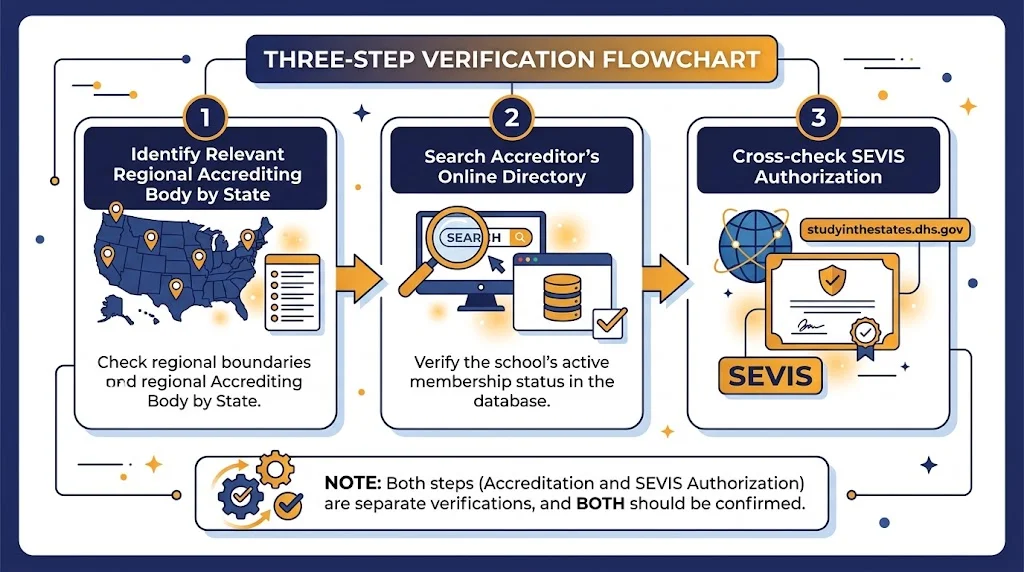
Verifying accreditation is a straightforward independent process that requires no special access or payment. The most reliable method is to search the relevant accrediting body's online school directory directly, using the school's full legal name. Most accrediting bodies publish their member school directories publicly. A school listed in an accreditor's directory with an active membership status is currently accredited.
Families can also request confirmation of accreditation status directly from the school's admissions office. A school that is genuinely accredited will be able to state clearly which body accredits it and provide the accreditation number or membership ID. If a school is vague about which body accredits it, or provides a body name that is not among the recognized regional or nationally recognized accreditors, families should investigate further before committing.
Additionally, most US states publish lists of approved private schools through the state Department of Education. State approval is not the same as accreditation, but it confirms the school is operating within state regulations. Families can also confirm F-1 authorization through SEVP, which maintains a searchable database of all SEVIS-authorized schools. Families reviewing how Amerigo selects its partner schools can read What Is an Amerigo Signature School? How Partner Schools Are Selected.
What Does SEVIS Authorization Prove?
SEVIS authorization means a school has been approved by SEVP to enroll F-1 international students and has a designated DSO (Designated School Official) responsible for managing student records in the SEVIS database. All Amerigo US partner schools are SEVIS-authorized. However, SEVIS authorization is a separate certification from academic accreditation.
A school can be SEVIS-authorized without being regionally accredited, though most established private schools in the US hold both. SEVIS authorization confirms immigration compliance capacity, not educational quality. Families should independently verify both SEVIS authorization and regional accreditation status when evaluating any school. For Amerigo students, all US Signature Schools are both SEVIS-authorized and regionally accredited, and their Niche A+/A ratings provide an additional data-supported quality signal. The on-campus international department at each US Signature School maintains SEVIS compliance for enrolled students throughout the program.
How Do Niche Ratings Help Families Compare?
Niche is an independent school and university ratings platform that collects data directly from schools and publishes student and parent reviews alongside academic quality indicators. Niche A+/A ratings reflect a combination of factors including academic rigor, teacher quality, campus environment, and student outcomes. The Niche rating system provides a standardized, third-party quality signal that supplements official accreditation status.
Amerigo partners exclusively with schools rated Niche A+/A across the network. This standard applies to all 40 schools in the Amerigo network, including US Signature Schools, Select Schools, FEIA Canada, and UK partner schools. Families comparing multiple placement programs can use Niche ratings as an independent data point alongside accreditation status and SEVIS authorization. Families can review Why Amerigo Only Partners With Niche A+/A Rated US High Schools for detail on how Niche ratings are constructed and what they reflect about daily academic life. For school-by-school details, the Amerigo school finder lists all 40 partner schools with location and program information.
What Should Families Ask for Placement Programs?
Families should ask placement programs direct questions about the accreditation status of every partner school before committing. Evasive or incomplete answers about which body accredits a partner school are a significant warning sign. The most important questions to ask are: which regional accrediting body accredits each partner school, when the school's accreditation was most recently reviewed, and whether the school is on any probationary or conditional status with its accreditor.
Families should also ask about the school's SEVIS designation and confirm the name and SEVIS School Code (OPEID) so they can independently verify authorization status through SEVP. A trustworthy placement program will provide this information promptly and encourage families to verify independently. Families can use the The Questions That Reveal Whether a US High School Program Will Actually Serve Your Child framework to build a complete pre-commitment checklist. Families can also review the university-guaranteed admission criteria to understand how Amerigo's selection of accredited, Niche A+/A partner schools supports the Top 100 Guarantee structure.
- Accreditation body name: Ask for the full name of the accrediting body, not just a general claim of being "accredited."
- Most recent review date: Accreditation is re-evaluated on a cycle; confirm the school is current and not in a conditional period.
- SEVIS School Code: Confirm the school's SEVIS OPEID code for independent verification at studyinthestates.dhs.gov.
Frequently Asked Questions
What Happens If a School Loses Accreditation Mid-Enrollment?
If a school loses accreditation while a student is enrolled, the student's transcripts from that school may be questioned by universities during the admissions process. F-1 status is not immediately affected by loss of academic accreditation, as SEVIS authorization is a separate process, but families should contact their DSO immediately if a school's accreditation is threatened or revoked. Choosing a school with a long-standing accreditation history reduces this risk.
Is Niche Rating an Official Accreditation?
No. Niche rating is not an official accreditation. It is a third-party quality comparison tool that collects data directly from schools and publishes comparative ratings based on academic performance, teacher quality, campus environment, and student and parent reviews. Niche ratings supplement official accreditation data but do not replace it. Families should confirm accreditation status through the relevant regional body directly.
Are All Amerigo US Partner Schools Regionally Accredited?
Yes. All Amerigo US Signature Schools are regionally accredited by the relevant body for their state and are SEVIS-authorized to enroll F-1 international students. Amerigo partners primarily with private schools, though the network includes 2 public school partners in California, which are regulated under state and district standards. Families can request confirmation of each school's accreditation body from the Amerigo admissions team.
Does Accreditation Affect F-1 Visa Eligibility?
F-1 visa eligibility is tied to SEVIS authorization, not academic accreditation directly. A student can hold F-1 status at a SEVIS-authorized school regardless of accreditation status. However, unaccredited schools may have difficulty obtaining or maintaining SEVIS authorization over time, as SEVP reviews SEVIS-authorized schools regularly. Families should confirm both SEVIS authorization and regional accreditation independently.
Can International Students Verify Accreditation Before Arrival?
Yes. Accreditation verification is fully available online through the relevant accreditor's school directory, which can be accessed from any country. Families can search by school name at the accreditor's website and confirm active membership status before signing any enrollment agreement or paying any deposit. SEVIS authorization can also be verified through the SEVP online database at SEVP.
How Often Is Accreditation Reviewed?
Accreditation is reviewed on a cycle that varies by accrediting body but typically ranges from five to ten years. Schools also undergo interim progress reviews within that cycle. A school with a long-standing accreditation history and no conditional or probationary status is a lower risk for families planning multi-year enrollment. Families should ask which year the school's most recent full accreditation review was completed and when the next review is scheduled.
Are FEIA Canada Schools Regulated Differently?
FEIA Canada operates under a different regulatory framework from US schools. Canadian schools are regulated under provincial education ministry standards, which vary by province. FEIA Canada does not use the US regional accreditation system. Families considering FEIA Canada should confirm provincial authorization and review school standing through the relevant Canadian provincial education ministry. The FEIA program runs its own boarding facilities, separate from the US Signature School model.
What Is the Difference Between Accreditation and Licensing?
Licensing is a state-level authorization that allows a school to operate legally within a state. It does not require the school to meet independent educational quality standards. Accreditation is a voluntary, independent evaluation by a recognized body that certifies the school meets defined academic standards. All accredited schools must be licensed to operate, but not all licensed schools are accredited. For international students, regional accreditation is the more meaningful quality signal.
Conclusion
Verifying a US partner school's accreditation requires two independent checks: confirming active membership with the relevant regional accrediting body through that body's school directory, and confirming SEVIS authorization through SEVP's online database. Niche A+/A ratings provide an additional, third-party quality indicator beyond minimum accreditation standards. All Amerigo US partner schools are Niche A+/A rated, regionally accredited, and SEVIS-authorized to enroll F-1 international students.
Find Your Amerigo Partner School
To learn more about studying in America at an accredited, Niche A+/A rated Amerigo partner school, contact us to speak with a program advisor, or apply now to start your application.
People Also Read
- Why Amerigo Only Partners With Niche A+/A Rated US High Schools
- 40 Niche A+/A Partner Schools: Guide for Families
- Study Abroad Program Red Flags: What to Avoid When Selecting High School Placement
About the Author
This guide was written by the Amerigo Education content team, drawing on program data from staff operating the on-campus international department at 40 Niche A+/A rated US, Canadian, and UK partner schools. Learn more about Amerigo Education.
Disclaimer: This article provides general information for educational purposes only. Families should conduct independent research, request current program data from providers, and consult with program representatives regarding specific circumstances. Contact us with questions.