All news
April 5, 2026
Study Abroad 101
Homestay Rules: What International Students Should Know Before Moving In
Homestay rules for international high school students: curfews, kitchen access, communication expectations, break periods, and how Amerigo manages placements directly.
Homestay Rules: What International Students Should Know Before Moving In
Last Updated: April 2026
Homestay rules are the agreed-upon standards of conduct, expectations, and household guidelines that govern the relationship between an international student and their host family. According to IIE Open Doors (2025), hundreds of thousands of international students in the US live in community-based placements, with homestay remaining one of the most common accommodation formats for high school-aged students. These rules exist to protect both the student and the host family, ensure cultural adjustment goes smoothly, and meet the legal requirements attached to F-1 (student visa for academic programs) status.
Amerigo Education partners with 40 Niche A+/A rated schools across the US, Canada, and the UK, supporting 3,500+ students from 55+ countries. The Class of 2025 achieved 97% admission to Top 100 US universities. Amerigo provides homestay placements directly, not through third-party referral, and supports homestay students through the on-campus international department office throughout the school year.
Key Takeaways
- Homestay vs. residence: Amerigo offers 4 accommodation options - homestay, off-campus residence, on-campus residence (select schools only), and self-provided (nearby family only).
- Amerigo's direct placement: At most Signature schools, Amerigo sources homestay families directly. At select schools, a third-party vendor (such as MDOC or Bishop Fenwick) may be involved, though families can always communicate directly with Amerigo if issues arise.
- Monthly reports: All students, including those in homestay, receive monthly progress reports. Real-time outreach occurs when updates require immediate attention.
- Safety technology: Homestay and residential students alike can use Life360 or Reach for parent location tracking throughout the program.
- Academic support access: Homestay students access academic help at the on-campus international department office, rather than in a residence building.
What Are the Core Rules in a Homestay Placement?
Core homestay rules are the household standards that a student agrees to follow when living with a host family. These rules are designed to ensure that both the student and the host family feel comfortable, respected, and safe throughout the placement. They typically cover curfews, mealtimes, communication expectations, use of household facilities, and personal conduct inside the home.
For international high school students, understanding these rules before moving in is critical. Most programs set these expectations in a written agreement or orientation document shared before the student arrives. Students who are unclear about any rule should ask their program coordinator for clarification before the placement begins.
Key categories of homestay rules typically include:
- Curfew and evening check-in time
- Notification requirements when the student will be late or absent
- Meal schedule and dining etiquette expectations
- Use of kitchen facilities and shared spaces
- Screen time and device usage policies
- Cleanliness and personal space standards
- Guest policy (who may visit and when)
- Communication with the host family in English to support language development
- Emergency contact protocol
- Respect for household values, religious practices, and household routines
What Kitchen Rules Apply in Homestay and Residences?
Kitchen rules in student accommodation are one of the most misunderstood areas for international students. In Amerigo's on- and off-campus residences, students have shared kitchen access but cannot cook independently. This is a safety measure, not a restriction on cultural preference. Amerigo prepares food and snacks, and select campuses feature on-site chefs who cook healthy meals and occasionally prepare home-country dishes. Supervised cooking sessions happen as special events only, not as regular access.
In a host family setting, kitchen arrangements vary by household. Students are typically expected to follow the host family's mealtimes and kitchen routines. Independent cooking is not an assumed right in most homestay placements; it is something students should discuss with their host family and program coordinator before expecting access.
Families often ask whether students can prepare familiar dishes from home. The answer depends on the specific host family's preferences and the agreement in place. Students should raise this question clearly during pre-departure planning, rather than assuming access upon arrival.
What Communication Rules Should Students Follow?
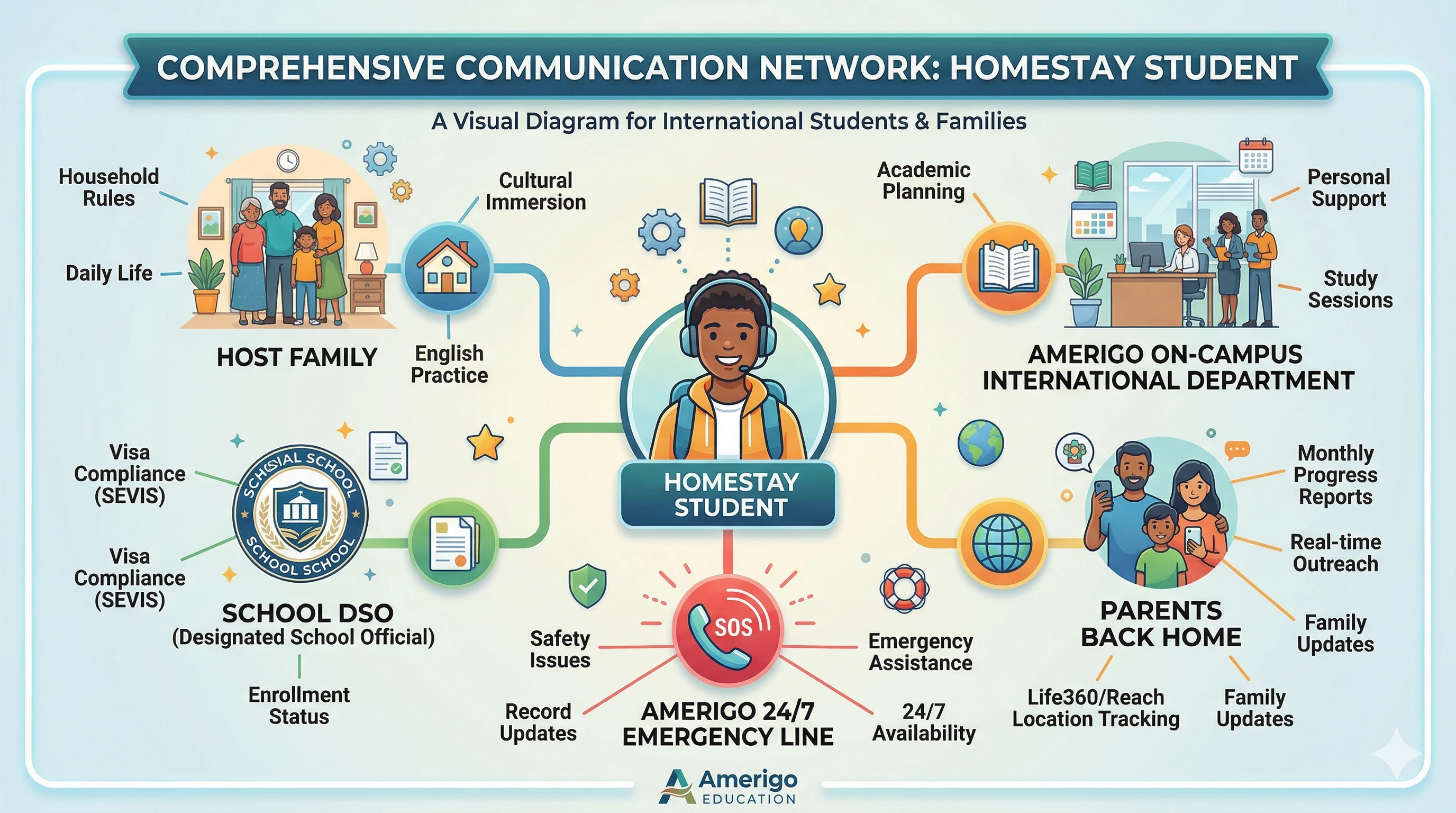
Communication rules in a homestay cover how students interact with their host family, their school, and their program coordinator. For international students, these rules also connect to visa compliance obligations. Under F-1 regulations administered by SEVIS (Student and Exchange Visitor Information System), students must maintain full-time enrollment and notify their designated school official (DSO) of any address changes promptly.
Within the home, most host families expect students to communicate in English as the primary language. This is consistent with the goals of an immersive study experience and supports ELL (English Language Learning) development. Excessive use of home-country languages in the household may be discouraged, particularly in shared family spaces. Students should treat this as a language-building opportunity rather than a restriction.
Regarding contact with the school and program, Amerigo's on-campus international department serves as the point of contact for academic and personal concerns. Homestay students can schedule meetings with Amerigo academic counselors for individualized academic planning, including identifying prerequisite courses for AP (Advanced Placement) enrollment.
How Do Curfew and Safety Rules Work?
Curfew and safety rules protect students and give host families and parents confidence in the placement. Most programs, including those coordinated through Amerigo, set curfew times that align with school schedules and local norms. School nights typically have earlier curfews than weekends. Any exceptions require prior notice to the host family.
Safety technology plays an important role for families back home. Amerigo uses Life360 or Reach to allow parents to track their student's location during the program. This applies to both residential and homestay students, giving families real-time awareness of their student's movements. In an emergency, 24/7 emergency assistance is available. Under SEVP regulations, maintaining student welfare is a shared responsibility between the school, the program provider, and the host family.
Students should understand that curfew is not optional. Repeated violations can affect the placement and, in some cases, may trigger a conversation with the program coordinator. Students who have plans that conflict with curfew should communicate in advance, not after the fact.
What Personal Conduct Rules Apply in Homestay?
Personal conduct rules cover how students behave within the home and in interactions with the host family. These include respect for the family's values, noise levels, cleanliness, and treatment of shared spaces. Students from the Taiwan Region and other Asian markets often find that some US household norms differ from home practices, such as removing shoes at the door, meal timing, and the level of noise expected in evening hours.
Amerigo Education provides native-language communication support for families from China, Vietnam, Korea, Mexico, the Taiwan Region, and more. This means students can receive guidance on cultural norms and expectations in their home language before departure. Pre-departure planning webinars from Amerigo help students anticipate common adjustment challenges.
For ongoing academic support, homestay students access the on-campus international department at their partner school. This includes structured study sessions, academic counseling, and subject-specific tutoring (note: additional costs may apply for tutoring). Evening study groups and structured study hours are supported by campus staff.
Parents receive monthly progress reports covering all students regardless of accommodation type. For more guidance on adjusting to homestay life, families can review the How to Overcome Culture Shock: A Guide for International High School Students Ages 14-18 article.
What Rules Govern School Break Periods in Homestay?
Break period rules are a frequent source of confusion for students and families. For students in Amerigo's on- and off-campus residences, the answer is clear: residences do not close during Spring Break. Students participate in Amerigo-organized trips and activities. No alternative housing is required.
For homestay students, break period arrangements depend on the individual host family's plans. Some host families remain in place during school breaks and continue to host the student. Others may travel or have other obligations. Program coordinators should communicate break period expectations clearly in advance, and students should ask about this before their placement begins.
Families should not assume that a homestay placement automatically provides coverage during all school break periods. This is a key question to ask during the pre-departure planning process. Amerigo shares school activity calendars and event announcements with parents, which helps families plan around break periods.
For a full breakdown of how accommodation options compare, including break-period policies, visit the Homestay vs Residence for High School International Students: How to Choose the Right Accommodation guide and the student accommodations service page.
Frequently Asked Questions
What are homestay rules for international high school students?
Homestay rules are the conduct expectations and household standards that students agree to follow when living with a host family. They typically cover curfew times, kitchen use, communication expectations, noise levels, guest policies, and cleanliness. These rules exist to protect both the student and the host family, ensure the placement functions smoothly, and support the student's English language development. Students should review all rules before arrival and ask their program coordinator to clarify anything unclear.
Can international students cook in a homestay?
Kitchen arrangements in a homestay vary by host family. Students should not assume they have open access to cook independently. Most placements involve the host family preparing meals, with the student following household mealtimes and kitchen routines. If a student wants to prepare home-country dishes, they should discuss this with the host family and program coordinator before the placement begins. In Amerigo's on- and off-campus residences, independent cooking is not permitted for safety reasons.
What happens if a student breaks a homestay rule?
If a student breaks a homestay rule, the host family will typically raise the issue with the program coordinator. Depending on the severity and frequency, the coordinator may speak with the student and, if necessary, with the student's parents. Repeated or serious violations can result in a placement change. Students should treat homestay rules as non-negotiable and communicate honestly with both the host family and program staff if they are struggling to adapt.
Do parents receive updates about their child's homestay placement?
Yes. Amerigo sends monthly progress reports to all families, including those with students in homestay placements. These reports cover academic progress and general wellbeing. When a situation requires immediate attention, Amerigo staff contact parents directly without waiting for the monthly cycle. Parents can also use Life360 or Reach for real-time location tracking. Amerigo also shares school activity calendars and event announcements with families throughout the year.
Is the homestay provider vetted by Amerigo?
Yes. Amerigo provides homestay families directly rather than through a third-party referral agency. This means Amerigo maintains oversight of the placement quality and the standards that host families are expected to meet. Families considering a homestay placement can ask Amerigo's admissions team about the vetting process and host family standards during the pre-enrollment conversation.
Can international students choose between homestay and a residence?
Yes. Amerigo offers 4 accommodation options: homestay, off-campus residence, on-campus residence (at select partner schools with limited availability), and self-provided accommodation (for students with nearby family in the US). Each option has distinct characteristics. Homestay is more affordable and provides cultural immersion. Off-campus residences are the primary residential model, located 20-30 minutes from schools, single-gender, with 24/7 staff and dedicated study areas. Families should discuss the options with Amerigo to find the best fit.
Do homestay students get the same academic support as residential students?
Homestay students receive academic support through the on-campus international department at their partner school. They can schedule meetings with Amerigo academic counselors and access individualized academic planning, including prerequisite guidance for AP enrollment. In-residence homework help is available for residential students in their building. Both groups receive monthly progress reports and real-time outreach when needed. Subject-specific tutoring is also available for all students, though additional costs may apply.
What are the English communication rules in a homestay?
Most host families expect students to use English as the primary language in shared household spaces. This supports the language immersion goals of the program and helps students build ELL skills faster. Students may speak their home language privately or with family back home, but sustained use of a non-English language in household common areas is generally discouraged. Amerigo's customized in-school ELL courses help students build the English skills needed to communicate comfortably in the homestay environment.
What safety measures are in place for homestay students?
Amerigo uses Life360 or Reach to provide parents with real-time location tracking for students throughout the program, including those in homestay placements. 24/7 emergency assistance is available at all times. Homestay students also have access to the on-campus international department at school for in-person support during the school day. Amerigo's native-language communication support helps students from China, Vietnam, Korea, Mexico, the Taiwan Region, and more flag concerns in their home language when needed.
What should students bring to a homestay placement?
Students should bring essential personal items, school supplies, and any cultural items that help them feel at home. Detailed pre-departure planning guidance is provided by Amerigo before the student's departure. Families also have access to pre-departure webinars that cover what to expect in the first weeks of a homestay placement. Students should avoid bringing large quantities of food from home, as this can create complications with US customs regulations and may conflict with the host family's meal routines.
Conclusion
Homestay rules provide the structure that allows international high school students and host families to live together successfully. Key areas include kitchen access, curfew, communication expectations, conduct standards, and break-period arrangements. Students who understand these rules before moving in are better prepared to adapt quickly and focus on their academic goals.
Explore Accommodation Options with Amerigo
Amerigo Education supports families in choosing the right accommodation model before enrollment. To compare homestay and residential options, visit the student accommodations page or contact us to speak with an advisor. When you are ready to move forward, apply here to begin the admissions process and discuss accommodation preferences with the Amerigo team.
People Also Read
- What Is Homestay for Students: Complete Guide 2026
- Homestay vs Residence for High School International Students: How to Choose the Right Accommodation
- Student Accommodation for High School Study Abroad: Complete Guide 2025-2026
About the Author
This guide was written by the Amerigo Education content team, drawing on program data from staff operating the on-campus international department at 40 Niche A+/A rated US, Canadian, and UK partner schools. Learn more about Amerigo Education.
Disclaimer: This article provides general information for educational purposes only. Families should conduct independent research, request current program data from providers, and consult with program representatives regarding specific circumstances. Contact us with questions.