All news
May 19, 2026
Study Abroad 101
Dartmouth Admissions for International High School Students: An Honest Assessment
Dartmouth admissions for international students: acceptance rate, GPA standards, D-Plan logistics, and how a US high school pathway strengthens the application.
.webp)
Last Updated: May 2026
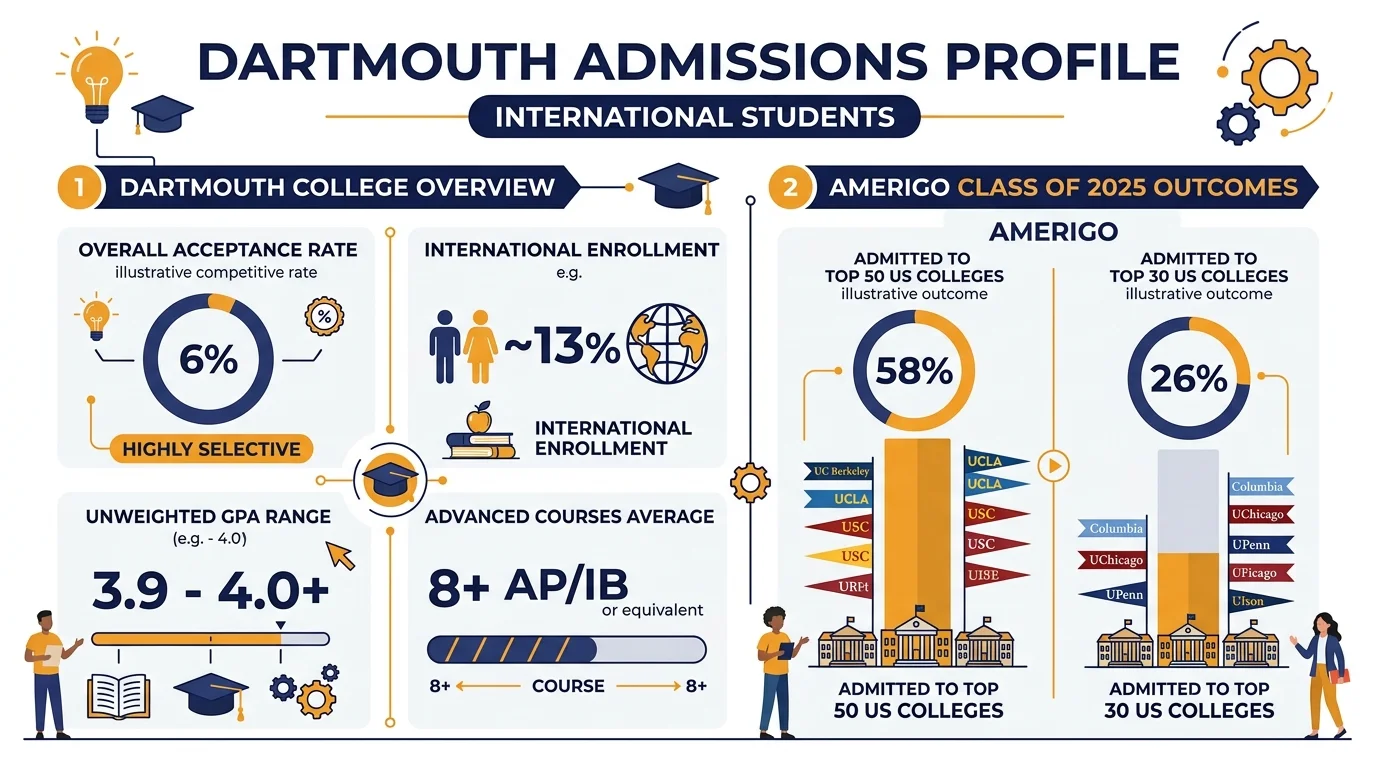
Dartmouth admissions for international students is an Ivy League application process that demands the same depth of academic achievement, extracurricular distinction, and personal narrative as any of the most selective US universities - with one additional complexity: Dartmouth enrolls approximately 4,500 undergraduates, making it the smallest Ivy League school and limiting the total number of international spots available each year. According to IIE Open Doors (2024), international students represent approximately 12% of Dartmouth's undergraduate enrollment, drawn from over 70 countries, with East Asian applicants representing a particularly competitive cohort.
Amerigo Education partners with 40 Niche A+/A rated schools (independent academic rankings based on school-reported curriculum quality, faculty credentials, student outcomes, and college matriculation data) across the US, Canada, and the UK, supporting 3,500+ students from 55+ countries. The Class of 2025 achieved 97% admission to Top 100 US universities. Of students from the Class of 2025 who applied to Top 50 universities, 60% gained admission; of those who applied to Top 30 institutions, 25% were admitted. Amerigo's Top 50 Track - a higher-tier program for students targeting universities ranked in the Top 50, combining elevated entry academic standards, structured extracurricular development, focused essay strategy, and dedicated university counseling from each Signature School's on-campus international department prepares students specifically for the academic and extracurricular profile that elite universities like Dartmouth evaluate.
This guide covers Dartmouth's international enrollment share, the academic standards admitted applicants hold, what makes Dartmouth distinctive among Ivy League schools, how a US high school transcript positions an applicant, and when to begin the application timeline.
Key Takeaways
- Acceptance rate around 6.2%: Dartmouth's Class of 2028 saw an overall acceptance rate of approximately 6.2%, among the most selective in the Ivy League for international applicants.
- Approximately 12% international enrollment: With only 4,500 undergraduates, Dartmouth's total international student cohort is smaller in absolute numbers than at larger Ivy League schools.
- D-Plan flexibility required: Dartmouth's quarter-based academic calendar (D-Plan) has distinct implications for international students around travel and schedule planning.
- US transcript removes conversion friction: According to NAIS (2024), students from US independent schools are admitted to selective universities at higher rates than graduates of international school programs.
- Top 50 Track preparation: Amerigo's Top 50 Track builds the academic depth, extracurricular distinction, and university counseling support international students need for Dartmouth-level applications.
What Is Dartmouth's International Enrollment?
Dartmouth College enrolls approximately 4,500 undergraduate students in Hanover, New Hampshire, with international students representing roughly 12% of that total - approximately 540 students from over 70 countries in a given year. The small undergraduate body means the absolute number of international spots is more constrained than at larger Ivy League institutions: a 12% share at Dartmouth represents fewer individual seats than the same percentage at Columbia or Cornell.
East Asian applicants - particularly from China, South Korea, and India - represent the most competitive national pools for Dartmouth admissions. Applicants from less-represented countries face somewhat different competition dynamics but must still meet the same academic and extracurricular standards that Dartmouth's small class size demands.
- Quarter system impact: Dartmouth's D-Plan divides the academic year into four 10-week terms. International students must plan their academic schedule around mandatory residency requirements and off-term options, which affects travel logistics significantly.
- Financial aid policy: Dartmouth meets 100% of demonstrated financial need for admitted students. Families should confirm international student financial aid eligibility and process directly with Dartmouth's financial aid office, as policies evolve.
- Hanover, NH context: Dartmouth's campus is in a small college town in rural New Hampshire - a significant lifestyle difference from urban Ivy League campuses. Families should discuss campus environment preferences with prospective students honestly.
What Grades Do Dartmouth Applicants Need?
Dartmouth admitted students typically hold unweighted GPA averages above 3.9, with most ranked in the top 5% of their graduating class. According to NACAC (2024), international applicants to top-10 US research universities face acceptance rates below 7%, making academic excellence a minimum qualification rather than a differentiator.
Dartmouth evaluates coursework in the context of school profile - a student at a school offering 5 AP (Advanced Placement) courses is held to different standards than one at a school offering 25. This makes the quality and trajectory of coursework more important than a fixed AP course count.
- AP coursework depth: Admitted students typically take the most rigorous courses available at their school, often 5-7 AP or Honors courses by graduation.
- Upward trajectory: A consistent GPA improvement from Grade 9 through Grade 12 carries meaningful weight - Dartmouth reads the entire academic record, not just senior-year performance.
- Test scores: Dartmouth is currently test-optional. Strong SAT (1510+) or ACT scores remain competitive differentiators for international applicants from high-volume sending countries where many qualified candidates apply each year.
Families building toward a Dartmouth application can review Amerigo's university counseling model, which begins AP course planning from the first year of enrollment at US Signature Schools.
What Makes Dartmouth Unique for International Students?
Dartmouth's distinctive features - the D-Plan, small class size, rural setting, and culture of undergraduate engagement - create a specific fit profile that international students should assess honestly before investing in an application.
The D-Plan's four-term academic calendar means students spend at least one off-campus term during their undergraduate years. International students typically use off-terms for research, internships, or travel - but the scheduling requires active planning around visa residency requirements and enrollment status. Understanding these logistics before applying demonstrates the kind of preparation Dartmouth values in international applicants.
- Research culture: Dartmouth's Presidential Scholars program and laboratory access give undergraduates meaningful research roles from the first year - particularly valued by students targeting STEM or social science careers.
- Outdoor engagement: The Dartmouth Outing Club (the oldest collegiate outing club in the US) and Dartmouth's New England mountain setting create a distinctive campus culture that differs significantly from urban Ivy League schools.
- Small class dynamics: Small class sizes mean more direct access to faculty and greater visibility within each course - an environment where academically engaged international students can distinguish themselves quickly.
- Community emphasis: Dartmouth's supplement asks applicants to describe their potential contribution to Dartmouth's community. International students whose essays speak specifically to Dartmouth's residential culture, research access, or outdoor tradition write significantly stronger applications than those with generic Ivy League essays.
How Does a US Transcript Strengthen the Application?
A US high school transcript from an accredited independent school provides Dartmouth admissions officers with a directly legible academic record, eliminating the conversion uncertainty that international transcripts introduce. Students who complete 2+ years at Amerigo's US Signature Schools - a network of partner schools in the United States where Amerigo provides dedicated on-campus international support, including residential accommodation, an on-campus international department, university counseling, and the Top 100 Guarantee - a refund of up to $50,000 USD in senior year tuition fees for US Signature School students who complete two consecutive years of enrollment, maintain a cumulative GPA of 3.2 or higher, achieve a TOEFL score of 85 or above, complete at least one AP, IB, or Honors course, and apply to Top 100 US universities but do not gain admission for eligible students build a graded record that Dartmouth evaluates on the standard 4.0 scale alongside domestic applicants.
The on-campus international department - a dedicated team at each US Signature School consisting of a Director of Campus Operations, Academic Director, Senior Campus Coordinators, Campus Coordinators, and an ELL teacher, who provide daily academic support, residential supervision, university counseling, and welfare oversight for enrolled international students supports individualized AP course planning from Grade 9, ensuring students enter junior and senior year with the rigorous transcript depth Dartmouth values. Campus Coordinators provide academic support during structured study hours, and students can schedule sessions with Amerigo academic counselors. Families can compare school options at find-your-school to assess coursework availability by location.
- Legible grading: A US 4.0 GPA is immediately comparable across all Dartmouth applicants - no conversion required.
- US extracurricular context: US school enrollment gives international students access to the clubs, competitions, and service activities that Dartmouth's community-focused culture values.
- Counselor relationship: Amerigo's university counseling team begins school list strategy and Common App preparation from junior year, allowing for Dartmouth supplement drafts well before the November or January deadlines.
What Supplements Does Dartmouth Require?
Dartmouth's application supplements ask students to address specific prompts about community, academic interests, and fit with Dartmouth's culture. For international students, these prompts require both linguistic precision and cultural self-awareness - the ability to describe, in specific terms, why Dartmouth's particular educational model matches the applicant's goals.
Generic responses citing flexibility, research opportunities, or Ivy League reputation are common across a high volume of applications. International students whose supplements reference specific Dartmouth programs, faculty research areas, or campus traditions - the Outing Club, the First-Year Trips program, the D-Plan off-term structure - write more distinctive applications.
- Community prompt: Describe what community you have been a part of, and what role you played within it. Answer with specifics - a particular role, impact, or outcome, not general participation.
- Academic interest prompt: What field of study appeals to you most, and why? Reference specific Dartmouth academic programs, courses, or research centers when possible.
- Essay development: Amerigo's counseling team assists with Common App essay development and Dartmouth supplement drafting as part of the Top 50 Track preparation.
When Should International Students Begin Applying?
Dartmouth's application deadlines are November 1 for Early Decision (binding) and January 1 for Regular Decision. International students targeting a fall start should plan the F-1 (student visa for US academic programs) and I-20 (issued by the school after enrollment confirmation) timeline in parallel with the application process.
For a student targeting Dartmouth as a senior-year applicant from an Amerigo US program, the recommended preparation sequence runs across four years:
- Grade 9-10: Enroll in a US high school program, establish transcript, begin AP prerequisite sequence and 2-3 focused extracurriculars.
- Grade 11: Build extracurricular leadership roles; begin TOEFL preparation if not yet above 100; start school list development with Amerigo counselors.
- Grade 12 (fall): Submit Dartmouth Early Decision by November 1 if Dartmouth is the first-choice school; Regular Decision by January 1 otherwise.
- Post-application: Prepare financial aid documentation; confirm I-20 and F-1 visa readiness for the enrollment deposit deadline.
Frequently Asked Questions
What is Dartmouth's acceptance rate for the Class of 2028?
Dartmouth's overall acceptance rate for the Class of 2028 was approximately 6.2%, placing it among the most selective Ivy League institutions. International applicants compete in the same review process as domestic applicants, with no separately published international acceptance rate. Dartmouth's small undergraduate size means fewer total international spots available each year compared to larger Ivy League schools at similar acceptance rates.
How many international students does Dartmouth enroll?
International students represent approximately 12% of Dartmouth's 4,500 undergraduates - roughly 540 students per entering class from over 70 countries. East Asia, South Asia, and Europe are historically the primary sending regions. Dartmouth does not publish country-specific enrollment caps, but applicants from China, South Korea, and India face the most concentrated peer competition within a single national pool.
What GPA do international students need for Dartmouth?
Admitted students typically hold unweighted GPAs above 3.9, ranked in the top 5% of their class. GPA is evaluated against the school's grading context and course offerings - a student taking the most rigorous available courses at a Niche A+/A rated school is evaluated more favorably than one with an identical GPA in less challenging coursework. AP (Advanced Placement) and Honors course rigor matters alongside raw GPA.
What is the D-Plan at Dartmouth?
The D-Plan is Dartmouth's quarter-based academic calendar, dividing the year into four 10-week terms. Students must be in residence for the fall terms of their freshman and senior years but can customize which other terms they take off. Off-terms are typically used for research, internships, or travel. International students must coordinate off-term plans with F-1 visa full-time enrollment requirements and consult their DSO (Designated School Official) before scheduling off-terms.
Does a US high school transcript help for Dartmouth?
Yes. A US transcript from an accredited independent school is directly legible to Dartmouth admissions on the standard 4.0 scale. According to NAIS (2024), students from US independent schools are admitted to selective universities at higher rates than graduates of international programs. US enrollment also provides access to the extracurricular ecosystem - clubs, competitions, community service - that Dartmouth's community-contribution supplement directly asks applicants to address.
When is the best time to apply to Dartmouth?
International students with Dartmouth as their confirmed first choice should apply Early Decision by November 1. ED at Dartmouth provides a meaningful admission rate advantage and signals genuine institutional commitment. However, ED is binding - families must confirm financial aid acceptability before applying. Students still evaluating school lists should apply Regular Decision by January 1 to preserve options while Amerigo's counseling team finalizes the application strategy.
How does Amerigo support students targeting Dartmouth?
Amerigo's university counseling model, delivered through the on-campus international department at US Signature Schools, begins AP course planning from Grade 9. Students targeting Dartmouth and Top 30 institutions are supported through the Top 50 Track - a higher-entry-standard pathway with additional academic, extracurricular, and application strategy preparation. The team guides students through Dartmouth's specific supplement requirements alongside the Common App personal statement.
What extracurriculars strengthen a Dartmouth application?
Dartmouth values community engagement, intellectual initiative, and activities that align with its culture of outdoor exploration, research, and collaborative learning. Sustained engagement in 2-3 activities with leadership or impact outperforms a long list of minimal participation. Community service, academic competitions, research projects, and arts or athletics are all valued. Amerigo organizes food drives, toy drives, and packing events for underprivileged families - concrete community engagement that translates directly into Dartmouth application content.
Conclusion
Dartmouth's approximately 6.2% acceptance rate and small undergraduate cohort make it one of the most competitive Ivy League applications for international students. US high school enrollment provides a directly legible transcript, US extracurricular context, and proximity to university counseling support that positions international applicants more competitively than most international school pathways alone.
Apply to an Amerigo Partner School
To learn more about studying in America at an Amerigo partner school with a university counseling pathway toward Dartmouth and Top 30 universities, contact us to speak with a program advisor, or apply now to take the first step.
People Also Read
- How Students Get Into Top 50 US Universities
- Early Decision vs Early Action for International Students
- College Application Essays for International Students
About the Author
This guide was written by the Amerigo Education content team, drawing on program data from staff operating the on-campus international department at 40 Niche A+/A rated US, Canadian, and UK partner schools. Learn more about Amerigo Education.
Disclaimer: This article provides general information for educational purposes only. Families should conduct independent research, request current program data from providers, and consult with program representatives regarding specific circumstances. Contact us with questions.