All news
April 3, 2026
Study Abroad 101
Early Decision vs Early Action for International Students
Early Decision vs Early Action for international students: binding vs non-binding differences, F-1 visa timing, financial aid implications, and how Amerigo counselors guide the choice.

Early Decision vs Early Action for International Students
Last Updated: April 2026
Early decision vs early action for international students refers to two distinct application pathways that US universities offer to candidates who apply before the regular deadline, typically in November. According to the Common App (2025), roughly 40% of students who used the Common Application submitted at least one early application, and acceptance rates at selective universities can run 10-20 percentage points higher for early applicants than for regular decision pools.
Amerigo Education partners with 40 Niche A+/A rated schools across the US, Canada, and the UK, supporting 3,500+ students from 55+ countries. The Class of 2025 achieved 97% admission to Top 100 US universities. For international students navigating the US admissions cycle from abroad, understanding the difference between binding and non-binding early plans is critical, and Amerigo's university counseling team guides students through these choices as part of the program.
Key Takeaways
- Early Decision is binding: Students who receive an ED offer must enroll and withdraw all other applications, making financial aid review essential before committing.
- Early Action is non-binding: Students receive an early answer but retain full freedom to compare offers until the standard May 1 reply deadline.
- Acceptance rate advantage: According to MIT Institutional Research (2025), EA acceptance rates at highly selective schools can exceed regular decision rates by a significant margin for equally qualified applicants.
- Financial aid complexity: International students rarely qualify for need-based US federal aid, so ED's binding commitment requires families to verify the full cost before applying, since Amerigo program fees start from $40,000/year.
- Visa timeline matters: An early offer letter, whether from ED or EA, gives F-1 (student visa for academic programs) applicants more time to file their DS-160 and schedule a consulate interview before the August enrollment date.
What Is Early Decision for International Students?
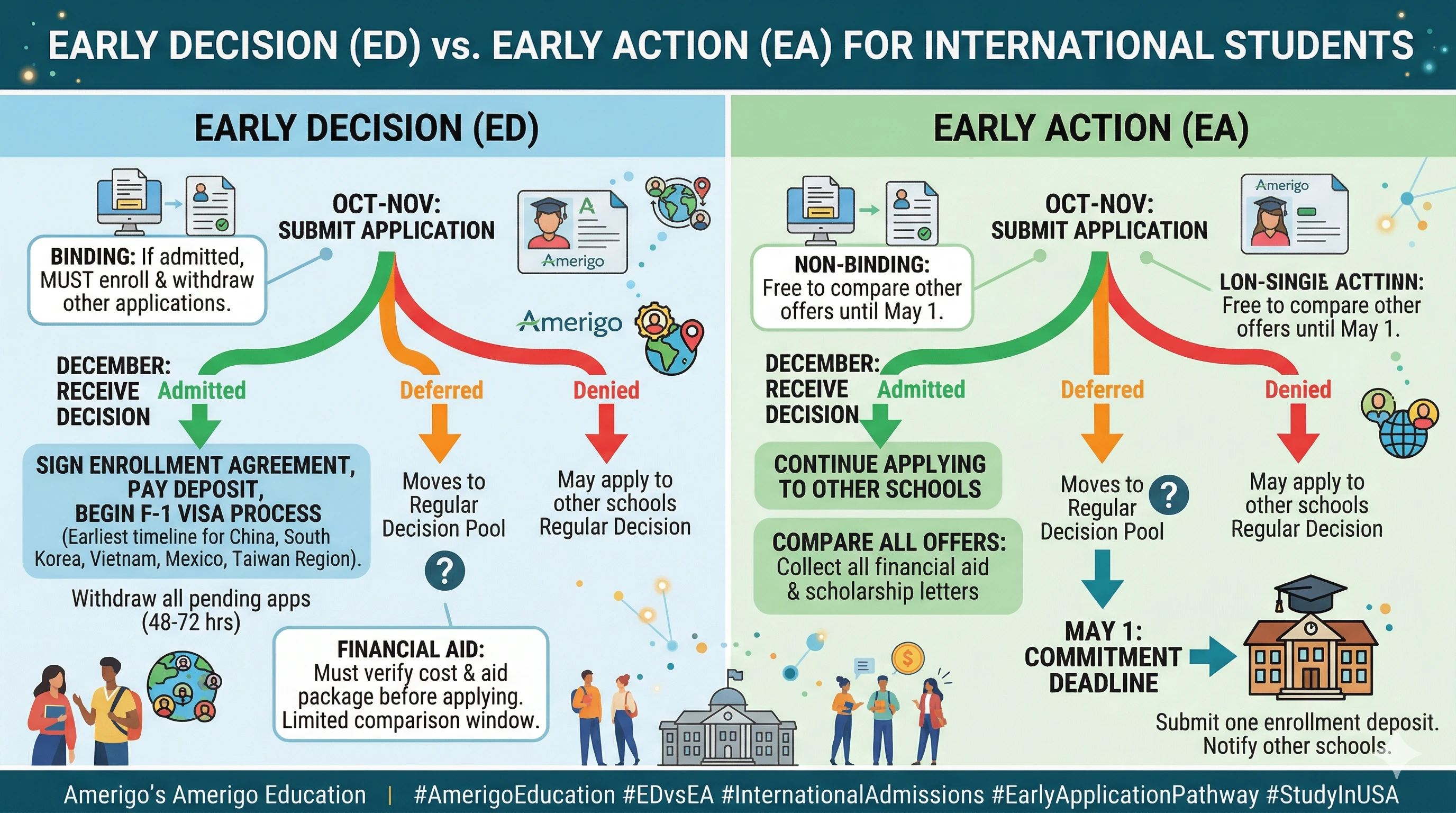
Early Decision (ED) is a binding application plan in which a student applies to one university by an early deadline, usually November 1 or November 15, and agrees in advance to enroll if admitted and if the financial aid offer is adequate. Most ED plans require students to withdraw applications from all other schools within 48-72 hours of receiving an offer.
For international students, the binding nature of ED creates additional pressure. Families must be confident about the financial package before submitting, because there is no comparison-shopping period. ED acceptance rates at selective universities often run higher than regular decision rates because admitted students represent genuine first-choice demand for the institution.
- Apply by the ED deadline (typically November 1 or November 15)
- Receive a decision by mid-December
- If admitted, sign the enrollment agreement and pay the deposit
- Withdraw all pending applications at other universities
- Begin F-1 visa preparation with the I-20 the university issues
- Complete housing and orientation registration before the spring deadline
- If deferred, your application moves to the regular decision pool automatically
- If denied under ED, you may apply to other schools in the regular round
What Is Early Action for International Students?
Early Action (EA) is a non-binding application plan that allows students to apply by the same early November deadline and receive a decision in December, while retaining the right to apply to other universities and compare all offers before committing. Restrictive Early Action (REA), offered by schools such as Harvard and Princeton, adds one restriction: students may not apply ED or EA elsewhere during that cycle.
EA is often the preferred option for international students who want the psychological advantage of an early answer without surrendering financial flexibility. According to NACAC's State of College Admission report (2024), approximately 37% of first-year students at four-year institutions applied early, and EA applicants reported higher satisfaction with the process than those who applied regular decision.
- Check whether the school offers standard EA or Restrictive EA (REA)
- If REA, confirm you will not apply ED or EA anywhere else simultaneously
- Submit by the EA deadline (typically November 1 or November 15)
- Receive a decision in mid-December: admitted, deferred, or denied
- If admitted, continue applying to other schools until January deadlines
- Compare all financial aid and scholarship offers by April
- Commit to one school by May 1 (National Candidates Reply Date)
- Notify other schools of your decision and begin F-1 visa steps
How Do ED and EA Affect Financial Aid?
Financial aid structures differ sharply between these two pathways, and the difference matters most for international students whose families pay the full program cost without access to US federal grants. ED's binding nature means that if a university's aid package falls short, a student's only exit is a documented financial hardship appeal, which is not guaranteed.
EA preserves the ability to compare offers side by side. Because Amerigo's university counseling team advises students on the full cost of attendance alongside program fees, families can use the EA window to evaluate scholarship eligibility at multiple schools before committing.
- Confirm whether the university meets 100% of demonstrated need for international students (rare)
- Request the university's international student financial aid policy in writing
- Calculate total cost: tuition + room + board + Amerigo program fee (from $40,000/year)
- Under ED, request the aid package before signing the enrollment agreement
- If the package is inadequate, document the shortfall and submit a financial appeal
- Under EA, collect all aid letters and compare line by line before May 1
- Consult Amerigo's counseling staff to clarify which costs fall inside vs outside the program fee
When Should International Students Apply ED vs EA?
The choice between ED and EA depends on three factors: certainty about a first-choice school, confidence in the financial package, and the student's academic profile. Students who have visited or researched one school extensively and whose family has confirmed the budget should consider ED only if the acceptance rate advantage is meaningful and the school offers merit aid to international students.
Students who are still refining their list, who need to compare scholarships, or whose test scores may improve by January should use EA wherever it is available. The on-campus international department at Amerigo partner schools provides counseling support to help students determine which plan fits their academic timeline, including AP (Advanced Placement) course completion status.
- Student has one clear first-choice school with a known cost - consider ED
- Student is comparing 3-5 strong options - use EA at all available schools
- TOEFL score is below 85 and may improve by January - wait for Regular Decision
- GPA (Grade Point Average) is on the lower edge - EA gives more comparison options
- School offers ED II in January - a second ED window if the December round did not work
- Restrictive EA prevents applying to other top schools - evaluate the trade-off carefully
How Does the F-1 Visa Timeline Interact with ED and EA?
An early admission offer, whether binding or non-binding, produces an acceptance letter and eventually an I-20 (SEVIS enrollment record) earlier than regular decision admits receive theirs. Students admitted in December can begin SEVIS (Student and Exchange Visitor Information System) registration and schedule a consulate appointment months before their peers, reducing the risk of delays that could affect August enrollment.
According to the US Department of State (2025), F-1 visa interviews at high-volume consulates in China, South Korea, Vietnam, and Mexico can carry wait times of 60-90 days or longer during peak spring and summer periods. An early offer from ED or EA materially reduces that risk for students from primary Amerigo markets including China, South Korea, Vietnam, Mexico, and the Taiwan Region.
- Receive acceptance letter from the university in December
- Complete the enrollment deposit (ED) or decide to accept (EA) by the university's deadline
- University issues Form I-20 once enrollment is confirmed
- Pay the SEVIS fee online at FMJfee.com
- Complete the DS-160 nonimmigrant visa application
- Schedule a visa interview at the nearest US consulate
- Attend the interview with I-20, financial documents, and acceptance letter
- Allow 4-8 weeks for visa processing after the interview
- Receive visa stamp and finalize travel plans for August enrollment
What Role Does Academic Preparation Play in ED and EA?
A student applying ED or EA is presenting their academic record through junior year and the first semester of senior year, often without final AP or IB (International Baccalaureate) exam scores. Admissions officers at selective universities assess ELL (English Language Learning) trajectory, course rigor, and upward grade trends when final scores are unavailable.
Students enrolled at Amerigo partner schools receive monthly progress reports and school activity calendars shared with families, structured study hours, and access to subject-specific tutoring (additional costs may apply), giving them documented academic momentum entering the early application window. The Amerigo partner school network provides rigorous AP coursework across subjects, which strengthens the academic profile presented in an early application.
- Complete at least one AP, IB, or Honors course before applying ED or EA
- Aim for a cumulative GPA of 3.2 or above to remain competitive and meet Amerigo's Top 100 Guarantee requirements
- Achieve TOEFL 85+ before the November deadline (or IELTS, Duolingo English Test, or Eltis equivalent)
- Request a mid-year report from your school counselor, which many ED/EA schools require
- Confirm with your Amerigo academic advisor that all prerequisite courses for AP enrollment are complete
- Use in-residence homework help and evening study groups (available to students in on- and off-campus residences; homestay and self-provided accommodation students access support at the on-campus international department) in the months before the deadline
- Review your application timeline with the on-campus international department well before October
Frequently Asked Questions
Does Early Decision improve admission odds for international students?
Early Decision generally does improve acceptance rates at selective universities, and this benefit extends to international applicants. Universities report higher ED acceptance rates because the applicant pool self-selects students who have done thorough research and demonstrated genuine first-choice interest. However, the statistical advantage varies by school, and students should not choose ED solely for the acceptance rate boost if financial flexibility is a priority.
What happens if an ED offer is financially unaffordable?
If an Early Decision financial aid package is inadequate, a student may submit a formal financial hardship appeal to the university. Most selective universities will release a student from the ED binding commitment if the documented cost exceeds what the family can pay. Students should collect written documentation of their financial situation before submitting the appeal. This process is not automatic and is at the university's discretion.
Is Early Action binding at any university?
Standard Early Action is never binding. However, Restrictive Early Action (REA), offered by a small number of highly selective universities including Harvard, Princeton, Stanford, and Yale, is non-binding but prohibits students from applying ED or EA elsewhere during the same cycle. Students admitted under REA still have until May 1 to accept or decline the offer and may compare financial aid offers from other schools applied to in the regular round.
When is the Early Decision II deadline?
Early Decision II (ED II) deadlines typically fall in January, often January 1 or January 15, with decisions released in mid-February. ED II carries the same binding commitment as ED I but offers students a second window to apply after December regular decision applications have been submitted. This option is useful for students who were deferred in ED I at another school or who identified a strong first choice later in the fall.
Does applying EA or ED affect scholarship eligibility?
Applying Early Action does not restrict scholarship eligibility, and most merit scholarships have the same deadline as the regular application anyway. Early Decision can restrict merit scholarship comparison because accepting an ED offer requires withdrawing from other schools before comparing their aid packages. Students relying heavily on scholarships to fund their program should consult with Amerigo's university counseling team before choosing an ED strategy.
How does ED or EA affect the F-1 visa process?
An early acceptance letter and I-20 form allow students to begin the F-1 visa process months before August enrollment. This is particularly valuable for students from China, South Korea, Vietnam, Mexico, and the Taiwan Region, where AIT (American Institute in Taiwan) office interview appointments can be booked 60-90 days or more in advance. Students who receive an ED or EA offer in December have the longest possible runway to schedule and complete their visa interview.
What GPA do international students need for ED or EA success?
There is no universal GPA threshold for early application success, but selective universities typically expect cumulative GPAs above 3.5 on a 4.0 scale for competitive consideration. Meeting Amerigo's Top 100 Guarantee eligibility requires a cumulative GPA of 3.2 or above, along with TOEFL 85+ and at least one AP, IB, or Honors course. Students close to these benchmarks should consult their academic counselor before deciding whether to apply early or wait for a stronger senior year record.
Conclusion
Early Decision and Early Action offer international high school students different trade-offs between admissions advantage and financial flexibility. ED provides the highest potential acceptance rate boost for students who are certain of their first choice and their budget, while EA gives students a December answer while preserving the freedom to compare offers. Understanding these timelines, their interaction with the F-1 visa process, and their academic requirements helps students and families build a well-sequenced application strategy.
Apply to an Amerigo Partner School
If you are an international student preparing for the US university application process, Amerigo Education can help you build an academic profile, course schedule, and application timeline that supports your early application goals. With 40 Niche A+/A rated partner schools across the US, Canada, and the UK, and a counseling team experienced with students from 55+ countries, Amerigo's program is designed to position students for competitive early applications.
Contact Amerigo Education to learn which partner school fits your goals, or apply directly to begin the enrollment process.
People Also Read
- Do International Students Have an Advantage Applying to US Universities from American High Schools?
- What GPA Do International Students Need for Top US Universities?
- Study Abroad Application Tips: Your Complete Guide for High School Students
About the Author
This guide was written by the Amerigo Education content team, drawing on program data from staff operating the on-campus international department at 40 Niche A+/A rated US, Canadian, and UK partner schools. Learn more about Amerigo Education.
Disclaimer: This article provides general information for educational purposes only. Families should conduct independent research, request current program data from providers, and consult with program representatives regarding specific circumstances. Contact us with questions.