All news
March 1, 2026
Study Abroad 101
How Students Get Into Top 50 US Universities
How international students gain Top 50 US university admission through GPA, TOEFL, AP courses, and structured high school pathway programs for 2026.
How Students Get Into Top 50 US Universities
Last Updated: March 2026
A Top 50 US university admission is a competitive outcome requiring international high school students to meet specific thresholds in GPA (Grade Point Average), English proficiency testing, Advanced Placement (AP) coursework, and extracurricular documentation. According to IIE Open Doors (2024), over 1.1 million international students studied at US institutions during the 2023-2024 academic year, with undergraduate enrollment growing 5% year over year.
Amerigo Education operates international high school pathway programs serving 3,500+ students from 55+ countries across 40 Niche A+/A rated partner schools in the US, Canada, and the UK. The Class of 2025 achieved a 97% Top 100 university admission rate and a 60% Top 50 admission rate. This guide covers the academic benchmarks, test scores, course planning, and application components that matter most.
Key Takeaways
- GPA baseline for Top 50 admission is 3.7 or above on a 4.0 unweighted scale: The Class of 2025 achieved 60% Top 50 admission with consistent GPA tracking from Grade 9 onward.
- TOEFL iBT (internet-based test) scores of 100 or above are standard for Top 50 universities: According to ETS, the TOEFL iBT is scored from 0 to 120 across four sections.
- Four to seven AP courses with scores of 3 to 5 define a competitive applicant: Amerigo Education partner schools offer 20 or more AP courses per campus.
- Extracurricular depth over two or more years matters more than activity count: US universities evaluate sustained commitment and leadership progression through the Common Application activities section.
- A structured high school pathway starting in Grade 9 or 10 produces the strongest outcomes: The Top 100 Guarantee requires a minimum of two consecutive years of enrollment at a US Signature School.
What GPA Do Top 50 Universities Require?
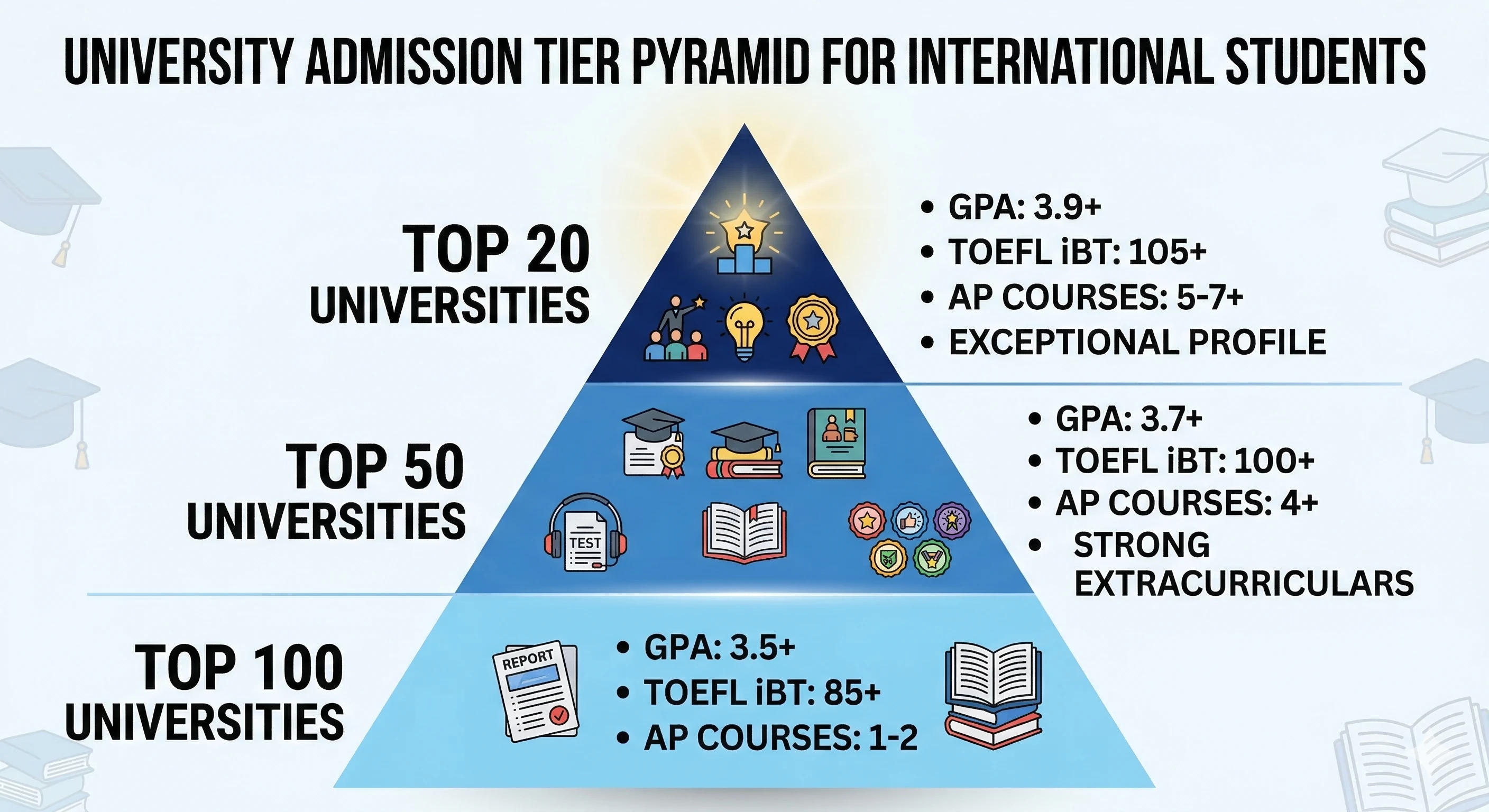
Top 50 US universities typically admit students with an unweighted GPA of 3.7 or above on a 4.0 scale. Weighted GPAs - which count AP and Honors courses at a higher value - are also submitted through the Common Application. GPA carries more weight than any single test score. According to US News and World Report (2025), the middle 50% of admitted students at Top 20 universities hold unweighted GPAs between 3.8 and 4.0.
International students transitioning from national curricula to the US system should understand that GPA is cumulative and cannot be recovered quickly after a weak semester. At Amerigo Education partner schools, the on-campus international department tracks GPA in real time and intervenes with academic support when performance shifts. Monthly progress reports keep families informed of academic standing throughout the school year.
Ranges are indicative based on published admissions profiles and may vary by institution and year.
What TOEFL Scores Do Top 50 Universities Need?
Most Top 50 US universities require a TOEFL iBT score of 100 or above for international applicants. Highly selective institutions set thresholds between 100 and 110, with some programs requiring higher scores for specific majors. IELTS scores of 7.0 or above are accepted at most institutions. According to ETS (2024), the TOEFL iBT measures reading, listening, speaking, and writing on a scale of 0 to 120.
Amerigo Education's Top 100 Guarantee requires a TOEFL score of 85 or above. Students targeting Top 50 should aim for 100 or higher. Students enter at B1 English level and build toward this benchmark through ELL (English Language Learning) coursework at the on-campus international department. The Class of 2025 includes students who entered at B1 English and reached Top 50 admission over two or more years of enrollment.
How Do AP Courses Affect University Admission?
Competitive Top 50 applicants typically complete four to seven AP courses with exam scores of 3, 4, or 5. According to College Board (2025), scores of 4 or 5 are strong indicators of college readiness. Universities evaluate course selection relative to what each school offers. A student completing every available AP at a smaller school demonstrates the same ambition as one taking seven APs where twenty are offered.
At Amerigo Education partner schools, students access 20 or more AP courses per campus. The on-campus international department guides AP selection based on intended major and university targets. Strategic AP planning begins in Grade 9 or 10, giving students time to build prerequisites before the most demanding courses in Grade 11 and 12.
The following list outlines the most effective AP subject pairings by intended major:
- Pre-med or biology: AP Biology, AP Chemistry, AP Statistics, AP English Language
- Engineering: AP Calculus BC, AP Physics C, AP Computer Science A, AP English Language
- Business or economics: AP Macroeconomics, AP Microeconomics, AP Statistics, AP Calculus AB
- Computer science: AP Computer Science A, AP Computer Science Principles, AP Calculus AB, AP Statistics
- Humanities or social science: AP US History, AP World History, AP English Literature, AP Psychology
- Environmental science: AP Environmental Science, AP Biology, AP Chemistry, AP Statistics
What Extracurriculars Do Top Universities Want?
Top 50 admissions officers evaluate extracurricular profiles based on depth, leadership progression, and genuine engagement rather than activity count. A student who participated in debate for four years and became team captain tells a stronger story than one who joined six clubs in Grade 12. According to NACAC (2024), sustained involvement ranks among the top factors outside academic performance.
International students at US high schools gain access to opportunities unavailable in their home country, including student government, competitive debate, varsity athletics, and academic competitions. At Amerigo Education partner schools, students participate alongside domestic students. Residential students in on- and off-campus residences have access to dedicated study areas with teacher availability.
Does Attending US High School Help Admission?
The structured pathway to Top 50 admission combines GPA management, AP completion, TOEFL preparation, extracurricular development, and university counseling across a minimum of two years. Students entering in Grade 9 or 10 have the most time to build each component. The Class of 2025 achieved 60% Top 50 admission through this model at Amerigo Education partner schools.
Grade 9 focuses on GPA foundation, ELL development, and early extracurricular engagement. Grade 10 introduces AP courses, TOEFL preparation, and university counseling. Grade 11 is the peak year for AP completion, testing, and activity leadership. Grade 12 focuses on applications, essays, and final semester grades. Amerigo Education provides native-language communication support for families from China, Vietnam, Korea, Mexico, and the Taiwan Region, and more.
- Grade 9: Build GPA foundation (target 3.7+), begin ELL coursework, join two extracurricular activities
- Grade 10: Add first AP courses, begin TOEFL preparation (target 85+ by year end), continue extracurricular commitment
- Grade 11: Complete three to five AP courses, take TOEFL (target 100+), begin university counseling and school list development
- Grade 12: Submit applications through Common Application, complete final AP courses, maintain GPA through spring semester
- Throughout: Monthly progress reports sent to families, real-time outreach for urgent academic updates
How Does the Top 100 Guarantee Work?
Amerigo Education's Top 100 Guarantee provides an up to $50,000 USD refund to eligible students who meet all program requirements and do not receive admission to a US News Top 100 university. The guarantee requires two consecutive years of enrollment at a US Signature School, a cumulative GPA of 3.2 or higher, a TOEFL score of 85 or above, and completion of at least one AP, IB (International Baccalaureate), or Honors course. Grade 12 direct entry students are not eligible.
Students targeting Top 50 should exceed guarantee minimums and aim for a GPA of 3.7 or above, TOEFL of 100 or higher, and four or more AP courses. The 97% Top 100 rate for the Class of 2025 reflects the baseline pathway outcome, while the 60% Top 50 rate reflects students who built beyond those thresholds. Families can view partner schools to identify campuses matching their student's interests.
For students targeting Top 50 admission specifically, Amerigo Education also offers the Top 50 Track Program. This pathway sets a 4.0 weighted GPA exit requirement, an SAT target of 1450 or above, and structured AP course sequencing designed for the most competitive university profiles.
What Role Does University Counseling Play?
University counseling connects academic performance to application strategy. Counselors at Amerigo Education partner schools help students build a balanced school list, develop essays, prepare for interviews, and meet deadlines through the Common Application.Under SEVP regulations, F-1 (student visa for academic programs) students must maintain enrollment at a SEVP-certified school, making counselor guidance on visa compliance essential.
University counseling at Amerigo Education begins in Grade 9 or 10, covering school selection, major exploration, and positioning. By Grade 11, students work with counselors on essay drafts, activity descriptions, and recommendation requests. SAT and ACT preparation, registration, and transportation to test centers are included. Visa services are provided through a third-party visa consulting partner and billed separately.
Frequently Asked Questions
What GPA is required for UCLA as an international student?
UCLA does not publish a single GPA cutoff for international applicants. Admitted students typically hold a weighted GPA of 4.18 or above, corresponding to an unweighted GPA of approximately 3.9 or higher. GPA is evaluated in the context of the high school attended and curriculum available. Academic achievement is the most heavily weighted factor in UCLA's review.
What TOEFL score is needed for Top 50 universities?
Most Top 50 US universities require a minimum TOEFL iBT score of 100, with highly selective institutions setting thresholds between 100 and 110. Some universities require higher scores for specific programs. IELTS scores of 7.0 or above are accepted at most institutions. Students should check individual university requirements for their intended major.
How many AP courses do Top 50 universities expect?
Competitive applicants to Top 50 universities typically complete four to seven AP courses with exam scores of 3, 4, or 5. Universities evaluate AP selection relative to what was available at the student's school. A student who takes all offered AP courses at a school with limited options demonstrates the same rigor as one selecting seven from twenty.
What extracurriculars matter most for Top 50 admission?
Top 50 universities look for depth, consistency, and leadership over time rather than a long list of brief participations. Strong profiles include sustained commitment to one or two primary activities across multiple years with progression to leadership. A clear connection between the student's interests and application narrative strengthens the profile.
Can students with B1 English reach Top 50 universities?
Yes. The Class of 2025 includes students who entered at B1 English level and achieved Top 50 admission by graduation. English proficiency develops progressively through ELL coursework and AP-level instruction over two or more years. The TOEFL score of 100 or above is achieved through structured preparation alongside daily English immersion.
When should preparation for Top 50 universities begin?
International students should begin building toward Top 50 admission from Grade 9. GPA is cumulative and cannot be recovered after weak early performance. AP courses must be completed before Grade 12 applications. Extracurricular depth requires multiple years to build. Students who enroll in Grade 9 or 10 have the fullest timeline to develop every component.
What is the difference between Top 50 and Top 100 universities?
Top 50 US universities represent the most selective tier of approximately 4,000 degree-granting institutions, as ranked by US News and World Report. Top 100 is a broader category that includes strong regional universities and specialized programs. The Top 100 Guarantee covers the Top 100 category. Students targeting Top 50 should aim for the higher benchmarks in this guide.
Do international students need SAT scores for Top 50 universities?
SAT and ACT submission policies vary by university. Many Top 50 universities adopted test-optional policies, meaning students may choose whether to submit scores. Students with strong SAT scores of 1450 or above generally benefit from submitting them. Test preparation, registration support, and transportation to test centers are included as part of Amerigo Education's on-campus support.
How does the Common Application work for international students?
The Common Application is an online platform accepted by over 1,000 US colleges and universities. International students complete one application and submit it to multiple schools. The application includes academic transcripts, test scores, extracurricular activities, essays, and teacher recommendations. Students at US high schools submit the same application as domestic students.
Are recommendation letters required for Top 50 universities?
Most Top 50 universities require one to three recommendation letters, typically from a school counselor and one or two subject teachers. Letters should speak to the student's academic ability, character, and growth over time. Teachers who know the student well and can provide specific examples write the strongest letters.
Conclusion
International students reach Top 50 US universities by combining a GPA of 3.7 or above, four or more AP courses, a TOEFL iBT score of 100 or above, and sustained extracurricular commitment. The Class of 2025 achieved 60% Top 50 admission across 3,500+ students from 55+ countries. The pathway requires building each component from Grade 9 onward with consistent GPA management, AP planning, and university counseling.
Start Your Top 50 University Pathway
International students ready to begin planning toward Top 50 university admission can view partner schools across the US, Canada, and the UK. Apply now or contact us to speak with an enrollment advisor about the right campus and entry point for your student.
People Also Read
- What GPA Do International Students Need for Top US Universities?
- What University Admissions Officers Actually See: Why US High School Changes Everything
About the Author
This guide was written by the Amerigo Education content team, drawing on program data from staff operating the on-campus international department at 40 Niche A+/A rated US and Canadian partner schools. Learn more about Amerigo Education.
Disclaimer: This article provides general information for educational purposes only. Families should conduct independent research, request current program data from providers, and consult with program representatives regarding specific circumstances. Contact us with questions.