All news
February 18, 2026
Study Abroad 101
Top Engineering Programs for International Students
Top US engineering programs require AP Calculus, Physics, and multi-year STEM preparation. Learn which universities lead and how international students prepare.

Last Updated: February 2026
Engineering ranks as the most popular field of study among international students in the United States. According to the Institute of International Education (IIE, 2025), over 200,000 international students pursue engineering degrees at US universities each year, drawn by ABET-accredited programs (Accreditation Board for Engineering and Technology) that employers and graduate schools worldwide recognize. For families planning high school pathways, understanding which universities lead in engineering and what admissions officers expect helps shape academic preparation across four years.
Amerigo Education operates as the on-campus international department at 40 Niche A+/A rated US and Canadian partner schools. The Class of 2025 achieved 97% Top 100 university admission, including acceptances to engineering-strong institutions such as UC Berkeley, University of Michigan, University of Illinois, and UCLA.
Key Takeaways
US engineering programs require strong mathematics through calculus, physics, and chemistry foundations built across multiple high school years rather than one year of preparation.
ABET-accredited programs at Top 100 universities evaluate applicants through course rigor, STEM extracurriculars, and demonstrated problem-solving alongside GPA (Grade Point Average) and test scores.
International students at US high schools gain advantages through recognized transcripts, AP (Advanced Placement) course access, and teacher recommendations from instructors who observe daily performance.
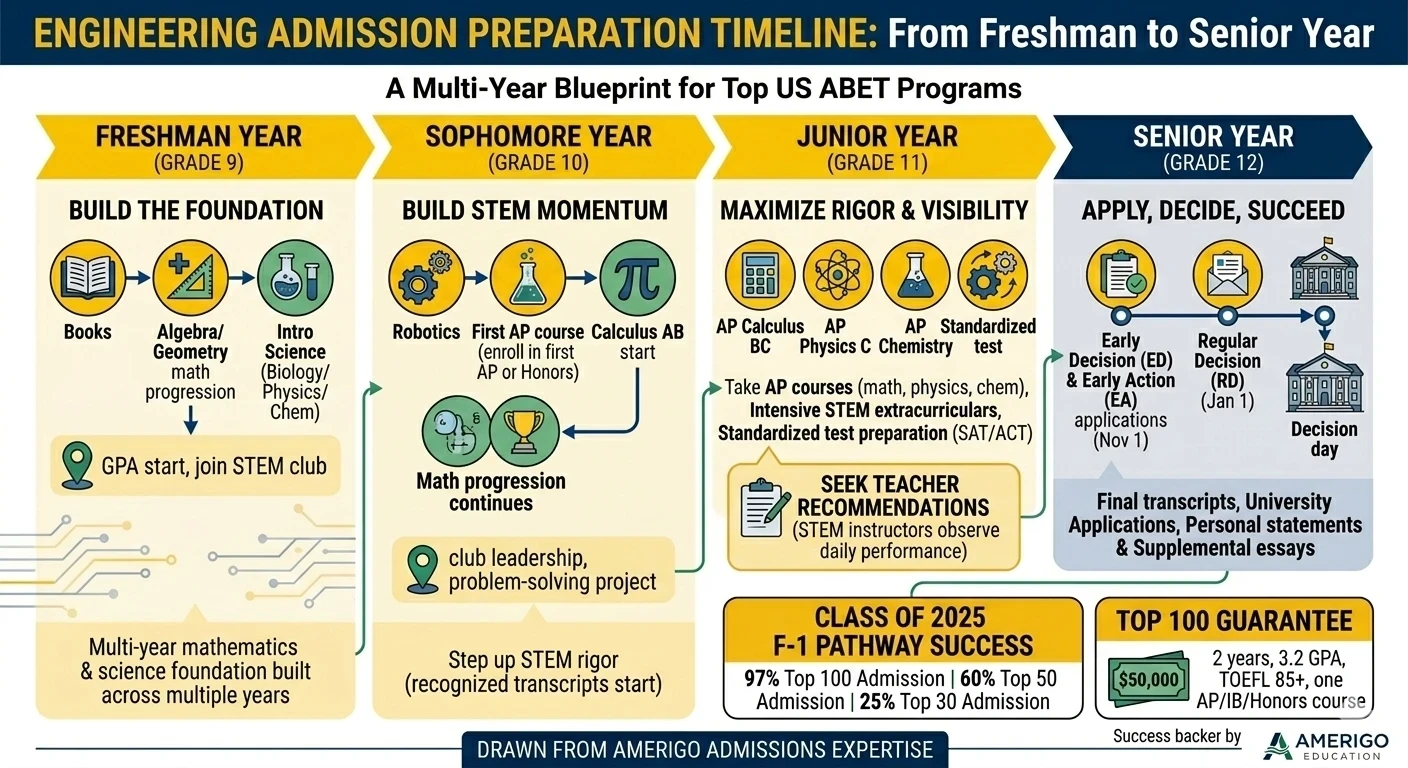
Leading F-1 (student visa for academic programs) pathway providers delivered 97% Top 100 university admission for Class of 2025, with 60% reaching Top 50 and 25% reaching Top 30.
The $50,000 Top 100 Guarantee provides financial backing for students meeting program requirements - two consecutive years, 3.2 GPA, TOEFL 85+, and one AP/IB/Honors course.
Which US Universities Lead in Engineering?
Top engineering universities share common strengths: ABET-accredited programs, dedicated research facilities, industry partnerships, and faculty conducting active research. Rankings from U.S. News evaluate faculty resources, research output, and student selectivity.
Among universities where Amerigo students have received acceptances, several maintain nationally recognized engineering schools. UC Berkeley's College of Engineering consistently ranks in the top 3 nationally. University of Michigan's College of Engineering and UIUC's Grainger College of Engineering both rank in the top 10. UCLA's Samueli School of Engineering, UC San Diego's Jacobs School, and Northwestern's McCormick School of Engineering rank within the top 20.
| University | Engineering School | Notable Strengths |
|---|---|---|
| UC Berkeley | College of Engineering | Computer science, electrical, mechanical |
| University of Michigan | College of Engineering | Aerospace, mechanical, industrial |
| UIUC | Grainger College of Engineering | Computer science, electrical, civil |
| UCLA | Samueli School of Engineering | Bioengineering, computer science |
| UC San Diego | Jacobs School of Engineering | Bioengineering, nanoengineering |
| Northwestern | McCormick School of Engineering | Biomedical, materials science |
| USC | Viterbi School of Engineering | Computer science, electrical |
Other top engineering schools include MIT, Stanford, Georgia Tech, Carnegie Mellon, and Caltech. Students should research programs by specific discipline rather than relying solely on overall rankings.
What High School Courses Prepare for Engineering?
Engineering admissions officers evaluate mathematics depth, science rigor, and technical coursework above all other academic factors. Students targeting engineering should complete the most advanced courses available at their school, particularly in mathematics and physics, building sequential foundations from freshman year.
The mathematics sequence matters most. Students should progress through Algebra II and Pre-Calculus into AP Calculus BC by junior or senior year. AP Physics C (Mechanics and Electricity & Magnetism) demonstrates college-level physics readiness. AP Chemistry and AP Computer Science A complete core preparation for most engineering disciplines.
8 Recommended Courses for Engineering Applicants:
- AP Calculus BC - essential for all engineering disciplines
- AP Physics C: Mechanics - demonstrates physics readiness for admissions
- AP Physics C: Electricity and Magnetism - valued by electrical and computer engineering programs
- AP Chemistry - required foundation for chemical and biomedical engineering
- AP Computer Science A - increasingly expected across all engineering fields
- AP Statistics - useful for data-driven engineering disciplines
- Pre-Calculus or Honors Algebra II - prerequisite foundation courses
- AP Environmental Science or AP Biology - supports environmental and biomedical tracks
Learn more about AP course planning for international students.
How Do Engineering Programs Evaluate Applicants?
Engineering admissions at Top 100 universities uses holistic review with emphasis on quantitative ability and STEM preparation. Admissions officers evaluate GPA strength, course rigor, standardized testing when submitted, extracurricular involvement, essays, and teacher recommendations.
According to NACAC (National Association for College Admission Counseling, 2024), course rigor ranks among the most important factors in selective university admissions. For engineering applicants specifically, this means completing advanced mathematics, physics, and computer science courses available at the student's school.
7 Factors Engineering Admissions Officers Evaluate:
- Mathematics achievement through AP Calculus BC completion
- Science depth across physics and chemistry
- GPA trajectory showing consistent academic improvement
- STEM-related extracurricular involvement and leadership roles
- Problem-solving ability demonstrated through competitions or projects
- English proficiency - TOEFL (Test of English as a Foreign Language) iBT 90-100+ or IELTS (International English Language Testing System) 7.0+
- Recommendation letters from STEM teachers who know the student's analytical abilities
| Evaluation Factor | Weight | What Officers Look For |
|---|---|---|
| Course Rigor | Very High | AP Calculus BC, AP Physics C, AP Computer Science |
| GPA | High | Strong unweighted with upward trajectory |
| STEM Activities | High | Competitions, research, technical projects |
| Test Scores | Moderate | SAT Math 750+/ACT Math 34+ when submitted |
| Essays | Moderate | Authentic engineering interest and problem-solving |
| Recommendations | Moderate | STEM teachers on analytical ability and curiosity |
What Extracurriculars Strengthen Applications?
Engineering programs value depth over breadth in STEM-related activities. Strong applicants demonstrate sustained commitment to technical projects, competitions, or research rather than surface-level participation across many clubs. Students should choose 3-5 core STEM activities and develop meaningful involvement over multiple years rather than joining many clubs briefly.
9 Extracurriculars That Strengthen Engineering Applications:
- FIRST Robotics or VEX Robotics competitions - hands-on engineering design
- Science Olympiad - tests knowledge across multiple STEM disciplines
- Mathematics competitions (AMC/AIME, MATHCOUNTS) - quantitative excellence
- Computer programming projects or hackathons - practical technical skills
- Science fair participation at regional or state level - independent research
- Engineering or STEM club leadership at school
- Online STEM coursework through university platforms
- Environmental or sustainability projects with measurable outcomes
- Peer tutoring in mathematics or science - demonstrates mastery and communication
Important for F-1 visa students: According to SEVP/ICE (2025), off-campus employment is restricted under F-1 regulations. Focus on school-based STEM activities, competitions, and academic projects rather than paid work.
Engineering Admission Timeline and Deadlines
Strategic preparation begins freshman year with course selection establishing mathematics and science foundations. Students should identify target engineering schools by sophomore year, allowing two full years to build program-specific profiles through advanced coursework and relevant extracurriculars.
Most engineering programs accept applications through the Common Application. Some universities require engineering-specific supplemental essays explaining interest in the discipline and chosen specialization. Research these requirements well before application deadlines.
| Timeline | Action | Engineering-Specific Notes |
|---|---|---|
| Freshman Year | Build GPA foundation, join STEM clubs | Start math progression toward calculus |
| Sophomore Year | Begin AP courses, deepen activities | AP Chemistry, start robotics/competitions |
| Junior Year | AP Calculus BC, AP Physics C | STEM leadership, begin test preparation |
| Summer Before Senior | Begin Common Application essays | Research engineering-specific supplements |
| October-November | Early Action/Decision applications | Verify engineering supplement deadlines |
| January | Regular Decision applications | Final deadline for most programs |
| March-April | Decisions released, compare offers | Evaluate labs, research, co-op programs |
How Does Structured Support Build Engineering Readiness?
Engineering admission requires multi-year preparation that international students benefit from having guided by advisors who understand both university expectations and international student challenges. Identifying the right AP course sequence, accessing STEM competitions, and building engineering-specific applications requires planning from freshman year.
Amerigo's on-campus support model embeds staff within partner schools for daily access to academic planning, prerequisite course sequencing for AP enrollment, and university counseling. Students preparing for engineering benefit from advisors who identify appropriate mathematics and physics progressions starting early.
The $50,000 Top 100 Guarantee requires two consecutive years, 3.2 GPA, TOEFL 85+, and one AP/IB/Honors course. S. Hong (St. Anthony's High School) improved from a GPA of 3.86 to 98.35 and was accepted to University of Illinois - home to Grainger College of Engineering, ranked in the top 10 nationally. Z. Chen (Justin-Siena High School) rose from 92 to 99.64 GPA and was accepted to UC Davis, which offers 14 ABET-accredited engineering programs.
Four accommodation options - including homestay for cultural immersion and off-campus residences with 24/7 supervision - provide stability for demanding STEM coursework. Monthly family reports in native languages keep parents informed. Learn more about program costs and inclusions.
Cost and Financial Considerations
Engineering degrees represent significant investment at both high school and university levels. Families should evaluate total cost including preparation program fees, university tuition, and potential financial aid when planning the full pathway from high school through university graduation.
F-1 pathway programs range from $40,000 for entry-level to $75,000-$110,000+ annually, covering partner school tuition, accommodation, academic support, and university counseling. Visa services are provided through third-party partners and billed separately from program fees.
Many engineering programs at public universities offer competitive tuition. Some provide merit-based scholarships for strong international STEM applicants. Students should research financial aid policies at target schools early, as policies vary and many institutions are need-aware for international applicants. Read about English proficiency development to strengthen admission and scholarship eligibility.
Frequently Asked Questions
What math level do engineering applicants need?
Top engineering programs expect AP Calculus BC completion by graduation. Students should begin the calculus track by junior year, completing Algebra II and Pre-Calculus beforehand. Some programs accept AP Calculus AB, but BC demonstrates stronger preparation. International students should work with advisors to map home-country curricula onto the US math sequence early.
Do engineering programs require SAT or ACT scores?
Many selective universities maintain test-optional policies, but competitive engineering applicants often submit strong math scores when available. SAT Math scores of 750+ or ACT Math of 34+ strengthen engineering applications. International students must also demonstrate English proficiency through TOEFL, IELTS, or Duolingo regardless of standardized test policies. Verify current requirements directly with target universities.
Which engineering discipline has the best career prospects?
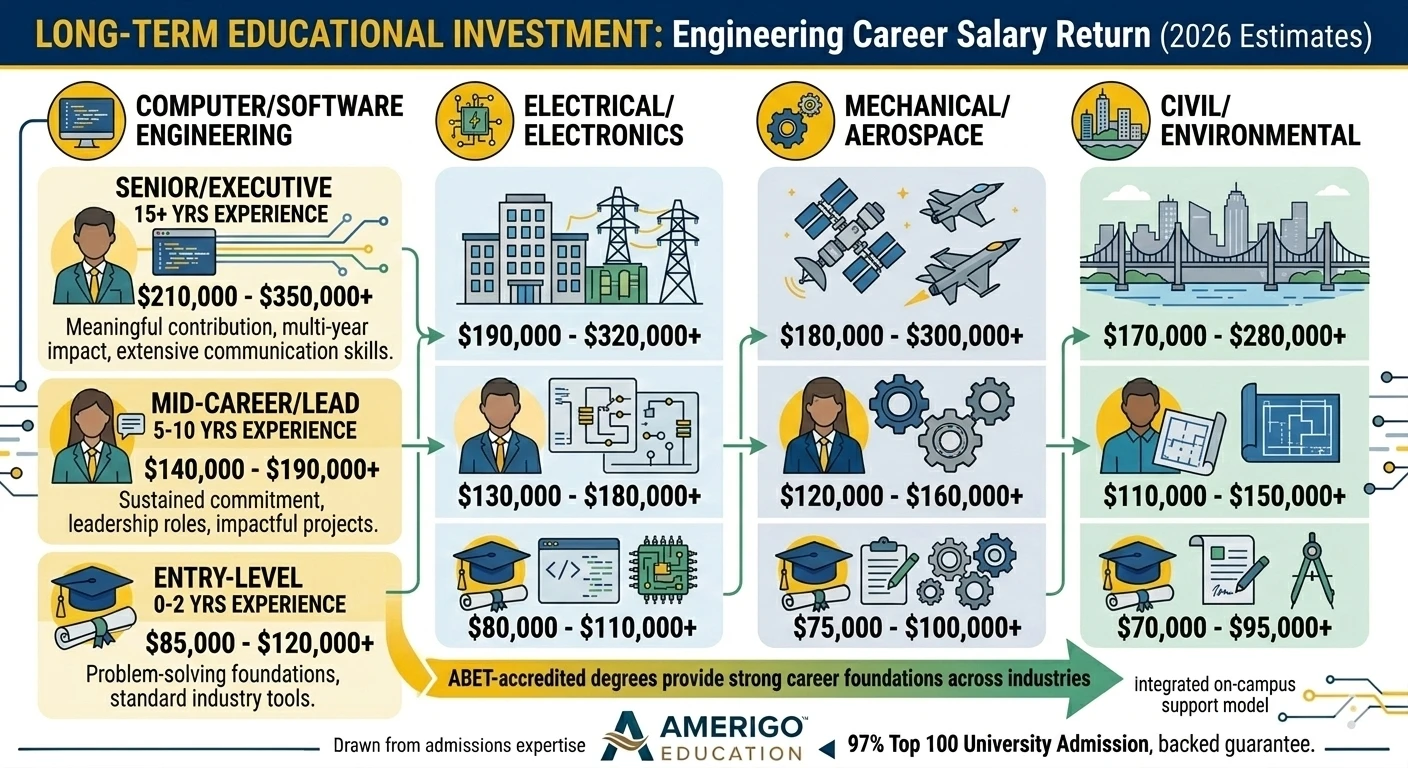
Computer science, electrical engineering, and mechanical engineering consistently show strong employment demand. According to the Bureau of Labor Statistics (BLS, 2025), engineering occupations are projected to grow steadily through 2032. Students should choose disciplines matching genuine interests rather than chasing projections, as all ABET-accredited engineering degrees provide strong career foundations across industries.
Can international students do research in high school?
Yes, many US high schools offer independent study or research mentorship programs. Students at schools with university connections may access introductory lab experiences or research shadowing. Science fair participation through regional competitions demonstrates research ability valued by engineering admissions officers. Focus on school-based opportunities that comply with F-1 visa activity guidelines.
How important are robotics competitions for admission?
Robotics demonstrates hands-on engineering skills that admissions officers value, but participation is not required for competitive applications. Students can demonstrate technical ability through programming projects, science competitions, mathematics achievements, or independent builds. Depth in any technical activity matters more than checking specific extracurricular boxes.
What English level do engineering applicants need?
Engineering programs at Top 100 universities typically require TOEFL iBT 90-100+ or IELTS 7.0+. Technical coursework demands strong reading comprehension and written communication skills. Students entering with developing English benefit from structured ELL (English Language Learning) progression, with 96% of B1 students at exclusive partnership schools achieving Top 100 university admission through multi-year preparation.
Do all engineering programs require physics?
Most engineering disciplines expect physics preparation, with AP Physics C: Mechanics providing the strongest admissions signal. Chemical engineering programs may weight chemistry more heavily. Biomedical engineering values biology alongside physics. Students should research specific prerequisites at target universities rather than assuming all programs share identical requirements.
When should students start preparing for engineering?
Freshman year course selection establishes the academic foundation. Students who delay advanced STEM courses until junior year may not complete the full AP Calculus BC and AP Physics C sequence that competitive engineering applications require. Early identification of engineering interest allows four years of progressive academic and extracurricular development.
People Also Read
How Many AP Courses Do International Students Need for Top US Universities in 2026? Guidance on AP course selection and recommended quantity for competitive university applications across different intended majors.
What to Look for in a US High School for International Students Key evaluation criteria for selecting the right US high school including academic quality, STEM course offerings, and support services.
International Student University Acceptance Rates: Improving Your Odds from High School Data-driven strategies for improving university admission outcomes through structured high school preparation and academic planning.
About the Author
Maria Chen writes about international education and university preparation on behalf of the Amerigo Education team. This guide draws on admissions expertise from counselors operating the on-campus international department at 40 Niche A+/A rated US and Canadian partner schools.
Conclusion
Engineering admission at Top 100 US universities requires multi-year preparation emphasizing advanced mathematics, physics, and sustained STEM extracurriculars. International students who attend US high schools with structured course progressions, daily academic support, and integrated university counseling build the profiles selective engineering programs expect.
The combination of recognized American transcripts, AP course portfolios, STEM competition experience, and detailed teacher recommendations gives F-1 pathway students measurable advantages. Programs like Amerigo that embed support within partner schools help students build the prerequisite sequences and preparation competitive engineering programs require.
Ready to Start Your Engineering Pathway?
Families exploring structured preparation for top engineering universities can contact Amerigo Education to learn about partner schools with strong STEM offerings and daily academic support. To begin the application process, visit the application page - most Signature schools offer rolling admissions with flexible English testing.
Disclaimer
This article provides general engineering admissions guidance for educational purposes. Admission requirements change annually. Verify current information with university admissions offices and consult qualified counselors. Contact us with questions.