All news
January 4, 2026
Study Abroad 101
What to Look for in a US High School for International Students
Evaluate US high schools for international students using 10 critical factors: proven outcomes (90%+ Top 100 admission), on-site staff, English support, accommodation quality, safety systems, and family communication. Learn what questions reveal program quality and guarantees.
%20(1).webp)
The most important factors when evaluating US high schools for international students are: proven university outcomes (ask for specific admission rates), on-site support staff (not remote management), comprehensive English support (for developing speakers), accommodation quality and options, safety systems, and family communication in your language. Programs that can demonstrate 90%+ Top 100 university admission rates, provide on-campus staff presence, and back their outcomes with guarantees offer the strongest foundation for your child's success.
This guide provides a detailed evaluation framework covering the 10 critical factors that separate programs where international students thrive from those where they struggle.
Why Evaluation Criteria Matter
Not all US high school options serve international students equally. The difference between a program designed for international student success and one that simply accepts international students can mean the difference between Top 50 university admission and struggling to find any placement.
Many families focus primarily on school prestige or location. While these matter, factors like support infrastructure, English development systems, and outcome accountability often determine success more than a school's name recognition.
The criteria below reflect what actually drives outcomes for international students—based on data, not marketing promises.
Factor 1: Proven University Outcomes
What to look for: Specific, verifiable university admission statistics—not vague promises.
Questions to Ask
- What percentage of international students were admitted to Top 100 universities?
- What about Top 50? Top 30?
- What outcomes do students with developing English achieve?
- Can you provide data for students at different entry levels?
Green Flags ✅
- Specific percentages provided readily — Programs confident in their outcomes share data openly
- Outcome data broken down by student profile — Shows they track and improve results systematically
- Results for developing English students — Demonstrates ability to transform students, not just accept already-strong ones
- 100% university placement — Every student finds a path forward
Red Flags 🚩
- Vague claims like "our students attend great universities"
- Unable or unwilling to provide specific statistics
- Only highlighting exceptional students (cherry-picking)
- No data for students who entered with challenges
Benchmark to Expect
Strong programs achieve 90%+ Top 100 admission rates. Amerigo Education's Class of 2025 achieved:
- 100% university acceptance
- 97% admitted to Top 100 universities
- 60% admitted to Top 50 universities
- 25% admitted to Top 30 universities
Students have been accepted to Duke, UCLA, NYU, Northwestern, Emory, UC Berkeley, University of Michigan, Washington University in St. Louis, and many other elite institutions.
Even more tellingly, 83% of students who entered with low-B1 English achieved Top 100 admission—proving the program transforms students regardless of starting point.
Factor 2: On-Site Support Staff
What to look for: Staff physically present at the school daily—not managing students remotely from another location.
Why This Matters
International students face challenges American students don't: language barriers, cultural confusion, homesickness, different academic expectations. When problems arise, they need immediate help from someone who understands their situation.
Remote management—staff in another city or country monitoring students through reports—cannot provide the immediate intervention that prevents small problems from becoming big ones.
Questions to Ask
- Where are your support staff located?
- Are staff on campus during school hours?
- Who does my child go to if they're confused about an assignment?
- What happens if my child has a problem during the school day?
Green Flags ✅
- Staff based directly on campus — Immediate access when needed
- Dedicated international student department — Specialized expertise, not generic school counselors
- Staff trained in cultural nuances — Understanding of challenges specific to your child's background
- Clear point of contact — Your child knows exactly who to approach
Red Flags 🚩
- Support staff located in a different city
- "We coordinate with the school" (means no on-site presence)
- Generic school counselors serving international students part-time
- Students must email or call for help rather than walk to an office
What Strong Programs Provide
Amerigo operates as the international department at partner schools—full-time staff based directly on campus providing immediate classroom support and daily presence. This on-site model delivers support unavailable at typical US high schools where international students are an afterthought.
Factor 3: English Language Support
What to look for: Structured ELL (English Language Learning) curriculum integrated into the school day—not just after-school tutoring.
Why This Matters
Many international students arrive with developing English skills. The question isn't whether they can improve—immersion guarantees improvement—but whether the program systematically accelerates that improvement while supporting academic success during the transition.
Questions to Ask
- What ELL curriculum do you use?
- How many hours of English instruction daily?
- Is ELL during school hours or after school?
- What's the progression system for advancing levels?
- How long until students typically join mainstream classes?
Green Flags ✅
- Integrated ELL during school day — Not competing with homework time
- Customized curriculum based on starting level — Appropriate challenge for each student
- Academic English focus — Preparing for university, not just conversation
- Clear progression system — Students know what advancement looks like
- Additional tutoring available — Extra support beyond classroom instruction
Red Flags 🚩
- "We offer English tutoring" (without structured curriculum)
- ELL only available after school
- One-size-fits-all English instruction
- No clear progression or level advancement system
- High English requirements with no support for developing students
Flexible Test Acceptance
Programs designed for developing English students accept flexible tests—not just TOEFL or IELTS.
Amerigo Signature schools accept:
- Eltis (designed for high school students)
- Duolingo English Test
- Lower TOEFL thresholds than traditional programs
This accessibility indicates a program built to develop English skills, not one that only accepts already-fluent students.
For more on English development, see how to improve English for international students.
Factor 4: Accommodation Options and Quality
What to look for: Multiple accommodation options with appropriate supervision for high school students (ages 14-18).
Why This Matters
Unlike college students, high school students need structured, supervised living environments. The right accommodation affects everything from academic performance to emotional wellbeing to safety.
Different families have different preferences and budgets. Quality programs offer options rather than one-size-fits-all solutions.
Questions to Ask
- What accommodation options do you offer?
- What supervision is provided?
- What's included in accommodation costs?
- How do you handle situations where a placement isn't working?
- What academic support is available in the living environment?
Accommodation Types to Consider
- Living with a local host family
- Deeper cultural immersion
- Usually more affordable
- Requires careful family matching
Residential (Off-Campus)
- Supervised residential buildings near school
- 24/7 staff presence
- Single-gender units for comfort and safety
- Dedicated study spaces with academic support
On-Campus Dormitories
- Traditional boarding experience
- Limited availability at most schools
- Integration with school campus
Self-Provided
- Family arranges independently
- Typically only appropriate if family has local connections
Green Flags ✅
- Multiple options offered — Families can choose what fits
- 24/7 supervision for residential students — Appropriate for minors
- Single-gender housing units — Safety and comfort prioritized
- Academic support regardless of housing type — Homestay students aren't disadvantaged
- Careful matching process — Not random placement
Red Flags 🚩
- Only one accommodation option with no flexibility
- Minimal supervision or "check-ins only"
- No academic support in living environment
- Housing arranged by third party with no program oversight
Understanding Off-Campus Residences
Many quality programs use off-campus residences—and this is often an advantage, not a limitation.
Amerigo's off-campus model enables access to top US day schools that don't offer traditional boarding. These schools often have stronger academics than remote boarding schools but historically couldn't serve international students needing housing.
Modern off-campus residences (typically 20-30 minutes from schools) feature:
- Single-gender units with 24/7 staff
- Dedicated common areas for group study with teacher support
- Facilities rivaling the best on-campus dorms
- Purpose-built for international student needs
Factor 5: School Quality and Rankings
What to look for: Verified quality indicators from independent sources—not just program marketing claims.
Questions to Ask
- What are the schools' Niche ratings?
- What academic programs are available (AP courses, dual enrollment)?
- What's the school's track record with international students?
- How selective is admission?
Green Flags ✅
- Niche A+ or A ratings — Independent quality verification
- 20+ AP courses available — Academic rigor for university preparation
- Dual enrollment opportunities — University-level coursework while in high school
- Years of international student experience — Established support systems
- Strong visa approval history — Schools known to immigration authorities
Red Flags 🚩
- Unable to provide independent rankings
- Limited AP or advanced course offerings
- New to accepting international students
- Vague descriptions of "excellent academics"
What Quality Looks Like
Amerigo's 40 partner schools are all rated Niche A+ or A. Partner schools include:
- A five-time National Blue Ribbon School (one of only six in the country)
- Top 17 Best Private K-12 School in America (Niche.com)
- Top 5% Best Private Schools in the US (Niche.com)
- Top 3% Best High Schools for Athletes in US (Niche.com)
All exclusive partnership schools offer 20+ AP courses and dual enrollment programs with institutions like UC San Diego, University of San Diego, University of Minnesota, and Milwaukee School of Engineering.
Factor 6: University Counseling Integration
What to look for: Comprehensive university counseling throughout high school—not just senior year college application help.
Why This Matters
University admission success begins years before applications are due. Course selection in 9th grade affects what's possible in 12th grade applications. Students need strategic guidance from day one, not last-minute application assistance.
Questions to Ask
- When does university counseling begin?
- What does counseling include beyond application help?
- How do counselors help with course selection for university goals?
- What's the counselor-to-student ratio?
- Do you help with test preparation strategy?
Green Flags ✅
- Counseling begins at enrollment — Strategic planning from the start
- Course selection guidance — Building the right transcript for target universities
- Application coaching — Essay review, interview preparation, school list development
- Timeline management — Keeping students on track across years
- Test strategy — SAT/ACT planning integrated with overall preparation
Red Flags 🚩
- "We help with applications senior year"
- Generic college counseling shared with American students
- No integration between academic planning and university goals
- Counseling is an add-on service at extra cost
Comprehensive Counseling Components
Amerigo's university counseling includes:
- Individualized academic planning aligned with university targets
- In-school support and academic advising
- Application coaching and essay review
- Interview preparation
- Parent communication throughout the process
- SAT/ACT schedules, registration support, and transportation to test centers
Factor 7: Safety Systems and Emergency Response
What to look for: Proactive safety measures and clear emergency protocols—not just reactive responses.
Why This Matters
Parents sending children across the world need confidence in safety systems. This goes beyond physical security to include emotional wellbeing monitoring, location awareness, and rapid response capabilities.
Questions to Ask
- What safety technology do you use?
- How can I track my child's location and safety?
- What's your emergency response protocol?
- Who is available if there's a problem at 2 AM?
- How do you monitor student wellbeing beyond academics?
Green Flags ✅
- Safety technology with parent access — Real-time awareness without intrusion
- 24/7 emergency assistance — Help available any time
- Proactive wellbeing monitoring — Not waiting for crises
- Clear emergency protocols — Staff know exactly what to do
- Local emergency contacts — Someone nearby, not overseas
Red Flags 🚩
- No parent visibility into student safety
- Emergency contact is an email address
- "The school handles emergencies" (no program-level response)
- No proactive monitoring of student wellbeing
What Strong Safety Looks Like
Amerigo employs safety technologies like Life360 or Reach that parents can access to track their student's safety and location in real time. Combined with:
- 24/7 emergency assistance
- On-campus staff during school hours
- 24/7 residential staff for residence students
- Stress and bullying intervention protocols
- Homesickness support systems
Factor 8: Family Communication
What to look for: Regular, structured communication in your language—not occasional updates only when problems arise.
Why This Matters
You're entrusting your child to a program across the world. You need to understand how they're doing—academically, socially, emotionally—without relying solely on what your teenager chooses to share.
Communication should be proactive and regular, not reactive and sporadic.
Questions to Ask
- How often will I receive updates?
- What do updates include?
- Can I communicate in my language?
- Who do I contact with concerns?
- How quickly can I expect responses?
Green Flags ✅
- Regular structured reports — Predictable communication rhythm
- Native language staff — Communication without barriers
- Multiple update types — Academic progress, social adjustment, emotional wellbeing
- Real-time outreach for urgent matters — Not waiting for scheduled reports when something's wrong
- Clear contact channels — You know exactly how to reach someone
Red Flags 🚩
- "We'll contact you if there's a problem"
- English-only communication
- Updates only available through student
- Vague communication promises without specifics
What Strong Communication Looks Like
Amerigo provides:
- Monthly reports for all homestay and residence students
- Real-time outreach when updates require immediate attention
- Local-language communication through staff in China, Vietnam, Korea, Mexico, and Taiwan
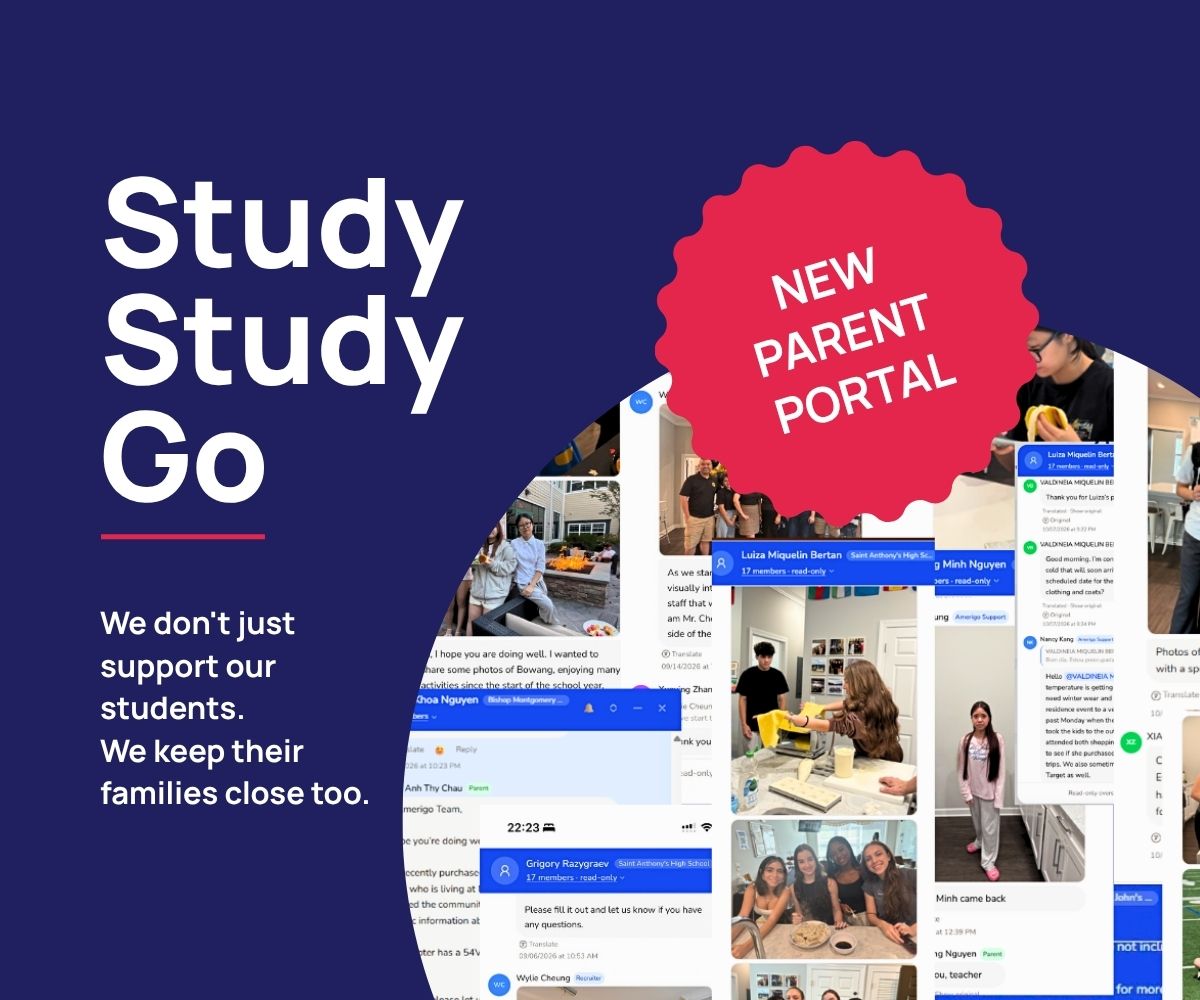
- Parent webinars and resources
- Direct access to on-campus staff
Factor 9: Outcome Guarantees and Accountability
What to look for: Programs willing to back their promises with financial guarantees—not just marketing claims.
Why This Matters
Any program can promise great outcomes. Programs that guarantee outcomes with financial backing demonstrate genuine confidence in their model—and accountability if they fall short.
Questions to Ask
- Do you guarantee university outcomes?
- What happens if my child meets requirements but doesn't achieve the guaranteed outcome?
- What are the requirements for guarantee eligibility?
- Is this guarantee in writing?
Green Flags ✅
- Written guarantee with specific terms — Clear accountability
- Financial refund policy — Real consequences for program if they fail
- Reasonable requirements — Achievable for committed students
- Transparent eligibility — You know exactly what's required
Red Flags 🚩
- "We're confident in our outcomes" (no guarantee)
- Guarantee with impossible requirements
- Vague guarantee language without specifics
- No financial backing to guarantee
What a Strong Guarantee Looks Like
Amerigo's Top 100 Guarantee includes a $50,000 USD refund policy:
Requirements:
- Minimum two consecutive years at same Amerigo Signature School
- Graduate with US high school diploma
- Minimum 3.2 GPA across all four years
- At least one AP/IB/Honors course
- TOEFL 85+ or equivalent
- Good attendance and behavior
- Complete all application steps as advised
If a student meets all requirements but receives no Top 100 offer: Amerigo refunds up to $50,000 USD in tuition fees.
This accountability demonstrates confidence in their model—and provides families with real protection.
Factor 10: Application Process and Accessibility
What to look for: Streamlined applications designed for international students—not bureaucratic barriers.
Why This Matters
Complex application processes with extensive requirements can exclude qualified students—especially those with developing English or limited access to testing centers. Programs designed for international students remove unnecessary barriers.
Questions to Ask
- What tests are required?
- Are recommendation letters required?
- Can I apply to multiple schools?
- What documents are needed?
- How long does the process take?
Green Flags ✅
- Flexible test acceptance — Eltis, Duolingo, not just TOEFL
- Minimal documentation requirements — Streamlined process
- No recommendation letters required — Reduces burden
- Multiple school applications through one process — Simplified access
- Rolling admissions — Flexibility in timing
Red Flags 🚩
- Only accepts TOEFL 80+ (excludes developing English students)
- Extensive recommendation letter requirements
- Separate applications for each school
- Rigid application deadlines with no flexibility
What Accessible Applications Look Like
- Accept flexible English tests including Eltis and Duolingo
- Most do NOT require recommendation letters
- Allow students to apply to multiple schools through one process
- Offer rolling admissions for flexibility
- Incur no extra costs for multiple school applications
This accessibility reflects a program designed to serve international students, not create barriers.
Evaluation Checklist: Summary
Use this checklist when comparing programs:
University Outcomes — Ask what percentage reach Top 100 and Top 50. Look for 90%+ Top 100 rates with data for all student profiles.
On-Site Support — Ask where staff are located. Look for staff physically on campus daily.
English Support — Ask about ELL curriculum and scheduling. Look for integrated instruction during the school day with clear progression.
Accommodation — Ask about options and supervision levels. Look for multiple options, 24/7 supervision, and academic support regardless of housing type.
School Quality — Ask about Niche ratings and AP courses. Look for A+/A ratings and 20+ AP courses available.
University Counseling — Ask when counseling starts and what's included. Look for support that begins at enrollment with comprehensive services.
Safety Systems — Ask about technology and 24/7 availability. Look for parent-accessible tracking and round-the-clock emergency response.
Family Communication — Ask how often you'll hear from them and in what language. Look for monthly reports and native language staff.
Outcome Guarantees — Ask if there's a written guarantee with financial backing. Look for specific terms and a refund policy.
Application Process — Ask about required tests and recommendation letters. Look for flexible test acceptance and a streamlined process.
Frequently Asked Questions
What's the most important factor when choosing a US high school for international students?
University outcomes with verifiable data. Programs should provide specific percentages—not vague promises—for Top 100, Top 50, and Top 30 admission rates. Strong programs achieve 90%+ Top 100 admission. Equally important: ask about outcomes for students who entered with challenges (developing English, average grades). Programs that transform students demonstrate more value than those that only succeed with already-strong students.
How do I verify a program's claims about university outcomes?
Ask for specific statistics: What percentage of last year's graduates were admitted to Top 100 universities? Top 50? Request data broken down by student starting profile. Ask for names of universities students were accepted to. Legitimate programs share this information readily. Programs that deflect, provide vague answers, or only highlight exceptional cases may not have strong overall outcomes.
Should I choose a boarding school or pathway program?
Pathway programs with partner schools often provide advantages over traditional boarding schools. Traditional boarding schools are frequently located in remote areas, have limited international spots, older facilities, and highly selective admissions. Pathway programs like Amerigo enable access to top US day schools (which typically don't offer boarding) while providing modern accommodation and comprehensive support designed for international students.
Is homestay or residential housing better for international students?
Neither is universally better—they serve different needs. Homestay offers deeper cultural immersion and is usually more affordable. Residential housing provides more structured supervision with 24/7 staff. Quality programs offer both options with academic support regardless of housing type. The right choice depends on your child's personality, independence level, and family preferences.
How important is on-campus staff presence?
Critical. International students face unique challenges—language barriers, cultural confusion, different academic expectations—that require immediate support. Programs with staff physically on campus can intervene quickly when problems arise. Remote management (staff in another city) cannot provide the same immediate assistance. Ask specifically where support staff are located and what happens when your child needs help during the school day.
What English level does my child need for US high school?
B1 or low-B1 is typically sufficient for programs with comprehensive English support. Programs requiring TOEFL 80+ are designed for already-fluent students. Quality pathway programs accept flexible tests (Eltis, Duolingo) and provide structured ELL curriculum to develop English skills. Amerigo's data shows 83% of low-B1 students achieved Top 100 university admission—proving that starting level matters less than quality of support.
How can I communicate with the program if I don't speak English?
Quality programs employ native-language staff specifically for family communication. Ask whether staff speak your language and how communication works. Amerigo has staff members in China, Vietnam, Korea, Mexico, and Taiwan providing local-language support. Programs offering only English communication create barriers for families and may struggle to convey nuanced concerns about your child.
What should be included in program fees vs. billed separately?
Typically included: Tuition, accommodation management, academic support, university counseling, SAT/ACT preparation, 24/7 emergency assistance, family communication. Typically separate: Visa services (through third-party partners), international travel, personal expenses, and sometimes health insurance. Ask for complete breakdowns—programs with many "additional fees" may cost more than transparent all-inclusive pricing.
Are outcome guarantees meaningful or just marketing?
Guarantees with financial backing demonstrate real accountability. Amerigo's Top 100 Guarantee includes a $50,000 USD refund if students meet requirements but don't receive a Top 100 offer. This financial commitment indicates confidence in their model. Guarantees without financial backing, with impossible requirements, or with vague language provide less meaningful accountability.
How long should my child study in the US before applying to universities?
Minimum two years is recommended for meaningful preparation. Students need time to adapt, develop English (if entering with developing skills), build academic records, and prepare applications. One year is typically insufficient for significant transformation. The Top 100 Guarantee requires minimum two consecutive years—reflecting the time needed for genuine preparation.
Making Your Decision
Choosing a US high school for your child is one of the most significant educational investments you'll make. The right program transforms potential into achievement; the wrong one wastes years and money.
Use this evaluation framework to compare options systematically. Ask hard questions. Demand specific data. Look for programs willing to back their promises with accountability.
Amerigo Education, founded in 2016 and backed by Avathon Capital, meets all criteria outlined in this guide:
- Outcomes: 97% Top 100 admission (Class of 2025), including 83% of low-B1 English students
- On-site support: On-campus international department with staff present daily
- English support: Integrated ELL curriculum; accepts Eltis and Duolingo
- Accommodation: Four options including homestay and supervised residences
- School quality: 40 Niche A+/A partner schools with 20+ AP courses
- University counseling: Comprehensive support from enrollment through acceptance
- Safety: Life360/Reach technology; 24/7 emergency assistance
- Communication: Monthly reports; staff in China, Vietnam, Korea, Mexico, Taiwan
- Guarantee: Top 100 Guarantee with $50,000 USD refund policy
- Application: No recommendation letters; flexible tests; streamlined process
Approximately 1,000 students from 11 countries across US and Canada programs trust Amerigo's model. Their transparency about outcomes, comprehensive support systems, and financial accountability provide a benchmark for evaluating any program.
Your child deserves a program that meets every criterion—not one that asks you to compromise.
This guide provides general evaluation criteria. Every family's priorities differ—contact Amerigo Education to discuss your specific situation and learn how their approach addresses what matters most to you, or apply now to begin your child's journey.