All news
February 20, 2026
Study Abroad 101
Scholarships for International Students in the US
International students can access merit scholarships at US universities. Learn scholarship types, requirements, and how high school preparation improves eligibility.

Last Updated: February 2026
Scholarships for international students are financial awards that reduce the cost of attending US universities, granted based on academic merit, financial need, or specialized talent. According to NACAC (National Association for College Admission Counseling, 2024), financial considerations rank among the top factors international families weigh when selecting universities, yet many families are unaware of scholarship options available to non-US citizens on F-1 (student visa for academic programs) visas. Understanding categories, eligibility, and application strategy before senior year helps families maximize financial opportunities.
Amerigo Education operates as the on-campus international department at 40 Niche A+/A rated US and Canadian partner schools. The Class of 2025 achieved 97% Top 100 university admission, and the strong academic profiles driving those acceptances also position students competitively for merit scholarship consideration at target universities.
Key Takeaways
Merit-based scholarships represent the primary financial aid option for international students, awarded based on GPA (Grade Point Average), test scores, extracurriculars, and demonstrated academic achievement.
Most public US universities offer limited financial aid to international students, while many private universities maintain dedicated international scholarship programs ranging from $5,000 to full tuition.
Strong high school preparation including AP (Advanced Placement) coursework, high GPAs, and meaningful extracurriculars directly increases merit scholarship competitiveness at target universities.
International students on F-1 visas are not eligible for FAFSA (Free Application for Federal Student Aid) federal financial aid, making institutional merit awards and external scholarships essential alternatives.
The $50,000 Top 100 Guarantee provides separate financial protection backing university admission outcomes independently of scholarship awards..
What Scholarship Types Exist for International Students?
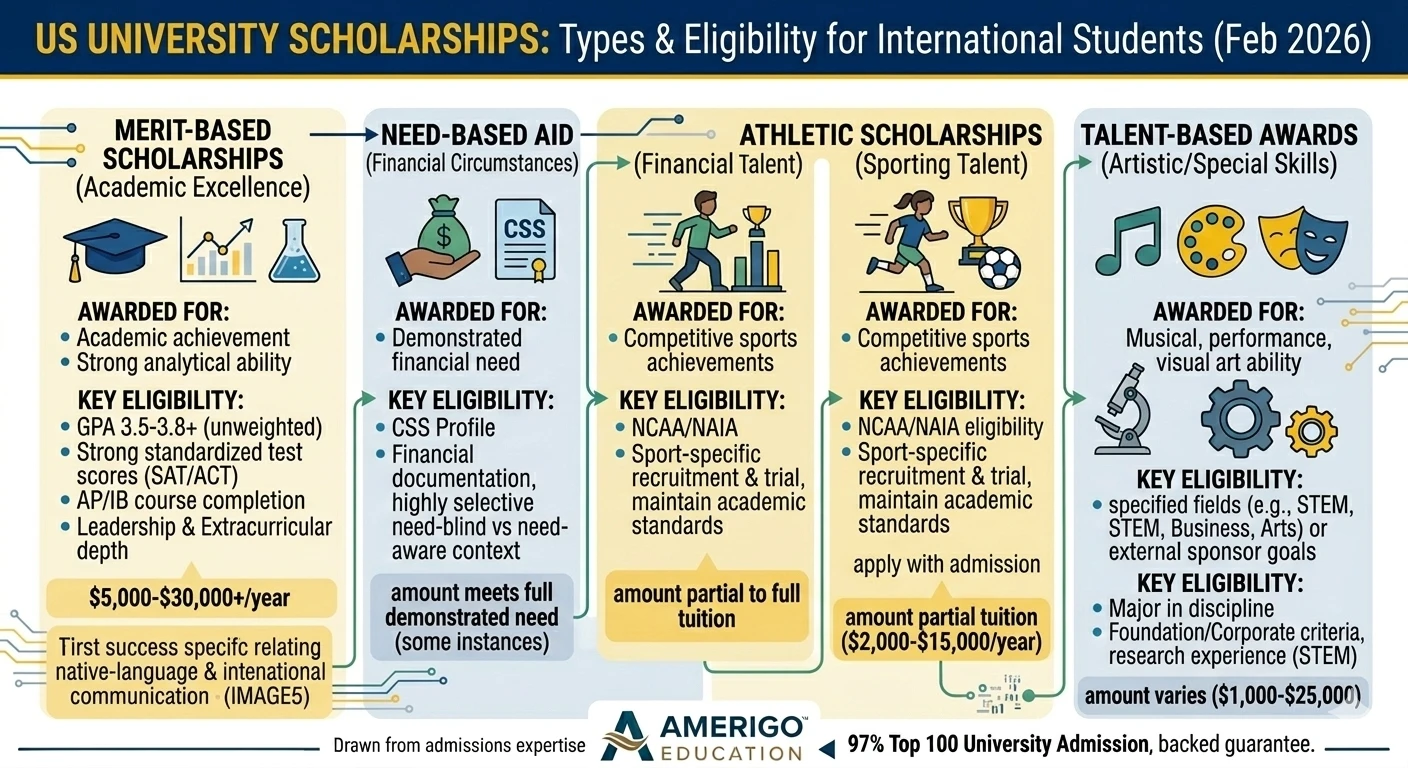
International students can access several scholarship categories at US universities, though availability differs significantly from what domestic students receive. Merit-based scholarships, awarded for academic or extracurricular achievement, represent the most accessible category for F-1 visa holders because they do not depend on citizenship status.
Need-based aid from US universities is available to international students at some private institutions, but most universities are need-aware for international applicants, meaning financial need may influence admission decisions. A small number of highly selective universities maintain need-blind policies regardless of citizenship, though these represent exceptions rather than the norm. Athletic and talent-based scholarships exist for students with competitive sports achievements or artistic portfolios meeting NCAA or NAIA standards.
8 Scholarship Types Available to International Students:
- University merit scholarships - awarded for academic excellence based on GPA and test scores
- University need-based grants - available at select private institutions through CSS Profile
- Department-specific awards - offered by academic programs in engineering, business, or arts
- Athletic scholarships - for NCAA or NAIA-eligible athletes in recognized sports
- Talent-based awards - for performing arts, visual arts, or music program applicants
- External organization scholarships - from foundations, corporations, and cultural organizations
- Country-specific awards - scholarships targeting students from particular nations or regions
- STEM research scholarships - for students demonstrating scientific research ability
| Scholarship Type | Availability | Amount Range | Key Requirement |
|---|---|---|---|
| Merit-Based | Most private universities | $5,000-$30,000+/year | Strong GPA + test scores |
| Need-Based | Select private universities | Varies by income | CSS Profile submission |
| Athletic | NCAA/NAIA schools | Partial to full tuition | Sport-specific recruitment |
| Department | Varies by university | $2,000-$15,000/year | Major-specific qualifications |
| External | Various organizations | $1,000-$25,000 | Organization-specific criteria |
Scholarship amounts are approximate ranges. Verify specific amounts with universities and organizations.
Which US Universities Offer International Scholarships?
Private universities generally offer more financial aid to international students than public institutions. Many private universities maintain dedicated scholarship funds, while most public universities direct limited aid budgets toward domestic students. This makes private university scholarship policies particularly important for international families to research.
Some highly selective private universities commit to meeting demonstrated financial need for admitted international students, though policies change annually. Less selective private universities often use merit scholarships to attract strong international applicants, making mid-tier private schools potentially more generous than top-ranked institutions. Liberal arts colleges frequently offer competitive merit packages to international students seeking smaller campus environments.
Universities listed in the International Education Financial Aid (IEFA) database provide searchable scholarship information organized by country, field, and award type. Students should begin research no later than junior year.
| University Type | International Aid | Strategy |
|---|---|---|
| Top 20 Private | Some meet full need | Apply if competitive; verify policies |
| Top 20-50 Private | Merit + need-based common | Strong profiles earn consideration |
| Public Flagship | Limited international aid | Target merit awards specifically |
| Private LACs | Often generous merit packages | Research smaller schools with merit aid |
How Does High School Preparation Affect Scholarships?
High school academic preparation directly influences merit scholarship eligibility at US universities. Admissions offices that award merit scholarships evaluate the same factors driving selective admissions: GPA strength, course rigor, test scores, and extracurricular depth. Students who build strong admission profiles simultaneously build profiles earning financial recognition.
AP course completion strengthens scholarship applications. Universities view AP coursework as evidence of college readiness and intellectual ambition. Students completing 6-10 AP courses with strong grades demonstrate the rigor scholarship committees seek. TOEFL (Test of English as a Foreign Language) or IELTS (International English Language Testing System) scores above minimum requirements also strengthen merit consideration.
7 Steps to Strengthen Scholarship Competitiveness:
- Maintain the highest possible GPA across all four high school years
- Complete 6-10 AP courses demonstrating subject depth and challenge
- Achieve TOEFL iBT 100+ or IELTS 7.5+ to exceed admission minimums
- Develop 3-5 meaningful extracurricular commitments with leadership progression
- Build teacher relationships producing detailed recommendation letters
- Research scholarship-specific essays and requirements early
- Apply to 10-15 universities including those known for international merit aid
Amerigo's academic planning model ensures prerequisite completion for advanced coursework, positioning students for both selective admissions and scholarship consideration. Learn more about AP course planning for international students.
Merit Scholarship Requirements and Application Tips
Merit scholarships at most universities require no separate application beyond the standard admission process. Universities automatically consider admitted students for awards based on application strength. Some institutions require additional scholarship essays, portfolio submissions, or separate forms with earlier deadlines than standard admission.
Common requirements include unweighted GPAs above 3.5-3.8, standardized test scores in the 90th percentile or higher when submitted, demonstrated leadership in extracurricular activities, and strong recommendation letters. Most merit scholarships are renewable annually provided students maintain minimum GPA requirements, typically 3.0-3.5.
Students should identify universities offering automatic merit consideration alongside those requiring separate applications. Check each university's financial aid page for international-specific information. Read about improving English proficiency to meet scholarship-level requirements.
What Role Do Test Scores Play in Scholarship Awards?
SAT (standardized admission test) and ACT scores remain important for merit scholarship consideration at many universities, even at test-optional institutions. Some universities automatically award scholarships at specific score thresholds regardless of other factors. Strong math scores particularly influence STEM scholarship consideration.
English proficiency scores above admission minimums also strengthen candidacy. TOEFL iBT 100+ or IELTS 7.5+ signals academic readiness scholarship committees value. Students with ELL (English Language Learning) backgrounds who achieve these scores demonstrate growth trajectory admissions offices recognize.
| Test | Scholarship-Competitive Score | Notes |
|---|---|---|
| SAT Total | 1400+ | Math section important for STEM awards |
| ACT Composite | 32+ | Strong across all sections |
| TOEFL iBT | 100+ | Above admission minimum signals strength |
| IELTS | 7.5+ | Above admission minimum signals strength |
| AP Exams | 4-5 on multiple subjects | Demonstrates college-level mastery |
Important for F-1 visa students: According to SEVP/ICE (2025), international students on F-1 visas are not eligible for FAFSA federal aid. Focus research on institutional merit awards, CSS Profile-based grants at participating universities, and external organization scholarships.
How Should Families Plan Scholarship Applications?
Scholarship planning should begin no later than junior year. Many deadlines fall before or alongside regular admission deadlines, and some require materials beyond standard applications. Families who research early avoid missing deadlines for their strongest scholarship matches.
The IEFA database provides searchable listings organized by country of origin, intended major, and award type. University financial aid pages list institution-specific awards. External organizations including cultural foundations, corporate sponsors, and international education nonprofits offer additional programs.
6 Scholarship Planning Steps:
- Research university-specific international scholarship pages by end of sophomore year
- Create a tracking spreadsheet listing deadlines, requirements, and materials needed
- Identify external scholarships through IEFA and country-specific education organizations
- Prepare CSS Profile for universities using it to assess international need
- Draft scholarship-specific essays during the summer before senior year
- Submit all materials one week before deadlines to avoid technical issues

Financial Planning Beyond Scholarship Awards
Scholarships reduce but rarely eliminate university costs. Families should develop financial plans covering the full pathway from high school through university graduation, including expenses scholarships typically exclude: travel, personal costs, health insurance, and visa services.
F-1 pathway programs range from $40,000 for entry-level to $75,000-$110,000+ annually, covering tuition, accommodation, academic support, and university counseling. Visa services through third-party partners are billed separately. Amerigo's $50,000 Top 100 Guarantee provides separate financial protection for university outcomes, requiring two consecutive years, 3.2 GPA, TOEFL 85+, and one AP/IB/Honors course.
Four accommodation options - including homestay for cultural immersion at typically lower cost and off-campus residences with 24/7 supervision - help families manage preparation costs. T. Nguyen (Mater Dei Catholic High School) improved from 3.83 to 4.57 GPA and was accepted to University of Virginia. Y. Li (St. Anthony's High School) improved from 3.57 to 3.70 GPA and was accepted to University of Florida. Both profiles represent academic achievement that strengthens scholarship candidacy. Learn more about program costs and inclusions.
Frequently Asked Questions
Can international students get financial aid at US universities?
Yes, though options differ from domestic students. F-1 visa holders are not eligible for FAFSA federal aid. Many private universities offer institutional merit and need-based grants to international students. Some highly selective schools meet full demonstrated need. Public universities generally provide limited international aid. Research each university's international financial aid policy directly before applying.
What is the CSS Profile and do international students need it?
The CSS Profile is a financial aid application used by approximately 400 US institutions to assess need beyond FAFSA. Some private universities require international students to submit it for need-based consideration. Not all universities use the CSS Profile, so check specific financial aid pages for requirements. The application requires detailed family financial documentation.
How much can merit scholarships cover?
Merit scholarship amounts vary from $2,000 annually to full tuition coverage depending on the university and student profile. Most institutional merit awards range from $5,000 to $30,000 per year. Full-tuition merit scholarships exist but are highly competitive. Students should apply to multiple universities to maximize merit opportunities across schools.
Do international students qualify for athletic scholarships?
Yes, international students can receive NCAA and NAIA athletic scholarships meeting eligibility requirements including academic standards and sport-specific recruitment. Awards range from partial to full tuition coverage. Student-athletes must maintain academic eligibility throughout enrollment. Contact university athletic departments directly for recruitment timelines and requirements.
When should scholarship research begin?
Begin researching university-specific international scholarships by end of sophomore year. External scholarship databases should be reviewed by spring of junior year. Many deadlines fall between October and February of senior year. Starting early ensures families identify all opportunities and prepare required materials without rushing before deadlines.
Are scholarships renewable each year?
Most institutional merit scholarships are renewable annually provided students maintain specified GPA requirements, typically 3.0-3.5. Some awards have additional conditions including full-time enrollment and satisfactory academic progress. Review renewal terms carefully before accepting any scholarship to understand long-term financial implications across all four university years.
Do AP scores affect scholarship eligibility?
Strong AP exam scores of 4-5 demonstrate college-level mastery scholarship committees value, though most awards are based on overall application strength rather than individual AP results. AP course enrollment matters more than exam scores for many merit considerations, as it demonstrates willingness to pursue academic challenge and intellectual curiosity.
Can students earn scholarships after university freshman year?
Some universities offer merit awards to current students based on academic performance during enrollment. Transfer scholarships exist at certain institutions for students changing schools. External organization scholarships often accept applications regardless of enrollment year. Students who improve academically may become eligible for awards unavailable at initial admission.
People Also Read
How to Calculate the True ROI of High School Study Abroad Framework for evaluating return on investment of international high school education including university outcomes and career earnings.
Study Abroad Program Red Flags: What to Avoid When Selecting High School Placement Warning signs indicating a study abroad program may not deliver on financial or academic promises.
Boarding School vs Day School for International Students: Complete Comparison Guide 2026 Compare boarding and day school models including cost differences, academic access, and support structures.
About the Author
Maria Chen writes about international education and university financial planning on behalf of the Amerigo Education team. This guide draws on program expertise from staff operating the on-campus international department at 40 Niche A+/A rated US and Canadian partner schools.
Conclusion
Scholarship opportunities for international students span merit-based university awards, need-based institutional grants, athletic scholarships, and external organization funding. While F-1 visa holders cannot access FAFSA federal aid, strong academic profiles built through rigorous high school preparation open doors to meaningful financial support at target universities.
The achievements that earn Top 100 university admission - strong GPAs, AP course portfolios, competitive test scores, and meaningful extracurriculars - simultaneously strengthen merit scholarship applications. Programs like Amerigo that build these profiles through structured multi-year preparation position students for both selective admissions and financial recognition of their academic work.
Start Planning Your University Pathway
Families exploring structured preparation that builds scholarship-competitive profiles can contact us for information about partner schools, academic support, and university counseling. To begin the application process, visit the application page - most Signature schools offer rolling admissions with flexible English testing.
Disclaimer
This article provides general scholarship guidance for educational purposes. Scholarship availability, amounts, and requirements change annually. Verify information with universities and scholarship organizations. Contact us with questions.