All news
April 22, 2026
Study Abroad 101
International Student Mental Health: Support Guide for Families and Schools
International student mental health guide for families. Covers homesickness, support models, and how Amerigo's on-campus team protects student wellbeing 24/7.

Last Updated: April 2026
International student mental health refers to the emotional, psychological, and social wellbeing of students who relocate abroad for education, particularly during the formative years of high school. According to the American Psychological Association, adolescents who experience major life transitions, such as moving to a new country, face elevated risk of anxiety, loneliness, and adjustment difficulties, particularly within the first twelve months. For students aged 14 to 18 studying in the United States, this is not a niche concern: it is a predictable part of the process that families and schools must plan for.
Amerigo Education partners with 40 Niche A+/A rated schools across the US, Canada, and the UK, supporting 3,500+ students from 55+ countries. The Class of 2025 achieved 97% admission to Top 100 US universities. Amerigo's on-campus international department provides dedicated emotional and social support for every student, regardless of accommodation type.
Key Takeaways
- Homesickness is normal and temporary: Most students experience a difficult adjustment period in the first semester. With the right support structures in place, this typically resolves within the first year.
- The support model matters as much as the school: Programs that embed staff on-campus and maintain family communication are better positioned to identify and respond to early warning signs than placement-only models.
- Native-language communication reduces isolation: Amerigo staff in China, Vietnam, Korea, Mexico, the Taiwan Region, and more allow both students and parents to flag concerns in their first language.
- Academic pressure and emotional health are closely linked: Struggling students rarely show academic or emotional problems in isolation. Identifying one usually surfaces the other.
- 24/7 emergency support is not optional: For students aged 14 to 18 living away from home, round-the-clock emergency access is a baseline safety requirement, not a premium feature.
Why Do International Students Struggle Emotionally?
International high school students face a combination of stressors that older university students do not: they are navigating a new country, a new language, a new school culture, and the developmental pressures of adolescence simultaneously. The APA's research on adolescent resilience highlights that young people without established social support networks are significantly more vulnerable to anxiety and depression following major life transitions.
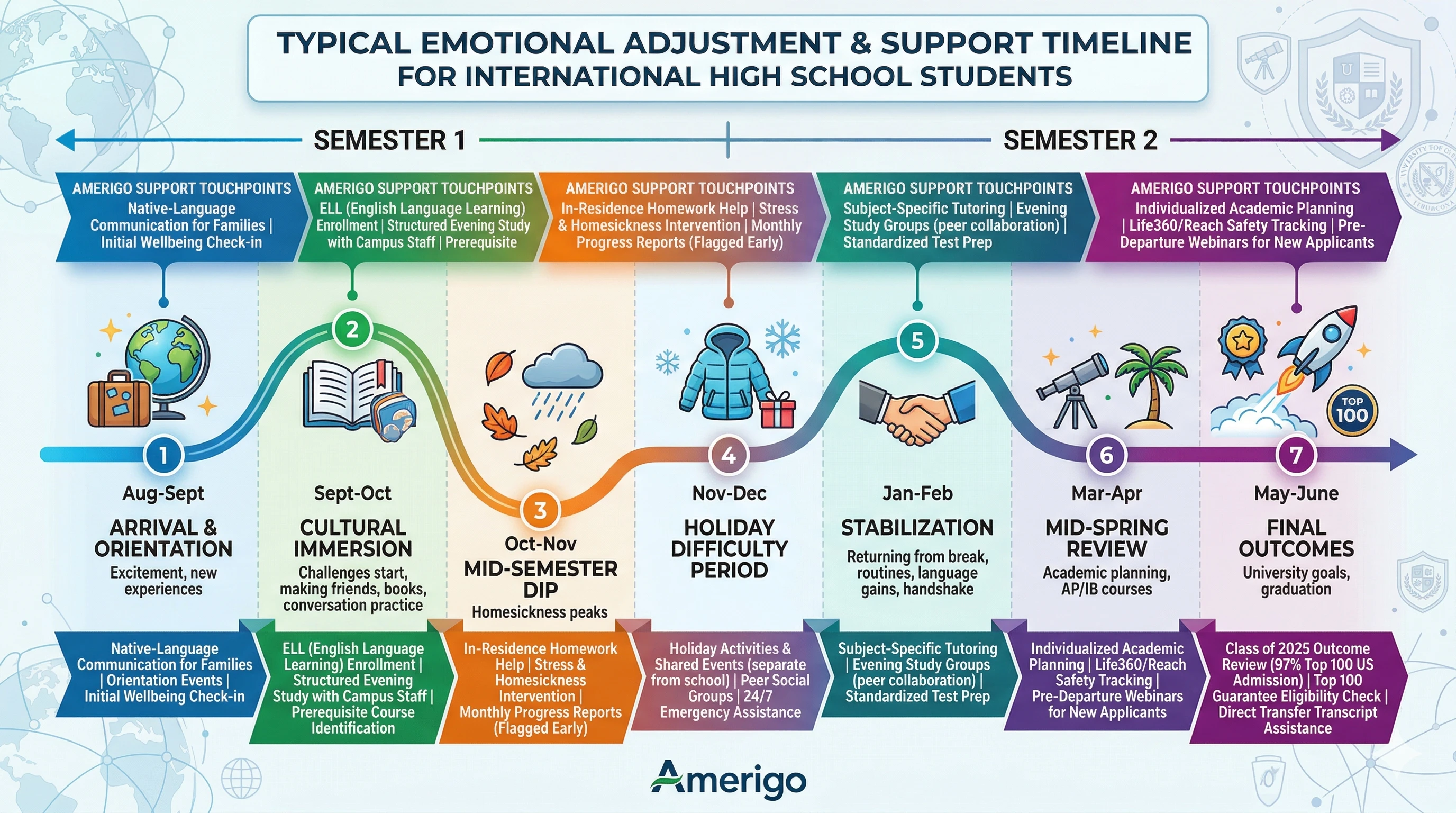
For international high school students specifically, the emotional challenges tend to cluster around three distinct phases. The first is the arrival period, typically the first four to eight weeks, when excitement gives way to the reality of being far from home. The second is mid-semester, when academic workload intensifies and the novelty of the new environment wears off. The third is around major holidays such as Thanksgiving and Christmas, when students see classmates return to families while they remain in the US. Each of these phases is predictable and manageable when a structured support system is already in place before the student arrives.
What Does Effective Mental Health Support Look Like?
Effective support for international student mental health is proactive, not reactive. It means staff who know the student by name before a crisis happens, not a hotline number given at orientation. For high school students, this requires on-site presence, consistent family communication, and the ability to identify early warning signs before they escalate.
Amerigo's model embeds staff directly on campus at each of its 40 partner schools through the on-campus international department. These staff members interact with students daily, observe their classroom engagement and social behavior, and can refer students to appropriate professional support when needed. Amerigo does not position itself as a mental health provider, its role is to maintain a close-enough relationship with each student to notice when something is wrong, and to connect families and students with the right help quickly. Monthly progress reports and school activity calendars are shared with parents, and real-time outreach happens when a situation requires immediate attention.
How Does Homesickness Differ at 15 vs 20?
Homesickness at 15 is a fundamentally different experience from homesickness at 20, and the support required is different too. A 15-year-old does not yet have the adult coping repertoire, the financial independence, or the established identity that makes distance from home manageable for older students.
Adolescents are still in the process of forming their sense of identity, which makes being removed from familiar social environments more destabilizing than it would be for a mature adult. Research published by the APA notes that parental separation during adolescence can elevate cortisol levels and contribute to sustained emotional dysregulation if not managed with appropriate support. This is precisely why structured residential environments with on-site adult supervision, rather than independent housing arrangements, are the appropriate model for students under 18. Amerigo's residences maintain 24/7 staff supervision, provide dedicated common areas for students and their friends to socialize, and organize student events specifically to reduce social isolation.
What Support Does Amerigo Provide Directly?
Amerigo provides structured emotional and social support as part of its standard program, built into the daily experience rather than offered as an add-on. The core support components available to all students include stress and bullying intervention, homesickness support, birthday celebrations and holiday activities, and 24/7 emergency assistance. Students are not left to self-identify when they need help, Amerigo staff are in regular contact with students through the school day and residential life.
For homestay students, academic and wellbeing support is provided at the on-campus international department office at school. For residential students, dedicated common areas allow group study and informal connection with teachers and staff who are present in the residence. Amerigo also organizes social events for students and their friends, separate from school-organized activities, specifically to help students build meaningful social relationships outside the classroom. Parents are kept informed through monthly progress reports and school activity calendars, with real-time outreach when any student requires more immediate attention.
How Do Support Models Compare?
Not all international student programs provide the same level of emotional support. The table below compares the key support components across different program models families might encounter when choosing a high school placement for their child.
| Support Feature | Amerigo (On-Campus Model) | Placement-Only Agency | Traditional Boarding School |
|---|---|---|---|
| On-campus dedicated staff | Yes, daily presence | No | Shared with all students |
| 24/7 emergency assistance | Yes | No | Varies by school |
| Native-language parent communication | Yes (Chinese, Korean, Vietnamese, and more) | Sometimes | Rarely |
| Homesickness and stress intervention | Yes, structured program | No | Varies by school |
| Monthly family progress reports | Yes + school activity calendars | No | Varies by school |
| Real-time parent outreach for urgent issues | Yes | No | Varies by school |
| Safety location tracking (Life360 / Reach) | Yes | No | No |
| Social events for students and their friends | Yes, Amerigo-organized | No | School events only |
What Can Parents Do to Support Wellbeing Remotely?
Parents play a critical role in their child's mental health, even from thousands of miles away. The most important thing a parent can do is maintain regular, low-pressure communication that is not dominated by academic performance questions. Students who feel that every call from home will involve interrogation about grades are less likely to reach out when they are struggling emotionally.
Ask open questions about daily life, friendships, and what the student is enjoying rather than only checking in on school results. Use the monthly progress reports and school activity calendars that Amerigo provides to stay informed about academic standing without needing the student to be the sole source of that information. If a parent notices a change in the student's communication patterns, including becoming more withdrawn, shorter in responses, or avoiding calls, this is worth raising directly with the Amerigo on-campus team rather than escalating with the student. Amerigo's staff can observe what is happening on the ground and advise accordingly. Parents with communication preferences in their native language can contact Amerigo staff, with dedicated support teams for families in China, Vietnam, Korea, Mexico, the Taiwan Region, and more.
Frequently Asked Questions
Is it normal for international students to feel depressed in their first year?
Periods of sadness, loneliness, and low motivation are common in the first year and do not necessarily indicate clinical depression. The adjustment process for international students aged 14 to 18 typically involves a difficult phase in the first semester that improves with social integration and academic confidence. However, if these feelings persist or intensify, involving a professional is the right step, and Amerigo staff can facilitate referrals to appropriate support.
How does Amerigo identify students who are struggling emotionally?
Amerigo staff are present on campus daily and interact with students in both the school environment and, for residential students, in the residence. This regular contact means staff notice changes in behavior, social withdrawal, or declining classroom engagement early. Proactive identification is one of the core advantages of an on-campus model over a placement-only approach.
What happens if a student has a mental health emergency?
Amerigo provides 24/7 emergency assistance for all students in its US programs. In a mental health emergency, on-campus staff can respond immediately, contact parents, and facilitate access to professional services. Parents are notified as quickly as possible, and real-time outreach is standard practice for situations requiring urgent attention.
Does Amerigo provide professional counseling on campus?
Amerigo's on-campus team provides emotional support, homesickness intervention, and stress management as part of its standard program. Amerigo is not a clinical mental health provider and does not replace professional counseling services. When a student requires professional support beyond what the team can provide, Amerigo facilitates referrals and assists families in accessing appropriate help.
Can students with pre-existing mental health conditions enroll?
Families of students with pre-existing mental health conditions should discuss their child's needs with the Amerigo admissions team before enrolling. Amerigo's support model is built around proactive wellbeing and academic success, but the appropriateness of enrollment for a student with significant clinical needs should be assessed on a case-by-case basis with full information.
How are parents notified if their child is struggling?
For routine updates, Amerigo shares monthly progress reports and school activity calendars with all families. When a situation requires immediate attention, Amerigo staff provide real-time outreach rather than waiting for the next scheduled report. Parents can also contact their child's Amerigo on-campus team directly at any time if they have concerns.
What role do social events play in student mental health?
Social connection is one of the most reliable protective factors against anxiety and depression in adolescents. Amerigo organizes social events for students and their friends specifically to build relationships outside the classroom, events that are separate from school-organized activities and designed to give students a sense of community within the Amerigo cohort at each school location.
Is the mental health support the same for homestay and residential students?
The type of daily contact differs but the standard of care does not. Amerigo offers four accommodation types, each with full access to the support model: homestay (more immersive, more affordable), off-campus residences (the primary model, 20-30 minutes from schools, single-gender, 24/7 staff), on-campus residences at select schools, and self-provided accommodation. Residential students benefit from on-site staff presence in the residence itself. Homestay students receive support at the on-campus international department office at school. Both groups have access to 24/7 emergency assistance, monthly communications, and the full range of Amerigo's emotional support services.
How does academic pressure interact with mental health for international students?
Academic pressure and emotional health are closely intertwined. Students under significant stress tend to disengage academically, which increases the risk of falling behind and creates a cycle of anxiety. Amerigo addresses this by combining academic support, including subject-specific tutoring (additional costs may apply depending on subject and frequency) and evening study groups, with emotional support, so neither is treated in isolation.
What can parents do if they are worried about their child but live in a different time zone?
Contact the Amerigo on-campus team directly. Amerigo has native-language staff in China, Vietnam, Korea, Mexico, the Taiwan Region, and more, which means parents can communicate concerns clearly and in their own language without depending on the student to translate. The team on the ground can observe the student directly and give parents an accurate picture of what is happening day to day.
Conclusion
Mental health support for international high school students is not a secondary concern, it is a prerequisite for academic success and a safe study abroad experience. The quality of emotional support embedded in a program's daily operations is one of the clearest indicators of whether a 14 to 18-year-old will thrive or struggle in their first year away from home.
Want to understand how Amerigo supports your child's wellbeing on campus? Explore the on-campus international department, contact the team, or start your child's application today.
People Also Read
- Homesickness at 15 vs 20: What High Schoolers Face
- International Student Counselling: Complete Guide 2026
- Why the Hardest Part of Study Abroad Is Also the Most Valuable
About the Author
This guide was written by the Amerigo Education content team, drawing on program data from staff operating the on-campus international department at 40 Niche A+/A rated US, Canadian, and UK partner schools. Learn more about Amerigo Education.
Disclaimer: This article provides general information for educational purposes only and does not constitute clinical mental health advice. Families should consult qualified mental health professionals for clinical concerns. Families should conduct independent research, request current program data from providers, and consult with program representatives regarding specific circumstances. Contact us with questions.