All news
April 23, 2026
Study Abroad 101
Is Studying at a US High School Worth the Cost? ROI for International Families
Is a US high school program worth the cost? Analyze the real ROI: Amerigo's 97% Top 100 outcomes, all-inclusive pricing, and the up to $50,000 Top 100 Guarantee.
Last Updated: April 2026
The return on investment (ROI) of a US high school education refers to the measurable long-term gains a family receives relative to the total cost of enrolling their child in a US-based international high school program. According to the College Board, graduates of US-accredited high schools applying to American universities with a full four-year US academic record are evaluated significantly more favorably by admissions officers than international applicants submitting foreign transcripts, because their academic preparation is directly comparable to the domestic applicant pool. For families spending $40,000 to $110,000+ per year, the key question is not whether the cost is high, it is whether the outcomes justify it.
Amerigo Education partners with 40 Niche A+/A rated schools across the US, Canada, and the UK, supporting 3,500+ students from 55+ countries. The Class of 2025 achieved 97% admission to Top 100 US universities. For families evaluating whether this investment is worth making, those outcomes are the starting point for any honest ROI analysis.
Key Takeaways
- 97% of the Amerigo Class of 2025 were admitted to Top 100 US universities: Compared to the national average of roughly 40 to 50% for international applicants, this represents a measurably better outcome for a structured program investment.
- The real cost comparison is total cost, not headline tuition: Programs quoting lower tuition often charge $15,000 to $25,000+ separately for housing. Amerigo's all-inclusive model eliminates hidden costs.
- The Top 100 Guarantee provides up to $50,000 refund as financial protection: Eligible students who meet program requirements but do not receive a Top 100 university offer can receive up to $50,000 USD back in tuition fees.
- What is not included matters as much as what is: Visa services, travel, personal expenses, and health insurance are separate costs families must budget for in addition to program fees.
- The long-term career value compounds: A US university degree from a Top 50 or Top 100 institution, preceded by a US high school diploma, carries significant and lasting professional value in global hiring markets.
What Does a US High School Program Actually Cost?
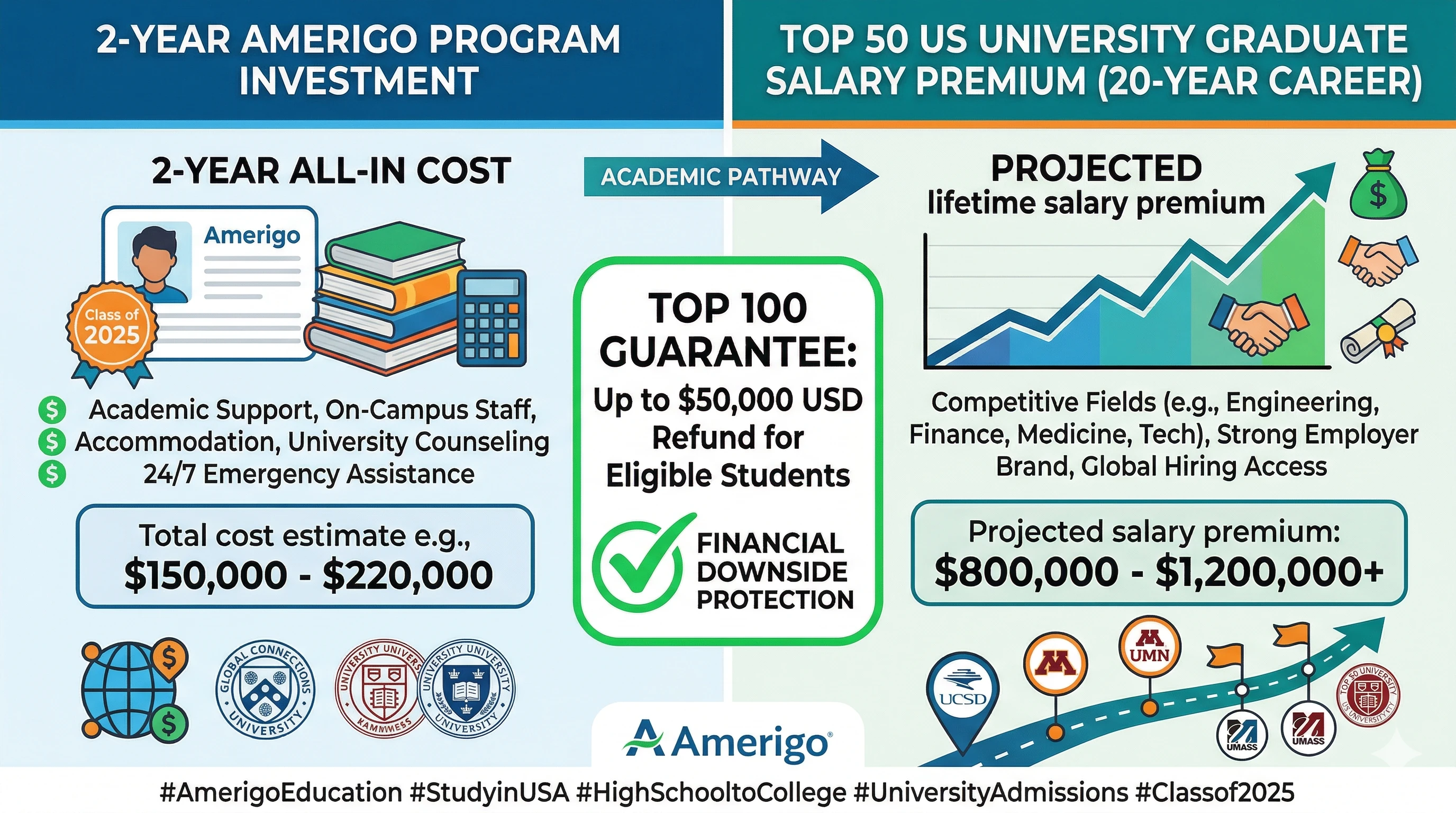
Amerigo's program fees range from $40,000 per year for entry-level programs to $75,000 to $110,000+ per year for premium Signature programs. These figures are all-inclusive for core services: academic support, on-campus staffing, accommodation management, university counseling, and 24/7 emergency assistance are all covered within the program fee.
Families should budget separately for costs that fall outside the program fee. Visa services are provided through a third-party partner and billed separately, Amerigo does not include visa processing in its tuition or housing fees. Travel costs, personal expenses, and health insurance (which varies by program) are also additional. Subject-specific tutoring, if needed, may involve additional costs depending on the subject and frequency of sessions. When comparing programs, families should always request a total cost breakdown that includes all of these items, not just the headline tuition figure. A program quoting $30,000 in tuition with $20,000 in separate housing fees represents a $50,000 total investment, not a budget option. Amerigo also shares monthly progress reports and school activity calendars with all families, and native-language communication is available through staff in China, Vietnam, Korea, Mexico, the Taiwan Region, and more, services that other programs often treat as premium add-ons are standard here.
How Do Outcomes Translate to Financial Value?
University placement data is the most direct way to evaluate ROI for an international high school program. 97% of the Amerigo Class of 2025 were admitted to Top 100 US universities, compared to a national average of roughly 40 to 50% for international applicants, according to data from the Institute of International Education. 60% were admitted to Top 50 universities, and 25% to Top 30 universities.
The financial value of a Top 50 or Top 100 US university degree in global employment markets is substantial. Research published by PayScale consistently shows that graduates of highly ranked US universities earn significantly higher lifetime salaries than graduates of lower-ranked institutions, particularly in competitive fields such as engineering, finance, medicine, and technology. For families in markets such as China and South Korea where employer brand prestige of the university is a primary hiring filter, the difference between a Top 50 university name and a lower-ranked institution can translate directly to career access and earning potential for decades. This is the compounding long-term dimension of the ROI calculation that is rarely represented in a simple cost comparison.
What Does the Top 100 Guarantee Actually Protect?
The Top 100 Guarantee is Amerigo's formal commitment that eligible students who meet all program requirements will receive a Top 100 university offer, or receive up to $50,000 USD back in tuition fees. It is the closest thing to financial downside protection that exists in international high school education.
Eligibility requires a minimum of two consecutive academic years at the same Amerigo Signature School in the US, graduating with a minimum 3.2 GPA, completing at least one higher-level course (AP, IB, or Honors, as defined in the guarantee eligibility criteria), achieving TOEFL 85 or equivalent, and maintaining good attendance and behavior. Students who enter directly into Grade 12 are not eligible. In Canada, only students enrolled at Fort Erie International Academy as of Junior year qualify. The guarantee covers US Signature Schools only. Families should read the full eligibility criteria carefully, the up to $50,000 figure is a refund cap tied to specific conditions, not a fixed payment. The Top 50 Track program, which targets admission to Top 50 universities, does not carry a refund guarantee.
How Does All-Inclusive Pricing Change the ROI Calculation?
All-inclusive pricing changes the ROI calculation significantly because it eliminates the compounding of hidden costs that typically erodes the perceived value of lower-priced alternatives. A program that charges $30,000 per year in tuition but requires separate housing arrangements, transportation coordination, and no on-campus support is not a $30,000 program, it is a program with an incomplete cost figure and an incomplete service model.
Amerigo's model includes accommodation management across all four accommodation types: homestay (more culturally immersive and more affordable), off-campus residences (the primary model, single-gender, 24/7 staff supervised), on-campus residences at select schools, and self-provided accommodation for students with family nearby. Families do not face the complexity of evaluating housing markets remotely, managing foreign rental contracts, or handling emergency housing issues from abroad. For high school students aged 14 to 18, the value of supervised, structured accommodation is not just financial, it removes a significant burden from families who cannot be present and ensures that students live in an environment designed for their age group. When Amerigo's total all-inclusive cost is compared against the true total of lower-priced programs with itemized add-ons, the gap is often much smaller than the headline figures suggest.
How Do Different Program Tiers Compare on Value?
Not all international high school programs offer the same level of service, and the cost difference between tiers reflects real differences in school quality, support depth, and university outcome data. The table below provides a framework for evaluating value across the main types of programs families typically encounter.
| Factor | Amerigo Premium Signature ($75K-$110K+) | Amerigo Entry-Level ($40K+) | Placement-Only Agency (lower headline cost) |
|---|---|---|---|
| Housing included | Yes, all types | Yes, all types | Usually separate cost |
| On-campus staff at school | Yes, daily presence | Yes, daily presence | No |
| Top 100 Guarantee available | Yes (eligible students) | Yes (eligible students) | No |
| University counseling included | Yes | Yes | Rarely |
| School quality (Niche rating) | A+/A (all schools) | A+/A (all schools) | Varies |
| Class of 2025 Top 100 rate | 97% | 97% | Not available |
| 24/7 emergency assistance | Yes | Yes | No |
| Verified outcome data published | Yes, Class of 2025 | Yes, Class of 2025 | Rarely |
What ROI Do Students with Lower English See?
One of the most compelling ROI arguments for a structured program is the outcome data for students who enter with developing English skills. 96% of B1-level English students at Amerigo were admitted to Top 100 universities in the Class of 2025. 83% of low-B1 students achieved the same result. This data directly addresses a common concern among families whose child's English proficiency is a limiting factor, the structured support environment converts that starting disadvantage into a Top 100 outcome at a very high rate.
For context, the national average Top 100 admission rate for international students is approximately 40 to 50%. Amerigo's outcomes for even the lowest-starting English levels exceed that average significantly. For families who are weighing the cost of a structured program against the risk of enrolling their child without intensive support, these numbers represent the difference in expected outcome that the program investment produces. The ROI is not just about the cost of the program, it is about the cost of the alternative.
Frequently Asked Questions
What is the total cost of an Amerigo program per year?
Amerigo's all-inclusive program fees range from $40,000 per year for entry-level programs to $75,000 to $110,000+ per year for premium Signature programs. In addition to program fees, families should budget for visa services (third-party partner, billed separately), travel, personal expenses, and health insurance. Subject-specific tutoring may involve additional costs depending on frequency and subject. Always request a full itemized breakdown when comparing programs.
Is Amerigo the cheapest option for US high school study abroad?
Amerigo is not positioned as the cheapest option. It is positioned as a high-value program where the all-inclusive cost reflects genuine included services: on-campus staffing, accommodation management, university counseling, and a proven university outcome record. Families comparing costs should ensure they are comparing total program costs, not headline tuition figures that exclude housing and support services.
How does the Top 100 Guarantee work as a financial protection?
The Top 100 Guarantee means that eligible students who meet all program requirements but do not receive a Top 100 university offer can receive up to $50,000 USD back in tuition fees. Eligibility requires at least two consecutive years at the same Amerigo US Signature School, a minimum 3.2 GPA, TOEFL 85+, and completion of at least one AP, IB, or Honors course, among other criteria.
What is not included in Amerigo's program fees?
Visa services are handled by a third-party partner and billed separately. Travel and transportation, personal expenses, and health insurance are also not included and vary by program and student circumstance. Subject-specific tutoring may involve additional fees depending on subject and session frequency. Families should request full cost details directly from Amerigo when planning their budget.
How does a US high school diploma improve university admission odds?
US university admissions officers can directly evaluate a US high school transcript using familiar grade scales, course rigor, and GPA calculations. International transcripts require conversion and explanation, which introduces uncertainty. Students who complete high school in the US arrive at the admissions process with comparable academic credentials to domestic applicants, which significantly improves how their application is evaluated.
Is the investment higher than a premium international school network?
Premium international school networks frequently charge similar or higher fees to Amerigo's programs. However, international school credentials are not US-accredited, which means students still face the transcript conversion challenge at university application stage. Amerigo's model delivers authentic US high school diplomas from Niche A+/A rated schools, which represents a different, and for US university purposes, stronger, credential.
What happens to the ROI if my child does not get into a Top 100 university?
If an eligible student meets all Top 100 Guarantee requirements but does not receive a Top 100 offer, Amerigo's refund policy provides up to $50,000 USD back in tuition fees. This is a meaningful financial backstop. The Class of 2025 saw 100% of graduates admitted to universities overall, with 97% reaching Top 100, the guarantee is designed for the rare case where eligible students fall short despite meeting all criteria.
Do students with low English really achieve Top 100 outcomes?
Yes. 96% of B1-level English students in the Amerigo Class of 2025 were admitted to Top 100 universities. 83% of low-B1 students achieved the same result. This is significantly above the national average for international applicants. The structured academic support environment, including pre-requisite course identification, subject tutoring (additional costs may apply), and evening study groups, is what enables this progression.
How long does a student typically need to be enrolled to see full ROI?
For Top 100 Guarantee eligibility, a minimum of two consecutive years at the same Amerigo Signature School is required. Two years is also generally the minimum time needed for a student to build the academic record, English proficiency, and extracurricular profile that supports a strong university application. Students who enroll for three or four years tend to have stronger outcomes, including access to the Top 50 Track for high-achieving students.
Is there a meaningful salary difference between Top 50 and lower-ranked universities?
Research from PayScale and other salary data sources consistently shows a significant lifetime earnings premium for graduates of highly ranked US universities, particularly in competitive industries. For families in markets where employer brand prestige determines hiring access, the university name on a graduate's degree has a direct and lasting impact on career trajectory, making the incremental investment to achieve a Top 50 admission a financially justified one over a 20 to 30 year career horizon.
Conclusion
For families who evaluate the investment honestly, total cost versus verified outcomes, including the financial protection of the Top 100 Guarantee, the ROI of a structured US high school program is compelling. The 97% Top 100 admission rate for the Amerigo Class of 2025, including 83% of low-B1 English starters, is the most direct answer to the question of whether the cost is worth it.
Ready to see the full program details? Explore the Top 100 Guarantee or start your child's application today.
People Also Read
- How to Calculate the True ROI of High School Study Abroad
- What Are You Actually Paying For? Understanding US High School Costs for International Students
- How Much Does It Cost to Study Abroad in High School? Complete 2026 Cost Breakdown
About the Author
This guide was written by the Amerigo Education content team, drawing on program data from staff operating the on-campus international department at 40 Niche A+/A rated US, Canadian, and UK partner schools. Learn more about Amerigo Education.
Disclaimer: This article provides general information for educational purposes only. University outcome statistics reflect the Class of 2025 and are subject to change. Families should conduct independent research, request current program data from providers, and consult with program representatives regarding specific circumstances. Contact us with questions.