All news
February 2, 2026
Study Abroad 101
J-1 Exchange vs F-1 Pathway: Which Leads to Top US Universities?
J-1 exchange programs focus on cultural immersion while F-1 pathway programs like Amerigo deliver 97% Top 100 university admission. Compare both models.

Last Updated: February 2026
A J-1 exchange program is a cultural immersion experience lasting up to one academic year, while an F-1 pathway program is a multi-year academic program leading to a US high school diploma and university admission. According to the Student and Exchange Visitor Program (SEVP) (2025), over 1.5 million international students hold active SEVIS (Student and Exchange Visitor Information System) records in the United States, with F-1 academic students representing the vast majority.
Amerigo Education operates as an F-1 pathway provider with an on-campus international department at 40 Niche A+/A rated US and Canadian partner schools. The Class of 2025 achieved 97% Top 100 university admission - demonstrating how structured F-1 programs produce measurable outcomes that short-term cultural exchanges cannot match.
Key Takeaways
J-1 exchange programs last one academic year maximum and focus on cultural immersion, while F-1 pathway programs span multiple years and award recognized US high school diplomas.
F-1 pathway students earn authentic American transcripts from Niche A+/A rated schools with 20+ AP (Advanced Placement) courses - credentials universities trust without additional verification.
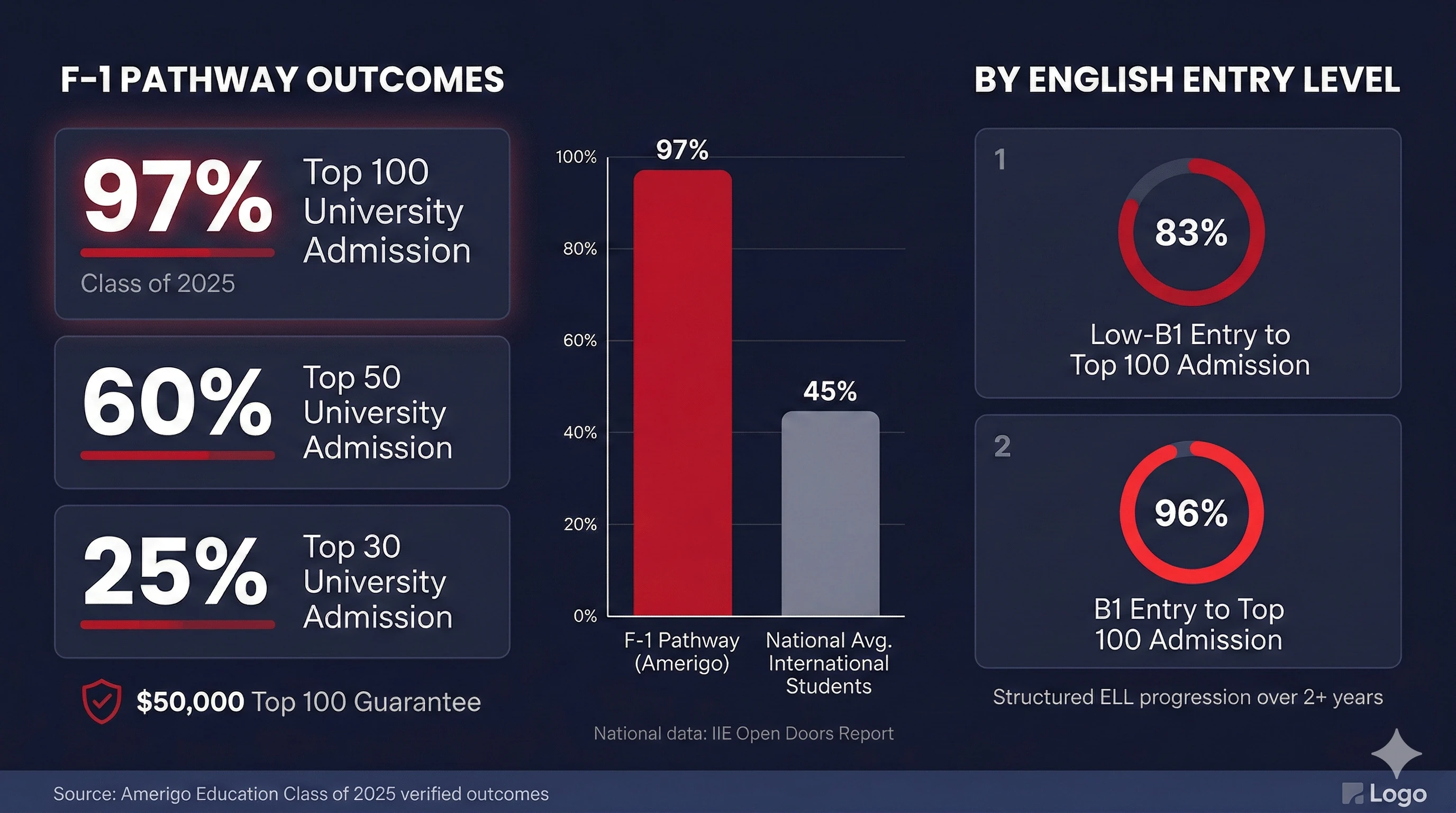
Leading F-1 pathway providers delivered 97% Top 100 university admission for Class of 2025, with 60% reaching Top 50 and 25% reaching Top 30.
F-1 pathway programs include on-campus academic support, university counseling, and a $50,000 Top 100 Guarantee - features unavailable in J-1 cultural exchange programs.
F-1 programs offer four accommodation types including homestay for cultural immersion and off-campus residences with 24/7 supervision, while J-1 programs typically place students exclusively with volunteer host families.
What Is the Difference Between J-1 and F-1?
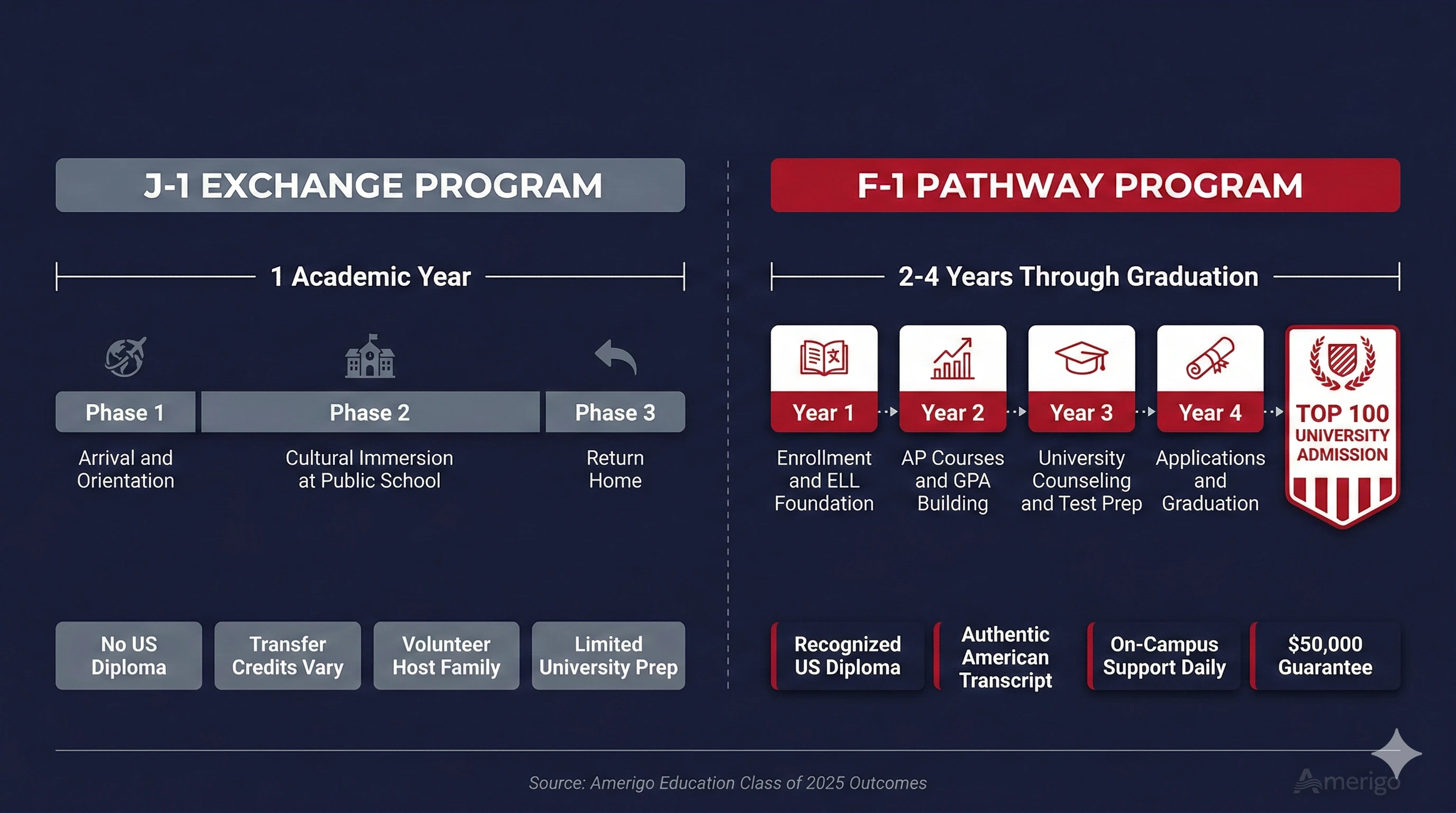
A J-1 visa (exchange visitor visa) permits cultural exchange lasting a maximum of one academic year. An F-1 visa (student visa for academic programs) permits enrollment in accredited US schools for the full duration needed to complete a diploma - typically two to four years for high school students.
The distinction matters because program duration directly shapes university readiness. According to the U.S. Department of State (2025), J-1 programs prioritize cross-cultural understanding and temporary immersion. Students return home after one year without a US diploma. F-1 students graduate with recognized American credentials and years of documented academic progress.
7 Key Differences Between J-1 and F-1:
- Duration - J-1: one academic year maximum; F-1: multiple years through graduation
- Diploma - J-1: no US diploma awarded; F-1: full US high school diploma
- Transcript - J-1: transfer credits vary; F-1: recognized American transcript
- School Type - J-1: typically public school placement; F-1: private schools with selective admissions
- University Prep - J-1: limited counseling; F-1: integrated multi-year planning
- GPA (Grade Point Average) Building - J-1: one year of grades; F-1: cumulative four-year GPA
- English Development - J-1: immersion only; F-1: structured ELL (English Language Learning) courses plus immersion
| Feature | J-1 Exchange | F-1 Academic Pathway |
|---|---|---|
| Visa Type | Exchange Visitor | Student Visa |
| Maximum Duration | 1 academic year | Through graduation |
| US Diploma | No | Yes |
| School Selection | Assigned placement | Family chooses school |
| AP Course Access | Limited (1 year) | Full multi-year access |
| University Counseling | Minimal | Integrated from enrollment |
| Host Organization | Volunteer coordinators | On-campus professional staff |
Academic Outcomes by Visa Type
F-1 pathway programs produce stronger university outcomes because students complete full academic progressions over multiple years. Class of 2025 data from leading F-1 providers shows 97% Top 100 university admission, 60% Top 50, and 25% Top 30 across eligible students.
One year provides insufficient time to build a competitive GPA, complete AP courses, and prepare standardized test scores. According to NACAC (National Association for College Admission Counseling, 2024), admissions officers evaluate academic trajectory across multiple years - precisely what one-year exchanges cannot demonstrate.
Results extend to developing English speakers. At exclusive partnership schools, 83% of low-B1 students and 96% of B1 students achieved Top 100 admission through structured ELL progression, individualized academic planning, and multi-year preparation exchanges cannot replicate.
The $50,000 Top 100 Guarantee provides financial backing. Students meeting requirements - two consecutive years, 3.2 GPA, TOEFL 85+, one AP/IB/Honors course - receive a refund if no Top 100 offer materializes.
Individual results confirm the pattern. V. Tran (Bishop Montgomery High School) improved from a 4.0 to 4.83 GPA and was accepted to NYU. Z. Chen (Justin-Siena High School) rose from a 92 to 99.64 GPA and was accepted to UC Davis. Both outcomes reflect multi-year academic development through structured F-1 pathway support.
What Support Do Students Receive in Each Model?
F-1 pathway programs provide 360-degree on-campus support through professional staff embedded at partner schools daily. Students access academic planning, homework help, tutoring, and university counseling through face-to-face interaction - not scheduled appointments with remote coordinators.
J-1 exchange programs typically operate through volunteer host families and regional coordinators managing multiple students across schools. According to U.S. Department of State J-1 regulations (2025), exchange programs must provide orientation and a local coordinator, but daily academic support structures vary significantly.
8 F-1 Pathway Support Advantages:
- On-campus international department staff present at school daily
- Individualized academic planning identifying prerequisite courses for AP enrollment
- In-residence homework help for residential students
- Academic support at the on-campus office for homestay students
- Customized ELL courses matched to English proficiency
- Subject-specific tutoring preventing academic struggles
- Monthly family reports with real-time outreach for urgent matters
- Safety technology - Life360 or Reach - enabling parents to track student location
Native-language staff in China, Vietnam, Korea, Mexico, and Taiwan Region ensure families receive updates they fully understand. Monthly reports cover all students regardless of housing type.
Which Visa Type Prepares Students for University?
F-1 pathway programs create university-ready applicants through multi-year development. Students complete prerequisite course sequences, build cumulative GPAs, develop AP portfolios, and receive integrated university counseling from enrollment through graduation.
J-1 exchange students return home after one year and apply to US universities from abroad - without American transcripts, without school counselor relationships, and without the documented trajectory admissions officers evaluate. The transcript recognition advantage alone makes F-1 pathways substantially stronger.
F-1 students at 40 partner schools access 20+ AP courses, dual enrollment with UC San Diego, University of San Diego, University of Minnesota, and other institutions, plus SAT/ACT (standardized admission tests) support. Exchange programs like CIEE and AFS serve valuable cultural purposes, but families targeting Top 100 university admission need the multi-year academic infrastructure F-1 pathways provide.
What Accommodation Options Exist for Each Model?
F-1 pathway programs offer multiple accommodation types matched to family preferences: homestay with vetted American families for cultural immersion at typically lower costs, off-campus residences with single-gender arrangements and 24/7 supervision as the primary model, on-campus residence at select schools, and self-provided housing.
J-1 programs place students almost exclusively with volunteer host families. While homestay provides excellent cultural immersion, limited options mean families cannot choose based on their child's specific needs.
The off-campus residence model represents a strategic advantage. Most elite US day schools do not offer boarding. Residences 20-30 minutes from schools enable access to academically superior day schools that boarding students cannot attend. All accommodation types include 24/7 emergency assistance, monthly reports, and safety technology.
Important for F-1 visa students: According to SEVP/ICE (2025), off-campus employment is restricted under F-1 (student visa for academic programs) regulations.
| Feature | J-1 Exchange | F-1 Pathway |
|---|---|---|
| Homestay | Primary/only option | Available – cultural immersion, affordable |
| Off-Campus Residence | Not typically offered | Primary model – 24/7 supervision |
| On-Campus Residence | Not available | Select partner schools |
| Safety Technology | Varies | Life360/Reach parent tracking |
| Family Reports | Varies | Monthly for all students |
Cost Comparison Between Program Types
J-1 exchange programs typically cost $8,000-$15,000 for one academic year covering placement and basic oversight. F-1 pathway programs range from $40,000 to $75,000-$110,000+ annually - but include tuition, accommodation, on-campus support, university counseling, and 24/7 emergency assistance.
J-1 programs place students in public schools at no tuition cost. F-1 programs enroll students in private schools with selective admissions and 20+ AP courses. The investment reflects fundamentally different educational quality and outcome potential.
5 Questions to Ask Before Choosing:
- Is your primary goal cultural experience or Top 100 university admission?
- Does your child need more than one year to build university-ready academics?
- Do you want your child to earn a recognized US high school diploma?
- Is daily on-campus academic support important for your family?
- Do you need a financial guarantee backing university outcomes?
Visa services for F-1 programs are provided through third-party partners and billed separately from program fees.
| Cost Element | J-1 Exchange | F-1 Pathway |
|---|---|---|
| Annual Cost | $8,000–$15,000 | $40,000–$110,000+ |
| Tuition | Free (public school) | Included (private school) |
| Accommodation | Host family (included) | Multiple options (included) |
| University Counseling | Not included | Included |
| University Guarantee | Not available | $50,000 Top 100 Guarantee |
Read more about study abroad cost breakdowns.
How Does the Application Process Differ?
F-1 pathway programs at most Signature schools offer rolling admissions year-round rather than fixed deadlines. Most do not require recommendation letters. English testing accepts flexible options including Duolingo and Eltis beyond TOEFL (Test of English as a Foreign Language) or IELTS (International English Language Testing System).
J-1 programs follow fixed enrollment windows tied to academic year start dates. Students cannot select their specific school - placement depends on available host families in participating districts.
Students apply to multiple partner schools through one streamlined process with no extra costs per application.
Frequently Asked Questions
Can J-1 exchange students earn a US diploma?
J-1 exchange students do not earn a US diploma. The visa permits cultural exchange for one academic year, after which students return home with transfer credits. F-1 students enroll in accredited private schools and graduate with a recognized American diploma over multiple years.
How long can students stay on each visa?
J-1 exchange visas permit one academic year with no extension. F-1 student visas remain valid for the full program duration. High school students typically study two to four years, building the multi-year academic record admissions officers evaluate.
Which program produces better university outcomes?
F-1 pathway programs produce stronger outcomes. Class of 2025 data shows 97% Top 100 admission through multi-year AP completion, GPA building, test preparation, and university counseling. One-year exchanges cannot replicate this timeline.
Can J-1 students switch to F-1 status?
Switching requires returning home and applying for a new visa through a SEVP-certified school with new I-20 documentation. Families targeting university admission should start with an F-1 pathway program rather than converting later.
What English level do students need?
J-1 programs generally require intermediate English for placement. F-1 pathway programs accept varying English levels because they provide structured progression through customized ELL courses. Students entering with B1 English receive academic support, with 96% of B1 students achieving Top 100 university admission at exclusive partnership schools.
Do both programs offer family communication?
Communication differs significantly. F-1 pathway programs provide monthly reports for all residential and homestay students, with real-time outreach for urgent matters. Native-language staff communicate in families' home languages. J-1 programs vary widely in reporting frequency and language accessibility.
Are host families screened differently?
J-1 host families volunteer for cultural exchange. F-1 pathway homestay families are vetted by the program provider and matched to students. Leading F-1 providers manage homestay as a full service with ongoing safety oversight and academic support at school.
What happens if a student struggles academically?
F-1 pathway programs provide immediate intervention through on-campus staff including individualized academic planning, subject-specific tutoring, evening study groups, and prerequisite course identification for AP enrollment. J-1 exchange students depend on host family support and regional coordinator availability.
How do safety standards compare?
F-1 pathway programs maintain structured protocols including Life360 or Reach safety technology for parent tracking, 24/7 emergency assistance, and single-gender off-campus residences with staff supervision. J-1 programs rely primarily on host family oversight.
Is F-1 better for younger students?
For students aged 14-18, F-1 pathway programs provide structured environments designed for minors abroad. Supervised accommodation, daily on-campus staff, monthly reporting, and emergency protocols address younger students' needs. The multi-year timeline allows earlier enrollment.
People Also Read
How to Get Student Visa for US: Complete Guide 2025-2026 Step-by-step F-1 student visa application process including I-20 documentation, visa interview preparation, and required financial documentation.
What to Look for in a US High School for International Students Key evaluation criteria for selecting the right US high school including academic quality, support services, and location factors.
Study Abroad Program Red Flags: What to Avoid When Selecting High School Placement Warning signs that indicate a study abroad program may not deliver on its promises and how to protect your investment.
About the Author
Maria Chen writes about international education and visa pathways on behalf of the Amerigo Education team. This guide draws on program expertise from staff operating the on-campus international department at 40 Niche A+/A rated US and Canadian partner schools.
Conclusion
The choice between J-1 exchange and F-1 pathway programs depends on your family's primary goal. Cultural exposure and a one-year international experience point toward J-1 programs. University admission to Top 100 US institutions requires the multi-year academic development, on-campus support, and structured progression that F-1 pathway programs deliver.
F-1 pathway students graduate with recognized American diplomas, cumulative GPAs, AP course portfolios, and university applications supported by counselors who know them personally. These credentials give admissions officers documented academic trajectory from a trusted American institution.
Ready to Explore F-1 Pathway Options?
For families prioritizing Top 100 university outcomes, contact Amerigo Education to discuss how the F-1 pathway model supports your child's university goals, or start your application to explore partner school options across the United States and Canada.
Disclaimer
This article provides general information about J-1 and F-1 programs for educational purposes. Visa regulations are subject to change. Consult immigration advisors and program representatives before enrollment decisions. University outcomes depend on eligibility and completion of requirements. For questions, contact Amerigo Education.