All news
March 7, 2026
Study Abroad 101
Homesickness at 15 vs 20: What High Schoolers Face
Homesickness at 15 vs 20: how international high school students experience adjustment differently from university students and what support helps.
Homesickness at 15 vs 20: What High Schoolers Face
Last Updated: March 2026
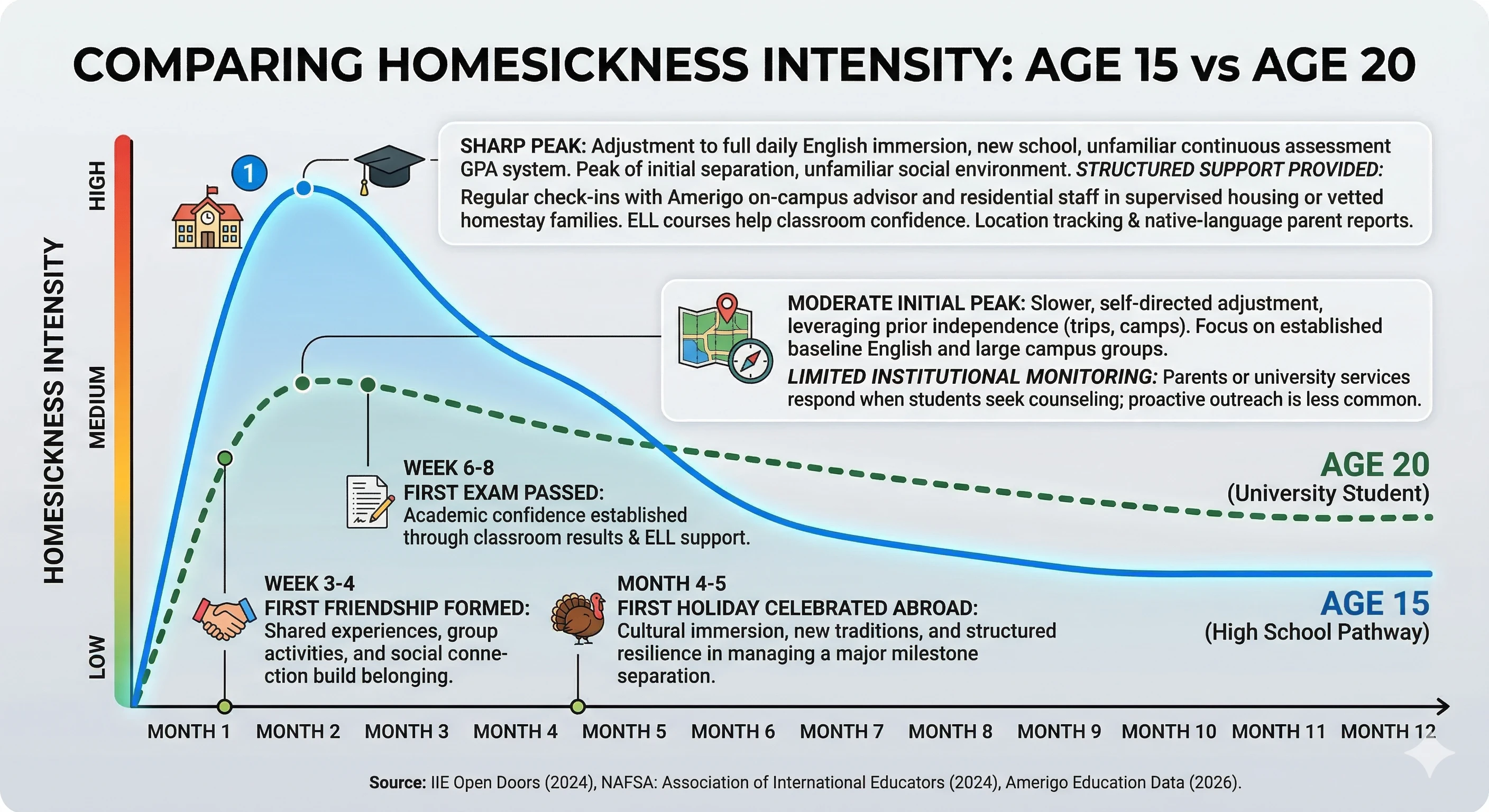
A homesickness experience at 15 is a more acute emotional adjustment than at 20 because younger students have less independence, fewer coping strategies, and stronger reliance on parental proximity. According to the Institute of International Education's Open Doors Report (2024), international enrollment in US secondary programs has grown steadily, reflecting families' confidence in the high school pathway despite early adjustment difficulty.
Amerigo Education supports 3,500+ students from 55+ countries through 40 Niche A+/A rated partner schools in the US, Canada, and the UK. The Class of 2025 achieved a 97% Top 100 university admission rate. Because the high school transition at ages 14 to 18 requires more active emotional support than a university transition, Amerigo builds structured wellbeing monitoring into its on-campus international department at every Signature partner school.
Key Takeaways
- Homesickness at 15 is more intense than at 20: Younger students manage more simultaneous adjustments - new language, new academic system, new social environment - with less prior independence, making the first two to eight weeks more emotionally demanding.
- Peak homesickness occurs in weeks two through eight: According to NAFSA: Association of International Educators (2024), structured institutional support during the first semester significantly improves adjustment outcomes for secondary-age international students.
- Structured communication patterns reduce adjustment time: Programs that advise one scheduled daily call rather than unrestricted contact produce faster social integration because students form school-based connections sooner.
- English proficiency predicts adjustment speed: Students entering at B1 (intermediate) level or above form classroom friendships faster, and 96% of B1 English entrants in the Class of 2025 achieved Top 100 university admission.
- 97% Top 100 university admission (Class of 2025): Across 3,500+ students from 55+ countries, Amerigo's academic outcomes demonstrate that early homesickness does not predict poor long-term results.
Why Is Homesickness Worse at 15 Than at 20?
Homesickness at 15 differs from homesickness at 20 because a 15-year-old has typically never lived independently. The first weeks away from home coincide with adapting to a new language environment, a GPA (Grade Point Average)-based continuous assessment system, unfamiliar food, new social dynamics, and often a different climate.
A 20-year-old university student often has years of overnight trips or shorter separations that build resilience before a major move. According to IIE Open Doors (2024), international enrollment at the secondary level continues to grow, reflecting families' understanding that the high school pathway produces strong long-term outcomes despite a steeper early adjustment curve.
What Are the Signs of Homesickness in Teenagers?
Signs of homesickness in teenagers studying abroad include persistent sadness, withdrawal from social activities, difficulty sleeping, reduced appetite, excessive phone contact with family, and declining academic engagement. These signs are normal during the first two to four weeks and typically resolve as students build friendships and gain classroom confidence through ELL (English Language Learning) coursework.
Signs that require intervention include sustained withdrawal lasting more than four weeks, declining grades without improvement, or refusal to attend classes. Amerigo Education's on-campus international department monitors student welfare through regular check-ins. Residential staff in on- and off-campus residences and homestay coordinators observe student behavior outside school hours. Monthly progress reports keep families informed.
- Persistent sadness or tearfulness, particularly on evenings and weekends
- Withdrawal from extracurricular activities the student previously enjoyed
- Difficulty sleeping or changes in sleep patterns lasting more than two weeks
- Reduced appetite or significant changes in eating habits
- Excessive daily phone contact with family rather than a brief check-in
- Declining classroom participation or incomplete homework submissions
How Long Does Homesickness Last Abroad?
Most international high school students experience peak homesickness during weeks two through eight. By weeks eight through twelve, most students have formed initial friendships, established a daily routine, and developed enough classroom confidence to engage more actively. By the end of the first semester, homesickness is typically reduced to brief episodes around holidays or family events.
Students entering at 14 or 15 tend to take slightly longer to settle than those entering at 16 or 17 due to less prior independence. ELL coursework plays a meaningful role: students whose English develops faster gain classroom confidence sooner, which drives social integration. According to NAFSA (2024), strong institutional support structures significantly improve adjustment outcomes and program completion rates.
How Do Programs Support Homesick Students?
Structured support at Amerigo Education begins before the student arrives through pre-arrival orientation materials, arrival day activities, and a residential community designed to reduce the shock of the first week. Residential staff in on- and off-campus supervised housing and homestay families are trained to identify and respond to signs of emotional distress.
Family communication follows a structured pattern rather than unrestricted access. Monthly reports ensure parents are informed, and Life360 or Reach parent tracking technology provides location visibility. Native-language communication support is available for families from China, Vietnam, Korea, Mexico, and the Taiwan Region, and more.
Note: Amerigo Education's Signature Schools include all features listed in the high school programs column.
Does Communication Frequency Affect Adjustment?
Yes. Communication frequency between students and families directly affects how quickly a student adjusts. Programs that advise one scheduled daily call rather than unrestricted contact produce faster adjustment timelines. Students who limit home contact to a brief daily check-in spend more time building relationships at school, which is the primary driver of reduced homesickness.
Regular communication reassures both students and parents. When a student spends hours daily on video calls with family, they invest less emotional energy in school-based friendships. Amerigo Education's on-campus international department advises families on communication patterns that support adjustment.
- Schedule one daily call at a consistent time rather than calling multiple times throughout the day
- Focus conversations on the student's school experiences - classes, activities, new friends
- Avoid detailed updates about home events that increase emotional pull toward home
- Resist suggesting that coming home early is an option unless a genuine welfare concern exists
- Use monthly reports from the program as the primary source of wellbeing information
What Makes Some Students Adjust Faster Than Others?
Students who adjust faster to a US high school program typically share several characteristics: they join extracurricular activities immediately upon arrival, they have some prior experience with overnight trips, they enter with at least basic conversational English at B1 level, and they arrive with realistic expectations about the first semester.
Among the Class of 2025, 96% of students who entered at B1 English level achieved Top 100 university admission, demonstrating that initial language limitations do not prevent strong outcomes. Amerigo's ELL coursework, individualized academic planning, and university counseling from Grade 9 or 10 onward help students close gaps during the adjustment period.
What Long-Term Benefits Come from Early Adjustment?
Students who navigate homesickness at 15 rather than 20 develop independence, cross-cultural confidence, and academic resilience during the high school years. These skills carry directly into university, where former international high school students typically adjust faster than peers experiencing their first time abroad.
Amerigo Education's Class of 2025 achieved a 97% Top 100 university admission rate across 3,500+ students from 55+ countries. Students who experienced significant early homesickness and worked through it with support went on to earn the same strong academic results. Families can explore Amerigo's partner schools to understand the range of programs available.
- Greater independence and self-reliance developed two to three years earlier than university-only peers
- Stronger cross-cultural communication skills from daily immersion during formative years
- Higher English fluency from academic and social use throughout high school
- More competitive university applications with US high school transcripts and AP (Advanced Placement) courses
- Faster university adjustment because students have already navigated a major transition
Frequently Asked Questions
How do international students deal with homesickness?
International students deal with homesickness most effectively through early social engagement, structured routines, and accessible adult support. Joining extracurricular activities in the first week builds friendships faster than withdrawing. Amerigo Education's on-campus international department provides individual check-ins. Families support the process by maintaining one scheduled daily call rather than unrestricted contact.
How common is homesickness among boarding school students?
Homesickness is extremely common among boarding school students, particularly in the first semester. Most students living away from home for the first time experience it regardless of nationality. Intensity varies based on prior independence, language proficiency, and adult support quality. Many students who struggle early go on to thrive academically.
What are common signs of homesickness in teenagers?
Common signs include persistent sadness, withdrawal from social activities, difficulty sleeping, reduced appetite, excessive family contact, and declining academic engagement. During the first two to four weeks these signs are normal. If withdrawal lasts beyond a month or a student refuses to attend classes, the situation warrants intervention from the school's support team.
How long does homesickness last for high school students abroad?
Most international high school students experience peak homesickness during weeks two through eight, with significant improvement by the end of the first semester. Students who engage with extracurricular activities settle faster. Homesickness may resurface around holidays. By the second year, most students feel fully settled.
Is homesickness more intense at 15 than at 20?
Yes, typically. Homesickness at 15 tends to be more intense because younger students have fewer prior experiences living away from home. They also manage more simultaneous adjustments - new language, new school system, new social environment. University students typically have more established independence and coping strategies.
Do parents worry more when children go abroad at 15?
Yes. Parental concern is consistently higher when students go abroad at 14 or 15 than at 18 or 19. Programs designed for ages 14 to 18 address this through single-gender residential supervision, Life360 or Reach tracking, monthly parent reports, and real-time emergency communication. Amerigo Education provides these features across all Signature Schools.
How can families help a homesick student abroad?
Families help most by maintaining regular but not excessive contact - one scheduled daily call rather than unrestricted access. Focusing conversations on school experiences rather than home events reduces emotional pull. Avoiding suggestions of coming home early unless a genuine welfare concern exists helps the student commit to adjustment.
What makes some students adjust faster than others?
Students who adjust faster typically join extracurricular activities immediately, have prior overnight trip experience, enter with at least B1-level English, and arrive with realistic expectations. English proficiency is particularly predictive because students who participate in conversations form classroom friendships more quickly.
What role does English proficiency play in homesickness?
English proficiency is one of the strongest predictors of adjustment speed. Students arriving at B1 level or above participate in classroom discussions and social interactions from their first week, which accelerates friendship formation. Students entering at lower levels take longer to settle because language barriers limit social connection. Amerigo Education's ELL courses help close this gap.
When should families be concerned about homesickness?
Normal homesickness includes missing family routines, feeling lonely during holidays, and occasionally wanting to go home. These feelings peak during weeks two through eight. Families should become concerned if withdrawal persists beyond four weeks, grades decline steadily, or physical health complaints appear without medical cause. These patterns warrant coordinated support.
Conclusion
Homesickness at 15 is a more intense experience than at 20 because younger students have less independence and manage more simultaneous adjustments. Most students experience peak homesickness in weeks two through eight, with significant improvement by semester end. Structured support through residential staff, monthly reporting, and location tracking reduces both severity and duration.
Learn More About Student Wellbeing Support
Families ready to understand how their child will be supported during the adjustment period can view partner schools and explore Amerigo Education's student support model. Apply now or contact us to speak with an enrollment advisor about how the on-campus international department supports students through the transition to a US or Canadian high school.
People Also Read
- How to Overcome Culture Shock: A Guide for International High School Students
- What Parents Should Expect: The Emotional Phases of Your Child's First Year Abroad
About the Author
This guide was written by the Amerigo Education content team, drawing on program data from staff operating the on-campus international department at 40 Niche A+/A rated US and Canadian partner schools. Learn more about Amerigo Education.
Disclaimer: This article provides general information for educational purposes only. Families should conduct independent research, request current program data from providers, and consult with program representatives regarding specific circumstances. Contact us with questions.
_converted.webp)