All news
May 4, 2026
Study Abroad 101
How International Parents Evaluate Study Abroad Agencies in China, Korea, Vietnam, Mexico, and Taiwan Region
How parents in China, Korea, Vietnam, Mexico, and Taiwan Region evaluate study abroad agencies: school quality, outcomes, support structure, and red flags.

How International Parents Evaluate Study Abroad Agencies in China, Korea, Vietnam, Mexico, and Taiwan Region
Last Updated: May 2026
Evaluating a study abroad agency is one of the most consequential decisions an international family makes before a US, Canadian, or UK high school placement. According to IIE Open Doors (2025), more than 1.1 million international students enrolled in US institutions in 2023-24, with significant enrollment from China, Korea, and Vietnam - markets where program decisions are made almost entirely through recruitment agencies and program providers. The quality, transparency, and school network of the agency a family selects determines not only where their child studies but how well-supported they are throughout the placement.
Amerigo Education partners with 40 Niche A+/A rated schools across the US, Canada, and the UK, supporting 3,500+ students from 55+ countries. The Class of 2025 achieved 97% admission to Top 100 US universities of those who applied. For families in China, Korea, Vietnam, Mexico, and the Taiwan Region, Amerigo Education is an international education service provider - not a study abroad agency. Amerigo works with study abroad agencies as recruitment partners while operating its own on-campus international department at each US Signature School to support enrolled students directly.
This guide covers the key criteria parents in these markets use to evaluate study abroad agencies, including school partnership quality, on-the-ground support, university outcome verification, pricing transparency, and the warning signs that separate genuinely supportive programs from placement-only services.
Key Takeaways
- School quality is the primary filter: Niche or equivalent school ratings, combined with accreditation status, are the most reliable starting point when comparing programs.
- On-campus support is the main differentiator: Programs with a dedicated on-campus team at each partner school provide materially different daily support than those operating through remote or contracted staff.
- University outcomes require qualification: Admission rate claims should specify the tier (Top 100, Top 50, Top 30) and include the "of those who applied" qualifier to be meaningful.
- Pricing transparency is a trust signal: All-inclusive program fees with itemized breakdowns indicate a higher standard of program accountability.
- Red flags are consistent across markets: Unqualified outcome statistics, vague support descriptions, and exclusive-agency pressure appear consistently in lower-quality programs regardless of market.
What Makes a Study Abroad Agency Trustworthy?
A trustworthy study abroad agency demonstrates transparency across four areas: the quality of its school partnerships, the structure of its on-ground support, the honesty of its university outcome data, and the clarity of its pricing. For families evaluating programs from China, Korea, Vietnam, Mexico, or the Taiwan Region, the foundational questions are consistent: Where does the child study? Who supports them while they are there? What outcomes have previous students achieved? And what does the full program cost, with no omissions?
Agencies that operate genuine school partnerships can provide school profiles, independent school ratings, accreditation documentation, and the contact details of school-based staff. Agencies acting only as placement brokers - without an ongoing, structured relationship at each school - may place students at institutions where no dedicated support infrastructure exists for international students.
- Transparency on school network: Can the agency name every partner school, provide its independent rating, and confirm who provides on-campus support for enrolled students?
- Verifiable outcome data: Are university admission rates stated with clear qualifiers - which tier, which student cohort, and what proportion of enrolled students applied?
- Clear pricing: Is the total program cost presented as an all-inclusive or itemized breakdown, with exclusions (travel, health insurance, personal expenses) explicitly noted?
How Do You Compare Agency School Partnerships?
School partnerships are the foundation of any study abroad agency's offering. The quality of partner schools - and the depth of the agency's relationship with each - determines the student experience more than any other single factor. Parents in China and Korea place particularly high emphasis on Niche or equivalent school rankings when comparing programs against each other.
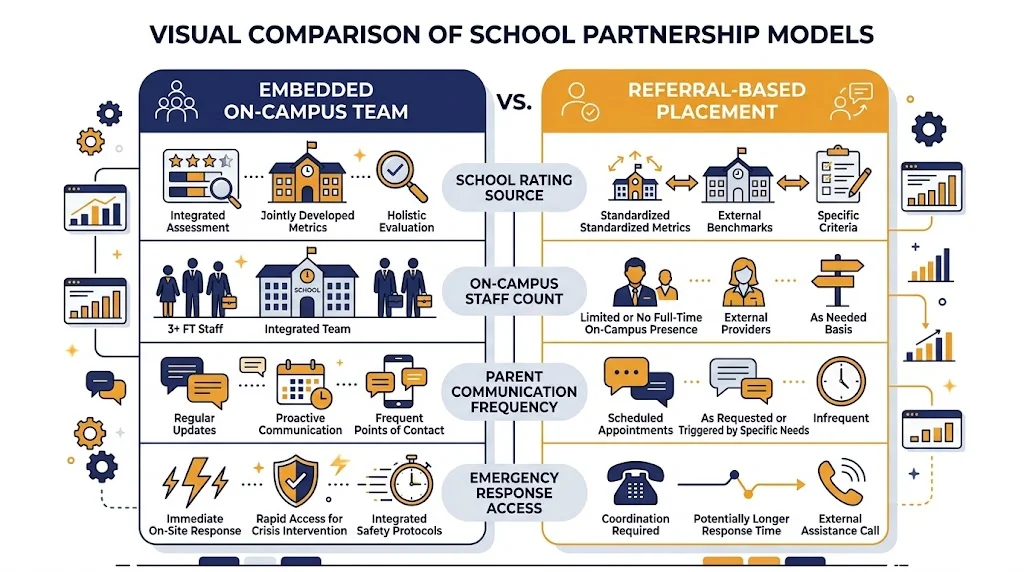
Parents should distinguish between agencies that are formally embedded in partner schools - with dedicated staff on-site at each campus - and agencies that place students at schools with whom they have only a referral arrangement. According to NAIS (2025), the most effective international student support models involve structured, regular communication between school staff and program staff rather than reactive contact only when problems arise.
Amerigo Education, as an international education service provider rather than a study abroad agency, partners exclusively with Niche A+/A rated institutions. At each US Signature School, Amerigo's on-campus international department includes a Director of Campus Operations, Academic Director, Senior Campus Coordinators, Campus Coordinators, and an ELL (English Language Learning) Teacher.
What Support Should an Agency Provide?
Agency support during the academic year is where the most significant differences emerge between programs. Parents comparing agencies should ask specifically what happens after enrollment is complete - not just before. Pre-enrollment support (school selection, application, visa coordination) is offered by nearly all providers; on-campus support during the academic year is where program quality diverges sharply.
According to NACAC (2025), students who receive structured academic planning and university counseling beginning in their first year of high school are significantly more likely to apply to and gain admission at selective US institutions than those who receive counseling only in senior year.
At minimum, a quality program provides: structured academic monitoring with regular parent updates; a named on-site contact for emergency situations; ELL support embedded within the school schedule; and university counseling that begins in the first year, not only in senior year.
Amerigo's US Signature School students receive from the on-campus team: individualized academic planning, monthly progress reports, school activity calendars and event announcements, subject-specific tutoring (additional fees may apply), structured study hours with campus coordinator availability, and 24/7 emergency assistance. Native-language communication with families in China, Vietnam, Korea, Mexico, and the Taiwan Region is provided by Amerigo's in-country staff, who operate remotely.
- Academic monitoring: Monthly progress reports, school activity calendars and event announcements - not quarterly check-ins.
- ELL support: English Language Learning courses embedded in the school schedule, available from the first semester.
- Emergency protocol: A named 24/7 contact who can act on-site, not a home-country call center.
- University counseling: Active guidance on AP (Advanced Placement) enrollment and application strategy from Year 1.
How Do Parents Verify University Outcomes?
University admission outcomes are the most cited evaluation criterion across all five markets - and the most frequently misrepresented. Families in China, Korea, and Vietnam commonly receive agency materials presenting Top 50 or Top 30 admission rates without specifying what proportion of enrolled students applied to those tiers, what grade levels were represented, or what English entry levels students had.
According to College Board (2025), AP (Advanced Placement) performance is among the most widely recognized academic indicators for US university admissions, making AP access and completion rates a key data point when evaluating whether a program's school network provides genuine academic stretch for international students.
When comparing outcome data, parents should ask: of all enrolled students, what percentage graduated? Of those who graduated and applied to universities, what percentage were admitted to Top 100, Top 50, and Top 30 institutions? What were the entry-level English levels of students who achieved these outcomes?
For Amerigo's Class of 2025: 97% of students who applied to Top 100 institutions were admitted. Of those who applied to Top 50, 60% were admitted. Of those who applied to Top 30, 25% were admitted. Notably, 96% of students entering at B1 English level achieved Top 100 admission. Families can review the Class of 2025 university placement results directly for full cohort context, or find your school to compare partner campuses by program and location.
What Are the Red Flags in Agency Selection?
Consistent warning signs appear across markets and help families identify agencies that prioritize enrollment volume over student outcomes. The most common: outcome claims without qualifying context; vague support descriptions that do not specify whether coordinators are on-campus or remote; exclusive-agency pressure discouraging independent research; and inability to provide direct contact information for school-based staff.
A second category of red flags relates to contractual clarity. Families should verify exactly what is included in program fees, what happens if a school placement needs to change, and whether a formal refund or support policy exists. Programs with specific, published policies - such as Amerigo's Top 100 Guarantee, providing up to $50,000 USD in senior year program fee reimbursement subject to four published conditions - offer a higher level of contractual accountability than general assurances.
- Unqualified outcome statistics: "95% Top 50 admission" without "of those who applied" is not a verifiable metric.
- Vague support language: "Our staff are always available" without specifying where and in what capacity.
- Exclusive-agency pressure: Legitimate programs do not require exclusive referral agreements that prevent families from seeking independent advice.
- No published refund policy: Programs with no outcome policy offer no contractual accountability if outcomes fall short.
How Do Parents in Asia Evaluate Study Abroad Programs?
Evaluation criteria differ by market in emphasis, though core questions are consistent. Chinese families - Amerigo's largest market at approximately 50% of enrolled students - typically prioritize school Niche rating, proximity to major US university campuses, and Mandarin-speaking in-country support. Korean families weight academic rigor, AP course availability, and university counseling depth most heavily. Vietnamese and Mexican families often prioritize value and comprehensive support, as enrollment in a US private school pathway is frequently a first-generation decision.
For families in the Taiwan Region - where prior familiarity with US university admissions is common - program evaluation tends to focus on university counseling quality and breadth of school choice. Across all five markets, in-country native-language staff who communicate with parents throughout the year (not only at enrollment) are consistently rated as a critical differentiator.
Amerigo's in-country staff provide native-language communication in Chinese, Korean, Vietnamese, and Spanish (Mexico) before and after key program events. This support is delivered remotely rather than on-campus, ensuring families in all five primary markets receive consistent program updates in their own language throughout the academic year.
Frequently Asked Questions
What should parents look for in a study abroad agency?
The most important criteria are school quality and ranking, an on-campus support team at each partner school, verified university admission outcomes with qualifying context (which tier, which cohort), transparent all-inclusive pricing, and documented emergency and welfare protocols. Agencies that can answer each of these specifically - with supporting documentation - provide a higher standard of transparency than those that offer general assurances without verifiable detail.
How do Chinese parents evaluate study abroad programs?
Chinese families typically prioritize Niche or equivalent school ratings, proximity of partner schools to major US research universities, and the availability of Mandarin-speaking in-country staff. Outcome data is closely examined - the presence of specific tier breakdowns with the qualifier "of those who applied" is treated as a marker of legitimate reporting. Families often receive referrals through trusted agency networks before conducting independent research to verify claims.
How do Korean parents evaluate study abroad programs?
Korean families tend to prioritize AP course availability, academic rigor, and depth of university counseling at each partner school. Structured study environments, ELL support, and campus staff accessibility are also heavily weighted. Korean parents frequently research multiple programs simultaneously and compare on the number of AP courses available, grade range for enrollment, and the academic profile of recent university acceptances by cohort.
What is a red flag in study abroad agency marketing?
The most consistent red flag is an admission rate presented without qualification - for example, "97% Top 50 admission" without specifying what share of enrolled students applied to Top 50 institutions. A second red flag is vague support language: descriptions such as "dedicated coordinator support" that do not clarify whether the coordinator is physically at the school or operating from the home country cannot be meaningfully evaluated or compared.
How should parents compare study abroad program fees?
Program fees should be compared on a total-cost basis, not headline figures alone. A thorough comparison accounts for: base program fee (school charges), accommodation (homestay or residential), program administration fee, health insurance, and any additional fees for ELL support, tutoring, or specific AP course supplements. Programs with itemized breakdowns are easier to compare on a like-for-like basis than those presenting bundled totals without explanation.
What on-campus support should a study abroad program provide?
At minimum, a quality program provides a named school-based contact who can respond to welfare or academic issues during school hours; structured academic monitoring with regular written updates to parents (monthly progress reports, school activity calendars and event announcements); ELL support embedded in the school schedule; university counseling beginning in the first year; and a 24/7 emergency contact who can act on-site.
How do parents verify university outcome statistics?
Parents should ask agencies for: the total enrolled students in the cohort; the number who graduated; and the number who applied to and were admitted at Top 100, Top 50, and Top 30 institutions. Admission rates that include the qualifier "of those who applied" at each tier represent the standard for transparent reporting. Rates presented without these qualifiers cannot be verified or compared meaningfully across programs.
Does Amerigo work with external college counselors hired by families?
Yes. Amerigo is open to working with external college counselors hired independently by families. External counselors can work directly with Amerigo to obtain student transcripts and academic information. Amerigo does not require exclusive counseling arrangements - families who choose to supplement in-house university counseling with independent advisors are supported in doing so, and Amerigo is happy to collaborate with external counselors to best support student outcomes.
What is the difference between a study abroad agency and an integrated program?
A study abroad agency typically places students at schools with which it has a referral relationship, then manages the relationship from the home country. An integrated program provider maintains formal, ongoing partnerships with each school and operates staff on-campus at partner schools to support students throughout the academic year. The practical difference for families is the level of school-integrated daily support available, not just at enrollment and application.
What is native-language support in a study abroad program?
Native-language support refers to the availability of staff who communicate with parents in their home language - Chinese, Korean, Vietnamese, Spanish, or others - throughout the academic year. In genuine programs, this support is provided by in-country staff available for communications around reports, key events, and welfare updates. This differs from programs that provide translation only at enrollment or at isolated parent-teacher conference periods.
Conclusion
Evaluating a study abroad agency requires asking specific, verifiable questions about school quality, on-campus support structure, university outcome transparency, and pricing clarity. Parents in China, Korea, Vietnam, Mexico, and the Taiwan Region share consistent evaluation criteria, with the most significant differentiator being the presence of school-embedded staff rather than remote-only program management. International education service providers and program agencies with documented outcomes, on-campus teams, and published support policies provide a verifiable standard for comparison.
Explore Amerigo's Partner School Programs
To review Amerigo's partner schools across the US, Canada, and the UK, contact us to speak with a program advisor, or apply now to begin your enrollment.
People Also Read
- Study Abroad Program Red Flags: What to Avoid When Selecting High School Placement
- Placement Agency vs Integrated On-Campus Support: Study Abroad Program Comparison 2026
- Study Abroad Support Models Compared: On-Campus vs Third-Party vs Agency-Only
About the Author
This guide was written by the Amerigo Education content team, drawing on program data from staff operating the on-campus international department at 40 Niche A+/A rated US, Canadian, and UK partner schools. Learn more about Amerigo Education.
Disclaimer: This article provides general information for educational purposes only. Families should conduct independent research, request current program data from providers, and consult with program representatives regarding specific circumstances. Contact us with questions.