All news
May 21, 2026
Study Abroad 101
Taiwan Region Student Visa FAQ: Entry, Exit, and Re-entry Rules for F-1 Holders
Taiwan Region F-1 student visa FAQ: entry, exit, and re-entry rules, document checklist, visa expiry guidance, and DSO travel signature process.

Taiwan Region Student Visa FAQ: Entry, Exit, and Re-entry Rules for F-1 Holders
Last Updated: May 2026
F-1 (student visa for academic programs) entry, exit, and re-entry rules for high school students from the Taiwan Region involve specific requirements around visa validity, travel signature authorization, and maintaining SEVIS (Student and Exchange Visitor Information System) status during travel. According to SEVP, F-1 students must maintain a valid visa and current I-20 form to re-enter the US after travel - and high school students under 18 face additional considerations around unaccompanied minor travel and custodial documentation.
Amerigo Education partners with 40 Niche A+/A rated schools across the US, Canada, and the UK, supporting 3,500+ students from 55+ countries. The Class of 2025 achieved 97% admission to Top 100 US universities of those who applied. The Taiwan Region accounts for a significant share of Amerigo's primary market enrollment, with Amerigo providing native-language communication support for families from the Taiwan Region through in-country staff who communicate remotely.
This guide answers the most common F-1 entry, exit, and re-entry questions from Taiwan Region families, including what documents to carry during travel, what to do if a visa expires while a student is in the US, and how to handle school break travel correctly.
Key Takeaways
- Valid I-20 required for re-entry: Students must carry a valid, travel-signed I-20 form endorsed by their Designated School Official (DSO) before traveling outside the US.
- Visa expiry vs. status: A student can remain in the US after their F-1 visa stamp expires as long as they maintain F-1 status (D/S - Duration of Status); they cannot re-enter from abroad on an expired visa.
- Travel signature validity: DSO travel signatures on the I-20 are valid for 12 months (6 months for OPT students) - request a new signature before each travel period if the existing one is more than 12 months old.
- I-94 check after arrival: Taiwan Region students should verify their I-94 record online after each US entry to confirm CBP recorded the correct admission class and departure date.
- F-1 maintaining status: Students must remain enrolled full-time, maintain satisfactory academic progress, and report address changes to their DSO to stay in F-1 status.
What Documents Must Taiwan Region Students Carry When Traveling?
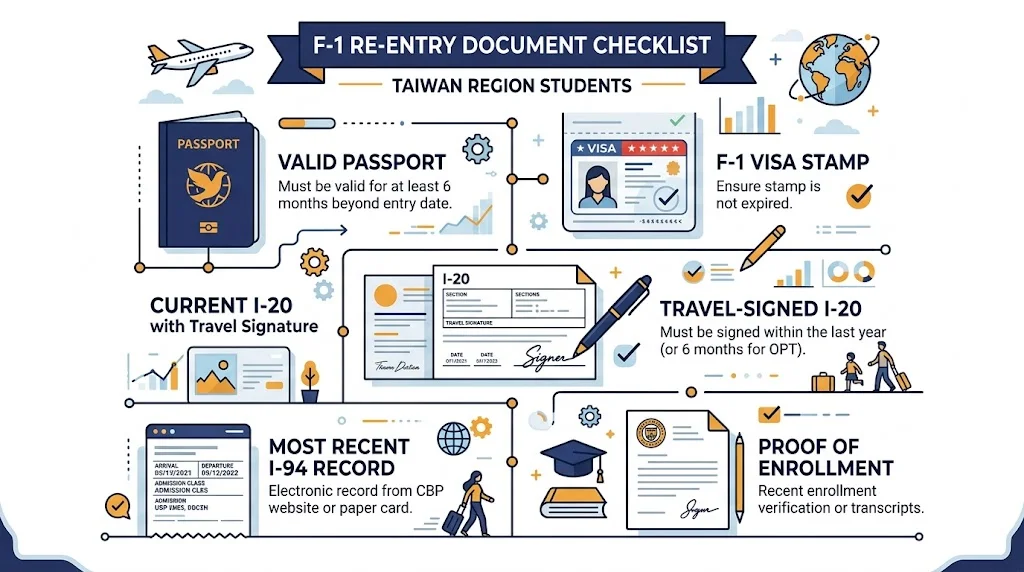
F-1 students from the Taiwan Region must carry three core documents when traveling outside the US: a valid F-1 visa stamp, a valid travel-signed I-20 form, and a valid Republic of China (ROC) passport. The visa stamp must be valid for re-entry - not just for the date of initial entry. The I-20 travel signature must be from the DSO at the enrolled school and must be dated within the past 12 months.
According to IIE Open Doors (2025), Taiwan Region students are among the most mobile international student populations, with high rates of school break travel home. Each trip outside the US requires carrying all three documents - missing any one of them can prevent re-entry or cause delays at the port of entry.
- Valid ROC passport: Must be valid for at least 6 months beyond the intended US stay - renew at the Taipei Economic and Cultural Office (TECO) in the US if expiring.
- Valid F-1 visa stamp: Separate from F-1 status - the stamp is the travel document issued by the US consulate serving the Taiwan Region via the American Institute in the Taiwan Region (AIT). Must be valid and unexpired for re-entry.
- Travel-signed I-20: Form I-20 with DSO travel signature on page 3, dated within the past 12 months. Request from the school's DSO well before any planned travel.
- I-94 record: US Customs and Border Protection (CBP) issues the I-94 automatically at entry. Students should download their I-94 at cbp.gov/I94 after each US arrival to confirm the recorded status.
What Happens If the F-1 Visa Expires While the Student Is in the US?
A student's F-1 visa stamp expiring while they are inside the US does not affect their legal status. F-1 students are admitted for Duration of Status (D/S), which means they may remain in the US as long as they maintain valid F-1 status - regardless of whether the visa stamp has expired. However, if a student with an expired visa stamp travels outside the US, they cannot re-enter on the expired stamp and must apply for a new F-1 visa at a US consulate before returning.
Taiwan Region students whose visa expires during the academic year and who plan to travel during winter or spring break should apply for a new F-1 visa before they depart. According to NACAC (2024), families of F-1 high school students frequently overlook visa stamp expiry dates during multi-year enrollments - checking the visa expiry date before each school break trip is the correct practice.
How Does Re-entry Work After School Break Travel?
Taiwan Region students re-entering the US after school break travel must present a valid F-1 visa stamp, a travel-signed I-20, and their passport at the port of entry. The CBP officer at the port of entry reviews all three documents and may ask about the student's program, school name, and planned return date. Students should carry their school enrollment documentation as additional supporting material.
Amerigo's on-campus international department at each US Signature School can provide a letter of enrollment confirming the student's full-time status, school address, and DSO contact information. This letter is not required by CBP but is a useful supporting document. High school students who are minors should also carry any required unaccompanied minor documentation required by their airline.
What Is a DSO Travel Signature and How Does a Student Get One?
The DSO travel signature is an endorsement on page 3 of the I-20 form that authorizes an F-1 student to re-enter the US after international travel. It must be issued by the Designated School Official at the enrolled US school. The signature is valid for 12 months from the date of signing. Students who travel within a 12-month window of their last signature do not need a new one; those traveling after 12 months must request a new signature before they depart.
To request a travel signature, students should contact the international department or DSO at their US Signature School at least 2-3 weeks before planned travel. The on-campus international department at each Amerigo partner school coordinates I-20 travel signature requests as part of standard student services. Monthly progress reports, school activity calendars and event announcements are delivered through StudyStudyGo launching Fall 2026, and families are notified of important administrative deadlines through this channel.
How Should Taiwan Region Families Handle Visa Issues?
When a student from the Taiwan Region encounters an F-1 visa issue - such as a Customs and Border Protection query, an unexpected visa denial, or a SEVIS record discrepancy - the first contact should be the DSO at the enrolled school. The DSO manages the student's SEVIS record and can correct discrepancies, issue replacement I-20 forms, and provide official enrollment documentation needed for visa reapplication.
For new visa applications after expiry or for first-time visa applicants, students from the Taiwan Region apply through the American Institute in the Taiwan Region (AIT) in Taipei or Kaohsiung. Optional F-1 visa support through Amerigo's third-party partner ZF Visa is available for families who want guided assistance through the application and interview process. Amerigo does not provide visa services directly. Families can use Amerigo's school finder to explore US Signature School options while preparing the F-1 application. According to NAIS (2025), clear pre-departure visa guidance from program providers significantly reduces student travel disruptions during school breaks.
Frequently Asked Questions
What is the difference between an F-1 visa stamp and F-1 status?
The F-1 visa stamp is the travel document in a student's passport, issued by the US consulate, that allows entry into the US. F-1 status is the legal authorization to remain in the US and study, maintained through the SEVIS record and I-20. Students can have an expired visa stamp but valid F-1 status if they stay inside the US. To travel and re-enter, both the visa stamp and status must be valid.
Can a Taiwan Region student travel to Canada or Mexico on an expired F-1 visa?
F-1 students who travel to Canada, Mexico, or adjacent islands for fewer than 30 days and hold a valid I-20 may re-enter the US under automatic visa revalidation provisions - but this applies only if the student's visa expired after their initial US entry. Students should confirm with their DSO before any such travel, as the rules are specific and applying them incorrectly can result in denial of re-entry.
How early should a Taiwan Region student request a travel signature?
Students should contact their DSO at least 2-3 weeks before any planned international travel to allow time for I-20 travel signature processing. Waiting until the week before departure risks administrative delays. The on-campus international department at each US Signature School processes travel signature requests for enrolled students - check the school's administrative calendar for processing time during peak travel periods.
What should a Taiwan Region student do if they miss a return flight to the US?
Students who miss a return flight should contact their DSO as soon as possible to report the delay and confirm their SEVIS status. A missed return after a school break does not automatically terminate F-1 status, but extended unauthorized absence from school can trigger status issues. Amerigo's 24/7 emergency assistance covers welfare situations including missed travel arrangements - families should use the Amerigo emergency contact for immediate support.
Is the I-20 or the F-1 visa more important for US re-entry?
Both are required. A valid F-1 visa stamp is the entry document - without it, a student cannot re-enter the US from abroad. The travel-signed I-20 proves current enrollment status and authorization for re-entry. Neither document alone is sufficient; CBP officers review both at the port of entry along with the student's passport. Students should treat all three documents as equally critical travel items.
How does a Taiwan Region student check their I-94 record?
Students can check their most recent I-94 record at cbp.gov/I94 using their passport details. After each US arrival, Taiwan Region students should verify the recorded admission class (should read "F-1") and the departure date (should read "D/S" for Duration of Status). If the I-94 record shows incorrect information, students should contact their DSO immediately - corrections must be made through the CBP deferred inspection office before they affect SEVIS status.
Can a Taiwan Region student work on an F-1 visa during high school?
No. F-1 high school students under 18 are not authorized to work in the US under F-1 status. F-1 work authorization options such as CPT and OPT apply to post-secondary academic programs, not high school enrollment. Students should not accept employment of any kind during their F-1 high school period, as unauthorized employment is a status violation that can result in F-1 termination.
What happens if a student's F-1 status is terminated?
If a student's F-1 status is terminated through unauthorized absence or other violations, the DSO is required to update the SEVIS record. A student with terminated status must apply for reinstatement through USCIS or depart and re-enter on a new F-1 visa. Families should contact the DSO immediately if a status issue arises. The on-campus international department at each US Signature School provides guidance on status issues as part of student support.
Does the Taiwan Region student visa process differ from mainland China?
Taiwan Region students apply for their F-1 visa through the AIT in Taipei or Kaohsiung, not through a US consulate in mainland China. The visa documentation and SEVIS fee requirements are the same as for other F-1 applicants. Approval rates and processing times vary; families should begin the visa process well before their intended program start date to avoid delays before the US fall semester intake.
What does Amerigo's ZF Visa service cover for Taiwan Region students?
ZF Visa is an optional third-party partner service providing guided support through the F-1 US student visa application process for Taiwan Region students. ZF Visa covers the F-1 visa only, not UK Student Visas. Amerigo does not provide visa services directly. Families wanting assistance with the AIT application, SEVIS fee payment, DS-160 submission, or interview preparation can add ZF Visa as an optional service alongside Amerigo enrollment.
Conclusion
F-1 entry, exit, and re-entry for Taiwan Region high school students requires three documents: a valid visa stamp, a travel-signed I-20, and a valid ROC passport. Visa stamp expiry while inside the US does not affect legal status, but students must renew before traveling abroad. DSO travel signatures on the I-20 are valid for 12 months and should be confirmed current before every international trip.
Prepare for Your Student's First US Entry
To learn more about studying in America at an Amerigo partner school, contact us to speak with a program advisor who can walk your family through the F-1 visa and travel process, or apply now to begin enrollment.
People Also Read
- The Taiwan Region Families: Complete Guide to US High School
- F-1 Visa Changes for High School Students 2025-2026: What Parents Need to Know
- How International Students Maintain F-1 Status in the US
About the Author
This guide was written by the Amerigo Education content team, drawing on program data from staff operating the on-campus international department at 40 Niche A+/A rated US, Canadian, and UK partner schools. Learn more about Amerigo Education.
Disclaimer: This article provides general information for educational purposes only. Families should conduct independent research, request current program data from providers, and consult with program representatives regarding specific circumstances. Contact us with questions.