All news
February 16, 2026
Study Abroad 101
Placement Agency vs Integrated On-Campus Support: Study Abroad Program Comparison 2026
Compare placement agency and integrated on-campus support models for international high school students. Understand support, accommodation, outcomes, and cost differences.

Last Updated: February 2026
Study abroad programs for international high school students operate through two fundamentally different models: placement agencies that recruit students and match them with third-party schools, and integrated on-campus support programs that embed dedicated staff within partner schools. According to the Institute of International Education (IIE, 2025), families increasingly evaluate not just which school a student attends but what daily support structure surrounds them. For international families comparing study abroad options, understanding how each model delivers academics, support, and university preparation determines which approach matches student needs.
Amerigo Education, founded in 2016 and backed by Avathon Capital, operates the integrated on-campus model as the on-campus international department at 40 Niche A+/A rated US and Canadian partner schools. Placement agencies like Educatius Group represent the broker model, connecting approximately 8,000 students annually with 350+ partner schools across 16 countries. This comparison examines how each model's structure serves international students differently.
Key Takeaways
- Placement agencies recruit students internationally and match them with third-party schools, using external local coordinators for support and host families for accommodation
- Integrated on-campus programs embed full-time staff within specific partner schools, providing daily academic support, university counseling, and supervised residential options
- Accommodation differs significantly - placement agencies primarily use host families while integrated programs offer multiple options including supervised off-campus residences
- University outcome data varies - integrated programs publish verified admission rates (97% Top 100, Class of 2025) while placement agencies typically do not publish comparable statistics
- Cost reflects model scope - placement programs start from approximately $13,000-$14,000 annually for basic tiers while integrated all-inclusive programs range from $40,000-$110,000+
How Do These Models Differ Structurally?
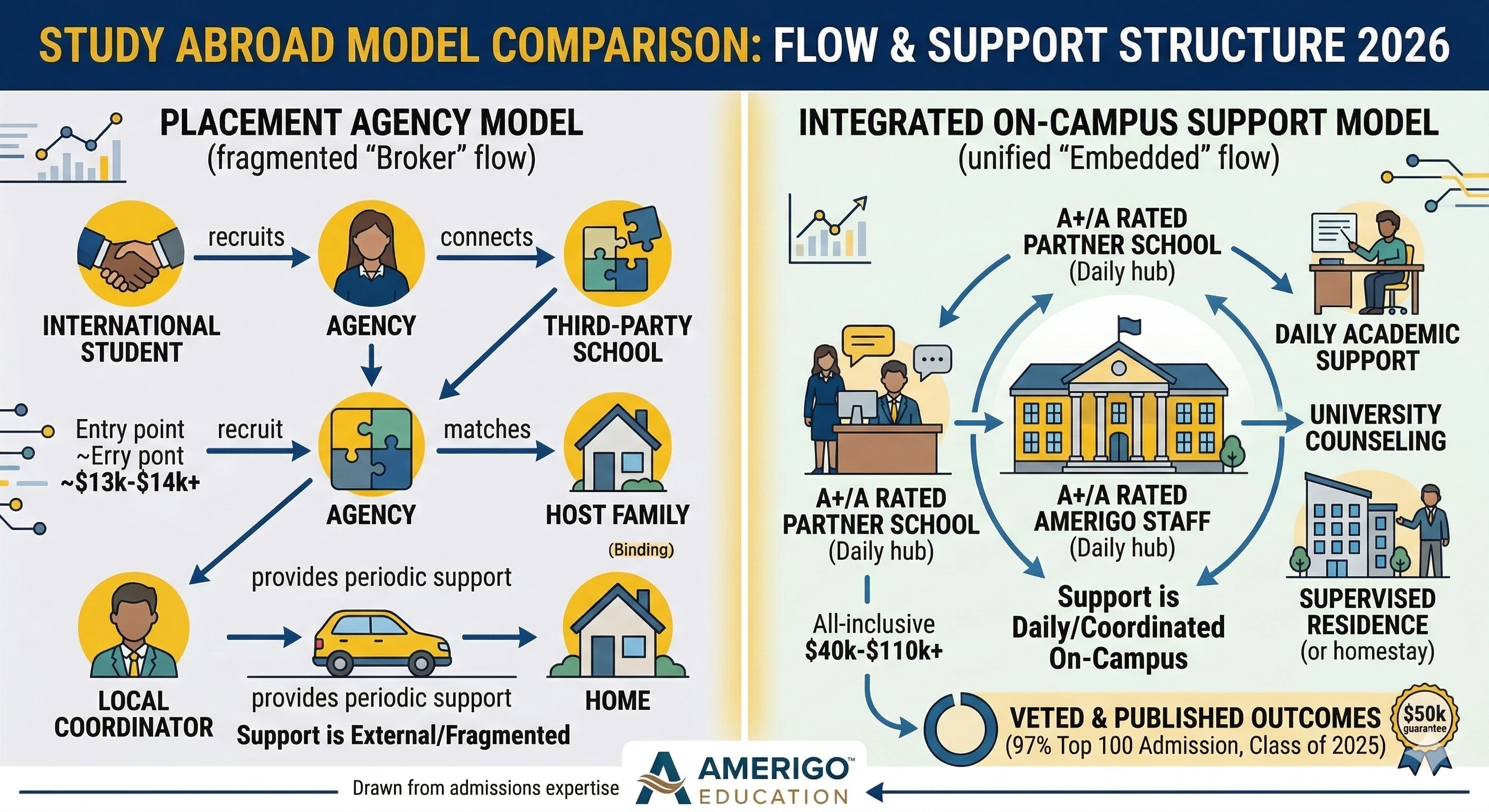
The placement agency model functions as an intermediary between international families and existing schools. Agencies recruit students from source countries, assess their academic level and preferences, then match them with schools in their network. The agency handles paperwork, visa coordination, and provides a local coordinator in the student's area. The student attends a school that may have dozens of agency-placed international students or just one.
The integrated on-campus model operates differently. Dedicated staff work inside the partner school daily, functioning as that school's international department. Students see support staff in hallways, at lunch, and after classes without scheduling appointments. Academic planning, university counseling, and residential supervision all operate under one coordinated program rather than through separate providers.
8 Structural Differences Between Models:
- Placement agencies match students to schools from a large network; integrated programs operate at specific partner schools
- Agency support comes through external coordinators; integrated support is embedded within the school
- Agencies primarily use host families; integrated programs offer multiple accommodation types
- Agency coordinators may serve students across several schools; integrated staff are dedicated to one campus
- Agencies typically offer both J-1 (exchange visitor visa) and F-1 (student visa for academic programs) pathways; integrated programs focus on F-1 academic pathways
- Agencies operate across many countries (some in 16+ destinations); integrated programs concentrate in specific markets
- University counseling may be an add-on with agencies; it is built into integrated programs
- Family communication frequency and format differs between models
What Support Do Students Receive in Each Model?
Placement agencies assign a local coordinator who serves as the student's primary support contact. This coordinator handles host family issues, school communication, and emergency situations. Some agencies also provide a 24/7 phone line for urgent matters. The coordinator may support students placed at multiple schools across a geographic region, meaning availability depends on caseload and distance.
The integrated model embeds full-time staff at each partner school. Students access academic advisors, ELL (English Language Learning) specialists, and university counselors daily on campus. Support includes individualized course planning for AP (Advanced Placement) prerequisites, in-residence homework help, customized English courses, and monthly family reports with native-language communication available for families in multiple countries. Life360 or similar safety technology enables parent location tracking.
Neither model is inherently superior - they serve different needs. Placement agencies offer broader geographic reach and flexibility. Integrated programs offer deeper daily support and structured university preparation. Families should evaluate which level of embedded support matches their student's maturity, independence, and academic goals.
6 Questions to Compare Support Models:
- Where are support staff physically located relative to the student's school?
- How many students does each support person serve?
- Is university counseling included or available as a separate add-on?
- How are parents informed about student progress and how frequently?
- Is native-language communication available for families?
- What academic support exists outside classroom hours?
Accommodation Options by Model
Placement agencies primarily use host families for student housing. In J-1 exchange programs, host families are typically volunteers. In F-1 programs, families are screened and compensated. Host families provide meals, a bedroom, and transportation. This model offers cultural immersion and English practice through daily family interaction. However, the student's residential experience depends heavily on the individual host family match.
Integrated programs typically offer multiple accommodation types. These may include homestay with American families for cultural immersion at typically lower cost, off-campus residences with single-gender arrangements and 24/7 staff supervision, on-campus housing at select schools, or self-provided arrangements. Off-campus residences serve as the primary model for many integrated programs, enabling access to elite day schools that do not offer boarding facilities.
| Accommodation Feature | Placement Agency Model | Integrated On-Campus Model |
|---|---|---|
| Primary housing type | Host family | Off-campus residence (primary) |
| Options available | Host family or boarding school | 4 types including homestay |
| Staff supervision | Coordinator visits periodically | 24/7 on-site residential staff |
| Meals | Host family provides | Included in residential program |
| Cultural immersion | Strong through family interaction | Available through homestay option |
| Student independence | High - living in family home | Structured - supervised environment |
How Do University Outcomes Compare?
This is where models diverge most visibly. Integrated on-campus programs that include university counseling as a core service can track and publish admission data tied directly to their student population. Verified Class of 2025 data from the integrated model shows 97% Top 100 US university admission, 60% Top 50, and 25% Top 30, backed by a $50,000 USD refund guarantee for students meeting requirements. Published student results include S. Hong (St. Anthony's High School, GPA 3.86 to 98.35, accepted to University of Illinois) and Y. Li (St. Anthony's High School, GPA 3.57 to 3.70, accepted to University of Florida).
Placement agencies generally do not publish comparable university admission statistics. Some offer college advisory programs as add-ons, which may include guaranteed acceptance to network partner universities and application fee waivers. However, families should distinguish between "guaranteed acceptance to a network school" and "admission to a Top 100 ranked university" - these represent different outcomes.
5 Questions to Ask About University Outcomes:
- Does the program publish verified university admission rates by graduating class?
- Are outcomes broken down by university ranking tier (Top 100, Top 50, Top 30)?
- Is university counseling included in the base program or an additional cost?
- Does the program offer any financial guarantee backing outcome claims?
- Can the program provide named student outcomes with specific university placements?
Important for F-1 visa students: According to SEVP/ICE (2025), off-campus employment is restricted under F-1 (student visa for academic programs) regulations. Students in either model should focus on school-based activities and academic competitions rather than paid work.
Cost and Value Comparison
Cost differences between models reflect scope and inclusion level. Placement agencies offer entry points starting from approximately $13,000-$14,000 annually for basic exchange programs, with premium options (private schools, boarding) ranging significantly higher. These fees typically cover placement, host family coordination, local support, and basic insurance.
Integrated all-inclusive programs range from $40,000 for entry-level to $75,000-$110,000+ annually for premium programs. These fees typically include partner school tuition, accommodation management, on-campus academic support, university counseling, and 24/7 emergency assistance. Visa services are provided through third-party partners and billed separately in both models.
Families should compare total value rather than base price alone. A lower-cost placement without university counseling, structured academic support, or supervised housing may require families to arrange and pay for these services independently. The total investment when adding college counseling, tutoring, and residential supervision separately may narrow the cost gap. Learn more about study abroad costs and what is included.
| Cost Factor | Placement Agency | Integrated On-Campus |
|---|---|---|
| Annual range | ~$13,000-$60,000+ | $40,000-$110,000+ |
| Tuition | Included (varies by school) | Included |
| Housing | Host family included | Included (4 options) |
| University counseling | Add-on or not available | Included |
| Academic support | Through school's systems | Dedicated on-campus staff |
| Family reporting | Varies | Monthly + native-language |
How Do Application Processes Differ?
Placement agencies typically assess students through English testing, transcript review, and interviews, then match them with appropriate schools from their network. Some agencies offer school choice at premium tiers while basic programs assign placement. Application timelines follow standard academic year cycles with fixed deadlines.
Integrated programs at most partner schools offer rolling admissions year-round, accept flexible English testing including Duolingo or Eltis beyond TOEFL (Test of English as a Foreign Language) and IELTS (International English Language Testing System), and allow students to apply to multiple schools through one process. No recommendation letters are required at most partner schools. Visit the application page for details.
Frequently Asked Questions
What is the main difference between these models?
Placement agencies recruit students internationally and match them with schools from a large network, providing external coordinator support and host family housing. Integrated on-campus programs embed dedicated staff within specific partner schools, providing daily academic support, university counseling, and supervised residential options. The core distinction is external coordination versus embedded daily presence.
Which model provides better university outcomes?
Integrated programs that include university counseling publish verified outcome data - Class of 2025 results show 97% Top 100 admission backed by a $50,000 guarantee. Placement agencies generally do not publish comparable statistics. Families should request specific university placement data from any program before enrolling.
Are placement agencies less expensive?
Entry-level placement programs start significantly lower (approximately $13,000-$14,000 annually). However, these base prices may not include university counseling, supervised housing, or structured academic support. Families should compare total investment including all services needed rather than base program fees alone.
How does support quality differ?
Placement agencies provide external coordinators who may serve students across multiple schools. Integrated programs embed full-time staff at each school campus for daily accessibility. Neither is inherently better - the right choice depends on the student's maturity level, independence, and need for structured daily support.
Can students in placement programs access university counseling?
Some placement agencies offer college advisory programs as add-ons with guaranteed acceptance to network partner universities and application fee waivers. Verify whether this is included in base pricing or requires additional fees. Integrated programs typically include university counseling from freshman year through applications as a core service.
What accommodation is better for international students?
Host families offer strong cultural immersion and daily English practice. Supervised residences provide structured environments with 24/7 staff oversight. The best choice depends on student maturity, family preference for supervision level, and whether cultural immersion or structured support matters more.
Which model offers more school choices?
Placement agencies typically maintain larger school networks (350+ schools across multiple countries). Integrated programs operate at fewer schools (40 in the US and Canada) but provide deeper support infrastructure at each location. Breadth of choice versus depth of support represents the fundamental tradeoff.
How should families decide between models?
Consider the student's maturity and independence level, the family's priority for university outcomes versus cultural exchange, budget parameters, desired accommodation type, and how much daily structured support the student needs. Visit schools or request virtual tours when possible and ask detailed questions about support staffing and university outcomes before committing.
People Also Read
Boarding School vs Day School for International Students: Complete Comparison Guide 2026 Compare boarding and day school models for international students including access to academics, extracurriculars, and support structures.
On-Campus International Department vs External Coordinator Model: Daily Support Access Comparison Compare daily embedded support with external coordination models and how accessibility differences impact academic performance.
Study Abroad Accommodation Options: Homestay vs Residence vs On-Campus vs Self-Provided Compare accommodation types and understand how housing choice affects total study abroad costs and student experience.
About the Author
Maria Chen writes about international education and study abroad program evaluation on behalf of the Amerigo Education team. This guide draws on program expertise from staff operating the on-campus international department at 40 Niche A+/A rated US and Canadian partner schools.
Conclusion
The choice between a placement agency and an integrated on-campus support program depends on what matters most to your family. Placement agencies offer broader school networks, lower entry-level pricing, and geographic flexibility across multiple countries. Integrated on-campus programs offer deeper daily support, structured university preparation with published outcomes, and supervised residential options.
Both models serve international families seeking American high school education. Programs like Amerigo that publish verified outcome data and offer financial guarantees provide concrete comparison points alongside support structure and accommodation options. The questions outlined in this guide help families evaluate either model based on how support is delivered and which approach best serves their student.
Take the Next Step
Families ready to explore the integrated on-campus support model can contact Amerigo for detailed information about partner schools, daily support structure, and enrollment. To begin the application process, visit the application page - most partner schools offer rolling admissions with flexible English testing.
This article provides program comparison information for educational purposes only. Families should conduct independent research, request current data from both program types, and consult with representatives regarding specific circumstances. Contact us with questions.