All news
May 21, 2026
Study Abroad 101
Columbia International Admit Rate: How High School Students Can Strengthen Their Application
Columbia's ~3.9% acceptance rate and Core Curriculum set it apart. Learn what international high school students need to build a competitive application.

Last Updated: May 2026
Columbia University's acceptance rate for the Class of 2028 was approximately 3.9% - among the lowest at any US university and a figure that reflects decades of rising application volumes alongside constrained class sizes. According to IIE Open Doors (2024), international students represent approximately 13% of Columbia's undergraduate enrollment, drawn from more than 100 countries to one of the most academically rigorous institutions in the Ivy League. For high school students outside the US, understanding what distinguishes competitive international applicants is a practical first step.
Amerigo Education partners with 40 Niche A+/A rated schools (independent academic rankings based on school-reported curriculum quality, faculty credentials, student outcomes, and college matriculation data) across the US, Canada, and the UK, supporting 3,500+ students from 55+ countries. The Class of 2025 achieved 97% admission to Top 100 US universities - and of those who applied to Top 30 universities, 25% gained admission. Amerigo's Top 50 Track - a higher-tier program for students targeting universities ranked in the Top 50, combining elevated entry academic standards, structured extracurricular development, focused essay strategy, and dedicated university counseling from each Signature School's on-campus international department is designed specifically for students targeting highly selective universities like Columbia.
This guide covers Columbia's international enrollment figures, academic expectations, application requirements, and how attending a US high school positions international students relative to their global competition.
Key Takeaways
- Acceptance rate: Columbia's Class of 2028 acceptance rate was approximately 3.9% overall.
- International enrollment: International students make up ~13% of Columbia's undergraduate population, from 100+ countries.
- Core Curriculum: All Columbia students complete the same required curriculum - a differentiating factor applicants must engage with in essays.
- Financial aid: Columbia is need-blind for all applicants, including international students, and meets 100% of demonstrated financial need.
- Application deadlines: Early Decision November 1; Regular Decision January 1.
What Is Columbia's International Enrollment?
Columbia's undergraduate student body of approximately 4,500 students includes international students from more than 100 countries. According to IIE Open Doors (2024), Columbia consistently ranks among the top US universities by international enrollment density relative to undergraduate class size.
International students enroll across both Columbia College (arts and sciences) and the Fu Foundation School of Engineering and Applied Science (SEAS). Both require completion of the Core Curriculum, which distinguishes Columbia from peer Ivy institutions and is a deliberate part of the university's educational identity. For international applicants, the ability to articulate why the Core Curriculum appeals to them is treated as a signal of genuine interest.
What Grades Do International Applicants Need?
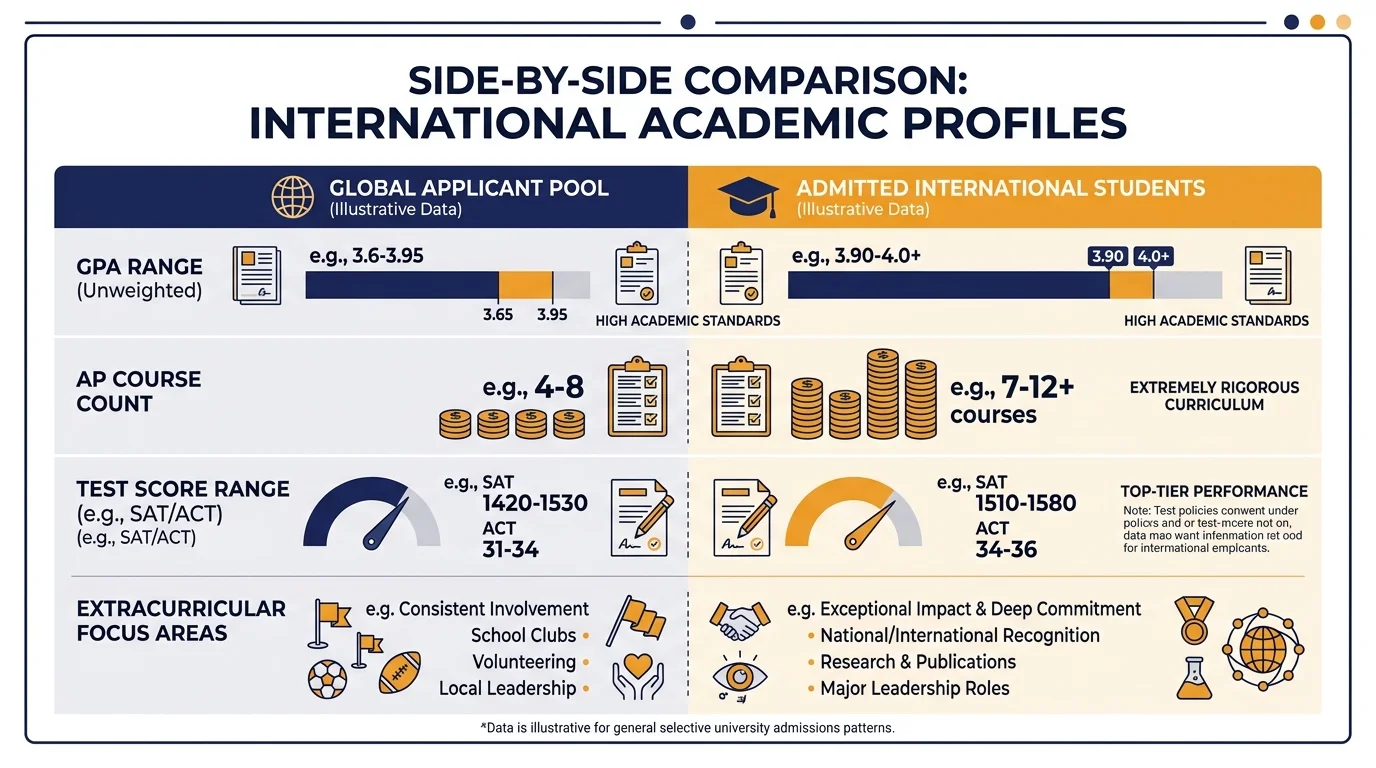
The academic profile of admitted international students at Columbia is among the strongest of any US university. Most admitted students present cumulative GPAs of 3.9 or higher, with course rigor at the AP (Advanced Placement) and Honors level throughout high school. Columbia evaluates the full four-year transcript for trend - improving grades in a challenging curriculum are viewed more favorably than a flat record in easier courses.
- GPA: 3.9-4.0 unweighted; weighted GPAs at the top of a challenging curriculum.
- AP and Honors courses: 5-7 AP courses, with strong performance (4s and 5s) on AP exams.
- English proficiency: TOEFL or IELTS required for non-native speakers; most admitted students score above 110 TOEFL.
- SAT/ACT (optional): Columbia is test-optional - strong scores can strengthen an application, but absence does not disadvantage applicants with strong AP exam results.
- Extracurriculars: Depth over breadth - sustained leadership or achievement in 1-2 areas is preferred over a long list of casual participations.
What Makes Columbia Different From Other Ivies?
Columbia's Core Curriculum is the most defining academic feature of the undergraduate experience. All students - regardless of major - complete Literature Humanities, Contemporary Civilization, Art Humanities, Music Humanities, Frontiers of Science, and University Writing. The Core is not a distribution requirement but a structured set of shared courses taken as a community.
According to NACAC (2024), admissions rates at highly selective universities are increasingly influenced by demonstrated fit rather than statistical qualifications alone - and at Columbia, fit means engagement with the Core's intellectual community. International applicants who can articulate why a shared curriculum appeals to them, rather than focusing solely on major-specific outcomes, tend to write more compelling essays.
Manhattan location adds a second dimension: Columbia's position in New York City is not incidental. The university expects students to treat the city as an extension of the classroom. International applicants who reference specific institutions, organizations, or industries in New York City - specific to their academic goals - signal genuine rather than generic interest.
Does Financial Aid Apply to International Students?
Yes. Columbia University is one of a small number of US universities that is need-blind for all applicants - including international students - and meets 100% of demonstrated financial need without loans. This policy applies to Columbia College and SEAS students. According to NAIS (2024), among Ivy League institutions, only a handful maintain fully need-blind international policies, making Columbia unusual in its accessibility regardless of financial background.
Families should file the CSS Profile and provide supporting financial documentation as part of the application. International financial aid awards are made alongside admission decisions.
When Do International Students Apply to Columbia?
Columbia offers Early Decision (ED) and Regular Decision (RD) pathways. ED deadline is November 1, with decisions released in mid-December. RD deadline is January 1, with decisions released in late March or early April.
International students applying ED should ensure their F-1 (student visa for US academic programs) application timeline accounts for an earlier start date. Visa processing times vary by country of origin - students from China, Vietnam, Korea, Mexico, and the Taiwan Region should plan for additional lead time when targeting an August arrival. Students should also confirm that all supporting financial documentation required for the CSS Profile is available before the ED deadline, as late submissions can delay aid decisions.
- November 1: Early Decision application deadline (binding commitment).
- January 1: Regular Decision application deadline.
- Mid-December: ED decisions released; accepted students commit immediately.
- Late March - early April: RD decisions released; international students should begin F-1 visa preparation immediately upon acceptance.
How Does Amerigo's Top 50 Track Help?
Amerigo's Top 50 Track supports students whose goal is admission to universities ranked in the Top 50. Of Class of 2025 students who applied to Top 50 universities, 60% gained admission. Of those who applied to Top 30 universities, 25% gained admission.
The Track combines higher entry academic standards with focused extracurricular development, essay strategy, and university counseling from the on-campus international department - a dedicated team at each US Signature School consisting of a Director of Campus Operations, Academic Director, Senior Campus Coordinators, Campus Coordinators, and an ELL teacher, who provide daily academic support, residential supervision, university counseling, and welfare oversight for enrolled international students. For a university like Columbia - where a student's intellectual narrative must be coherent across transcripts, essays, and recommendations - two years of structured US high school preparation represents a material advantage over applicants presenting international credentials alone.
Frequently Asked Questions
What is Columbia's acceptance rate for international students?
Columbia does not publish acceptance rates broken down by domestic vs international status. The overall acceptance rate for the Class of 2028 was approximately 3.9%. International applicants compete across the full applicant pool alongside domestic applicants. According to IIE Open Doors (2024), Columbia consistently enrolls approximately 13% of its undergraduate class from outside the US, representing students from over 100 countries - one of the higher international enrollment densities among Ivy League schools.
Does Columbia require the SAT or ACT from international students?
Columbia is currently test-optional, meaning SAT and ACT scores are not required but may be submitted. International students whose high school systems do not emphasize standardized tests are evaluated on the same criteria as domestic applicants - academic record, essays, extracurriculars, and recommendations. Strong AP exam scores (4s or 5s) carry significant weight in the absence of SAT/ACT scores.
What is the Core Curriculum at Columbia?
The Core Curriculum is a set of required courses all Columbia undergraduates complete regardless of major. It includes Literature Humanities, Contemporary Civilization, Art Humanities, Music Humanities, Frontiers of Science, and University Writing. The Core is taken as a shared community and distinguishes Columbia from Ivies with open or distribution-based curricula. International applicants should explain in essays why this structure appeals to their learning goals.
Does Columbia offer financial aid to international students?
Yes. Columbia is need-blind for all applicants, including international students, and meets 100% of demonstrated financial need. Families apply using the CSS Profile and submit supporting financial documents. Aid packages may include scholarships, grants, and work-study. Columbia does not require families to accept loans as part of their financial aid package, which is an unusual policy among highly selective US universities.
What extracurricular activities do Columbia-admit students typically have?
Columbia admits students who demonstrate depth rather than breadth in extracurriculars. Most admitted students show sustained involvement in 1-2 meaningful activities - such as academic research, competitive performance, entrepreneurship, or service leadership - rather than a long list of clubs or casual memberships. For international students, national-level competition, published work, or documented community impact in their home country are recognized as equivalently compelling to domestic activity profiles.
How does studying at a US high school help with Columbia applications?
A US high school transcript demonstrates academic performance within the American grading and curriculum system that Columbia admissions officers evaluate daily. AP exam scores, teacher recommendation letters from US educators, and demonstrated English fluency in classroom settings provide evidence that is directly comparable across all applicants. International students submitting foreign transcripts require additional translation and credential evaluation, which introduces variability Columbia must account for in assessment.
Should international students apply Early Decision to Columbia?
Early Decision is binding - students who are admitted must attend. For international students who have identified Columbia as their clear first choice and whose families have completed financial planning, ED can signal commitment that is valued in the full review process. Students who need to compare financial aid packages across universities or whose visa timelines are uncertain should consider Regular Decision.
What essays does Columbia require?
Columbia requires the Common App essay plus a set of Columbia-specific short essays. These typically ask about the Core Curriculum, a list question covering books, music, films, or academic interests, and a "Why Columbia" essay. The Why Columbia essay is particularly important - generic statements about Ivy League prestige fail. Specific references to the Core, faculty research, NYC institutions, or particular programs within Columbia College or SEAS demonstrate genuine fit.
How many international students from China attend Columbia?
Columbia does not publish country-by-country enrollment data at the undergraduate level. According to IIE Open Doors (2024), China is the largest single sending country of international students to US universities overall. Applicants should not factor co-national enrollment volumes into their strategy - Columbia evaluates individual applications on their own merits, and published nationality quotas do not exist. Academic achievement and personal distinction matter far more than country of origin in the evaluation process.
Can an Amerigo student apply to Columbia through the Top 50 Track?
Yes. Amerigo's Top 50 Track is available to Signature School students who meet the entry standards and maintain the required academic and extracurricular profile. The track includes university counseling through the on-campus international department, which supports essay development, application strategy, and pre-application college advising. Students can explore school and program options at find your school.
Conclusion
Columbia University's ~3.9% acceptance rate and Core Curriculum make it one of the most demanding targets for international high school applicants. Academic preparation at the AP and Honors level, combined with a coherent intellectual narrative in essays and genuine fit with the Core, are the primary differentiators among competitive applicants.
Apply to an Amerigo Partner School
To learn more about studying in America at an Amerigo partner school, contact us to speak with a program advisor, or apply now to take the first step toward enrollment.
People Also Read
- How Students Get Into Top 50 US Universities
- Amerigo's Top 50 Track: How Students Reach Elite Universities
- Early Decision vs Early Action for International Students
About the Author
This guide was written by the Amerigo Education content team, drawing on program data from staff operating the on-campus international department at 40 Niche A+/A rated US, Canadian, and UK partner schools. Learn more about Amerigo Education.
Disclaimer: This article provides general information for educational purposes only. Families should conduct independent research, request current program data from providers, and consult with program representatives regarding specific circumstances. Contact us with questions.