All news
April 28, 2026
Study Abroad 101
What to Pack Before Joining an International High School Program
Study abroad packing list for international high school students - documents, clothing, tech, medication, and what to leave home before joining Amerigo.
What to Pack Before Joining an International High School Program
Last Updated: April 2026
Packing for an international high school program differs from packing for a vacation. Students are typically moving for one or two academic years, which means accounting for seasonal climate changes, school-specific requirements, electronics compatibility, and the documents needed at border entry. Getting the packing list right before departure reduces arrival stress and helps students settle in without early-term disruptions. According to U.S. Customs and Border Protection (CBP, 2025), F-1 students must carry specific documents at the US port of entry - and the principle applies to every critical document: if it cannot be replaced quickly, it belongs in carry-on luggage.
Amerigo Education, founded in 2016 and backed by Avathon Capital, partners with 40 Niche A+/A rated schools across the US, Canada, and the UK, serving international students aged 14-18 - 3,500+ students from 55+ countries. The Class of 2025 achieved 97% admission to Top 100 US universities. Amerigo's on-campus international department conducts a pre-departure 1:1 call with each student's academic director to review transcripts and plan course selection. A separate pre-departure orientation session run by campus coordinators covers arrival logistics, health documentation, and emergency contacts. Amerigo's in-country staff support families from China, Vietnam, Korea, Mexico, and the Taiwan Region in their native language throughout the pre-departure period.
This guide covers essential packing across six categories: documents, clothing, technology, health and toiletries, items to leave behind, and how accommodation type affects what to bring.
Key Takeaways
- Documents go in carry-on only: Passport, visa, I-20 (or CAS for Brentwood UK students), enrollment letter, and insurance card should never travel in checked luggage.
- Clothing depends on school location and season: US partner school climates vary widely. Students joining in September should be prepared for all four seasons at Northern schools.
- Bring a universal power adapter: US outlets run at 110V/60Hz; UK outlets at 230V/50Hz. Most modern devices are dual-voltage and only need a plug adapter.
- Prescription medication needs a 90-day supply: Carry in original packaging with a doctor's note in English. Some medications require advance customs clearance.
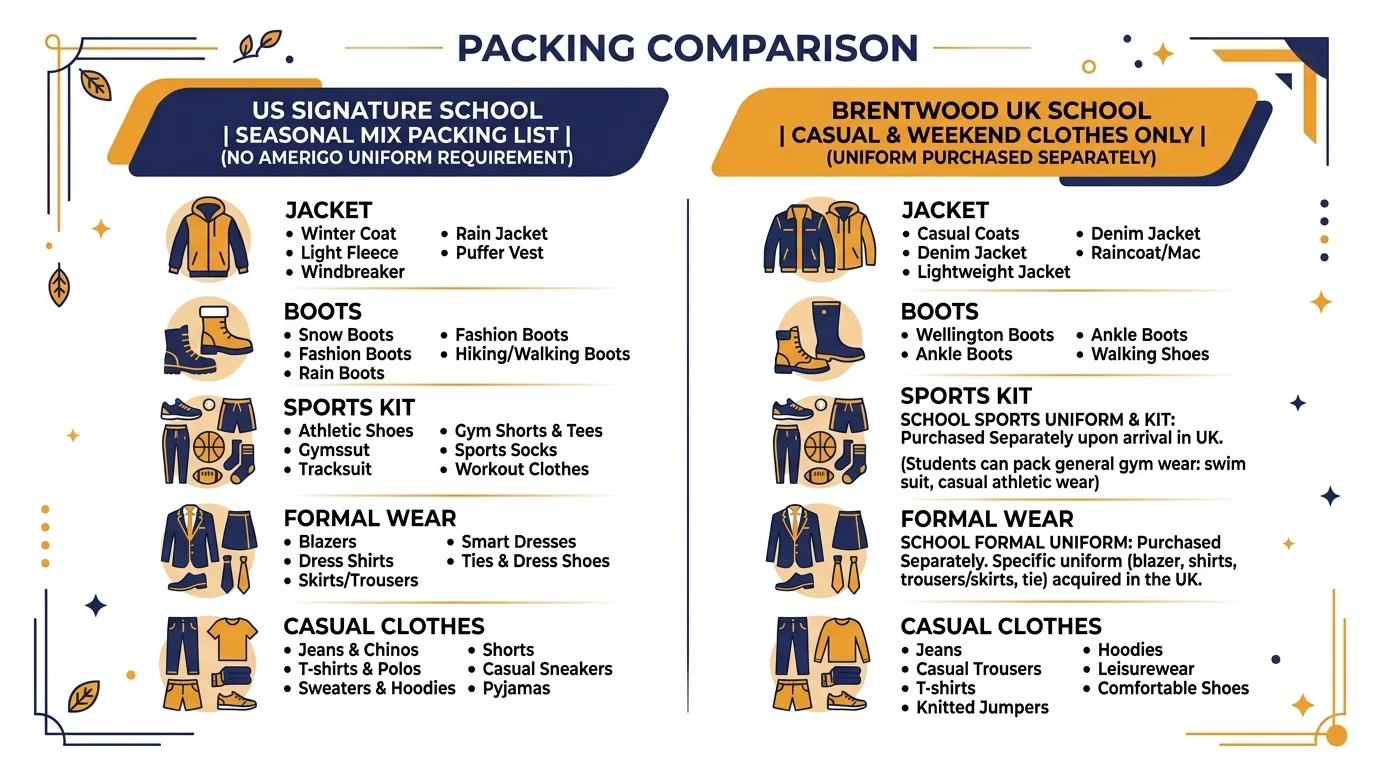
- School uniforms purchased separately: All Amerigo Signature US partner schools and Brentwood School Essex require formal school uniforms that students purchase separately on acceptance. Pack casual and weekend clothing only.
What Documents Should You Pack First?
Documents are the most critical packing category - they cannot be replaced quickly if lost, and missing paperwork at entry can delay enrollment or affect visa compliance. All original documents must travel in carry-on luggage, with digital copies saved to cloud storage and shared with parents.
Documents to carry in hand luggage:
- Passport: Valid for at least 6 months beyond the program end date.
- Visa: US F-1 visa stamp (US program students) or UK Student visa (Brentwood students).
- Form I-20 (US students): The SEVIS-generated document F-1 students must carry at the US port of entry and retain throughout enrollment. Brentwood students carry their CAS reference number instead.
- SEVIS fee receipt: Proof of I-901 payment, required alongside the I-20 at US entry.
- Enrollment letter: Official confirmation from the school or Amerigo with program dates and accommodation address.
- Health insurance document: Coverage details valid for the full program period.
- Emergency contact list: Amerigo staff numbers, school contact, and family details in hard copy - stored separately from your phone.
Store digital copies of all documents in a shared folder your parents can also access.
What Clothing Do You Need for Your Program?
Clothing needs depend on the region where the partner school is located and the program's start date. US climates vary significantly - a school in Illinois, New York, or Massachusetts requires full winter gear; a school in Florida or California does not. Students joining in September for a full academic year should pack for all four seasons at cold-climate schools.
General clothing guidance for US Signature School students:
- Everyday clothing: 7-10 days of school-appropriate casual clothes. Laundry facilities are available at Amerigo residences.
- Winter outerwear: Insulated jacket, gloves, scarf, and waterproof boots for schools in cold-climate states.
- Sports or PE kit: Athletic shorts, trainers, and sports socks - check school requirements in the enrollment pack.
- Formal attire: One smart outfit for school events or parent weekends.
- Sleepwear and loungewear: Practical for residence or homestay evenings.
Both Brentwood School Essex and Amerigo's US Signature partner schools require formal school uniforms. Schools send a full uniform list on acceptance, and items can be purchased before traveling or through the school shop on arrival. Pack only casual and weekend clothing in your luggage.
What Tech and Devices Should You Bring?
Electronics are essential for academic work, family communication, and daily life. The most important consideration is voltage compatibility: US outlets run at 110V/60Hz; UK outlets at 230V/50Hz. Most modern laptops, phones, and tablets are dual-voltage - check the power brick label for "100-240V." If dual-voltage, a plug adapter is all that is needed.
Recommended devices:
- Laptop: Required for academic work at all Amerigo partner schools. Pack in carry-on with the charger and a protective sleeve.
- Smartphone (carrier-unlocked): Essential for communication and navigation. Students at US Signature Schools have access to Life360 or Reach - parent-accessible location apps. Unlock the phone before departure to use a local SIM card.
- Universal power adapter: A compact multi-country adapter is sufficient for US and UK outlets.
- Earphones or headphones: For study focus and entertainment during downtime.
- Portable charger: Useful for long school days when outlet access is limited.
Leave large electronics at home - gaming consoles, desktop computers, and large speakers add significant weight and are not compatible with most residence room setups.
What Toiletries and Health Items Are Essential?
Toiletries are widely available near all US and UK partner schools. Bring a starter kit for the first week only - students can buy locally once settled.
Prescription medication requires advance planning. Carry all medications in original pharmacy packaging with a prescription label and a signed doctor's note in English explaining dosage and medical necessity. Aim for a 90-day supply minimum, as replenishing specific prescription medications abroad can be slow and expensive. Certain controlled substances are subject to strict import regulations regardless of a valid prescription - verify requirements with the US embassy or CBP before traveling.
Starter toiletry kit to pack:
- Shampoo, conditioner, and body wash (travel sizes)
- Toothbrush and toothpaste
- Deodorant
- Skincare items specific to your routine
- Preferred-brand feminine hygiene products if not available locally
Avoid packing large quantities - toiletry items add weight, exceed airline carry-on liquid limits (100ml per item, TSA 2025), and are easily replaced on arrival.
What Should You Leave at Home?
Overpacking is one of the most common mistakes on departure. Most items are available locally, and airlines charge significant fees for overweight luggage.
Items to leave at home:
- Cookware and kitchen equipment: Amerigo residences provide all meals - breakfast and dinner daily, with snacks available. Students are not permitted to cook independently for safety reasons. Rice cookers, pots, and kitchen appliances are unnecessary.
- Large electronics: Gaming consoles, desktop computers, and large speakers are difficult to transport and not compatible with most residence room setups.
- Excess books: Partner schools provide textbooks and course materials. Bring only personal reading books you plan to use.
- Expensive valuables: Leave high-value jewellery and luxury items at home. School residences have secure storage, but unnecessary valuables increase loss risk.
- Full-year toiletry supplies: All standard items are available near US and UK partner schools. Buying locally keeps luggage within airline weight limits.
How Does Accommodation Type Affect Packing?
The accommodation option selected through Amerigo's US Signature School programs has practical packing implications. Understanding what each type provides helps avoid overpacking and arriving without something essential.
For off-campus and on-campus residence students, meals and study areas are fully included. There is no need to bring food, cookware, or bulk household supplies. For homestay students, it is a common and appreciated gesture to bring a small culturally meaningful gift from the student's home country for the host family - not required, but a warm start to the homestay relationship.
For students at Brentwood School Essex, Brentwood's boarding program provides all meals and a fully equipped boarding house. The addition to the standard packing list is the school uniform, for which Brentwood sends a purchase list on acceptance.
Frequently Asked Questions
What documents do F-1 students need to carry on arrival in the US?
F-1 students must carry their valid passport with F-1 visa stamp, Form I-20, SEVIS fee receipt (I-901), and an enrollment letter confirming school placement and accommodation. All documents should travel in carry-on luggage only - never checked bags. Store digital copies in cloud storage and share with parents. Your Amerigo coordinator will confirm the complete document checklist during the pre-departure call.
How much clothing should an international student pack for a full academic year?
Aim for 7-10 days of school-appropriate clothing plus seasonal layers for the partner school's region. Northern US schools require winter coats, boots, and gloves; Southern schools are milder year-round. Laundry is available at Amerigo residences, so a 7-10 day wardrobe is sufficient. Students at Brentwood and most Amerigo US Signature partner schools pack casual and weekend clothes only; school uniforms are purchased separately on acceptance.
Do Amerigo students need to bring their own laptop?
Yes. A laptop is required for academic work at all Amerigo partner schools. Check the power brick for "100-240V" dual-voltage compatibility - if dual-voltage, a plug adapter is sufficient for US or UK outlets. Pack in carry-on luggage alongside documents. Bring the charger and a protective sleeve. Schools do not typically provide laptops, so this is a must-pack item for every student.
Can students bring prescription medication when traveling internationally?
Yes, with planning. Carry medication in original packaging with a doctor's note in English explaining the diagnosis, dosage, and medical necessity. A 90-day supply is recommended, as replenishing abroad can be slow and expensive. Certain controlled substances have strict import rules regardless of a valid prescription - verify requirements with the relevant embassy or U.S. Customs and Border Protection before departure.
Should students pack a full year's supply of toiletries?
No. A starter kit for the first week is sufficient - shampoo, toothpaste, deodorant, and personal skincare basics. All standard toiletry items are available at supermarkets near US and UK partner schools. Carry-on liquid rules limit containers to 100ml per item. Packing a full year's supply adds unnecessary weight and bulk. Bring preferred-brand products only if they are not available locally.
Do Amerigo residence students need to bring cooking equipment?
No. Amerigo provides all meals for residential students - breakfast and dinner daily, with snacks available throughout the day. Students are not permitted to cook independently for safety reasons. Cookware, rice cookers, and kitchen appliances are unnecessary. At select campuses, on-site chefs prepare healthy meals and occasionally dishes from students' home countries. Bringing cooking equipment wastes luggage space better used for clothing and personal items.
What is the packing difference between homestay and off-campus residence?
Both accommodation types include Amerigo-provided meals - no cookware is needed for either. Homestay students may want to bring a small culturally meaningful gift from their home country for the host family. Both types are fully furnished. Residence students should also focus on clothing appropriate for the school's regional climate and personal study supplies such as stationery and organisers.
Do students at Brentwood School Essex need a school uniform?
Yes. Brentwood School Essex requires a formal school uniform. Students receive the full uniform list from the school on acceptance and can purchase items before traveling or through Brentwood's school shop on arrival in Essex. Pack only casual and weekend clothing in your luggage - the school uniform is handled as a separate purchase. Evening and weekend clothing guidance follows the same standard as other Amerigo program types.
What electronics are essential for an international high school student?
A laptop, carrier-unlocked smartphone, universal power adapter, and earphones are the core essentials. Students at US Signature Schools have access to Life360 or Reach - parent-accessible location tracking apps - so setting up a smartphone before arrival is recommended. A portable charger is useful for long school days. Gaming consoles, large speakers, and desktop computers should be left at home.
What do most international students wish they had packed differently?
Common overpacking regrets include excess clothing, cooking equipment, and heavy books. Common underpacking regrets include seasonal layers for cold-climate schools, a small cultural gift for homestay host families, and printed copies of key documents. Keeping luggage to two bags at most makes airport transit, ground transfer, and settling into the residence or homestay significantly easier from the very first day.
Conclusion
A well-prepared packing list keeps documents in carry-on luggage, matches clothing to the school's regional climate, packs voltage-compatible tech, and skips items Amerigo residences provide. Most toiletries are sourced locally. Light luggage makes the first week significantly easier.
Prepare for Your Amerigo Program
For program-specific packing guidance and to confirm requirements for your partner school, contact us to speak with a program advisor, or apply now to begin the enrollment process.
People Also Read
- Study Abroad Preparation Checklist: US High School Guide 2025-2026
- How Amerigo Prepares International Students Before They Arrive
- How to Prepare for Studying Abroad: Complete Guide 2025
About the Author
This guide was written by the Amerigo Education content team, drawing on program data from staff operating the on-campus international department at 40 Niche A+/A rated US, Canadian, and UK partner schools. Learn more about Amerigo Education.
Disclaimer: This article provides general information for educational purposes only. Families should conduct independent research, request current program data from providers, and consult with program representatives regarding specific circumstances. Contact us with questions.