All news
May 20, 2026
Study Abroad 101
What to Do If Your I-20 Has an Error (and Who Fixes It)
I-20 errors must be corrected by your school's DSO before any visa appointment or US entry. Learn the steps, timelines, and what families should do next.
Last Updated: May 2026
An I-20 error occurs when the Certificate of Eligibility for Nonimmigrant Student Status contains incorrect information - such as a misspelled name, wrong date of birth, or inaccurate program dates. According to SEVP, the I-20 is the foundational document linking a student's identity to their SEVIS (Student and Exchange Visitor Information System) record, and any discrepancy between the I-20 and the passport can trigger visa delays, entry refusals, or complications at the US border. Over 1 million international students hold active F-1 status in the US each year, according to IIE Open Doors (2024), making accurate I-20 documentation one of the most consequential administrative tasks in international education.
Amerigo Education partners with 40 Niche A+/A rated schools (independent academic rankings based on school-reported curriculum quality, faculty credentials, student outcomes, and college matriculation data) across the US, Canada, and the UK, supporting 3,500+ students from 55+ countries. The Class of 2025 achieved 97% admission to Top 100 US universities. Every student enrolled at an Amerigo US Signature School receives an I-20 issued by the school's DSO (Designated School Official), with Amerigo's on-campus international department - a dedicated team at each US Signature School consisting of a Director of Campus Operations, Academic Director, Senior Campus Coordinators, Campus Coordinators, and an ELL teacher, who provide daily academic support, residential supervision, university counseling, and welfare oversight for enrolled international students providing direct support when document issues arise.
This guide covers the most common I-20 errors, the correction process, and what families should do when a mistake is found - whether before the visa appointment, during an interview, or after a US border entry.
Key Takeaways
- Most common errors: Name misspellings, wrong date of birth, incorrect program dates, and inaccurate financial support figures account for the majority of I-20 corrections.
- DSO authority: Only the DSO at the issuing school can correct an I-20 - students and parents cannot alter the document directly.
- No travel before correction: Students must not attempt US entry or attend a visa appointment while holding a known I-20 error.
- Correction timeline: Most DSOs complete corrections within 1-5 business days once the family provides the correct supporting documentation.
- New signature required: Every corrected I-20 must be signed by the student in the student signature field before it becomes valid for official use.
What Errors Appear Most Often on the I-20?
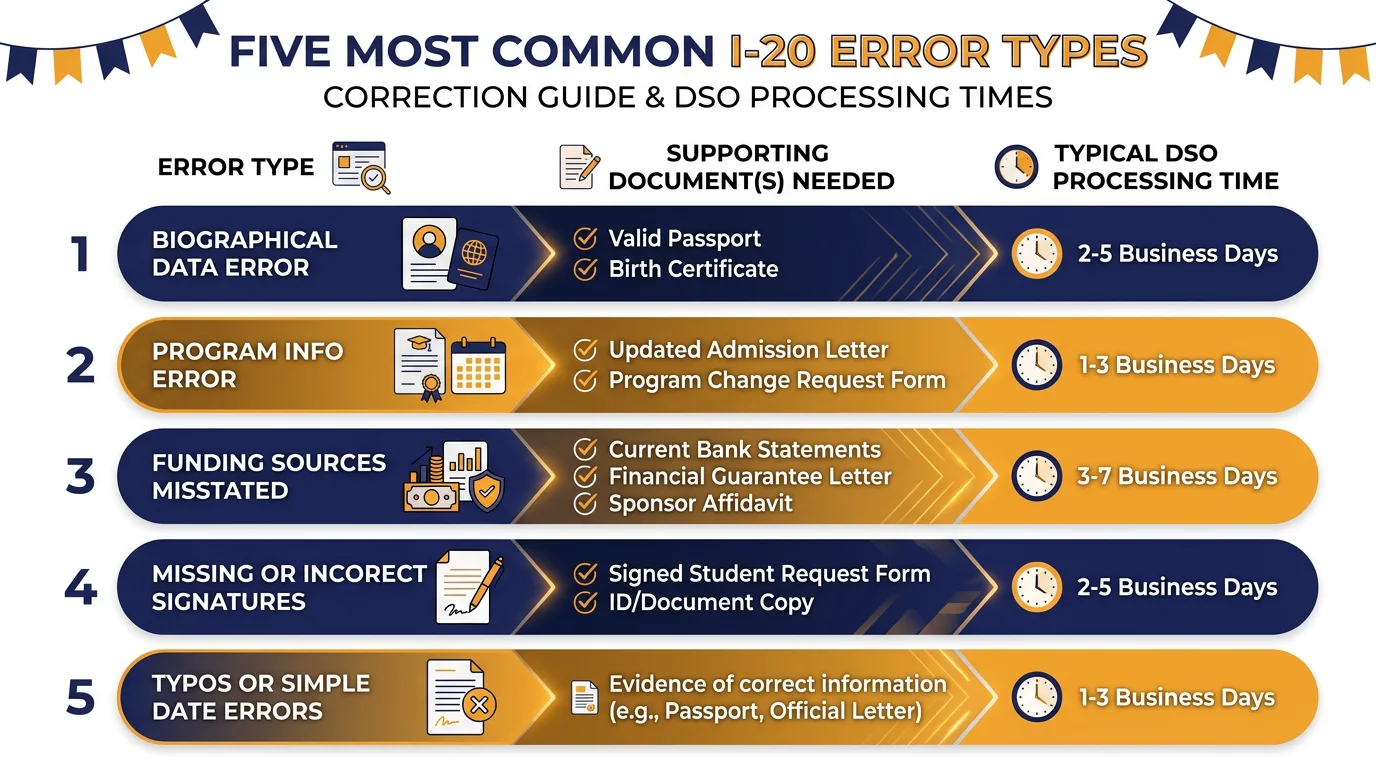
I-20 errors fall into four categories: personal identity information, program details, financial data, and school information. Identifying the category early helps families prepare the right supporting documents before contacting the DSO.
The most frequently reported errors are:
- Name misspelling: The full legal name on the I-20 must match the passport exactly, including middle names, hyphens, and diacritical marks.
- Date of birth: A single transposed digit can cause a mismatch at the consulate visa window and the US border.
- Program start or end date: Incorrect dates create SEVIS record inconsistencies that officers are trained to flag.
- Financial support amount: The funding section must meet the annual minimum and accurately reflect the documented source.
- Level of study or major: The program field must read "High School - Secondary" and must match what the student declared on the F-1 (student visa for US academic programs) application.
Families should review every field on the I-20 immediately upon receipt and compare it line by line with the student's passport. Catching an error before a visa appointment is significantly easier than resolving it during or after an interview.
Who Has the Authority to Correct an I-20?
Only the DSO at the school that originally issued the I-20 can make corrections to the document. Students and families cannot alter the form themselves - any unauthorized change, including handwritten corrections, voids the I-20 entirely and may generate a SEVIS compliance alert.
According to SEVP, each SEVIS-registered school designates a Principal DSO (PDSO) and may appoint additional DSOs to manage student records. The DSO corrects errors by updating the relevant fields in SEVIS and printing a new I-20. At Amerigo's US Signature Schools - a network of partner schools in the United States where Amerigo provides dedicated on-campus international support, including residential accommodation, an on-campus international department, university counseling, and the Top 100 Guarantee - a refund of up to $50,000 USD in senior year tuition fees for US Signature School students who complete two consecutive years of enrollment, maintain a cumulative GPA of 3.2 or higher, achieve a TOEFL score of 85 or above, complete at least one AP, IB, or Honors course, and apply to Top 100 US universities but do not gain admission for eligible students, the on-campus international department team includes trained staff who work directly with the school's DSO to identify errors and coordinate corrections on a student's behalf. Families from China, Vietnam, Korea, Mexico, and the Taiwan Region can access native-language support from Amerigo's in-country staff throughout this process.
At Brentwood School and Berkhamsted School - Amerigo's UK partner schools - Amerigo's role is enrollment coordination and administrative support. F-1 documentation applies to US Signature School students only. UK Student Visa applications are handled by each school's admissions team directly.
What Steps Fix an I-20 Error?
Correcting an I-20 follows the same sequence regardless of where the error was introduced.
- Identify and document the error: Locate the supporting document that shows the correct information. For name or date of birth errors, this is the passport photo page. For program date or financial errors, this is an updated enrollment confirmation or bank statement.
- Contact the DSO by email: Write a clear description of the incorrect field, state what the correct value should be, and attach the supporting document in the same message.
- DSO updates the SEVIS record: The DSO edits the SEVIS entry and generates a corrected I-20 PDF, usually within 1-5 business days.
- Receive, print, and sign the corrected I-20: The student must sign the new form in the student signature field. An unsigned I-20 is not valid for any official purpose.
- Retain the original erroneous I-20: Do not discard the original. Immigration officers may ask to see the full document history at a border entry or consulate appointment.
Amerigo's on-campus international department at US Signature Schools can assist families in drafting the correction request, confirming which documents are needed, and following up with the school DSO to confirm the timeline.
How Long Does an I-20 Correction Take?
Most DSOs process standard I-20 corrections within 1-5 business days from the date they receive the supporting documentation. Complex cases - such as errors that require the school to request a new SEVIS ID - may take longer. Families should contact the DSO immediately upon discovering an error rather than waiting until closer to the visa appointment date.
If a visa appointment is scheduled within 10 business days, families should state the appointment date in the initial email to the DSO and request expedited handling. Most schools prioritize urgent corrections when a visa interview is at risk. According to NAIS (2024), documentation inconsistencies - rather than substantive eligibility issues - account for the majority of F-1 visa delays for international high school students. According to NACAC (2024), most document-related visa delays are resolved within one appointment cycle once corrected paperwork is in hand.
Can You Travel With an Incorrect I-20?
No. A student should never travel to a US port of entry, or attend a consulate visa appointment, while holding an I-20 with a known error. Customs and Border Protection (CBP) officers verify the I-20 against the passport and the live SEVIS record at entry. A mismatch - including a name variant or transposed digit - can result in secondary inspection, refused admission, or a SEVIS compliance flag.
If an error is discovered after departure - for example, at a connecting airport - the student should not alter the I-20 and should contact the school DSO before proceeding. Families should not make the decision to travel independently. Contacting the DSO first is always the correct sequence.
What If the Error Is Found at the Visa Interview?
If a consular officer identifies a discrepancy between the I-20 and the passport, the officer will decline to issue the visa and return all documents. The student must obtain a corrected I-20 before booking a new appointment.
- Request DSO correction within 24 hours of the refused appointment to minimize delay.
- Do not rebook immediately - wait until the corrected, signed I-20 is in hand.
- Confirm the SEVIS fee status: If the same SEVIS ID is retained and the fee was already paid, no new fee applies. If a new SEVIS record was issued, the school will advise.
- Ask the DSO for a brief explanation letter - some consulates request this when a returning applicant presents a different I-20.
Families enrolled with Amerigo should contact the on-campus international department as soon as an appointment is refused. The team can coordinate with the DSO and assist with rebooking.
Frequently Asked Questions
What is an I-20 form and who issues it?
An I-20 is the Certificate of Eligibility for Nonimmigrant Student Status issued by a SEVIS-certified school's DSO to students accepted into an F-1 program. The form confirms the student's program details, financial support figures, and enrollment dates, and it is required to apply for an F-1 student visa at a US consulate. The issuing school retains responsibility for maintaining accuracy throughout the student's enrollment.
Can a student correct an I-20 themselves?
No. Students and families cannot alter or correct an I-20 independently. Any change must be processed by the DSO through the official SEVIS system. Unauthorized edits - whether handwritten corrections or typed overlays - void the document entirely and may create a compliance alert in the student's SEVIS record that delays future applications. The original, unaltered I-20 should be retained even after the corrected version is issued.
What documents should I send the DSO to fix a name error?
Send a clear scan of the passport photo page showing the student's full legal name exactly as it appears on the travel document. The DSO will update the SEVIS record to match. Some schools also request a brief cover email confirming which field is incorrect and what the correct value should be, to keep a clear paper trail for the school's compliance records.
How will I know when the corrected I-20 is ready?
The DSO will contact the student or family by email once the corrected I-20 has been generated in SEVIS. Most schools send the document as a PDF for the student to print and sign. Always verify that the new version shows the correct information before using it at a visa appointment or border entry. Do not discard the original erroneous copy.
Does a corrected I-20 require a new student signature?
Yes. The student must sign the corrected I-20 in the designated student signature field, which appears at the bottom of the form's first page. An unsigned I-20 is not valid for any official purpose. If the student is overseas when the corrected version is issued, they can print, sign, and retain the form before travelling to the US consulate or port of entry.
Will a corrected I-20 affect my SEVIS fee payment?
No, in most cases. The SEVIS fee is linked to the student's SEVIS ID. If the correction preserves the same SEVIS ID, no new fee is required. If the error was significant enough that the school needed to create a new SEVIS record with a new ID, the school's DSO will advise on whether a new payment is necessary before the corrected I-20 can be used.
How far in advance should I request a correction before my visa appointment?
Contact the DSO as soon as the error is discovered - ideally at least 10 business days before a scheduled visa appointment. This allows time for the correction, digital delivery, and student signature. Requesting a correction fewer than 5 business days before an appointment carries the risk that the new form will not be ready in time, which may require rescheduling.
Can Amerigo's team help with I-20 corrections?
Yes. At Amerigo US Signature Schools, the on-campus international department helps students and families identify errors, compile supporting documentation, and coordinate with the school DSO. The department can also help families track correction timelines and prepare for rebooking when a visa appointment is involved. Families from China, Vietnam, Korea, Mexico, and the Taiwan Region can communicate with Amerigo's in-country staff for native-language support.
What happens if the I-20 error was the school's data entry mistake?
The correction process is the same regardless of who caused the original error. The DSO updates the SEVIS record and issues a new I-20 at no charge to the family. If the error caused a missed or refused visa appointment, families should ask the DSO for a brief written explanation that can be submitted when rescheduling, to help the consular officer understand the context.
Is there a deadline for correcting an I-20 error?
There is no SEVP-imposed deadline, but errors must be corrected before any visa appointment, US entry attempt, or program start date. Students who enter the US on an erroneous I-20 may face secondary inspection, SEVIS compliance reviews, or entry refusal - any of which takes significantly longer to resolve than a standard pre-departure DSO correction, and may delay a student's program start considerably.
Conclusion
I-20 errors are correctable through the school's DSO, who updates the SEVIS record and issues a new signed form. Families should act promptly on any discovered error, gather the appropriate supporting documents, and avoid all visa appointments and US entry attempts until a valid, signed, corrected I-20 is in hand.
Apply to an Amerigo Partner School
To learn more about studying in America at an Amerigo partner school, contact us to speak with a program advisor, or apply now to take the first step toward enrollment.
People Also Read
- What Is the I-20 Form? Guide for International Student Families
- What Is a DSO? How Designated School Officials Support F-1 Students
- How International Students Maintain F-1 Status in the US
About the Author
This guide was written by the Amerigo Education content team, drawing on program data from staff operating the on-campus international department at 40 Niche A+/A rated US, Canadian, and UK partner schools. Learn more about Amerigo Education.
Disclaimer: This article provides general information for educational purposes only. Families should conduct independent research, request current program data from providers, and consult with program representatives regarding specific circumstances. Contact us with questions.