All news
February 17, 2026
Study Abroad 101
What Does a Typical Day Look Like at a US High School?
What does a typical day look like for international students at US high schools? Understand schedules, after-school activities, study hours, and support access.
Last Updated: February 2026
A typical day at a US high school for international students combines structured academic periods, extracurricular activities, and independent study time across roughly 10-12 active hours. According to the National Center for Education Statistics (NCES, 2025), the average US high school operates on a 6-7 period daily schedule running from approximately 7:30 AM to 3:00 PM, with significant variation by state and district. For international families evaluating study abroad programs, understanding what daily life actually looks like - from morning routines through evening study hours - helps set realistic expectations and identify which support structures matter most.
Amerigo Education, founded in 2016 and backed by Avathon Capital, operates as the on-campus international department at 40 Niche A+/A rated US and Canadian partner schools. Students in this model interact with dedicated support staff throughout the school day - in hallways, at lunch, and during after-school hours - rather than scheduling separate appointments with external coordinators.
Key Takeaways
- US high school days run approximately 7:30 AM to 3:00 PM with 6-7 class periods, each lasting 45-55 minutes depending on the school's schedule format
- After-school hours (3:00-6:00 PM) are critical for extracurricular activities, sports practice, club meetings, and college-application-building experiences
- Evening study hours in supervised residential programs typically run from 7:00-9:30 PM with tutor access and structured homework time
- Academic support extends beyond classrooms through dedicated on-campus staff, in-residence homework help, and customized English courses
- Weekend schedules balance cultural exploration, community service, standardized test preparation, and personal downtime

What Does the School Day Schedule Look Like?
US high schools typically operate on either a traditional 6-7 period schedule or a rotating block schedule. Traditional schedules run 45-55 minute classes throughout the day, while block schedules alternate longer 80-90 minute periods. Both formats include a lunch period of 25-35 minutes and passing time between classes.
International students follow the same schedule as domestic peers. A typical day starts with homeroom or advisory, followed by core subjects (English, Mathematics, Science, Social Studies) and electives. Students move between classrooms for each subject rather than staying in one room. According to the College Board (2025), students targeting selective universities should balance core AP (Advanced Placement) courses with strategic electives.
Sample Traditional Schedule (7-Period Day):
| Period | Time | Example Course |
|---|---|---|
| Homeroom | 7:30-7:45 AM | Advisory/Announcements |
| Period 1 | 7:50-8:40 AM | AP English Language |
| Period 2 | 8:45-9:35 AM | AP Calculus AB |
| Period 3 | 9:40-10:30 AM | US History |
| Period 4 | 10:35-11:25 AM | Biology or AP Chemistry |
| Lunch | 11:30 AM-12:00 PM | Cafeteria |
| Period 5 | 12:05-12:55 PM | Spanish or Art Elective |
| Period 6 | 1:00-1:50 PM | ELL or English Support |
| Period 7 | 1:55-2:45 PM | Physical Education |
| Dismissal | 2:50-3:00 PM |
Note: Schedules vary significantly by school. Some schools use block scheduling with 4 longer periods per day.
How Do Students Spend After-School Hours?
The hours between 3:00 PM and 6:00 PM are among the most important for building university-competitive profiles. This is when extracurricular activities, sports practices, club meetings, and community service happen. US universities evaluate involvement outside the classroom as heavily as academic performance.
International students should commit to 3-5 activities showing genuine passion rather than joining many clubs superficially. School-based activities are especially important for F-1 visa holders. According to SEVP/ICE (2025), off-campus employment is restricted under F-1 (student visa for academic programs) regulations, making on-campus activities the primary way students build their profiles.
8 Common After-School Activities for International Students:
- Varsity or JV sports (soccer, swimming, tennis, cross-country, basketball)
- Academic competition teams (Science Olympiad, DECA, Math League)
- Student government or class council
- Performing arts (theater productions, orchestra, choir)
- Community service and volunteer organizations
- Cultural exchange clubs or international student associations
- School newspaper, yearbook, or literary magazine
- STEM clubs (robotics, coding, engineering challenges)
What Academic Support Exists Outside Class?
Academic support for international students extends well beyond the classroom bell. The type and quality of this support varies dramatically between program models and represents one of the largest differences families should evaluate.
Programs with embedded on-campus staff provide daily access to academic advisors, ELL (English Language Learning) specialists, and subject tutors without requiring separate appointments. Students can ask questions in hallways, get help during lunch, or stop by the international department office between classes. This accessibility matters particularly for students adjusting to English-medium instruction for the first time. Individualized academic planning identifies prerequisite courses needed for AP enrollment - critical since missing one prerequisite freshman year can close doors to advanced courses junior and senior year.
6 Types of Academic Support Available:
- In-school customized ELL courses designed for international student needs
- Subject-specific tutoring matched to individual academic gaps
- Individualized course planning for AP prerequisite sequencing
- Standardized test preparation support (SAT, ACT, TOEFL)
- In-residence homework help during evening study hours
- Dedicated common areas for group study with teacher availability
Residential Life: Evenings and Study Hours
What happens after extracurriculars end around 6:00 PM depends entirely on the student's living arrangement. This is where accommodation type directly shapes daily experience.
Students in homestay arrangements return to their host family's home for dinner, conversation practice, and homework. This model offers strong cultural immersion and daily English practice in a family setting, typically at lower cost. Academic support for homestay students happens at the on-campus international department office during school hours rather than in the evening.
Students in supervised off-campus residences follow a more structured evening routine. Dinner is provided communally, followed by mandatory study hours - typically 7:00 to 9:30 PM - in dedicated common areas with tutor access. Single-gender units with 24/7 staff supervision provide security and structure. This model particularly benefits students who need consistent academic support and a disciplined study environment.
| Evening Activity | Homestay | Off-Campus Residence |
|---|---|---|
| Dinner | With host family (~6:00 PM) | Communal dining (~6:00 PM) |
| Free time | Family interaction | Common area socializing |
| Study hours | Self-directed at home | Structured 7:00-9:30 PM |
| Tutor access | During school hours | Available during study hours |
| Supervision | Host family oversight | 24/7 residential staff |
| Lights out | Host family rules | Program schedule (~10:30 PM) |
Weekend Activities and Cultural Integration
Weekends provide essential time for cultural exploration, personal development, and rest. Residential programs typically organize group activities on Saturdays - trips to local landmarks, shopping districts, cultural events, or nearby cities. These excursions help international students experience American life beyond school walls.
Many students use weekend mornings for standardized test preparation or catching up on coursework. SAT (Scholastic Assessment Test) and ACT (American College Testing) exams are administered on Saturday mornings several times per year - transportation to test centers is an important logistical consideration.
Typical Weekend Schedule:
| Time | Saturday | Sunday |
|---|---|---|
| Morning | Sleep in or test prep | Personal time or worship |
| Late morning | Group activity or trip | Homework and study |
| Afternoon | Cultural exploration | Community service or free time |
| Evening | Social time | Preparation for Monday |
Holiday breaks require separate planning. Homestay students remain with their host families during short breaks. Residential students may travel home, stay with guardians, or join organized programs depending on break length.
How Do Parents Stay Informed?
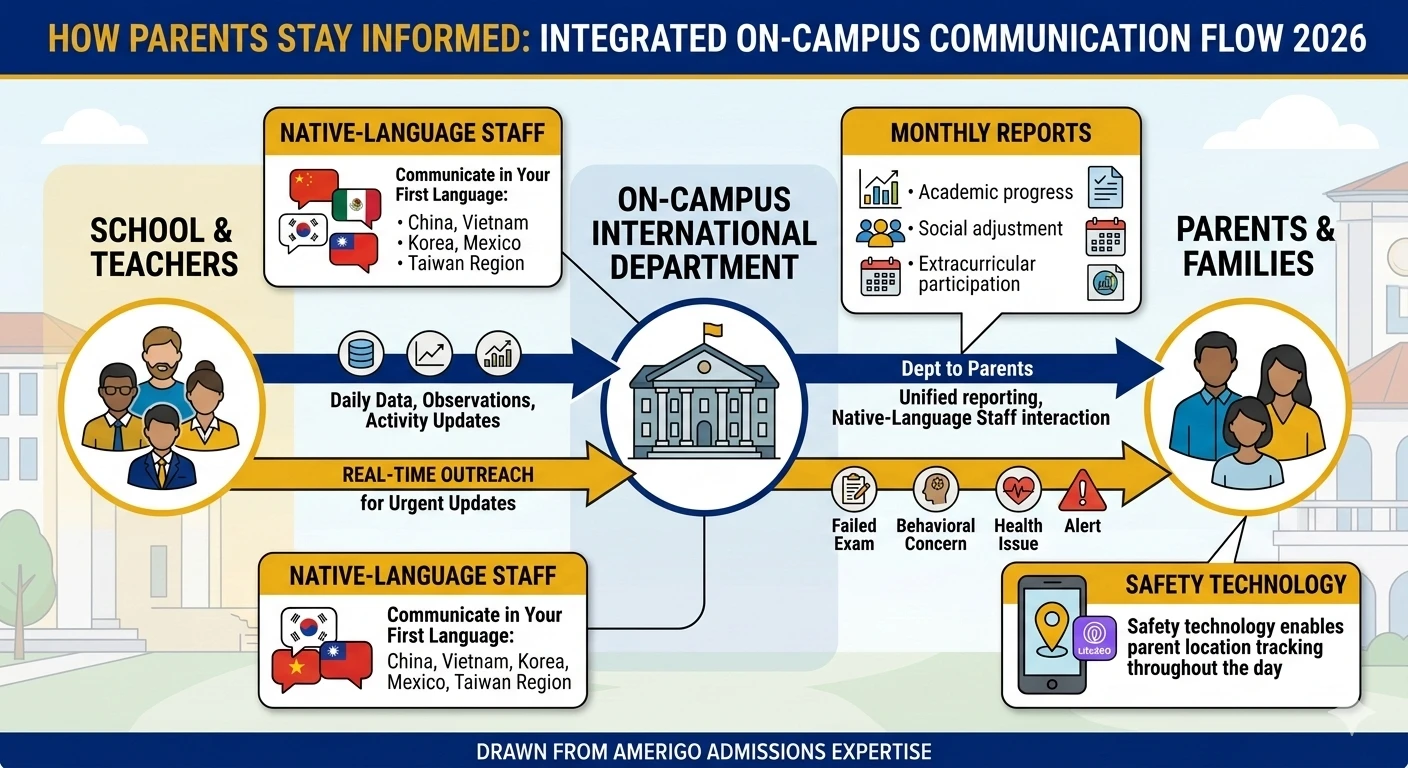
Communication between programs and families varies significantly by model. For parents thousands of miles away, the frequency and quality of updates directly affects peace of mind and the ability to support their child's decisions.
Programs with embedded staff at partner schools provide monthly reports covering academic progress, social adjustment, and extracurricular participation. Real-time outreach happens when updates require immediate attention - a failed exam, a behavioral concern, or a health issue. Native-language staff availability in countries including China, Vietnam, Korea, Mexico, and Taiwan Region means parents can communicate in their first language. Safety technology like Life360 enables parent location tracking throughout the day.
5 Questions to Ask About Parent Communication:
- How frequently will I receive formal progress reports?
- Is native-language communication available for my family?
- How quickly will I be contacted about urgent concerns?
- Can I track my child's location during the school day?
- Who is my primary contact and how do I reach them?
How Does University Preparation Fit into Daily Life?
University preparation is not a separate activity - it runs through every aspect of daily high school life. Course selection starting freshman year, extracurricular depth built over four years, standardized test preparation, and essay development all happen alongside regular academics.
Students in programs with integrated university counseling receive guidance woven into their daily schedule. Counselors review course selections each semester to ensure AP prerequisites are met, monitor GPA (Grade Point Average) trajectory, and begin college list development by junior year. This is fundamentally different from programs where university counseling is an add-on service scheduled outside school hours. Verified Class of 2025 outcomes through the integrated model show 97% Top 100 US university admission, 60% Top 50, and 25% Top 30, backed by a $50,000 USD refund guarantee for students meeting requirements. Published results include T. Nguyen (Mater Dei Catholic High School, GPA 3.83 to 4.57, accepted to University of Virginia) and M. Zhong (St. Anthony's High School, GPA 91 to 98.72, accepted to UC Berkeley).
Frequently Asked Questions
What time does the school day start and end?
Most US high schools start between 7:15 AM and 8:00 AM and end between 2:30 PM and 3:15 PM. Start times vary by state and district. Some schools have shifted to later starts based on adolescent sleep research. Confirm exact hours with your specific school and plan transportation accordingly.
How much homework do students receive each night?
Homework loads vary by course level. Students taking multiple AP courses should expect 2-4 hours nightly. Standard-level courses typically assign 1-2 hours. Structured evening study hours in residential programs provide dedicated time and tutor access. Time management is one of the most important skills international students develop.
Do international students eat lunch with American students?
Yes. Lunch periods are shared with the entire student body in a common cafeteria. This is an important social integration opportunity. Many schools offer diverse food options. Homestay students may bring packed lunches or purchase school meals depending on their arrangement.
How do students get to and from school?
Transportation varies by program and location. Residential programs typically provide organized transportation between residences and partner schools. Homestay families often provide rides or students use school bus routes. Confirm logistics before enrollment as commute time affects the daily schedule.
Is there free time during the school day?
Some schedules include a study hall or free period, but this varies by school and course load. Students with a full 7-class schedule may not have free periods. When available, free periods offer time for homework, meeting with teachers, or additional English practice with support staff.
How do students handle language barriers in class?
International students receive ELL support courses alongside regular academics. Some schools offer sheltered instruction where core content is taught with language accommodations. Students with embedded on-campus support access language help throughout the day. English proficiency improves rapidly through immersion - classroom interaction, lunch conversations, and extracurricular participation all accelerate development.
What happens during school breaks and holidays?
Short breaks (Thanksgiving, spring break) last 1-2 weeks. Winter break spans 2-3 weeks. Summer runs June through August. Students may travel home, stay with host families, or join organized programs. Book travel early, especially for international flights during peak holiday seasons.
Are weekends structured or free time?
This depends on the program model. Residential programs offer a mix of organized activities and personal time. Homestay students follow their host family's routines. Saturdays often include SAT/ACT testing dates or group excursions while Sundays tend to be more relaxed.
People Also Read
First Year in America: Month-by-Month Timeline for International High School Students A month-by-month guide to what international students experience during their first year at a US high school.
Parent Guide: How to Support Your Child Studying Abroad in High School 2026 Practical strategies for parents supporting their child through the study abroad experience from a distance.
What Grade Should International Students Start US High School? Complete Timing Guide 2026 Understanding the optimal entry point for international students considering factors like age, English level, and university preparation timeline.
About the Author
Maria Chen writes about international education and student life on behalf of the Amerigo Education team. This guide draws on daily operational experience from staff working inside the on-campus international department at 40 Niche A+/A rated US and Canadian partner schools.
Conclusion
A typical day for an international student at a US high school extends well beyond classroom hours. From early morning arrivals through structured evening study sessions, every part of the day contributes to academic growth, cultural integration, and university preparation. The quality of daily life depends on the support structure surrounding the student - embedded on-campus staff, structured residential programs, or host family environments each shape the experience differently.
Families should ask specifically about daily schedules, after-school support access, evening study structures, and weekend programming. Programs like Amerigo that embed staff within partner schools create seamless daily support rather than requiring students to coordinate with external providers.
Take the Next Step
Families wanting to understand what daily life looks like at specific partner schools can contact Amerigo for detailed information about school schedules, residential routines, and support access. To begin the application process, visit the application page - most partner schools offer rolling admissions with flexible English testing.
This article provides general information about daily life at US high schools for educational purposes only. Schedules, activities, and support structures vary by school and program. Verify specific details with program providers before making enrollment decisions. Contact us with questions.