All news
May 5, 2026
Study Abroad 101
Twelve Questions International Parents Should Ask Before Signing Any Study Abroad Program
Twelve questions international parents should ask before signing any study abroad program - from academic support to visa compliance, accommodation, and guarantees.
_converted.webp)
Twelve Questions International Parents Should Ask Before Signing Any Study Abroad Program
Last Updated: May 2026
Before signing a contract with a study abroad program for a high school student, families should conduct structured due diligence that goes beyond marketing materials and program brochures. According to IIE Open Doors (2024), over 1.1 million international students were enrolled at US educational institutions, and a growing share entered through structured high school pathway programs that vary significantly in the depth of support they provide. The twelve questions below help families evaluate any program systematically - covering academic support, visa compliance, accommodation, university outcomes, and contract terms before a financial commitment is made.
Amerigo Education partners with 40 Niche A+/A rated schools (independent academic rankings based on school-reported curriculum quality, faculty credentials, student outcomes, and college matriculation data) across the US, Canada, and the UK, supporting 3,500+ students from 55+ countries. The Class of 2025 achieved 97% admission to Top 100 US universities. For families comparing programs, Amerigo's on-campus international department - a dedicated team at each US Signature School consisting of a Director of Campus Operations, Academic Director, Senior Campus Coordinators, Campus Coordinators, and an ELL teacher, who provide daily academic support, residential supervision, university counseling, and welfare oversight for enrolled international students provides the institutional structure that answers many of the questions below with specific, verifiable data.
This guide is structured as twelve questions across six evaluation areas: on-campus support, university outcomes, accommodation, visa compliance, family communication and safety, and program guarantees. Families should ask each question of any provider before making a decision.
Key Takeaways
- On-campus vs. external support: Programs with a dedicated on-campus international department at each partner school provide more immediate and consistent support than programs relying on external coordinators or agent networks.
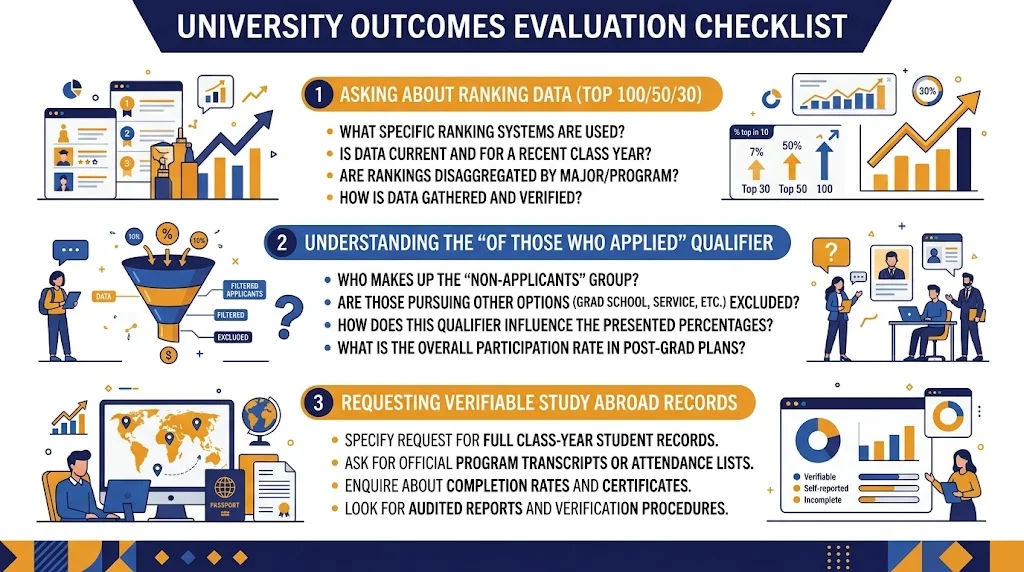
- Outcomes verification: Any university placement claim should be verified by tier - ask for the percentage at Top 100, Top 50, and Top 30, always with the qualifier "of students who applied" to each tier.
- Accommodation depth: Programs should be able to name at least four accommodation model options and explain the screening and staffing behind each one.
- Guarantee conditions: A university admission guarantee is only meaningful if the provider discloses all four conditions required to qualify and caps the refund amount in writing.
- Communication systems: Families should receive monthly progress reports, school activity calendars and event announcements - not informal updates or reports only on request.
What Support Can My Child Expect On-Campus?
The presence of a permanent on-campus team - not just a visiting coordinator or agency representative - determines how quickly a student receives help when academic or personal issues arise. According to NAIS (2024), private secondary schools with dedicated international student offices report higher retention and academic completion rates among international students than schools that rely on general counseling staff. Ask for the staff-to-student ratio and confirm whether staff are employed by the program or contracted through a third party.
Academic support should extend beyond classroom teachers to include structured study hours with campus coordinator availability, individualized academic planning with a named contact, and access to subject-specific tutoring. Programs that delegate all academic support to the school's general faculty without a dedicated international team leave students without a structured safety net for the gap between home-country learning styles and US classroom expectations.
What University Outcomes Has the Program Delivered?
Ask for the percentage of students admitted to Top 100, Top 50, and Top 30 universities - but only when presented with the correct qualifier: "of students who applied" to each tier. A program that quotes "60% Top 50 admission" without clarifying the denominator may be measuring against a very small subset of students. Of those who applied to Top 50 universities in the Class of 2025, 60% gained admission. Of those who applied to the Top 30, 25% gained admission. Families should request the same tier-level breakdown from any program they evaluate.
University preparation should include named services: AP (Advanced Placement) and Honors course planning with prerequisite tracking, Common App essay support, college list development, and recommendation letter strategy. Confirm whether these services are delivered by program staff or the school's existing counseling team, and whether they begin in Grade 10 or only in the senior year. Families evaluating Amerigo's US programs can use the find a school tool to review specific partner school locations and the academic planning support included at each campus.
What Accommodation Options Does the Program Offer?
A program that can only offer one accommodation type - typically homestay or a single residence model - limits a family's ability to match placement to a student's needs. The best programs offer at least four options with clear staffing and location specifications.
Amerigo offers four accommodation options: homestay, off-campus residences (the primary model, located 20-30 minutes from partner schools with single-gender units and 24/7 staff), on-campus residences at select schools, and self-provided accommodation for students with family nearby.
Programs that source homestay families through third-party vendors rather than directly have less control over screening consistency. Ask whether the program has a defined process for reassigning students to a new homestay if the initial placement is unsatisfactory, and confirm the timeline for response when a student reports concerns about their host.
How Does the Program Handle Visa Compliance?
Every school enrolling F-1 (student visa for academic programs) students must have a DSO (Designated School Official) who maintains SEVIS (Student and Exchange Visitor Information System) records. However, the quality of F-1 compliance support varies significantly. Ask whether the program monitors enrollment status proactively, tracks I-20 renewal timelines, and alerts families when documentation gaps are identified - before they become formal status violations.
Programs that operate across multiple partner schools should have a defined process for SEVIS transfer releases when students move between campuses. If a program cannot explain how it handles a mid-year transfer, it likely does not have the infrastructure to manage status compliance proactively. According to NAIS (2024), international student support staff at private schools increasingly cite F-1 compliance monitoring as a primary administrative function requiring dedicated program-level infrastructure.
What Safety and Communication Systems Are in Place?
Family communication should be structured, not reactive. Programs should provide monthly progress reports, school activity calendars and event announcements on a regular schedule - not only when problems occur. Ask whether native-language communication is available for your home market and whether there is a named contact for family communication questions throughout the year.
Amerigo's communication for families from China, Vietnam, Korea, Mexico, and the Taiwan Region is supported by in-country staff throughout enrollment and the school year, with real-time outreach when updates require immediate attention. Safety technology such as Life360 or Reach is available at Amerigo's US Signature Schools - a network of partner schools in the United States where Amerigo provides dedicated on-campus international support, including residential accommodation, an on-campus international department, university counseling, and the Top 100 Guarantee for eligible students, giving parents location awareness for residential students.
Ask for the specific emergency contact chain: who is called first, what authority they have, and what the program's protocol is for medical emergencies, mental health crises, and situations requiring police or hospital involvement. Programs that rely on the school's general emergency line without a dedicated international student contact create response gaps that matter most in high-stress situations.
What Does the Program Guarantee?
Any university admission guarantee must be evaluated against its qualifying conditions. Amerigo's Top 100 Guarantee - a refund of up to $50,000 USD in senior year tuition fees for US Signature School students who complete two consecutive years of enrollment, maintain a cumulative GPA of 3.2 or higher, achieve a TOEFL score of 85 or above, complete at least one AP, IB, or Honors course, and apply to Top 100 US universities but do not gain admission - a refund of up to $50,000 USD in senior year tuition fees for US Signature School students who complete two consecutive years of enrollment, maintain a cumulative GPA of 3.2 or higher, achieve a TOEFL score of 85 or above, complete at least one AP, IB, or Honors course, and apply to Top 100 US universities but do not gain admission covers students who meet all four requirements: two consecutive enrollment years, cumulative GPA of 3.2 or above, TOEFL of 85 or above, and completion of at least one AP, IB, or Honors course. The refund is up to $50,000 USD toward senior year tuition if Top 100 admission is not achieved. Ask any program offering a guarantee to state all qualifying conditions in writing and specify the refund cap.
Contract terms should specify what happens if a student leaves the program early, whether tuition is refundable in part or in full, and what obligations the family retains if the student withdraws before the contract term ends. Programs that do not provide a clear refund schedule in writing at signing leave families with limited recourse if circumstances change. Request a copy of the enrollment agreement before committing and confirm whether the terms differ for mid-year versus pre-term withdrawals.
Frequently Asked Questions
What is the most important question to ask a study abroad program?
The most revealing question is the university outcomes breakdown by tier - specifically the percentage of students admitted to Top 100, Top 50, and Top 30 universities, each qualified by "of students who applied" to that tier. Programs that present aggregate admission rates without specifying the denominator or tier are obscuring the data families need to evaluate outcomes realistically. Verifiable, tier-level outcome data is the clearest differentiator between programs that prioritize results and those that prioritize marketing.
How should I evaluate on-campus support for an international student?
Ask whether the program employs a permanent staff team at the partner school - not a visiting coordinator or agent representative. Confirm the staff-to-student ratio, the availability of academic support outside classroom hours, and whether there is a named contact for both the student and the family throughout the year. Programs that cannot name the specific staff member responsible for a student's daily welfare at their school location are not providing genuine on-campus support.
What should a university admission guarantee actually include?
A genuine university admission guarantee should specify all qualifying conditions in writing, state the refund amount as a cap rather than a fixed sum, apply specifically to students at schools where the program has the infrastructure to deliver the outcome, and be backed by a financial mechanism the provider can demonstrate. Conditions that appear only in footnotes or program FAQs rather than in the enrollment agreement should be treated as unenforceable.
How many accommodation options should a quality study abroad program offer?
A well-structured program should offer at least four distinct accommodation types: homestay with screened host families, off-campus residential programs with 24/7 staff, on-campus options at select schools, and self-provided accommodation for students with family nearby. Programs that offer only one model cannot match the accommodation to a student's welfare and learning needs. Ask specifically about staffing, location, and the process for changing accommodation if the initial placement is not working.
What family communication should I expect from a high school program?
Families should expect structured, scheduled communication - not reactive updates when problems occur. This includes monthly progress reports, school activity calendars and event announcements, and a defined protocol for real-time outreach when an issue requires immediate attention. Families should also confirm whether native-language communication is available from in-country staff for their home market, particularly for families from China, South Korea, Vietnam, Mexico, and the Taiwan Region.
What visa compliance support should programs provide?
Programs should actively monitor F-1 status requirements for every enrolled student, not simply respond when a student reports a problem. This includes tracking I-20 expiration dates, monitoring enrollment status against program requirements, coordinating SEVIS records when students transfer between partner schools, and alerting families to documentation gaps before they become formal violations. Programs that cannot describe a proactive compliance monitoring process are likely managing compliance reactively.
How should I compare costs across study abroad programs?
Cost comparisons should account for what is included in the base program fee. Programs that bundle tuition, accommodation, on-campus international department support, university counseling, and 24/7 emergency assistance into one fee are more directly comparable to all-inclusive pricing than programs that list separate fees for each service. Ask each provider to itemize what is and is not included in the stated annual cost before comparing headline figures across programs.
What red flags should disqualify a study abroad program?
Programs with no permanent on-campus staff at partner schools, no tier-level university outcome data, accommodation models with no described screening or staffing, and guarantees with undisclosed conditions or no refund cap are the clearest structural red flags. Additionally, programs that cannot name the specific DSO at the enrolled school, that provide only reactive family communication, or that do not offer a physical enrollment agreement with cancellation terms should be evaluated very carefully before a commitment is made.
When is the right time to start the program selection process?
Families targeting enrollment for the following academic year should begin program evaluation at least six to nine months in advance. Most programs have application cycles and enrollment slots that fill progressively, with the most desirable accommodation options - particularly residential placements at select partner schools - allocated to earlier applicants. Beginning the evaluation process early also allows time to compare multiple providers, visit school locations if possible, and review enrollment agreements carefully before signing.
What should the enrollment agreement cover?
The enrollment agreement should specify the school placement, accommodation type, program fee breakdown, refund and cancellation policy for both pre-term and mid-year, visa support services included or excluded, and specific conditions of any university admission guarantee. Any term that would limit the family's recourse if the program fails to deliver its stated services should be identified and understood before signing. Request the agreement before the enrollment call rather than reviewing it for the first time at signing.
Conclusion
Twelve structured questions covering on-campus support, university outcomes, accommodation, visa compliance, family communication, and program guarantees give families a consistent framework for evaluating any study abroad provider. Programs that can answer each question with specific, verifiable data and written contract terms are demonstrably different from programs that rely on marketing language in place of evidence.
Apply to an Amerigo Partner School
To learn more about studying in America at an Amerigo partner school, contact us to speak with a program advisor, or apply now to take the first step toward enrollment.
People Also Read
- Study Abroad Program Red Flags: What to Avoid When Selecting High School Placement
- Study Abroad Support Models Compared: On-Campus vs Third-Party vs Agency-Only
- The Questions That Reveal Whether a US High School Program Will Actually Serve Your Child
About the Author
This guide was written by the Amerigo Education content team, drawing on program data from staff operating the on-campus international department at 40 Niche A+/A rated US, Canadian, and UK partner schools. Learn more about Amerigo Education.
Disclaimer: This article provides general information for educational purposes only. Families should conduct independent research, request current program data from providers, and consult with program representatives regarding specific circumstances. Contact us with questions.