All news
May 12, 2026
Study Abroad 101
MIT International Admit Rate for High School Applicants: 2026 Data Snapshot
MIT acceptance rate for international high school applicants 2026: admit rate data, requirements, financial aid, and US high school preparation for STEM.
MIT International Admit Rate for High School Applicants: 2026 Data Snapshot
Last Updated: May 2026
MIT's (Massachusetts Institute of Technology) admission rate for the Class of 2028 was approximately 4.7%, making it one of the most selective research universities in the United States. According to IIE Open Doors (2025), international students enroll at US universities at record levels, yet elite STEM-focused universities like MIT maintain acceptance rates that require applicants - domestic and international alike - to demonstrate exceptional academic preparation well before submitting any application.
Amerigo Education partners with 40 Niche A+/A rated schools across the US, Canada, and the UK, supporting 3,500+ students from 55+ countries. The Class of 2025 achieved 97% admission to Top 100 US universities and 25% to Top 30 universities of those who applied. For international students targeting MIT and similarly selective institutions, university counseling through the on-campus international department helps shape application strategy from course selection in Grade 9 through submission.
This guide explains MIT's admission data for international applicants, what MIT evaluates in international high school applications, and how US-based academic preparation affects competitive outcomes at Top 30 universities.
Key Takeaways
- MIT acceptance rate: MIT's Class of 2028 acceptance rate was approximately 4.7% across all applicants; MIT does not publish a separate international acceptance rate.
- International enrollment: International students represent approximately 10% of MIT's enrolled undergraduate student body, according to MIT Admissions (2024).
- Testing required: MIT reinstated standardized test requirements for the Class of 2028; SAT or ACT scores are required for all applicants, domestic and international.
- Financial aid: MIT meets 100% of demonstrated financial need for all admitted students, regardless of citizenship - an unusual commitment among elite US universities.
- Amerigo Top 30: Of students in the Class of 2025 who applied to Top 30 universities, 25% gained admission of those who applied.
What Is MIT's Admit Rate for International Students?
MIT does not publish a separate acceptance rate for international applicants. The overall Class of 2028 acceptance rate was approximately 4.7%, according to MIT Admissions (2024). International students are evaluated in the same applicant pool as domestic students and must demonstrate the same academic, extracurricular, and personal qualities that MIT's admissions team seeks across all applicants.
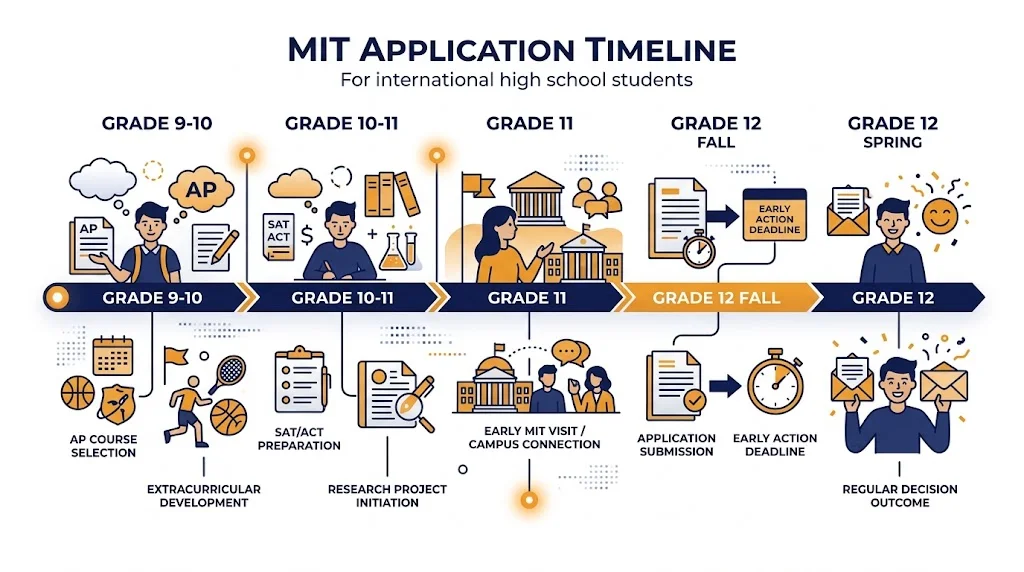
The competitive context for international applicants is shaped by strong academic preparation in home countries, English proficiency requirements, and the relative unfamiliarity of the US application process. Families planning MIT applications should build a multi-year timeline that begins no later than Grade 9 - AP (Advanced Placement) course selection, extracurricular development, and standardized test preparation all contribute to an application that reflects the depth MIT evaluates.
According to NACAC (2024), students who begin university counseling in Grade 9 or Grade 10 achieve statistically stronger outcomes at selective institutions than students who begin in Grade 11 or 12. The on-campus international department at each Amerigo US Signature School begins academic planning from the student's first semester.
What Does MIT Look for in International Applicants?
MIT evaluates applicants on academics, research or project depth, extracurricular commitment, and personal character. For international high school students, the academic record evaluated is the transcript from the US high school of enrollment - not a home-country transcript. US high school transcripts include course rigor, GPA (Grade Point Average), grade trends, and AP and Honors course performance, all of which provide MIT's evaluation team with standardized signals that home-country transcripts from different grading systems cannot.
Extracurricular depth - significant involvement in one or two areas rather than broad surface-level participation - is a consistent theme across MIT-admitted student profiles. Research projects, STEM competitions, and demonstrated intellectual curiosity outside class carry significant weight in MIT's overall application review. Students who use their high school years to develop genuine expertise in a discipline rather than maximizing a resume list present stronger profiles.
- Academic rigor: AP and Honors course depth, especially in mathematics and science, at a US Signature School.
- Standardized testing: SAT or ACT scores required; MIT recommends SAT Math Level 2 and at least one science subject test for STEM applicants where available.
- Research and project depth: Genuine investigation or creation in a field, not general participation.
- Extracurricular commitment: Sustained involvement in a few areas over multiple years.
How Does US High School Preparation Help MIT Bids?
International students applying to MIT from a US high school present transcripts in a format MIT's evaluation team reads directly - no translation, conversion, or interpretation of a foreign grading system is required. AP course performance in calculus, physics, chemistry, and computer science is immediately legible as a signal of academic readiness for MIT-level coursework.
According to College Board (2024), students who complete 5 or more AP courses achieve significantly higher scores on AP exams and stronger university outcomes compared with students who complete fewer. Students at Amerigo US Signature Schools work with the on-campus international department team to identify which AP courses they can access and to plan prerequisite pathways from Grade 9 onward.
Enrollment at a Niche A+/A rated private partner school signals to elite universities that the student's academic environment meets the quality threshold they expect from competitive applicants. Amerigo's 40 partner schools across the network all carry Niche A+/A ratings.
What AP Courses Strengthen MIT Applications?
MIT applicants from international backgrounds are strongest when their AP course history shows genuine depth in STEM disciplines rather than a broad spread across unrelated subjects. AP Calculus BC, AP Physics C, AP Chemistry, AP Computer Science A, and AP Biology are the courses most directly aligned with MIT's undergraduate curriculum requirements in engineering and science.
Academic Directors at each Amerigo US Signature School review each student's incoming transcript to identify AP course pathways from the entry grade. Students entering at B1 English level begin ELL (English Language Learning) coursework in-school, with a planned transition to standard-track AP courses as English proficiency progresses. The Class of 2025 data shows that 96% of B1 English entrants achieved Top 100 university admission of those who applied - demonstrating that ELL entry does not preclude elite university outcomes when preparation is structured over multiple years.
MIT requires students to complete Calculus before enrollment regardless of AP credit. Students who demonstrate AP Calculus BC credit and strong exam scores typically receive advanced placement in MIT's curriculum.
Does MIT Offer Aid to International Students?
MIT meets 100% of demonstrated financial need for all admitted students, regardless of citizenship. This policy makes MIT one of a small number of elite US universities that offer need-blind admission for international students - meaning international applicant status and financial need do not reduce admission probability.
The MIT financial aid calculation is based on the family's income, assets, and size. International families must submit supporting financial documentation as part of the aid application, which occurs after admission. Aid takes the form of grants (not loans), which reduces the net cost of attendance significantly for qualifying families. For full cost-of-attendance planning, international families should review MIT's published aid calculator and cost-of-attendance figures on the MIT Admissions website.
Not all elite US universities offer need-blind international admission - MIT is an exception. Families evaluating university tiers should research each institution's international financial aid policies during the counseling process, which Amerigo's on-campus university counselors support from Grade 11 onward.
How Does the Top 30 Track Apply to MIT Applicants?
Amerigo's Top 50 Track applies higher entry criteria for students targeting Top 50 institutions, with additional academic benchmarks, extracurricular engagement requirements, and soft-skill development. For students targeting Top 30 universities including MIT, the Top 50 Track pathway provides the academic structure and counseling depth needed to build a competitive application.
Of students in the Class of 2025 who applied to Top 30 universities, 25% gained admission of those who applied. Top 30 outcomes depend heavily on AP course rigor, standardized test scores, extracurricular depth, and counseling that begins early in the high school pathway. All admitted Signature School students access the Top 100 Guaranteed track; the Top 50 Track applies additional criteria for students with elite university targets.
Families exploring Amerigo enrollment for a student targeting MIT or similar institutions should discuss the Top 50 Track and school selection with the recruitment team during the initial consultation. School location, available AP courses, and STEM extracurricular opportunities vary by Signature School partner.
Frequently Asked Questions
What is MIT's acceptance rate for international students?
MIT does not publish a separate acceptance rate for international applicants. The overall acceptance rate for the Class of 2028 was approximately 4.7%. International students are evaluated in the same applicant pool as domestic students. International students represent approximately 10% of MIT's enrolled undergraduate student body, according to MIT Admissions (2024). There is no separate international quota or rate published.
Does MIT require the SAT or ACT from international students?
Yes. MIT reinstated standardized test requirements starting with the Class of 2028. All applicants - domestic and international - must submit SAT or ACT scores. MIT recommends submitting SAT Subject Tests (Math Level 2 and at least one science) where available, as these provide additional academic signals relevant to MIT's STEM curriculum. International students should plan test preparation at least 12-18 months before their application deadline.
Does MIT offer financial aid to international students?
MIT meets 100% of demonstrated financial need for all admitted students, regardless of citizenship. This need-blind international aid policy is among the most generous of any US university. Aid is grant-based, not loan-based. International families submit financial documentation after admission for the aid calculation. The net cost of attendance for qualifying international families can be significantly lower than published sticker prices.
What GPA do international students need for MIT?
MIT does not publish a minimum GPA requirement. Admitted students typically present near-perfect or perfect GPAs from highly competitive high schools, alongside strong AP and Honors course performance. For international students at US Signature Schools, Academic Directors focus on building a GPA and course record that reflects genuine academic rigor rather than grade inflation. AP and Honors coursework in STEM disciplines is central to a competitive MIT application.
Does MIT use the Common App for international applicants?
MIT does not use the Common Application. MIT uses its own application portal, MyMIT, with application deadlines that differ from Common App institutions. International applicants should confirm current MIT application deadlines directly with MIT Admissions. Amerigo's university counselors guide students through the application process for both Common App and non-Common App institutions during the Grade 12 counseling cycle.
What English proficiency does MIT require from international students?
MIT requires all non-native English speakers to demonstrate English proficiency through the SAT Reading and Writing section, TOEFL, or IELTS. Minimum scores are not published as cutoffs; MIT evaluates proficiency in the context of the overall application. Students at Amerigo US Signature Schools who arrive at B1 or low-B1 English level complete in-school ELL (English Language Learning) courses, with progression to standard and AP-track coursework structured over one to two years.
How many AP courses do MIT applicants typically complete?
MIT does not publish average AP course counts for admitted students. Students at highly selective high schools typically complete six to ten AP courses across their high school career, with strong exam scores. AP Calculus BC, AP Physics C, AP Chemistry, and AP Computer Science A are particularly relevant for MIT's engineering and science programs. Amerigo's Academic Directors help students build AP pathways from Grade 9 based on each student's incoming academic record and language progression.
What extracurriculars do MIT-admitted international students have?
MIT values depth over breadth in extracurricular profiles. Admitted students typically demonstrate sustained commitment to one to three activities over multiple years, with leadership or achievement within those areas. STEM competitions, research projects, robotics, math olympiad participation, and independent technical projects appear frequently in MIT-admitted profiles. Amerigo hosts its own social events for students and their friends separate from school-organized activities, alongside supporting school-level extracurricular involvement.
Can students from Amerigo partner schools apply to MIT?
Yes. Students enrolled at Amerigo US Signature Schools apply to MIT and other elite universities through the university counseling process managed by the on-campus international department at each school. Monthly progress reports, school activity calendars and event announcements keep families informed throughout the academic planning and application cycle. Amerigo also facilitates sending transfer transcripts directly to US universities at Signature campuses.
When should a student targeting MIT begin planning?
Students targeting MIT should begin academic planning no later than Grade 9. AP course selection, extracurricular development, standardized test timelines, and research project initiation all contribute to an application that MIT evaluates over the full high school record. Families considering Amerigo enrollment for a student with MIT or Top 30 university targets should discuss the Top 50 Track and optimal US Signature School selection during the initial recruitment consultation, ideally 12-18 months before the intended enrollment date.
Conclusion
MIT's overall acceptance rate of approximately 4.7% for the Class of 2028 reflects the highly selective nature of admission for all applicants, including international students. International high school students who complete AP coursework in STEM disciplines at a US Signature School, build extracurricular depth, and begin counseling in Grade 9 present stronger MIT application profiles than students who begin preparation late.
Explore Amerigo's University Counseling
To learn more about studying in America at an Amerigo partner school, contact us to speak with a program advisor about the Top 50 Track, or apply now to begin your high school pathway.
People Also Read
- 97% Top 100, 60% Top 50, 25% Top 30: Which University Tier Should You Target?
- How Students Get Into Top 50 US Universities
- Amerigo's Top 50 Track: How Students Reach Elite Universities
About the Author
This guide was written by the Amerigo Education content team, drawing on program data from staff operating the on-campus international department at 40 Niche A+/A rated US, Canadian, and UK partner schools. Learn more about Amerigo Education.
Disclaimer: This article provides general information for educational purposes only. Families should conduct independent research, request current program data from providers, and consult with program representatives regarding specific circumstances. Contact us with questions.