All news
May 18, 2026
Study Abroad 101
Korean School Year vs US School Year: Timing Your Child's Transition
Korean vs US school year: calendar differences, grade placement, credit transfer, and timing guide for Korean families planning US high school enrollment.

Korean School Year vs US School Year: Timing Your Child's Transition
Last Updated: May 2026
The Korean school year and the US school year follow different calendar structures, academic progression systems, and grading conventions - and the timing of a student's transition between them has a direct impact on credit recognition, grade placement, and university admission readiness. According to IIE Open Doors (2025), South Korea is one of the top five source countries for international students in the US, with Korean families consistently identifying transition timing and academic credit transfer as primary concerns before enrollment.
Amerigo Education partners with 40 Niche A+/A rated schools across the US, Canada, and the UK, supporting 3,500+ students from 55+ countries. The Class of 2025 achieved 97% admission to Top 100 US universities. Amerigo provides native-language communication support for Korean families through in-country staff who communicate remotely, and works with the on-campus international department at each US Signature School to support credit transfer review and grade placement for Korean students.
This guide explains the key differences between the Korean and US school year structures, how Korean credits transfer to US high school transcripts, how to time a student's entry for maximum academic continuity, and what Korean families should prepare before the transition.
Key Takeaways
- Calendar gap: The Korean school year begins in March and ends in February; the US school year begins in August-September and ends in May-June, creating a 6-month offset between systems.
- Grade year shift: Korean Grade 10 (Year 1 of high school) roughly aligns with US Grade 9-10 depending on entry semester and age - families should confirm grade placement with Amerigo during the consultation.
- Credit transfer: Korean transcripts are reviewed on a case-by-case basis by the admissions team at each US Signature School; prior academic records are used to inform course placement, not direct credit substitution.
- Optimal entry points: August-September (start of US fall semester) is the primary entry window; January mid-year entry is available at select schools but limits some course options.
- University timeline: Starting Grade 9 or 10 at a US Signature School gives Korean students the most time to complete 2 consecutive years and meet Top 100 Guarantee (GPA 3.2+, TOEFL 85+, one AP/IB/Honors course) requirements.
How Does the Korean School Year Differ From the US System?
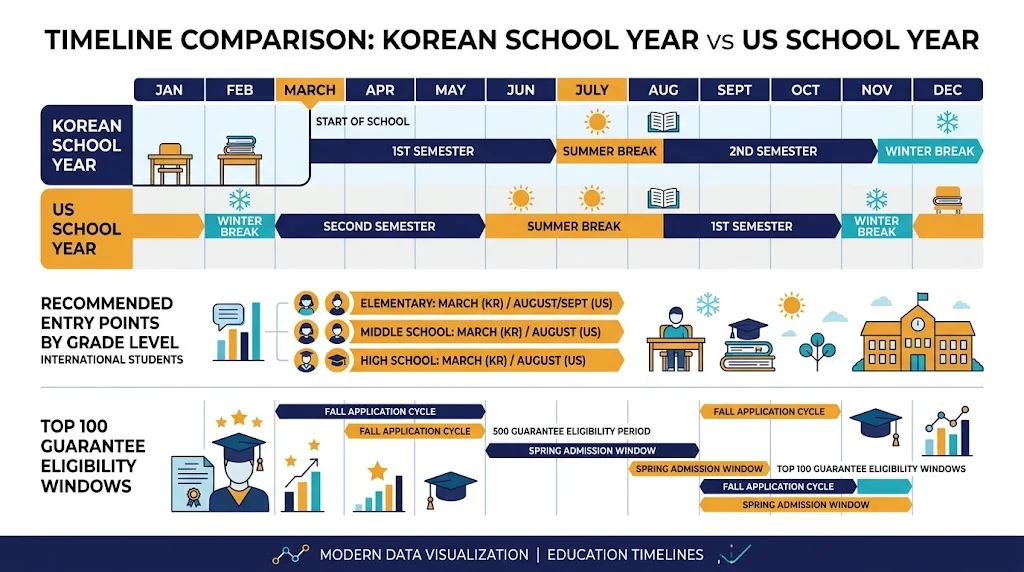
The Korean school year runs from March to February, divided into two semesters: March-July and September-February. The US school year runs from August or September to May or June, also divided into two semesters. This creates a structural calendar gap of approximately 6 months between the two systems.
Korean high school (grades 10-12 in the Korean system) spans 3 years across a different subject structure, with national curriculum requirements that differ significantly from the AP (Advanced Placement) and Honors course framework used at US private high schools. According to NACAC (2024), US university admissions offices review Korean transcripts as part of international credential evaluation but apply US grade-level standards when assessing course rigor.
How Are Korean Grades Placed in US High Schools?
Grade placement for Korean students transferring to a US high school depends on age, prior years of schooling, and academic readiness rather than a direct 1-to-1 grade equivalency. The on-campus international department at each US Signature School works with the admissions team to review incoming transcripts and assign the appropriate grade.
Most Korean students completing their middle school equivalent (Grade 9 in the Korean system, typically age 15) enter US high school at Grade 9 or 10. Students transferring mid-high school from Korea are typically placed in Grade 10, 11, or 12 depending on completed coursework. Families should not assume automatic grade alignment - confirmation during the Amerigo consultation process is the correct step.
- Age-based placement: US high schools primarily use age and completed years of schooling to assign grade level.
- Transcript review: Korean school records are submitted to the admissions team for subject and credit review during the application process.
- ELL placement: Most Korean students entering Grade 9-10 are assessed for ELL (English Language Learning) level on arrival to determine course placement within the ELL curriculum.
- AP eligibility: Korean students typically access AP (Advanced Placement) or Honors courses in their second year of enrollment after demonstrating sufficient English proficiency and grade progression.
When Is the Best Time for a Korean Student to Transition?
According to NAIS (2025), students who enter US high school at Grade 9 or Grade 10 build the strongest university application profiles, accumulating the AP coursework, extracurricular history, and academic consistency that US admissions offices evaluate most heavily. For Korean families, this means planning a transition before or during the first year of Korean high school (age 14-15) for maximum US program benefit.
The primary US entry window is August-September, aligning with the standard US fall semester start. Mid-year January entry is available at select Amerigo US Signature School partners but limits some course selection options and may affect first-semester credit accumulation.
- Grade 9 entry (August-September): Optimal for meeting the 2-year Top 100 Guarantee requirement and building a full 4-year US transcript for competitive university applications.
- Grade 10 entry (August-September): Allows 2-3 years of US high school, sufficient for Guarantee eligibility starting in junior year.
- Grade 11 entry (August-September): One full year before the university application cycle; Guarantee eligibility possible with strong academic progression.
- Grade 12 entry: Foundation Year Program only - students complete a US diploma year and receive conditional admissions from Amerigo's partner universities.
How Do Korean Credits Transfer to US Transcripts?
Korean academic records are reviewed by each US Signature School's admissions team as part of the enrollment process. The outcome is course placement and academic planning, not direct credit substitution in the manner used for US-to-US transfers. Korean national curriculum subjects do not map directly to US credit hours, which are structured around Carnegie Units (one Carnegie Unit equals 120 hours of instruction per subject per year).
According to NCES, US high schools issue diplomas based on Carnegie Unit credit completion in specified subject areas. Korean students entering in Grade 9 or 10 typically complete their full US credit requirement across their enrollment period without requiring prior credit recognition. Students entering in Grade 11 or 12 may have selected subjects recognized at the discretion of the admissions team, but families should not rely on credit transfer to reduce US enrollment requirements.
What Should Korean Families Prepare Before Enrollment?
Korean families applying to an Amerigo partner school should prepare a standard set of academic and visa documents well before the intended start date. The on-campus international department at each US Signature School coordinates document review and supports the F-1 (student visa for academic programs) application process, with optional visa support available through Amerigo's third-party partner ZF Visa.
Amerigo's in-country staff in Korea communicate with Korean families in Korean throughout the pre-enrollment and pre-departure process. The Amerigo recruitment team handles the initial consultation and school selection, with the pre-departure process including a 1:1 academic director call for course planning and a pre-departure orientation session for logistics preparation.
- Korean school transcripts: Official records from all secondary years completed, with certified English translation if not already in English.
- English proficiency test: TOEFL, IELTS, Duolingo English Test, or Eltis score submitted with the application.
- Passport and SEVIS: Valid passport is required for F-1 visa; SEVIS (Student and Exchange Visitor Information System) fee of $350 is paid as part of the visa process.
- Financial documentation: Proof of ability to cover multi-year program costs, required for F-1 visa application.
Frequently Asked Questions
What grade would a Korean Grade 10 student enter at a US high school?
A Korean student completing Grade 9 (the final year of Korean middle school) and entering at age 15 would typically be placed in US Grade 9 or 10, depending on the school's age-based placement and transcript review. Grade placement is confirmed during the Amerigo admissions process - families should not assume alignment without verification, as individual academic histories vary and each school makes its own determination.
Does the Korean school year calendar affect F-1 visa timing?
Yes. Korean students finishing their academic year in February should plan their F-1 visa application to align with the US August-September intake, allowing 3-5 months for visa processing, SEVIS fee payment, and pre-departure preparation. Starting the Amerigo consultation in the preceding autumn gives families sufficient time to complete the enrollment, school selection, and visa process before the US fall semester starts.
Can Korean school subjects replace AP credits at US high schools?
Korean national curriculum subjects do not directly replace AP (Advanced Placement) credits at US high schools. Transcripts are reviewed by the school's admissions team to inform course placement, but Korean academic records cannot substitute for Carnegie Unit-based US credits earned at the US partner school. Korean students typically complete their full credit requirements through their years of US enrollment.
How does Amerigo support Korean-speaking families during enrollment?
Amerigo provides native-language communication support for Korean families through in-country staff who communicate remotely in Korean. The in-country team supports Korean families before and after key enrollment milestones - from initial consultation through visa preparation and pre-departure. On-campus staff at US Signature Schools operate in English; in-country staff relay key updates and summaries to Korean families in their native language.
Is the CSAT (Suneung) preparation compatible with US high school enrollment?
Students enrolled at a US Signature School follow the US curriculum, which focuses on AP and Honors coursework rather than CSAT preparation. Families planning for a Korean university pathway alongside or instead of a US university pathway should discuss this with the Amerigo team during consultation, as the program is designed to optimize US university outcomes. Monthly progress reports, school activity calendars and event announcements are delivered through StudyStudyGo launching Fall 2026, keeping Korean families informed of academic progress.
What accommodation options are available for Korean students?
Amerigo offers four accommodation options: homestay, off-campus residences (the primary model, located 20-30 minutes from partner schools with single-gender units and 24/7 staff), on-campus residences at select schools, and self-provided accommodation for students with family nearby. Accommodation selection takes place before the enrollment deposit is paid, with the recruitment team walking families through each option. Over 90% of Amerigo enrollment comes through Korean agency partners, who can assist with accommodation guidance.
When should Korean families start the Amerigo application process?
Korean families should begin the Amerigo consultation 6-12 months before the intended US enrollment start date. For August-September entry, starting the consultation in the previous October-January gives sufficient time for school selection, document preparation, visa processing, and pre-departure activities. The school finder tool helps families identify partner schools by location and grade level before the first consultation call.
Does Amerigo have a Korea-specific enrollment guide?
Amerigo provides a country-specific consultation for Korean families through its in-country staff and the recruitment team. The pre-departure process includes Amerigo's Know Before You Go Guide, covering arrival logistics, health documentation, accommodation setup, and the first-week orientation schedule. Korean families can access native-language support throughout the pre-departure and orientation period through the in-country relay model.
How does the Top 100 Guarantee apply to Korean students?
The Top 100 Guarantee is available to Korean students at US Signature Schools meeting all four requirements: 2 consecutive enrollment years, GPA 3.2 or above, TOEFL 85 or higher, and at least one AP, IB, or Honors course. Students who meet all four but do not gain Top 100 admission receive up to $50,000 USD in senior year program fees. Korean students entering Grade 9-11 have the most time to meet all criteria.
What university results have Korean students at Amerigo achieved?
Amerigo does not publish country-specific admission statistics. The overall Class of 2025 results were: of students who applied to Top 100 universities, 97% gained admission. Of those who applied to Top 50, 60%. Of those who applied to Top 30, 25%. Korean families interested in program-specific outcomes for Korean students should ask the recruitment team during the consultation for current data available.
Conclusion
The Korean school year's March-February calendar creates a 6-month offset from the US August-May structure, making transition timing a key factor in grade placement and credit planning. Korean students entering US high school in Grade 9-10 have the strongest foundation for meeting Top 100 Guarantee requirements and building a competitive university application. Preparation should begin 6-12 months before the intended US start date.
Find the Right Entry Point for Your Child
To learn more about studying in America at an Amerigo partner school and identify the right grade entry and timing for your Korean student, contact us to speak with a program advisor, or apply now to begin the enrollment process.
People Also Read
- Korean Families' Guide to Amerigo Education: Enrollment, Support, and Outcomes
- Korean Students in US High Schools Guide 2026
- What Grade Should International Students Start US High School? Complete Timing Guide 2026
About the Author
This guide was written by the Amerigo Education content team, drawing on program data from staff operating the on-campus international department at 40 Niche A+/A rated US, Canadian, and UK partner schools. Learn more about Amerigo Education.
Disclaimer: This article provides general information for educational purposes only. Families should conduct independent research, request current program data from providers, and consult with program representatives regarding specific circumstances. Contact us with questions.