All news
May 1, 2026
Study Abroad 101
International Student Admit Rate at Stanford: What High School Applicants Should Realistically Expect
Stanford's international admit rate is ~3.68%. Learn how US high school preparation changes the equation and how Amerigo builds competitive student profiles.

International Student Admit Rate at Stanford: What High School Applicants Should Realistically Expect
Last Updated: May 2026
The Stanford international admit rate for high school applicants sits within one of the most competitive admission environments in US higher education. According to IIE Open Doors (2025), more than 1.1 million international students enrolled in US universities in 2023-24, with demand for elite institutions rising each cycle. Stanford accepted approximately 3.68% of all applicants for its Class of 2028 across a pool exceeding 57,000 applications. For international applicants, demonstrating academic readiness through a US-recognized transcript directly influences how admissions teams evaluate each application.
Amerigo Education partners with 40 Niche A+/A rated schools across the US, Canada, and the UK, supporting 3,500+ students from 55+ countries. The Class of 2025 achieved 97% admission to Top 100 US universities. Amerigo's embedded university counseling at each US Signature School is designed to build the academic profile that competitive universities reward - from transcript rigor and AP (Advanced Placement) course sequencing to extracurricular positioning.
This guide covers how Stanford evaluates international high school applicants, how US-based transcripts change the competitive equation, what factors distinguish successful applications, and how families can build a tiered university strategy that includes elite aspirational targets alongside well-matched targets.
Key Takeaways
- Stanford's overall admit rate: Approximately 3.68% for the Class of 2028 - international candidates go through the same comprehensive review as domestic applicants.
- US transcript advantage: According to NACAC's State of College Admission report, admissions officers consistently rate grades in college prep courses and overall academic rigor among the most important factors in selective admissions decisions, areas where students attending US high schools demonstrate clear, comparable evidence to admissions committees.
- Amerigo outcomes: Of students who applied to Top 100 universities, 97% gained admission (Class of 2025). Of those who applied to Top 50, 60%. Of those who applied to Top 30, 25%.
- Two structured tracks: Amerigo's Top 100 Guaranteed track and Top 50 Track give students a framework for elite university goals from day one of enrollment.
- Course rigor is decisive: Competitive applicants to elite universities consistently complete AP and Honors courses - the foundation Amerigo's planning team builds from Grade 9 onward.
What Is Stanford's Admit Rate for Internationals?
Stanford does not publish a separate acceptance rate for international applicants. Stanford University admitted approximately 3.7% of applicants for the Class of 2028, accepting roughly 2,099 students from a pool of approximately 57,000 applications based on widely reported figures (Stanford does not always publish official acceptance rates in its Common Data Set). International students represent roughly 10-12% of undergraduates, placing them within a competitive cohort reviewed against the same comprehensive standards as domestic applicants. Academic transcript rigor, AP (Advanced Placement) and Honors course completion, extracurricular depth, essays, and English language fluency all factor into the evaluation.
For students from China, South Korea, Vietnam, Mexico, and the Taiwan Region, application volume from these markets intensifies differentiation pressure. A US-verified transcript - rather than a converted foreign grade - presents a more immediately interpretable record to admissions readers who process thousands of files each cycle.
- Overall admit rate: Approximately 3.68% across all applicants (Class of 2028).
- No separate published international rate: Stanford evaluates all applicants through the same comprehensive process.
- International enrollment share: Roughly 10-12% of undergraduates hold international status.
- Full-application review factors: Transcript rigor, AP course history, essays, extracurricular narrative, and demonstrated English fluency.
How Do Domestic and International Rates Compare?
Nationally, international students face a structurally distinct admissions landscape. At elite research universities, geographic diversity goals and legacy considerations - neither of which applies to most international candidates - can favor domestic applicants. According to IIE Open Doors (2025), international enrollment at the most selective US institutions has remained stable, reflecting sustained demand from high-performing global students.
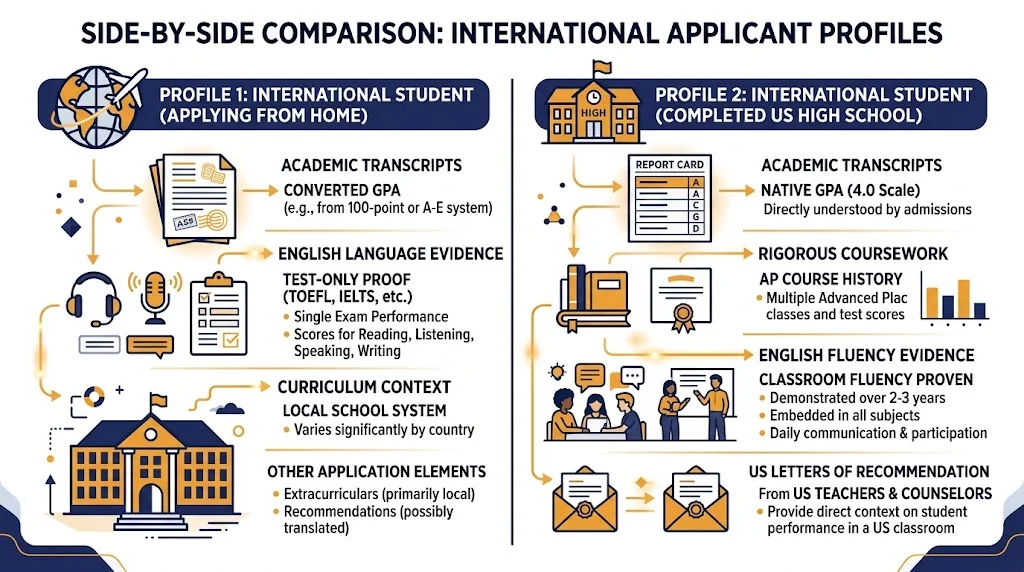
The competitive gap narrows for international applicants who complete US high school before applying. A native-scale GPA (Grade Point Average), AP (Advanced Placement) and Honors course history, and US educator recommendations carry distinct weight in comprehensive admissions review, compared to a converted foreign transcript supported only by standardized test scores.
What Factors Does Stanford Weigh in Admissions?
Stanford uses a comprehensive review that weighs academic excellence, personal character, intellectual vitality, and campus contribution. According to the College Board AP Program Annual Report, AP course enrollment and exam performance remain among the most visible academic readiness signals admissions officers evaluate at highly selective universities, with successful AP exam scores correlating with stronger college persistence and graduation rates.
For international applicants, three factors consistently distinguish stronger applications. First, transcript rigor: students who complete AP and Honors coursework in 10th and 11th grade demonstrate university-level readiness more clearly than students in unfamiliar home curricula. Second, English language ability beyond test scores: years of US classroom instruction build academic fluency that TOEFL preparation alone cannot replicate. Third, a coherent extracurricular narrative - sustained commitment to 1-2 meaningful activities, not a broad list assembled for applications.
- Academic rigor: AP (Advanced Placement) and Honors coursework with strong exam performance signals university readiness.
- Classroom English fluency: Multi-year US instruction distinguishes applicants from those with test scores only.
- Authentic extracurricular depth: A focused narrative of sustained involvement and growth.
- Personal essays: Authentic voice, intellectual curiosity, and clear sense of purpose - not a summary of achievements.
How Does US High School Change the Equation?
Completing 2-3 years at a US high school before applying to Stanford shifts the competitive calculation in measurable ways. According to NACAC (2024), students who complete US high school demonstrate academic and cultural readiness that resonates with admissions teams reviewing large international applicant pools.
Amerigo Education embeds university counseling within the on-campus international department at each US Signature School. The Academic Director and counseling team plan AP (Advanced Placement) and Honors course sequencing, build extracurricular positioning, and prepare students for SAT and ACT registration from the first semester. Monthly progress reports, school activity calendars and event announcements are shared with families via StudyStudyGo, Amerigo's parent communication platform.
What Should Students Target If Not Stanford?
Stanford is an appropriate aspirational target for well-prepared international high school students, but a strong application strategy includes a tiered university list. The Class of 2025 results show what structured preparation achieves: of students who applied to Top 100 universities, 97% gained admission. Of those who applied to Top 50, 60%. Of those who applied to Top 30, 25%.
A practical tiered approach includes 1-2 aspirational schools at the Top 30 level, 3-4 targets at the Top 50 level, and a confirmed set of strong-fit schools at the Top 100 level. The university guaranteed admission program gives US Signature School students a structured framework: the Top 100 Guarantee requires two consecutive years of enrollment, cumulative GPA (Grade Point Average) of 3.2 or higher, TOEFL 85 or above, and at least one AP, IB, or Honors course - with a refund of up to $50,000 USD against senior year program fees if the Top 100 outcome is not achieved.
For students with higher academic profiles, the Top 50 Track applies additional criteria designed to secure Top 50 outcomes.
How Does Amerigo Support Elite University Goals?
The campus team at each US Signature School is led by a Director of Campus Operations and includes an Academic Director, Senior Campus Coordinators, Campus Coordinators, and an ELL (English Language Learning) Teacher. The Academic Director handles both pre-departure academic planning and on-campus academic management - the same role serving students from first enrollment through the application cycle.
Students who begin in Grade 9 or Grade 10 build the longest academic record. Students entering in Grade 12 enroll through the Foundation Program, which provides a US high school diploma and a university pathway through partner universities. Amerigo hosts its own social events for students and their friends separate from school-organized activities, building the community involvement and leadership that elite universities value.
Frequently Asked Questions
What is Stanford's acceptance rate for international students?
Stanford does not publish a separate acceptance rate for international applicants. The overall rate for the Class of 2028 was approximately 3.68% across more than 57,000 applications. International students represent roughly 10-12% of undergraduates. All applicants go through the same comprehensive review, which weighs transcript rigor, AP (Advanced Placement) course completion, essays, extracurricular depth, and English fluency.
Does attending US high school help with Stanford admission?
Attending a US high school before applying to Stanford provides measurable advantages: a native-scale GPA, verified AP (Advanced Placement) and Honors course history, recommendation letters from US-based educators, and English fluency proven through years of classroom instruction. While no pathway guarantees admission, the profile built through US high school is materially stronger for elite US university applications than one assembled abroad.
How competitive are Stanford applications from Asian students?
Applications from China, South Korea, Vietnam, and the Taiwan Region are among the most competitive globally at elite US universities. Students from these markets who complete US high school distinguish themselves from home-country applicants by presenting a US-verified academic record, extracurricular profiles recognizable to American admissions teams, and recommendation letters from US educators. A clear intellectual narrative and genuine activity depth are critical for differentiation.
What GPA do international students need for Stanford?
Stanford does not publish a minimum GPA requirement. The admitted student profile consistently shows average unweighted GPA at or near 4.0. For international applicants preparing through US high school, maintaining a cumulative GPA (Grade Point Average) of 3.7 or above alongside AP (Advanced Placement) course completion positions students competitively at the Top 50 and Top 30 tier. Amerigo's university counseling team tracks GPA progression each semester to help students stay on target.
Does Amerigo provide university counseling for Stanford applications?
Yes. At US Signature Schools, the Academic Director and counseling team support individualized planning for academic and extracurricular positioning, including applications to Top 30 and elite institutions. Counselors advise on AP (Advanced Placement) course sequencing, essay strategy, and application timing from the first semester. For students at Brentwood School Essex or Berkhamsted School, each school's own counseling team manages all university applications independently.
For students at Brentwood School Essex or Berkhamsted School, Brentwood's own counseling team manages all university applications independently.
What is the Amerigo Top 50 Track?
The Top 50 Track is Amerigo's structured pathway for students targeting Top 50 university outcomes. It applies higher entry standards alongside additional academic, extracurricular, and soft-skill criteria designed to secure Top 50 admissions results. Of students who applied to Top 50 universities, 60% gained admission (Class of 2025, of those who applied). The Top 100 Guaranteed track is available to all admitted US Signature School students who meet the four eligibility requirements.
What SAT score do international students need for Stanford?
Stanford uses a comprehensive review process and does not publish a minimum SAT score requirement. The middle 50% SAT range for admitted students has historically been 1500-1570. International students at US Signature Schools receive SAT and ACT test registration support, transportation to test centers, and structured study hours with campus coordinator availability for academic support throughout the school year.
Can Grade 12 international students apply to Stanford?
Grade 12 international students can apply to Stanford through the standard process, but entry at Grade 12 leaves less runway to build the AP (Advanced Placement) and Honors course record that elite universities evaluate. Students who join Amerigo in Grade 12 enroll through the Foundation Program, receiving a US high school diploma and a university pathway through partner universities. Earlier entry at Grade 9 or Grade 10 maximizes preparation time for elite university applications.
How does Amerigo compare to applying to Stanford from home?
A student applying from their home country presents a converted transcript, test-only English evidence, and recommendation letters from educators less familiar to US admissions readers. A student completing 2-3 years at an Amerigo US Signature School presents a native-scale GPA, verified AP (Advanced Placement) course history, and recommendations from US educators. The Class of 2025 outcomes reflect this: of those who applied to Top 100, 97% gained admission; Top 50, 60%; Top 30, 25%.
What are realistic alternatives to Stanford for international students?
Top universities realistic for well-prepared international high school students include UC Berkeley, University of Michigan, NYU, Emory, Duke, Northwestern, Penn State, and the University of Washington - all of which have accepted Amerigo students. These universities evaluate candidates with the same rigor as Stanford but at higher overall acceptance rates. Families should work with Amerigo's counseling team to build a tiered list aligned with academic profile and program goals.
Conclusion
Stanford's international admit rate reflects the same competitive standard applied to all applicants - approximately 3.68% overall, with no separate published figure for international candidates. Students who complete 2-3 years of US high school before applying present a materially stronger profile than those applying directly from abroad, with a native GPA, verified AP and Honors course history, and English language fluency built in the classroom. A tiered university strategy - with elite aspirational targets alongside well-matched Top 50 and Top 100 targets - produces the strongest outcomes for international families.
Build Your Path to Elite University Admission
To learn more about studying in America at an Amerigo partner school and building the academic profile that competitive universities reward, contact us to speak with a program advisor, or apply now to take the first step toward enrollment.
People Also Read
- How to Get Into UCLA as an International High School Student: Complete Pathway Guide
- 97% Top 100, 60% Top 50, 25% Top 30: Which University Tier Should You Target?
- What University Admissions Officers Actually See: Why US High School Changes Everything for International Students
About the Author
This guide was written by the Amerigo Education content team, drawing on program data from staff operating the on-campus international department at 40 Niche A+/A rated US, Canadian, and UK partner schools. Learn more about Amerigo Education.
Disclaimer: This article provides general information for educational purposes only. Families should conduct independent research, request current program data from providers, and consult with program representatives regarding specific circumstances. Contact us with questions.