
All news
February 3, 2026
Study Abroad 101
How to Get Into UCLA as an International Student
UCLA admits below 9% of international applicants. Learn A-G requirements, GPA targets, PIQ strategies, and how authentic US high schools provide UC system advantages. (162 chars)

Last Updated: February 2026
Getting into UCLA as an international high school student requires minimum 3.4 GPA (Grade Point Average) in UC-approved A-G courses, though admitted students typically present 3.8+ unweighted. Students also need English proficiency through TOEFL (Test of English as a Foreign Language) 100+ or IELTS (International English Language Testing System) 7.0+, and eight Personal Insight Question responses. According to UCLA Undergraduate Admissions (2024), international students comprised 11% of Fall 2024's freshman class with admission rates below 9%, making UCLA one of the most selective public universities for international applicants.
Students attending authentic American high schools gain advantages through automatic UC course approval, California proximity for campus visits, and access to US extracurricular activities that strengthen applications. Amerigo Education, founded in 2016 and backed by Avathon Capital, partners with 40 Niche A+/A rated US and Canadian high schools where students earn recognized US diplomas - including California partner schools with direct UC system advantages. UCLA is among the program's notable university acceptances for the Class of 2025.
Key Takeaways
- Minimum 3.4 GPA required in UC A-G courses, though competitive international applicants typically present 3.8+ unweighted GPAs calculated using only 10th-11th grade coursework
- UC application deadline November 30 requires eight Personal Insight Questions (PIQs, 350 words each), activities list, and academic record with no extensions granted
- Authentic US high schools provide strategic advantages through UC-approved courses, extracurricular access, and counselor familiarity with UC system expectations
- UCLA evaluates 13 review factors beyond GPA including leadership, special talents, challenges overcome, and context of opportunities available
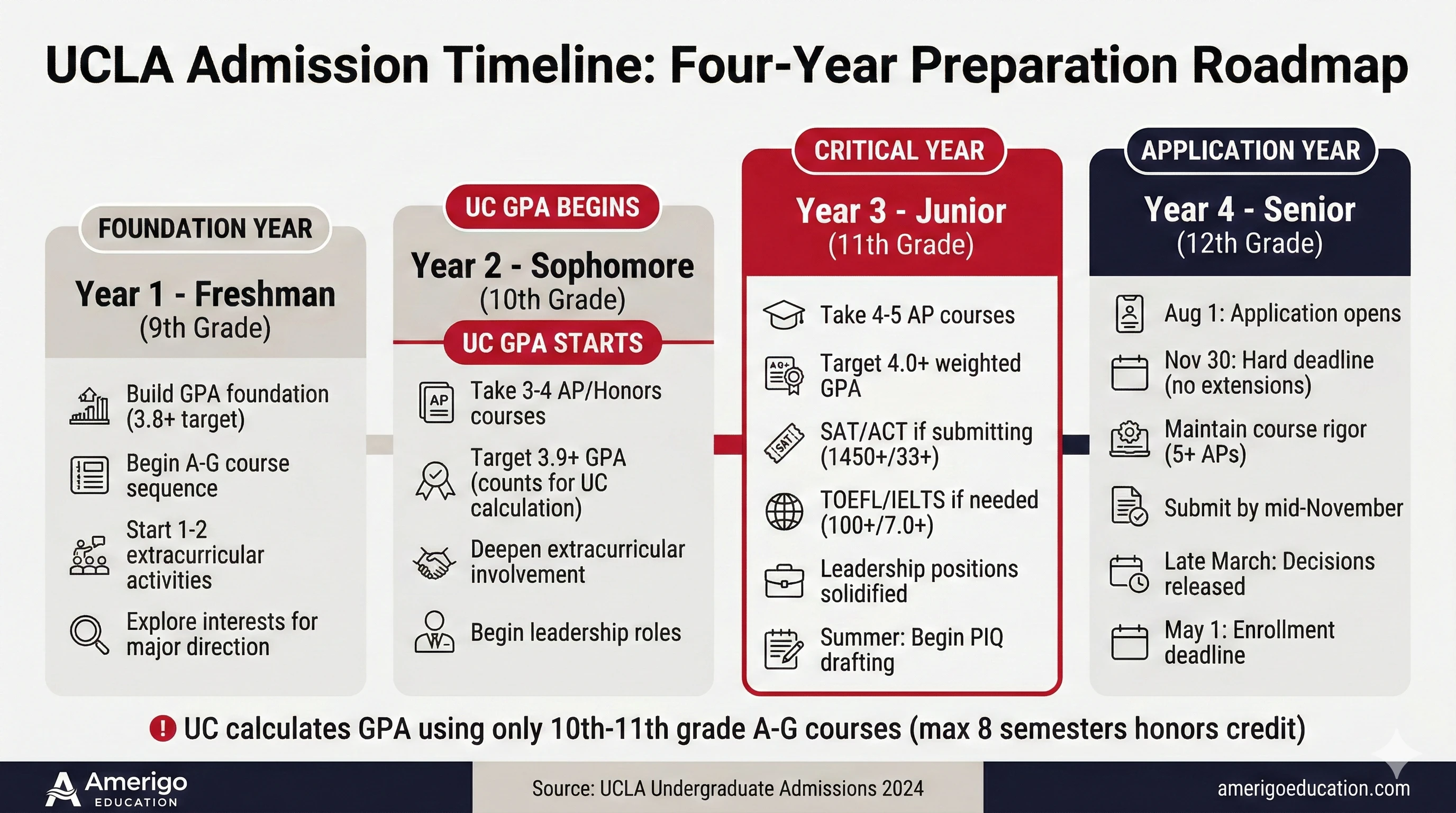
- Four-year preparation from freshman year through AP (Advanced Placement) course selection, sustained extracurricular leadership, and strong academic performance builds competitive applications
What Are UCLA's Academic Requirements?
UCLA requires A-G course completion: two years history, four years English, three years math (four recommended), two years lab science (three recommended), two years foreign language (three recommended), one year visual/performing arts, one year college-prep elective. Minimum 3.4 GPA in A-G courses is required, though admitted international students typically present 3.8+ unweighted GPAs.
UC calculates GPA using only 10th-11th grade A-G courses, awarding extra points for AP/IB/UC-approved honors (maximum eight semesters honors credit). This calculation means exceptional sophomore and junior year performance is critical. Students attending authentic US high schools benefit from automatic UC course approval versus international schools requiring credential evaluation. Learn more about GPA requirements for top US universities.
English proficiency requires TOEFL iBT 100+, IELTS 7.0+, or Duolingo 120+. Students attending US high schools three or more years may be exempt from testing - a strategic advantage for students beginning US study by 10th grade versus arriving only for senior year.
UCLA A-G Requirements Summary:
- History/Social Science - 2 years (world history, US history, civics)
- English - 4 years (college-prep composition and literature)
- Mathematics - 3 years minimum (algebra, geometry, advanced algebra)
- Laboratory Science - 2 years minimum (biology, chemistry, physics)
- Language Other Than English - 2 years minimum, same language
- Visual/Performing Arts - 1 year (dance, drama, music, visual arts)
- College-Prep Elective - 1 year additional A-G course
| Requirement | Minimum | Competitive | Strategic Notes |
|---|---|---|---|
| GPA (A-G) | 3.4 | 3.8+ unweighted | 10th-11th grades only |
| English Test | TOEFL 100+/IELTS 7.0+ | 3+ years US exempts | Begin US by Grade 10 |
| AP Courses | None required | 6-8 recommended | Max 8 semesters honors credit |
| SAT/ACT | Test-optional | Submit if 1450+/33+ | Optional submission |
| Timeline | Action | Notes |
|---|---|---|
| August 1 | Application opens | Begin PIQ drafting |
| November 1-15 | Submit application | Avoid last-minute issues |
| November 30 | Hard deadline | 11:59 PM PT, no extensions |
| January-February | Supplemental requests | ~15% contacted |
| Late March | Decisions released | Multiple waves |
| May 1 | Enrollment decision | Final deadline |
Planning Four-Year Course Selection for UCLA
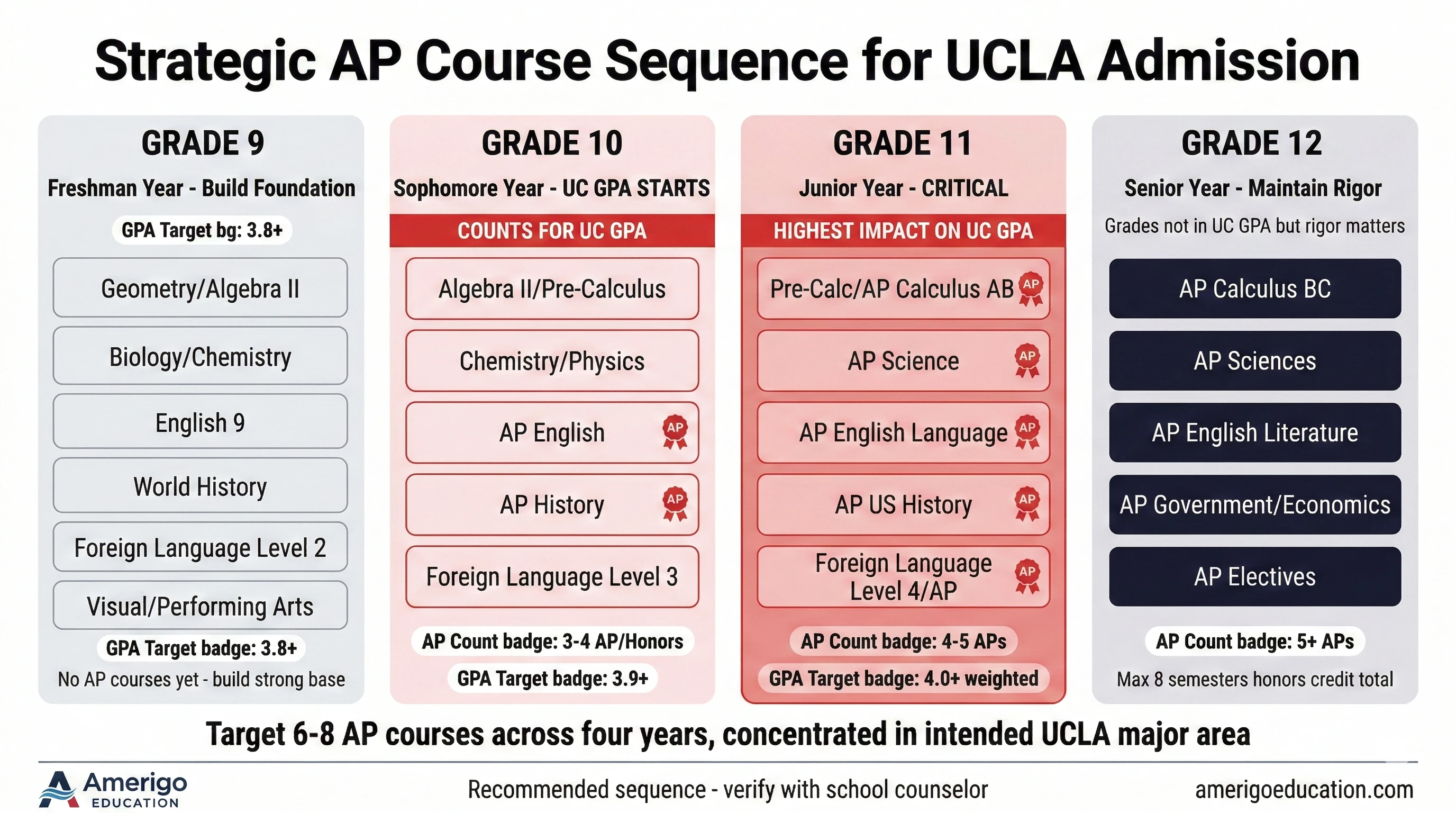
Strategic course selection begins freshman year with rigorous curriculum while maintaining strong grades. Target 6-8 AP courses across four years, concentrating in areas related to intended UCLA major. UC honors credit awards extra GPA points for AP/IB/honors courses but limits honors credit to eight semesters - strategically select which honors courses during 10th-11th grades when UC GPA is calculated.
Students at schools with dual enrollment partnerships gain advantages through university coursework while in high school. Schools partnering with UC San Diego enable actual UC system course completion, demonstrating readiness and potentially transferring credits to UCLA. Learn more about AP course requirements for top universities.
Year-by-Year Course Strategy:
- Freshman (9th): Build GPA foundation (3.8+) - Geometry/Algebra II, Biology/Chemistry, English 9, World History, Foreign Language Level 2, Visual/Performing Arts
- Sophomore (10th) - UC GPA STARTS: Take 3-4 AP/Honors - Algebra II/Pre-Calc, Chemistry/Physics, AP English, AP History, Foreign Language Level 3. Target 3.9+ GPA.
- Junior (11th) - UC GPA CRITICAL: Take 4-5 APs - Pre-Calc/AP Calc AB, AP Science, AP English Language, AP US History, Foreign Language Level 4/AP. Target 4.0+ weighted.
- Senior (12th): Maintain rigor - AP Calculus BC, AP Sciences, AP English Lit, AP Gov/Econ, AP electives. Grades don't affect UC GPA but rigor matters.
What Extracurricular Activities Does UCLA Value?
UCLA's official review process values depth over breadth - 3-5 sustained activities with increasing leadership responsibility outweigh superficial participation in numerous clubs. Leadership positions aligned with intended major or demonstrating organizational and problem-solving skills carry significant weight. Four years in debate with leadership progression impresses more than one year each in ten activities.
Community service and volunteer work demonstrate social awareness UCLA emphasizes. Sustained involvement with one organization showing increasing impact outweighs scattered short-term experiences. Students attending authentic American high schools access leadership through established clubs, teams, and organizations that international schools may not offer. Learn why authentic US high school participation strengthens university applications.
Valued Extracurricular Categories:
- Academic/Intellectual - Science Olympiad, Debate, Math Club, Research
- Leadership - Student government, club officers, team captains
- Community Service - Sustained volunteer work with measurable impact
- Arts - Visual arts, music, theater, dance with skill development
- Athletics - Varsity sports with leadership or championship achievement
- Work Experience - On-campus roles, volunteer positions, entrepreneurial projects
- Special Talents - Exceptional achievement in specific areas
Important for F-1 visa students: According to SEVP/ICE (2025), off-campus employment is restricted under F-1 (student visa for academic programs) regulations.
How Do Personal Insight Questions Impact Admission?
UCLA requires eight Personal Insight Questions (PIQs) with 350-word maximum each, distinct from Common Application's single essay approach. Students select eight from available prompts covering leadership, creativity, talent/skill, educational barrier, significant challenge, academic inspiration, community contribution, and additional information.
Effective PIQs demonstrate authenticity, specificity, and reflection. Generic responses about "learning teamwork through sports" don't differentiate applicants. Strong responses include specific details (exact situations, conversations, outcomes), demonstrate growth (what changed), and connect to future goals (how experience shaped UCLA major choice).
International students should draw on the unique perspectives their backgrounds provide. Living in multiple countries, navigating cultural transitions, or overcoming language barriers provides authentic material for challenge, community, and educational opportunity prompts. Avoid fabricating hardship but honestly address real challenges while demonstrating resilience and growth.
PIQ Strategy:
- Be specific - Names, dates, locations, exact conversations, concrete outcomes
- Show growth - Explain what you learned and how it changed perspective
- Connect to UCLA - Relate experiences to intended major or goals
- Avoid cliches - Skip generic lessons about teamwork or helping others
- Use vivid details - Help readers visualize through sensory descriptions
- Reflect deeply - Go beyond describing to explaining why it matters
- Be authentic - Write in your voice, not what admissions expects
- Proofread - Eliminate errors suggesting carelessness
UCLA Application Timeline and Key Deadlines
UC application opens August 1, closes November 30 (no extensions). UCLA notifies admitted students late March, with enrollment decisions due May 1. Strategic students begin PIQ drafting the summer before senior year for multiple revisions. Complete applications by mid-November avoiding technical issues, even though deadline is November 30. UC accepts one submission per applicant - no updates after submission.
Some applicants (approximately 15%) receive supplemental information requests January/February for additional achievements, circumstances, or qualifications documentation. Students receiving requests should respond promptly as this often indicates borderline admission consideration.
How Does UCLA's Review Evaluate Applicants?
UCLA uses a 13-factor review evaluating criteria beyond grades. Academic factors include GPA, course rigor, subject achievement, and courses beyond minimum requirements. Personal factors evaluate PIQs, leadership, special talents, volunteer work, work experience, and accomplishments relative to opportunities. Context factors examine school opportunities, special circumstances, and geographic factors.
International applicants face additional scrutiny regarding English proficiency, ability to pay (UCLA is need-aware for international students), and likelihood of contributing to campus diversity. Strong applicants demonstrate not only academic qualification but also unique perspectives, experiences, or talents enhancing UCLA's community.
UCLA's 13 Review Factors:
- Academic: GPA, courses beyond minimums, honors courses, senior year rigor, subject performance, AP/IB achievement
- Personal: Leadership, special talents, community service, academic enrichment
- Context: High school curriculum quality, special circumstances, personal insights from PIQs

What Model Best Prepares Students for UCLA?
UCLA admission requires four-year strategic preparation beginning freshman year. Students at California partner schools gain advantages through automatic UC-approved courses, proximity for campus visits, and authentic extracurricular participation strengthening review profiles.
The on-campus international department model provides university counseling from freshman year, ensuring students understand A-G requirements, strategically select AP courses optimizing honors credit caps, and develop extracurricular profiles demonstrating sustained leadership. Dedicated support - individualized academic planning, subject tutoring, and application guidance - enables students to build competitive UCLA applications systematically across four years. Amerigo's Class of 2025 achieved 97% Top 100 university admission, including UCLA acceptances, backed by a $50,000 USD refund guarantee. Recent outcomes include T. Nguyen (Mater Dei Catholic High School, GPA 3.83 to 4.57, accepted to University of Virginia) and Y. Li (St. Anthony's High School, GPA 3.57 to 3.70, accepted to University of Florida).
Frequently Asked Questions
What GPA do international students need for UCLA?
UCLA requires minimum 3.4 GPA in UC A-G courses, but admitted international students typically present 3.8+ unweighted and 4.0+ weighted GPAs. UC calculates GPA using only 10th-11th grade A-G courses, awarding extra points for AP/IB/honors (maximum 8 semesters credit). Students should aim for 3.9+ GPA specifically during sophomore and junior years to remain competitive in the applicant pool.
Does UCLA require SAT or ACT scores?
UCLA is test-optional - students choose whether to submit SAT (Scholastic Assessment Test) or ACT (American College Testing) scores. Submit only if scores strengthen the application (typically SAT 1450+ or ACT 33+). Students attending US high schools 3+ years may be exempt from English proficiency testing, providing strategic advantage over students arriving only for senior year.
When should international students apply to UCLA?
UC application opens August 1, closes November 30 for fall admission (no spring admission). Submit by mid-November avoiding technical issues, though the hard deadline is November 30 at 11:59 PM PT. Begin PIQ drafting the summer before senior year for adequate revision time rather than rushing in November.
How important are extracurriculars for UCLA?
UCLA values depth over breadth - sustained participation with increasing leadership outweighs superficial involvement in numerous activities. Focus on 3-5 activities demonstrating genuine interest, leadership development, and measurable impact. Quality leadership roles and meaningful community service matter more than padding applications with brief memberships.
What are UCLA's most competitive majors?
Most competitive majors include engineering (computer science, electrical), life sciences (biology, biochemistry), business economics, psychology, and communications. Students applying to competitive majors should demonstrate strong performance in related coursework (AP Calculus and Sciences for engineering) and relevant extracurricular achievement.
Can students attending US high schools skip English testing?
Yes, students attending US high schools three or more consecutive years concluding with graduation may be exempt from TOEFL/IELTS. This exemption provides significant advantage for students beginning US high school by 10th grade versus arriving only for senior year. Verify exemption eligibility with UCLA directly as policies may change.
How does UCLA evaluate international school students?
UCLA evaluates international school transcripts through credential evaluation requiring official reports and course descriptions demonstrating A-G completion. International school courses are not automatically UC-approved, requiring additional documentation and case-by-case evaluation. Students attending authentic US high schools gain advantage through automatic UC course approval eliminating this barrier.
What percentage of UCLA students are international?
International students comprised approximately 11% of UCLA's Fall 2024 freshman class with admission rates below 9%. This level of selectivity means international applicants must present exceptional academic profiles, compelling PIQs, and demonstrated readiness for UCLA's rigorous academic environment to gain admission among a highly selective applicant pool.
People Also Read
What GPA Do International Students Need for Top US Universities? Strategic Guide 2026 Understand GPA requirements, calculation methods, and competitive ranges for Top 100, Top 50, and Top 30 universities.
How Many AP Courses Do International Students Need for Top US Universities in 2026 Discover strategic AP course selection timelines and recommended course counts by university tier.
Why US High School Transcripts Give International Students a University Admission Advantage How recognized American transcripts strengthen applications compared to international school credentials.
About The Author
Maria Chen writes about international education and university admissions on behalf of the Amerigo Education team. This guide draws on admissions expertise from counselors operating the on-campus international department at 40 Niche A+/A rated US and Canadian partner schools.
Conclusion
UCLA admission for international students requires four years of strategic preparation across academics, extracurriculars, and application materials. Students who begin planning freshman year, maintain strong GPAs during the critical 10th-11th grade UC calculation period, build sustained extracurricular leadership, and craft authentic Personal Insight Questions position themselves competitively. The authentic US high school advantage - automatic UC course approval, English testing exemptions, and genuine American school context - provides a foundation that strengthens every element of the application.
Take the Next Step
Families targeting UCLA and other top UC schools can contact Amerigo for information about California partner schools, UC system preparation, and enrollment timelines. To begin the application process, visit the application page - most Signature schools offer rolling admissions with flexible English testing including Duolingo and Eltis.
This article provides general UCLA admission guidance for educational purposes. Requirements may change. Verify information with UCLA Undergraduate Admissions and consult qualified counselors. Contact us with questions.