All news
March 17, 2026
Study Abroad 101
How US School Culture Works: Homecoming, Prom, and Social Events
What are homecoming, prom, spirit week, and other US high school social events? Complete guide to American school culture for international students and families.
How US School Culture Works: Homecoming, Prom, and Social Events
Last Updated: March 2026
A US high school social event is a school-organized activity outside regular classes that brings students together for celebration, competition, or community building. According to the National Center for Education Statistics (NCES), 96% of US high schools host at least one formal dance annually, and 87% organize spirit weeks or pep rallies tied to athletic seasons. These events form a social calendar that shapes student identity, peer connections, and school belonging throughout the academic year.
Amerigo Education operates on-campus international departments at 40 Niche A+/A rated partner schools across the US, Canada, and UK, supporting 3,500+ students from 55+ countries. The Class of 2025 achieved 97% Top 100 university admission. On-campus staff help international students understand, prepare for, and participate in American social traditions that may have no equivalent in their home country.
Key Takeaways
- Homecoming, prom, and spirit week are the three signature social events at most US high schools, each with specific traditions around dress codes, timing, and participation that international students benefit from understanding in advance.
- No event requires a date, prior experience, or cultural knowledge to attend: International students participate alongside American classmates, and going with a friend group is common and socially accepted.
- Sports games function as social gatherings: Football and basketball games draw hundreds of students who attend for the atmosphere, food, and social interaction rather than purely for the sport itself.
- Club fairs, volunteer events, and school plays offer year-round social entry points beyond the major dances, creating ongoing opportunities to meet peers through shared interests.
- On-campus staff prepare international students for events: Amerigo Education's on-campus international departments explain dress codes, social norms, and logistics before each major event so students arrive confident and informed. Amerigo also hosts its own events for students, and their friends are welcome, creating additional opportunities to socialize and develop meaningful relationships.
What Is Homecoming and How Does It Work?
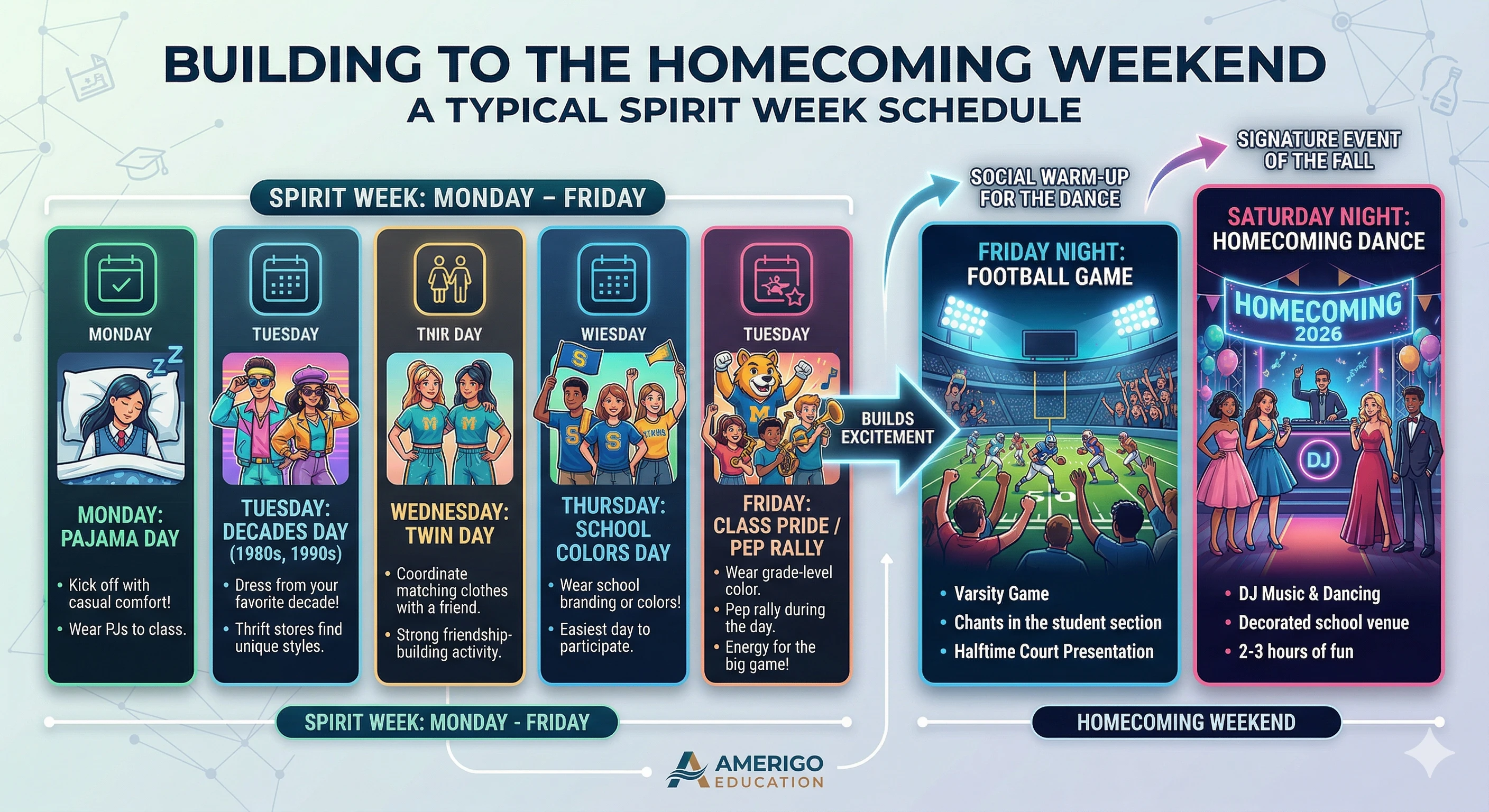
Homecoming is an annual fall celebration, typically held in September or October, that combines a football game, a semi-formal dance, and a week of school spirit activities. The tradition originated as a welcome-back event for alumni but has evolved into one of the biggest social events on the high school calendar. For international students, homecoming is often the first major school event they experience after arriving in August or September.
The homecoming football game is held on a Friday night under stadium lights, with students wearing school colors and sitting in a designated student section. The homecoming dance follows on Saturday evening in the school gymnasium or cafeteria, decorated with a theme chosen by the student council. Students typically wear semi-formal clothing: dresses or dress pants and button-down shirts. Unlike prom, homecoming is open to all grades (9 through 12), making it an accessible first social event for younger international students.
- International students can attend homecoming without a date by joining a friend group, which is how the majority of underclassmen attend
- Dance tickets cost between $15 and $40 at most schools and are purchased in advance from the student council
- Semi-formal dress codes are less strict than prom, and students can ask classmates or on-campus staff for guidance on appropriate attire
- Homecoming court nominations are popularity-based and international students can both vote and be nominated
- The football game is free for enrolled students and serves as a social warm-up for the dance the following night
- On-campus staff at Amerigo Education partner schools explain homecoming logistics and help students arrange transportation to and from events
What Happens at Prom and Who Attends?
Prom is a formal dance held in the spring, typically in April or May, primarily for juniors (Grade 11) and seniors (Grade 12). It is considered the most prestigious social event of the high school experience. Prom takes place at an off-campus venue such as a hotel ballroom, event center, or country club, and students dress in formal gowns and suits or tuxedos. Many students arrive in rented limousines or decorated cars after gathering at a classmate's home for group photos.
The prom experience extends beyond the dance itself. Students spend weeks choosing outfits, coordinating colors with dates or friend groups, and planning pre-prom photo sessions. Some schools host a "prom court" election similar to homecoming court, with a prom king and queen crowned during the event. After-prom activities organized by the school or parent groups often follow the dance, providing supervised entertainment until midnight or later. International students who have never encountered a formal dance tradition can prepare by discussing expectations with classmates and on-campus international department staff.
- Prom tickets cost $30 to $75, with total expenses (attire, transportation, photos) ranging from $150 to $500 depending on choices
- Formal attire can be purchased at department stores, rented from formalwear retailers, or borrowed from classmates who attended the previous year
- A date is not required, and attending in a friend group carries no social stigma at most American high schools
- Promposals (creative public invitations to ask someone to prom) are a popular tradition but are entirely optional and not expected of every student
- Schools that allow underclassmen to attend prom usually require them to be invited by a junior or senior
- After-prom events are school-supervised and designed to provide a safe, substance-free environment for students to continue socializing
What Is Spirit Week and Why Does It Matter?
Spirit week is a five-day event, typically held before homecoming or another major game, where students dress according to daily themes and compete in grade-level challenges. The purpose is to build school pride and create a shared experience that brings students from different social groups together. For international students, spirit week is a low-pressure way to participate in American school culture because the activities are visual, physical, and require no prior cultural knowledge.
Each day carries a different dress-up theme announced by the student council. Common themes include pajama day, decades day (dressing in 1970s, 1980s, or 1990s styles), school colors day, twin day (matching outfits with a friend), and career day. Participation is voluntary, and students can join some days and skip others without any consequence. The week usually ends with a pep rally in the gymnasium where the marching band performs, cheerleaders lead chants, and student competitions between grades generate energy before the big game.
How Do Sports Games Function as Social Events?
High school sports games, particularly football (fall) and basketball (winter), are among the most accessible and frequent social events on the American school calendar. Friday night football games draw hundreds of students, families, and community members to the school stadium. Students gather in a designated student section, wear school colors, paint their faces, and follow organized cheers led by the cheerleading squad. The social experience extends beyond the game itself to include concession stands selling food, halftime performances by the marching band, and informal socializing before and after the event.
International students do not need to understand the rules of American football or basketball to participate socially. The student section atmosphere is about collective energy, not sports expertise. Many international students attend their first game to observe and quickly learn the rhythms of when to stand, cheer, and react. Basketball games during winter provide a similar social function in a smaller, indoor setting. Attending games regularly establishes a student's presence in the school community and creates natural conversation topics with classmates throughout the week.
- Football games are typically held on Friday evenings from September through November, with basketball games running December through February
- Admission is free or costs $2 to $5 for enrolled students with valid school ID
- Concession stands sell hot dogs, popcorn, nachos, and drinks for $1 to $5 per item
- Student sections at football games often have organized chants that are easy to follow by watching nearby classmates
- Halftime shows feature the marching band, dance team, and sometimes grade-level competitions
- Away games (at opposing schools) also attract student fans and can include organized bus transportation
What Social Events Happen Year-Round?
Beyond the headline events of homecoming and prom, US high schools maintain a continuous social calendar that gives international students multiple entry points for participation throughout the year. Club fairs at the start of each semester allow students to browse organizations, sign up, and meet members. School plays and musicals in the fall and spring involve not only performers but also backstage crew, set builders, and publicity volunteers. Talent shows, cultural nights, and holiday celebrations fill gaps between the major events.
Volunteer events and community service projects function as both social activities and graduation requirements at many schools. Food drives, park cleanups, tutoring programs, and charity fundraisers place students in informal, cooperative settings where friendships form through shared work rather than conversation alone. These events are especially valuable for international students still building English confidence because they emphasize action over verbal interaction.
How Do School Plays and Musicals Build Community?
School theater productions are among the most intensive social experiences available at US high schools. A typical fall play or spring musical involves 6 to 10 weeks of after-school rehearsals, 3 to 5 hours per session, culminating in 2 to 4 public performances. The time commitment creates deep bonds between cast and crew members who spend more hours together during production season than in any other extracurricular. For international students, theater offers a structured social environment with a clear shared goal and built-in daily interaction.
Participation is not limited to acting. Backstage roles include set construction, lighting, sound, costume management, makeup, and stage management. Students who prefer behind-the-scenes work contribute meaningfully without performing in front of an audience. Auditions are open to all enrolled students regardless of experience, and directors frequently cast newcomers in ensemble roles that build confidence without requiring prior training. Cultural nights or international fairs, which many schools organize separately, give international students a platform to share music, dance, or traditions from their home country in a performance setting.
- Auditions for fall plays typically happen in September, with spring musical auditions in January or February
- Backstage crew positions require no audition and are available to any interested student
- Rehearsal schedules provide daily social interaction that builds friendships faster than weekly club meetings
- Performance nights are major school events where families, classmates, and community members attend
- Many schools offer technical theater as an elective course that combines academic credit with production participation
- International students with musical skills can contribute original cultural elements that enrich productions and increase visibility in the school community
How Can International Students Prepare?
International students benefit from understanding the US social event calendar before arrival so they can budget, plan attire, and mentally prepare for traditions that have no equivalent in most other countries. Amerigo Education's on-campus international departments brief students on upcoming events, explain dress codes, and coordinate logistics such as transportation from residential accommodations to off-campus venues. Students living in homestay, on- and off-campus supervised residences, or self-provided accommodation all receive the same event information and support.
Monthly progress reports to families include notes on social participation alongside academic data. Amerigo also shares school activity calendars and announcements with parents so they can easily follow upcoming events and encourage their students to participate. Parents receiving updates in their native language, available for families from China, Vietnam, Korea, Mexico, the Taiwan Region, and more, can track their child's social integration and encourage attendance at events. Students who attend at least one social event per month during the first semester consistently report higher school satisfaction and stronger peer connections by year-end. The $50,000 USD refund through the Top 100 Guarantee at US Signature partner schools (requiring 2 consecutive years, 3.2+ GPA, TOEFL 85+, and AP/IB/Honors coursework) reflects the program's investment in the full student experience, academic and social alike.
- Review the school's event calendar during orientation week and mark major dates
- Budget $200 to $600 for the full year of social events including homecoming, prom, game attendance, and club activities
- Ask on-campus staff or classmates about dress codes before each event rather than guessing
- Attend the first club fair and sign up for at least two organizations that match personal interests
- Accept invitations to group activities even when the event format is unfamiliar
- Use Life360/Reach location sharing for parent peace of mind during off-campus events, with 24/7 emergency contact through Amerigo Education staff
- Visa status is managed through a third-party provider (ZF Visa), billed separately, allowing students to focus on academics and social life without administrative distraction
Frequently Asked Questions
What is homecoming at a US high school?
Homecoming is an annual fall celebration that typically spans one week and centers on a varsity football game and a semi-formal dance. The week includes themed dress-up days, pep rallies, and a homecoming court election where students vote for representatives from each grade. The tradition originally welcomed back alumni, but modern homecoming is primarily a student social event. International students can attend all homecoming activities without a date or prior experience with the traditions.
Do international students need a date for prom?
No, international students do not need a date to attend prom. Many American students attend in friend groups rather than as couples, and going without a date is socially accepted at most US high schools. Students who prefer to attend with a date can invite a classmate, a friend from another school, or another international student. The social expectation around dates varies by school, but attending alone or with friends is common and carries no stigma.
How much does prom typically cost?
Prom costs vary by school and region but typically range from $150 to $500 per student when including the ticket, formal attire, transportation, and optional extras like corsages and group photos. Tickets alone usually cost $30 to $75. Many schools offer ticket assistance programs for students who need financial support. International students should budget for formal clothing, which can be purchased at department stores, rented from formal wear retailers, or borrowed from classmates.
What should my child wear to spirit week?
Spirit week themes change annually and are announced by the student council one to two weeks before the event. Common themes include pajama day, decade dress-up (1980s or 1990s clothing), school colors day, twin day (matching outfits with a friend), and career day. Participation is voluntary, and students can participate in some days and skip others. Thrift stores and classmates are good sources for themed clothing. Not participating carries no academic or social penalty.
Are school dances safe for international students?
School dances are supervised events held on campus with faculty chaperones, security staff, and clear entry and exit procedures. Most schools require student ID for entry and prohibit outside guests unless pre-approved through a guest registration process. Alcohol and drugs are prohibited, and schools enforce these policies strictly. Students in Amerigo Education programs have 24/7 emergency contact access through on-campus staff, and residential students return to supervised accommodations after events.
How do sports games work as social events?
High school sports games, particularly football and basketball, function as major social gatherings where students, families, and community members attend together. Students sit in designated student sections, wear school colors, and participate in organized cheers. Attending games is free or low-cost for enrolled students. International students do not need to understand every rule of the sport to participate socially. The atmosphere, food vendors, and halftime activities make games accessible social events.
What is a pep rally and is attendance required?
A pep rally is a school-wide assembly held in the gymnasium or auditorium before a major game or during spirit week. Students gather by grade, the marching band performs, cheerleaders lead chants, and coaches or team captains speak. Attendance is usually mandatory during school hours because pep rallies replace a class period. International students participate by sitting with their grade section and following the crowd energy. No preparation or prior knowledge is required.
Can international students join club fairs?
Club fairs are open enrollment events held at the start of each semester where every student organization sets up a table and recruits new members. International students can sign up for any club, and most clubs welcome members at all experience levels. Popular options include cultural clubs, STEM organizations, community service groups, performing arts, and athletic interest clubs. Joining clubs through the fair is one of the fastest ways for international students to meet peers with shared interests.
Do US high schools have volunteer requirements?
Many US high schools require community service hours for graduation, typically ranging from 20 to 100 hours over four years depending on the school and state. Service projects include food bank volunteering, tutoring younger students, environmental cleanups, and charity fundraisers organized through school clubs. These events double as social opportunities because students work alongside classmates in informal settings. Service hours also strengthen university applications by demonstrating civic engagement.
How can parents help their child participate?
Parents can support participation by budgeting for event costs like dance tickets and formal attire, encouraging their child to attend at least one social event per month, and asking about school events during regular calls. Monthly progress reports from Amerigo Education include social adjustment observations, so families can track participation alongside academic data. Parents should avoid discouraging attendance at social events in favor of extra study time, as social integration directly supports academic performance and university readiness.
Conclusion
US high school social events follow a predictable annual calendar that international students can learn, prepare for, and participate in with the same access as American classmates. Homecoming in the fall, spirit weeks tied to athletic seasons, prom in the spring, and year-round activities like club fairs, volunteer projects, and theater productions create continuous opportunities to build friendships and school belonging. None of these events require prior cultural knowledge, a date, or advanced English skills. Students who participate in at least one event per month report stronger peer connections and higher school satisfaction than those who limit interaction to the classroom.
Experience American School Culture Firsthand
International families exploring US high school options can browse US partner schools, view Canadian options, or learn about Brentwood School in the UK. Apply now to begin the enrollment process, or contact us for guidance on which school environment best supports your student's academic goals and social experience.
People Also Read
- What Does a Typical Day Look Like at a US High School?
- First Year in America: Month-by-Month Timeline for International High School Students
- How to Overcome Culture Shock: A Guide for International High School Students Ages 14-18
About the Author
This guide was written by the Amerigo Education content team, drawing on program data from staff operating the on-campus international department at Amerigo Education's partner schools across the US, Canada, and UK. Learn more about Amerigo Education.
Disclaimer: This article provides general information for educational purposes only. Families should conduct independent research, request current program data from providers, and consult with program representatives regarding specific circumstances. Contact us with questions.