All news
April 30, 2026
Study Abroad 101
What to Expect Your First Semester at a US High School
What international students experience in their first semester at a US high school - GPA, ELL, social adjustment, and how Amerigo supports the transition.
What to Expect Your First Semester at a US High School
Last Updated: April 2026
The first semester at a US high school is the most concentrated period of adjustment an international student will face. New classroom expectations, a different grading system, and academic English demands arrive simultaneously, before the student has built a support network or found their bearings. According to IIE Open Doors (2025), over 1.1 million international students study in the US each year, with the majority reporting the first semester as the most demanding phase.
Amerigo Education, founded in 2016 and backed by Avathon Capital, partners with 40 Niche A+/A rated schools across the US, Canada, and the UK, supporting 3,500+ students from 55+ countries aged 14-18. The Class of 2025 achieved 97% admission to Top 100 US universities. Amerigo's on-campus international department at each US Signature School coordinates orientation, academic planning, and welfare support to help students move through the first semester with structure rather than guesswork.
This guide covers what international students encounter in the first semester: orientation, the US schedule, academic expectations, social adjustment, emotional phases, and Amerigo's support.
Key Takeaways
- Orientation week sets the baseline: The first week involves school orientation, residence setup, schedule review, and a planning call with the Amerigo team before classes begin.
- US high school runs on a semester or trimester system: GPA (Grade Point Average) is calculated each semester on a 4.0 scale and carries into university applications from the first term.
- ELL courses accelerate academic English: Students below B2 proficiency are placed in ELL (English Language Learning) courses alongside core subjects.
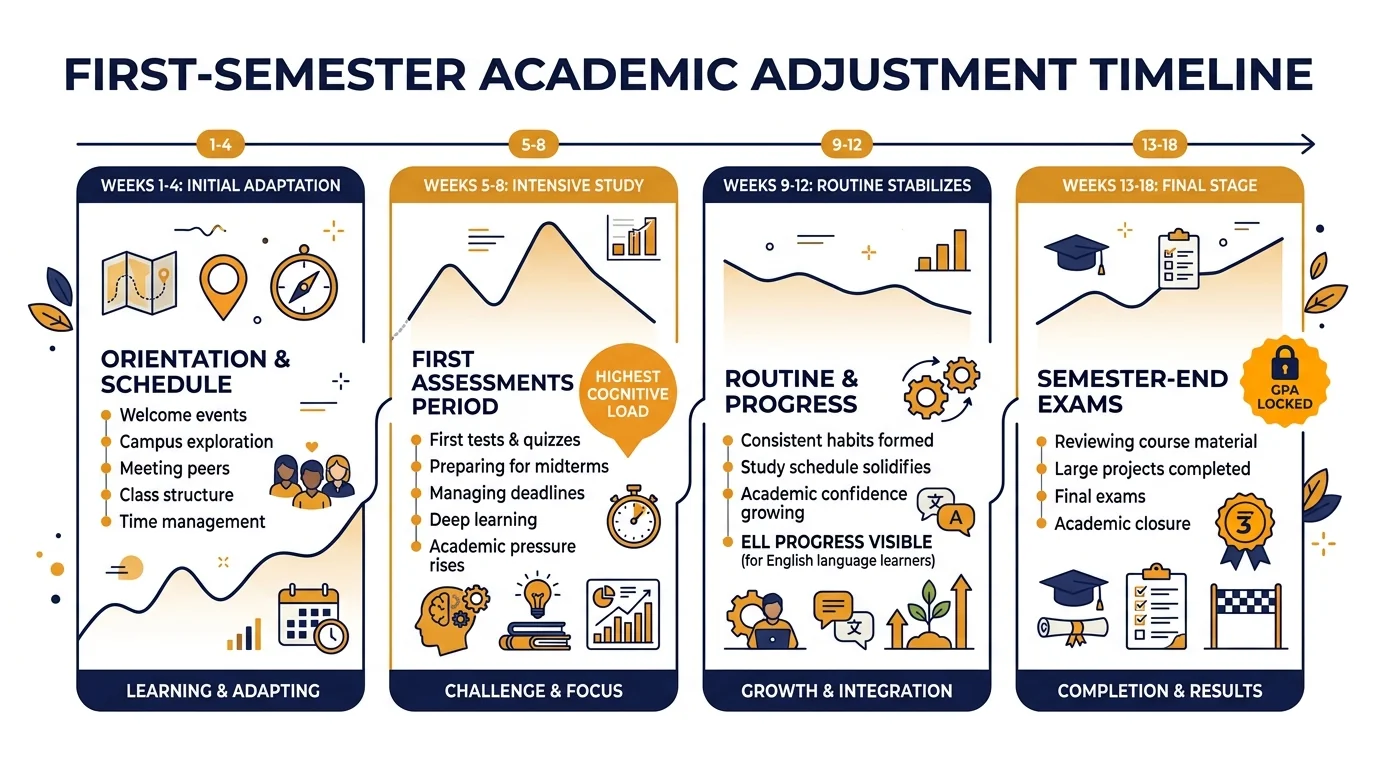
- Culture shock is normal and time-limited: The first 6-8 weeks are most disorienting. Students stabilize after the first major assessment period, when routines and peer relationships form.
- Families receive monthly updates throughout: Amerigo shares monthly progress reports, school activity calendars and event announcements with families at every stage.
What Happens During the First Week of School?
The first week at a US high school is structured. Students receive their class schedule, meet teachers and counselors, and tour campus. At Amerigo Signature Schools, this includes a welcome session with the on-campus international department covering school rules, residence or homestay expectations, and emergency contacts.
The pre-departure 1:1 call with each student's academic director - covering transcript review, course planning, and registration - means students arrive with their schedule discussed rather than navigating it cold. The on-campus team confirms placements during the first week and adjusts where needed.
- Welcome session: On-campus international department introduces school rules, contacts, and daily logistics on or before day one.
- Schedule confirmation: Course placements are reviewed and adjusted based on English proficiency and academic background.
- Residence or homestay setup: Students in off-campus or on-campus residences meet house staff and learn daily routines. Homestay students meet their host family and settle in.
- SEVIS update: F-1 (student visa) compliance requires SEVIS (Student and Exchange Visitor Information System) records to be updated with current address and contact details on arrival.
How Does the US High School Schedule Work?
US high school runs on a semester system (two terms) or trimester system (three terms). Classes are credit-based - students earn credit hours toward graduation each semester. GPA is calculated on a 4.0 scale with letter grades (A, B, C, D, F) each grading period. The first semester GPA appears on the transcript sent to US universities.
According to NAIS (2024), international students at US private high schools take five to seven courses per semester, with one or more English support courses in the first year. The academic day runs approximately 7:30am-3:00pm, with extracurriculars and study hours in the afternoon.
- Credit hours: Each course earns a set number of credits per semester. Graduation requires accumulating the school's minimum credit total across all four years.
- GPA calculation: A (4.0), B (3.0), C (2.0), D (1.0), F (0). Weighted GPA adds points for AP (Advanced Placement) and Honors courses.
- AP and Honors tracks: Students who qualify move into AP or Honors sections, which carry higher GPA weight and signal academic strength on university applications.
What Academic Challenges Should You Expect?
The academic shift to US high school involves three simultaneous transitions: language, grading culture, and classroom participation. According to APA (2024), students managing language acquisition alongside a new academic system experience higher cognitive load in the first semester than at any later point. The adjustment is real, measurable, and temporary.
ELL courses are built into each Signature School schedule for students below B2 proficiency, running alongside core subjects to build academic vocabulary, writing structure, and reading comprehension. Subject-specific tutoring is available for additional support, though it may involve extra costs.
- Classroom participation: US teachers expect verbal contribution. Waiting to be called on is less common than in many Asian and Latin American systems. Students are graded on participation in many courses.
- Written assignments: Essays, lab reports, and research papers require academic English writing from the first semester. The on-campus international department provides writing support.
- Academic integrity rules: Plagiarism and collaboration policies are stricter than in many home-country systems. Schools enforce these from day one with consequences that affect GPA and school standing.
How Do You Build Friendships as a New Student?
Building friendships in the first semester requires more effort than in a student's home country. US high school social life centers on activities - sports teams, clubs, arts programs, and school events - rather than class proximity. Students who join one activity in the first two weeks form friendships faster than those who wait.
Amerigo hosts its own social events for students and their friends separate from school-organized activities, providing a lower-pressure setting for international students to connect across schools and backgrounds.
- Join one club or team in week one: Sports tryouts, drama, robotics, Model UN, and student government all recruit in the first two weeks. Joining gives a ready-made peer group and a weekly routine.
- Use the residence as a social base: Off-campus and on-campus residences create community through shared meals, study hours, and common areas. Residence students have a built-in peer network from day one.
- Attend Amerigo social events: These events connect students across the Amerigo network in a low-pressure setting outside of school performance expectations.
- Engage with the host family: For homestay students, the host family is both a social and cultural resource. Shared meals and local outings accelerate cultural adjustment.
What Should You Expect Emotionally?
The emotional arc of the first semester follows a predictable pattern. The first two weeks often feel exciting - novelty and new people create energy. Weeks three through eight bring the adjustment dip: homesickness, language fatigue, social isolation, and academic pressure converge. Most students stabilize after the first major exam period, when routine replaces uncertainty.
Amerigo provides native-language communication for families from China, Vietnam, Korea, Mexico, and the Taiwan Region through in-country staff who communicate before and after key events. Monthly progress reports, school activity calendars and event announcements give families a structured picture of the first semester, so support happens proactively rather than reactively.
Students at US Signature Schools have access to Life360 or Reach - parent-accessible location apps - giving families real-time awareness during the early weeks. The 24/7 Amerigo emergency line is always available for welfare concerns.
How Does Amerigo Support You in the First Semester?
Amerigo's first-semester support runs through the on-campus international department at each US Signature School, which coordinates academic monitoring, welfare check-ins, and parent communication simultaneously. Students meet with Amerigo academic counselors to track GPA trajectory, plan coursework, and identify ELL or subject-specific gaps early.
In-residence students receive homework help during structured study hours, with Amerigo staff in dedicated study areas. Homestay students access the same support through the on-campus office. The student accommodations model - off-campus residences, on-campus residences, homestay, and self-provided options - connects all four accommodation types to the same academic support infrastructure.
Frequently Asked Questions
What happens in the first week at an Amerigo partner school?
The first week includes school orientation covering class schedules, campus logistics, and teacher introductions. The on-campus international department holds a welcome session covering house rules, emergency contacts, and residence or homestay setup. Students confirm course placements with the Amerigo team and update SEVIS records on arrival. Most students attend their first classes within two to three days of arriving on campus.
How is the US high school GPA system different from other countries?
The US GPA (Grade Point Average) uses a 4.0 scale tied to letter grades: A (4.0), B (3.0), C (2.0), D (1.0), F (0). GPA is calculated each semester and carries directly into university applications from year one. AP and Honors courses carry additional GPA weight. Students from percentage or ranking systems often find the letter-grade format forgiving at B level but strict at D and F.
Do international students at Amerigo schools take ELL classes?
Yes. Students who arrive below B2 English proficiency are placed in ELL (English Language Learning) courses integrated into their regular schedule alongside core subjects. ELL courses focus on academic writing, reading comprehension, and subject-specific vocabulary. As English proficiency improves, students transition into standard or Honors-track courses. The on-campus international department tracks this progression as part of each student's academic planning.
What is the biggest academic adjustment in the first semester?
Classroom participation is consistently the most unexpected adjustment for international students, particularly from China, Korea, Vietnam, and other systems where silent attentiveness is the norm. US teachers expect regular verbal contribution and grade it. Academic writing in English is the second major adjustment. ELL courses and the on-campus international department begin addressing both adjustments from the first semester onward.
How long does homesickness last for international high school students?
Most students experience the sharpest homesickness between weeks three and eight of the first semester - after initial novelty fades and before peer relationships have formed. Homesickness typically reduces significantly after the first major exam period, when routine stabilizes. Amerigo's monthly progress reports, school activity calendars and event announcements help families stay engaged, which reduces the isolation that intensifies homesickness.
Can parents track their child's location during the first semester?
Students at US Signature Schools have access to Life360 or Reach - parent-accessible location apps - so families can monitor their child's location in real time. The 24/7 Amerigo emergency line is available for welfare concerns at any hour. In-country staff communicate with families from China, Vietnam, Korea, Mexico, and the Taiwan Region in their native language before and after key events.
How many hours per day do students study in Amerigo residences?
Structured study hours are built into the Amerigo residence schedule, with Amerigo staff available in dedicated study areas during these periods. Exact hours vary by school and residence, but students should expect a daily structured study block in the afternoon or evening on school days. Homestay students access academic support through the on-campus international department office rather than in-residence study hours.
What social activities are available to international students in the first semester?
School-organized activities - sports teams, clubs, arts programs, student government - begin recruiting in the first two weeks. Amerigo also hosts its own social events for students and their friends separate from school-organized activities, connecting students across the Amerigo network in a lower-pressure setting. Residence students have daily social contact through shared meals and common areas. Homestay students also connect through host family routines.
What do monthly progress reports include?
Monthly progress reports, school activity calendars and event announcements are sent to families throughout the program. Progress reports cover academic standing, attendance, and any concerns identified by the school or Amerigo team. Activity calendars and event announcements give families visibility into what their student is experiencing week to week, so that families stay engaged without relying on student self-reporting.
How does Amerigo help if a student is struggling academically in semester one?
The on-campus international department monitors GPA trajectory from the first grading period. If a student is at risk, the team schedules counselor meetings, adjusts course placements where possible, and connects the student to subject-specific tutoring. Real-time outreach to parents happens when updates require immediate attention. Early identification is the primary tool - structured study hours, monthly reporting, and academic check-ins are designed to catch issues in week two, not week twelve.
Conclusion
The first semester at a US high school combines academic, social, and emotional adjustment simultaneously. Knowing the GPA system, classroom participation norms, and social structure in advance reduces the uncertainty that makes the first weeks hardest. Amerigo's on-campus international department coordinates orientation, academic monitoring, and family communication throughout, giving students and parents structured support from day one.
Start Your First Semester at an Amerigo School
To learn more about studying in America at an Amerigo partner school, contact us to speak with a program advisor, or apply now to take the first step toward enrollment.
People Also Read
- First Year in America: Month-by-Month Timeline for International High School Students
- How to Overcome Culture Shock: A Guide for International High School Students Ages 14-18
- How US Classrooms Differ from Home: What International Students Don't Expect
About the Author
This guide was written by the Amerigo Education content team, drawing on program data from staff operating the on-campus international department at 40 Niche A+/A rated US, Canadian, and UK partner schools. Learn more about Amerigo Education.
Disclaimer: This article provides general information for educational purposes only. Families should conduct independent research, request current program data from providers, and consult with program representatives regarding specific circumstances. Contact us with questions.