All news
April 20, 2026
Study Abroad 101
How to Talk to Your Teenager About Studying Abroad
How to talk to your teenager about studying abroad: when to start the conversation, how to handle resistance, discussing accommodation and costs together, and Amerigo's family support model.

Last Updated: April 2026
How to talk to your teenager about studying abroad is a question that more families face each year as international high school programs expand. Talking to your teenager about studying abroad means having a structured, honest series of conversations that address both the academic opportunity and the emotional realities of living away from home at ages 14 to 18. According to IIE Open Doors (2025), international student enrollment at US secondary schools has grown consistently year over year, reflecting a global shift in how families approach pre-university education. But the decision to study abroad must involve the student meaningfully, not just be presented to them as a plan already made.
Amerigo Education partners with 40 Niche A+/A rated schools across the US, Canada, and the UK, supporting 3,500+ students from 55+ countries. The Class of 2025 achieved 97% admission to Top 100 US universities. For families in earlier conversations about whether to study abroad, Amerigo offers pre-departure planning webinars and advisor consultations that parents and students can attend together, making the decision process a shared experience from the start.
Key Takeaways
- Decision timing: Starting the study abroad conversation 12 to 18 months before the intended enrollment date gives families time for research, visits, and student questions.
- Student involvement: Research from the American Psychological Association (APA, 2024) shows that adolescents who feel ownership over major decisions show stronger commitment and resilience when challenges arise.
- Safety visibility: Amerigo uses Life360 or Reach safety technology, giving parents real-time location tracking and reducing a common source of parental anxiety.
- Monthly reports: Families receive monthly progress reports for all students, residential and homestay, keeping parents informed throughout the program.
- Accommodation choice: Students and parents choose together from four accommodation options, each with different structures and support levels.
When Should You Start the Conversation?
The conversation about studying abroad should begin at least 12 to 18 months before the intended enrollment date. This timeline allows students to process the idea gradually, ask questions across multiple conversations, and participate in the research phase rather than arriving at a decision that feels handed to them. According to the American Psychological Association (APA, 2024), adolescents who feel a sense of ownership over major life decisions show significantly higher motivation and resilience when they encounter challenges.
Starting early also creates space for practical steps like test preparation, school research, and family visits to potential host schools. Many families who approach the conversation too late, for example two to three months before departure, report more student anxiety and more parental conflict because there is no time for the student to mentally prepare. See Why High School Is the Best Time to Study Abroad: The Science Behind Ages 14-18 for research on why the adolescent years are particularly well-suited to this experience.
| Conversation Stage | Timing | What to Cover |
|---|---|---|
| First introduction | 18+ months before departure | What studying abroad means, general options |
| Research phase | 12-15 months before | Specific schools, countries, program features |
| Decision conversations | 9-12 months before | Student preferences, concerns, financial reality |
| Logistics phase | 6-9 months before | Visa, accommodation, departure planning |
| Pre-departure | 1-3 months before | Emotional preparation, packing, communication plan |
How Do You Raise the Topic Without Pressure?
Raising the topic of studying abroad without pressure requires framing it as an exploration rather than a decision. Start by asking your teenager what they know about international high school programs, then share information about what the experience involves before presenting any specific schools or programs. This gives the student a chance to form their own initial reaction based on facts rather than a sense that a conclusion has already been reached.
Language matters in these early conversations. Phrases like "we are thinking about this as an option for you" or "we want to understand how you feel about this" invite participation. Phrases like "you are going to study abroad next year" close down the conversation before it begins. Research from SEVP/ICE notes that F-1 (student visa for academic programs) applications require a student's genuine intent to study, and students who feel agency in their decision generally demonstrate stronger intent throughout the visa and enrollment process.
- Share information about what studying abroad means before asking for a reaction
- Ask open questions rather than yes/no questions in the first conversation
- Give the student time to research independently before the next discussion
- Watch videos or read program materials together as a shared activity
- Acknowledge that feeling nervous is normal and expected, not a sign it is the wrong choice
- Avoid comparing your teenager to siblings or peers who have studied abroad
- Let the student's questions guide subsequent conversations
- Be honest about financial and timeline realities from the start
What Are the Most Common Teenager Concerns?
The most common concerns teenagers express about studying abroad include missing friends and family, uncertainty about language barriers, worry about academic difficulty in a new system, and fear of not fitting in socially. These concerns are realistic and should be treated as such rather than dismissed. Parents who acknowledge these concerns directly and provide specific, honest answers build more trust than parents who say "you will be fine" without addressing the specifics.
For families whose students are worried about English proficiency, Amerigo's in-school customized ELL (English Language Learning) courses provide language support from arrival. The Class of 2025 data shows that 96% of students who entered with B1-level English still achieved Top 100 university admission, and 83% of low-B1 entrants achieved the same. For students worried about safety, Life360 or Reach safety technology gives parents real-time location visibility, and 24/7 emergency assistance is available to all students in Amerigo residential programs. See How to Overcome Culture Shock: A Guide for International High School Students Ages 14-18 for student-facing guidance on adjustment.
| Common Concern | Honest Response | Amerigo Support |
|---|---|---|
| Missing family | Video calls, monthly reports shared with parents | Monthly reports, native-language support |
| Language barriers | ELL courses from day one | In-school customized ELL courses |
| Academic difficulty | Academic support and counseling available | On-campus international department |
| Social isolation | Structured social events and peer community | Amerigo social events separate from school |
| Safety | 24/7 emergency assistance and location technology | Life360 or Reach, 24/7 staff in residences |
How Do You Discuss Accommodation Options Together?
Discussing accommodation with your teenager is one of the most practical and productive parts of the study abroad conversation. Amerigo offers four accommodation options, and each one suits a different student personality and family comfort level. Homestay provides cultural immersion in a local family setting and is generally more affordable, appealing to students who want a family-like environment. On- and off-campus residences offer a peer community with structured support, including 24/7 staff, in-residence homework help, structured study hours with campus staff available, and dedicated common areas for group study with teacher availability. On-campus residences are available at select partner schools with limited availability. Self-provided accommodation is available only for students with family living nearby.
Involving your teenager in this choice is important because accommodation affects daily quality of life as much as the school itself. A student who prefers independence and peer community may thrive in an off-campus residence. A student who is more introverted or wants a quieter environment might prefer homestay. Families can review the student accommodations page together to compare the four options and use this as a structured decision point in the conversation.
How Do You Talk About Financial Reality?
Talking honestly about cost is one of the most important parts of a successful study abroad conversation with your teenager. International high school programs at Amerigo partner schools start from $40,000 per year for entry-level options, with Premium Signature programs ranging from $75,000 to $110,000 or more per year. This pricing includes tuition, accommodation, on-campus international department support, university counseling, and 24/7 emergency assistance. Travel, personal expenses, and health insurance are not included and vary by student and location.
When sharing these costs with your teenager, connect the financial investment to the outcome data. The Class of 2025 achieved 97% Top 100 university admission and 100% overall university acceptance. Amerigo's Top 100 Guarantee offers eligible students a refund of up to $50,000 USD if they do not gain Top 100 university admission, provided they complete two consecutive years of enrollment at a US Signature School, maintain a cumulative GPA (Grade Point Average) of 3.2 or above, achieve TOEFL 85 or higher, and complete at least one AP (Advanced Placement), IB, or Honors course. Presenting both the cost and the guarantee together gives students a clear picture of the financial structure and the program's commitment to outcomes. Visit How Much Does It Cost to Study Abroad in High School? Complete 2026 Cost Breakdown for a detailed breakdown families can review together.
How Do You Handle a Teenager Who Says No?
A teenager who says no to studying abroad in the first conversation is not necessarily refusing permanently. The initial "no" often reflects anxiety about the unknown rather than a considered rejection. Parents who respond by forcing or pressuring the decision almost always create more resistance, while parents who acknowledge the concern and keep the conversation open often find their teenager's position shifts as they learn more.
Give your teenager specific things to research independently after the first conversation. Ask them to look up what a typical school day at an Amerigo partner school looks like, what the on-campus international department does, or what previous students have said about their experience. Give this process two to four weeks before returning to the conversation. If the student has ongoing fundamental objections after multiple genuine conversations, it is worth considering whether the timing is right, since students who enroll without genuine buy-in tend to struggle with the emotional challenges of adjustment. See First Year in America: Month-by-Month Timeline for International High School Students to show your teenager what a realistic first year looks like.
How Do You Keep the Lines of Communication Open After Departure?
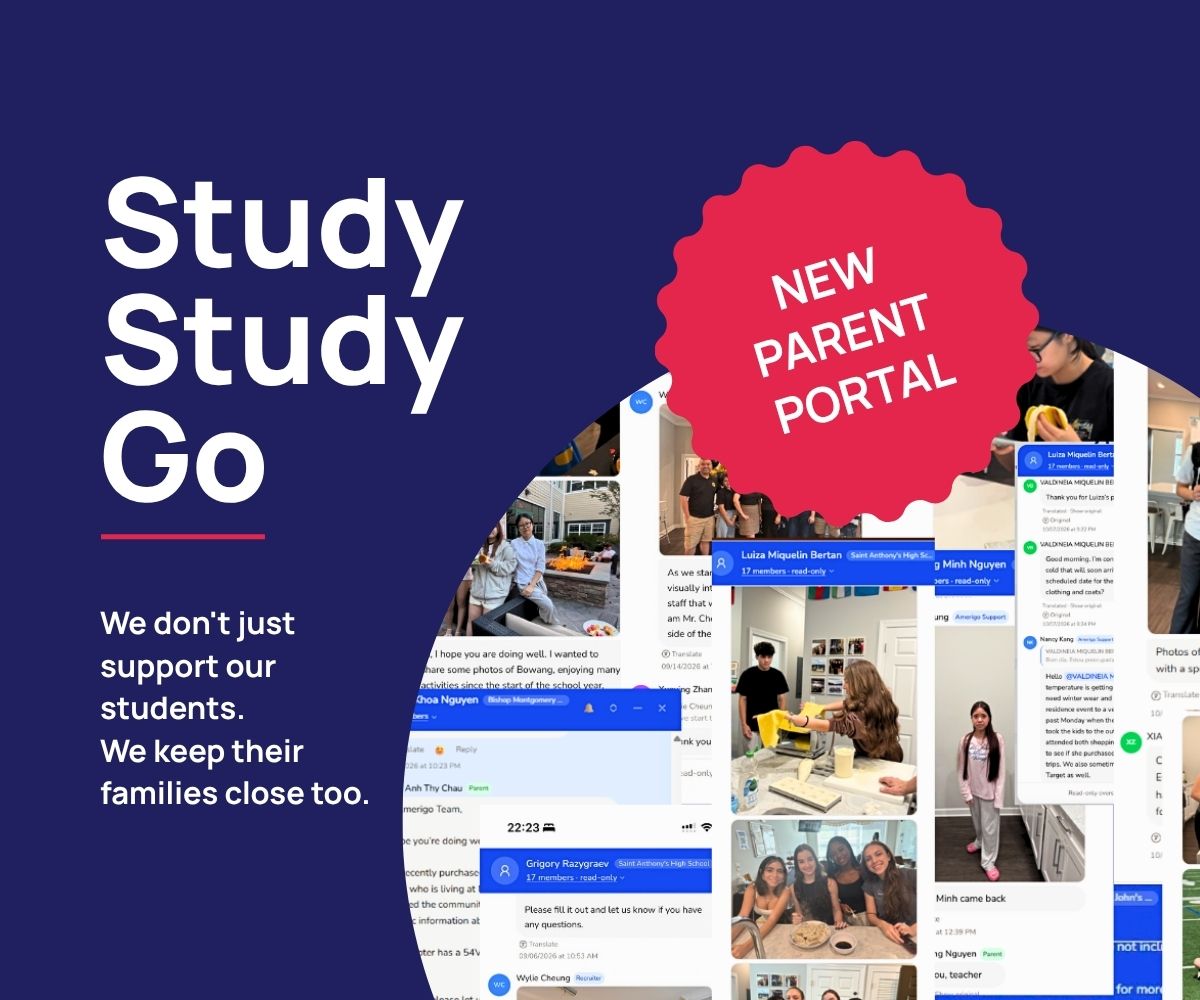
Keeping communication strong after your student departs requires a clear plan established before departure, not improvised after they leave. Families should agree on a regular communication schedule, typically video calls one to two times per week at a fixed time that works for the time zone difference. Amerigo sends monthly progress reports and school activity calendars to all families, covering academic performance and general wellbeing, giving parents a formal update channel that complements personal conversations.
Amerigo Education provides native-language communication support for families from China, Vietnam, Korea, Mexico, and the Taiwan Region, ensuring that language is not a barrier to parent-advisor communication. Safety technology including Life360 or Reach gives parents real-time location visibility, which many parents find significantly reduces day-to-day anxiety. When something requires immediate attention, Amerigo staff reach out in real time rather than waiting for the next scheduled monthly report, creating a responsive safety net alongside the regular communication structure.
Frequently Asked Questions
At what age should a teenager start studying abroad?
Most international high school programs, including Amerigo's, enroll students from Grade 9 (typically age 14 to 15) onward. Some students start in Grade 10 or 11. Earlier enrollment generally produces stronger academic and language outcomes because students have more time to build their US transcript and progress through ELL courses. However, readiness is individual. Parents should assess their teenager's emotional maturity, language base, and genuine interest before committing to a grade level and school year for enrollment.
What if my teenager is afraid of living away from home?
Fear of living away from home is one of the most common concerns teenagers raise about studying abroad, and it is a healthy sign of self-awareness rather than a reason to abandon the idea. Discuss the specific fears in detail, whether they concern food, safety, language, or loneliness, and provide concrete information about the support structures available. Amerigo's residential options include 24/7 staff, in-residence homework help, and structured social events. Monthly reports keep parents informed. Encourage your teenager to speak with current or former students through an Amerigo advisor.
How many accommodation options does Amerigo offer?
Amerigo offers four accommodation options: homestay, off-campus residences, on-campus residences at select partner schools, and self-provided accommodation for students with nearby family. Homestay provides cultural immersion and is generally more affordable. On- and off-campus residences offer a peer community with 24/7 staff, structured study hours, and in-residence homework help. No accommodation type is promoted as superior to another, and both homestay and residential models have supported students to strong outcomes. Families should discuss the options with an Amerigo advisor to find the right fit.
What do monthly reports include and how do they help parents?
Monthly progress reports sent to all Amerigo families cover academic performance including grades in each subject, assignment completion trends, and any areas flagged by teachers or counselors. For families in China, Vietnam, Korea, Mexico, and the Taiwan Region, Amerigo provides native-language communication support so parents can engage fully with the report content. When a concern requires immediate attention between scheduled reports, Amerigo staff reach out directly rather than waiting for the next monthly cycle.
How do I explain the cost of studying abroad to my teenager?
Connect the cost directly to outcomes. Amerigo partner school programs start from $40,000 per year and include tuition, accommodation, university counseling, 24/7 emergency assistance, and on-campus international department support. The Class of 2025 achieved 97% Top 100 university admission. Amerigo's Top 100 Guarantee offers a refund of up to $50,000 USD for eligible students who meet all four qualifying conditions and do not gain Top 100 admission. Presenting both the investment and the outcome data together helps teenagers understand the financial logic behind the decision.
Should both parents be involved in the study abroad conversation?
Yes, when possible. Teenagers are more likely to trust and commit to a major decision when they see both parents presenting a unified, thoughtful perspective. If one parent is more reluctant, it helps to discuss those reservations privately before including your teenager, so the family conversation can focus on the student's questions rather than unresolved adult disagreements. When both parents are informed and aligned, the teenager feels greater stability and confidence in moving forward with research and ultimately decision-making.
What if my teenager says yes but I am not ready as a parent?
Parental anxiety about a teenager studying abroad is entirely normal, especially for the first child in a family to undertake this experience. The most practical way to address that anxiety is to learn as much as possible about the specific program and support systems. Understanding how Amerigo's 24/7 emergency assistance works, how the monthly progress reports are structured, and what the safety technology covers can shift parental concern from general worry to specific, manageable questions. Contact an Amerigo advisor to ask your specific concerns directly.
How do I talk about visa requirements with my teenager?
Explain the F-1 (student visa for academic programs) visa as the formal permission required to study in the US, issued through SEVIS (Student and Exchange Visitor Information System)-certified schools. Tell your teenager that the visa process involves an interview at the US embassy or consulate where they will need to demonstrate genuine intent to study and return home after completing school. Visa support is available as an optional add-on through ZF Visa, a third-party partner, and is not handled directly by Amerigo. Review F-1 Visa Changes for High School Students 2025-2026: What Parents Need to Know together with your teenager before the visa conversation.
What is the Top 100 Guarantee and how do I explain it to my teenager?
Amerigo's Top 100 Guarantee is a formal commitment that eligible students who do not achieve Top 100 US university admission will receive a refund of up to $50,000 USD. Eligibility requires four conditions: two consecutive years of enrollment at a US Signature School, a cumulative GPA of 3.2 or above, a TOEFL score of 85 or higher, and completion of at least one AP, IB, or Honors course. Explaining this to your teenager frames studying abroad not just as an experience but as a structured academic investment with defined outcome goals and formal accountability.
How do I handle disagreements between siblings about studying abroad?
If one teenager in a family has studied abroad and another is resistant, avoid direct comparisons. Each teenager is a different person with different social needs, academic strengths, and comfort levels with independence. The fact that one sibling had a positive experience does not mean the decision is right for all children in the family at the same age or stage. Focus the conversation on the specific teenager's circumstances, interests, and concerns rather than on what worked for another family member.
Conclusion
Talking to your teenager about studying abroad is most effective when it starts early, stays honest, and keeps the student as an active participant rather than a passive recipient of a decision already made. For families considering Amerigo partner schools, the conversation benefits from real outcome data, such as 97% Top 100 university admission and 96% Top 100 admission for B1 English entrants in the Class of 2025, alongside specific information about the four accommodation options, monthly progress reports, and safety support systems. Students who feel genuinely involved in the decision tend to engage more fully with the academic support available to them once they arrive.
Start the Conversation with an Amerigo Advisor
If you are ready to take the conversation from a family discussion to a formal inquiry, contact Amerigo Education to speak with an advisor who can answer your student's specific questions alongside yours. When your family is ready to move forward together, apply to an Amerigo partner school. A single application covers multiple Niche A+/A rated schools at no extra cost, and most Signature Schools offer rolling admissions.
People Also Read
- Why Study Abroad in High School: Complete Guide 2025-2026
- How to Overcome Culture Shock: A Guide for International High School Students Ages 14-18
- First Year in America: Month-by-Month Timeline for International High School Students
About the Author
This guide was written by the Amerigo Education content team, drawing on program data from staff operating the on-campus international department at 40 Niche A+/A rated US, Canadian, and UK partner schools. Learn more about Amerigo Education.
Disclaimer: This article provides general information for educational purposes only. Families should conduct independent research, request current program data from providers, and consult with program representatives regarding specific circumstances. Contact us with questions.