All news
February 9, 2026
Study Abroad 101
How to Apply to Amerigo Education: Complete Application Process Guide 2026
Apply to Amerigo Education through rolling admissions with flexible English testing and multi-school applications. Complete guide covering documents, timeline, and enrollment. (165 chars)

Last Updated: February 2026
Applying to a US high school study abroad program involves document preparation, English proficiency testing, school selection, and visa processing. According to the Student and Exchange Visitor Program (SEVP, 2025), international students seeking F-1 (student visa for academic programs) status must secure acceptance from a SEVP-certified school before beginning the visa application. For families evaluating study abroad enrollment, understanding application timelines and requirements helps avoid delays and ensures smooth placement.
Amerigo Education, founded in 2016 and backed by Avathon Capital, operates as the on-campus international department at 40 Niche A+/A rated US and Canadian partner schools. The application process features rolling admissions at most Signature schools, flexible English testing, and the ability to apply to multiple schools through one process. With 97% Top 100 university admission for the Class of 2025, the program combines accessible enrollment with strong outcomes.
Key Takeaways
- Rolling admissions at most Signature schools allow families to apply year-round without fixed deadline constraints
- No recommendation letters required at most Signature schools, reducing administrative burden for international families
- Flexible English testing accepts Duolingo or Eltis beyond traditional TOEFL (Test of English as a Foreign Language) and IELTS (International English Language Testing System)
- Multi-school application allows applying to multiple partner schools through one process with no extra costs
- 2-4 week timeline from inquiry to acceptance when families have documentation prepared
What Documents Do Families Need to Prepare?
The application requires academic transcripts from current and previous schools covering the most recent two years, English proficiency test results, a completed application form with student and family information, passport copy for visa processing, and a recent student photograph.
Academic transcripts should include grades, course titles, grading scales, and school official stamps when possible. Request official transcripts from current schools 2-3 weeks before applying to ensure adequate processing time, as some schools have administrative delays during busy periods. Transcripts in languages other than English require certified translations, though qualified translators are accepted rather than requiring expensive official translation services. Families should ensure transcripts cover at least the most recent two years of academic work to provide a clear picture of student performance and course progression.
English proficiency testing provides flexibility through multiple accepted assessments. TOEFL iBT, IELTS Academic, Duolingo English Test, and Eltis assessments all satisfy requirements, with minimum scores varying by program level. Families in regions with limited TOEFL or IELTS testing center access benefit from Duolingo's online option, which can be completed from home with results available within 48 hours at significantly lower cost ($65 versus $200+ for traditional tests). Eltis assessments, available through educational agencies, provide specialized testing focused on study abroad readiness. Read more about English proficiency improvement.
| Test Type | Testing Location | Approximate Cost | Results Timeline |
|---|---|---|---|
| TOEFL iBT | Authorized test centers | $200–$250 | 6-10 days |
| IELTS Academic | Authorized test centers | $215–$250 | 5-7 days |
| Duolingo | Online from home | $65 | 48 hours |
| Eltis | Through agencies | Varies | Varies |
6 Steps for Document Preparation:
- Request official academic transcripts from your current school 2-3 weeks early
- Arrange certified translation if transcripts are not in English
- Register for and complete an accepted English proficiency test
- Gather a valid passport copy for F-1 visa processing
- Prepare a recent student photograph for school records
- Collect immunization and medical records if requested
How Does the Multi-School Application Work?
The multi-school application allows students to apply to multiple partner schools through one process with no additional fees. Families indicate school preferences based on location, size, program offerings, or other priorities, with admissions counselors providing guidance about which partner schools best match the student's academic level and family preferences.
This approach provides strategic advantages: families can compare different locations across the US and Canada, evaluate school sizes and campus environments, and consider program-specific offerings before making final enrollment decisions. Application review occurs centrally, coordinating with partner schools to determine placement based on academic background, English proficiency, grade level, and availability.
7 Multi-School Application Advantages:
- No extra costs for applying to multiple partner schools
- One application form serves all school options
- Compare locations across California, New York, the Midwest, and Canada
- Evaluate different school sizes and campus environments
- Receive counselor guidance matching student profile to appropriate schools
- Avoid redundant paperwork required when applying to schools independently
- Make final school selection after reviewing matched placement options
What Is the Timeline from Inquiry to Enrollment?
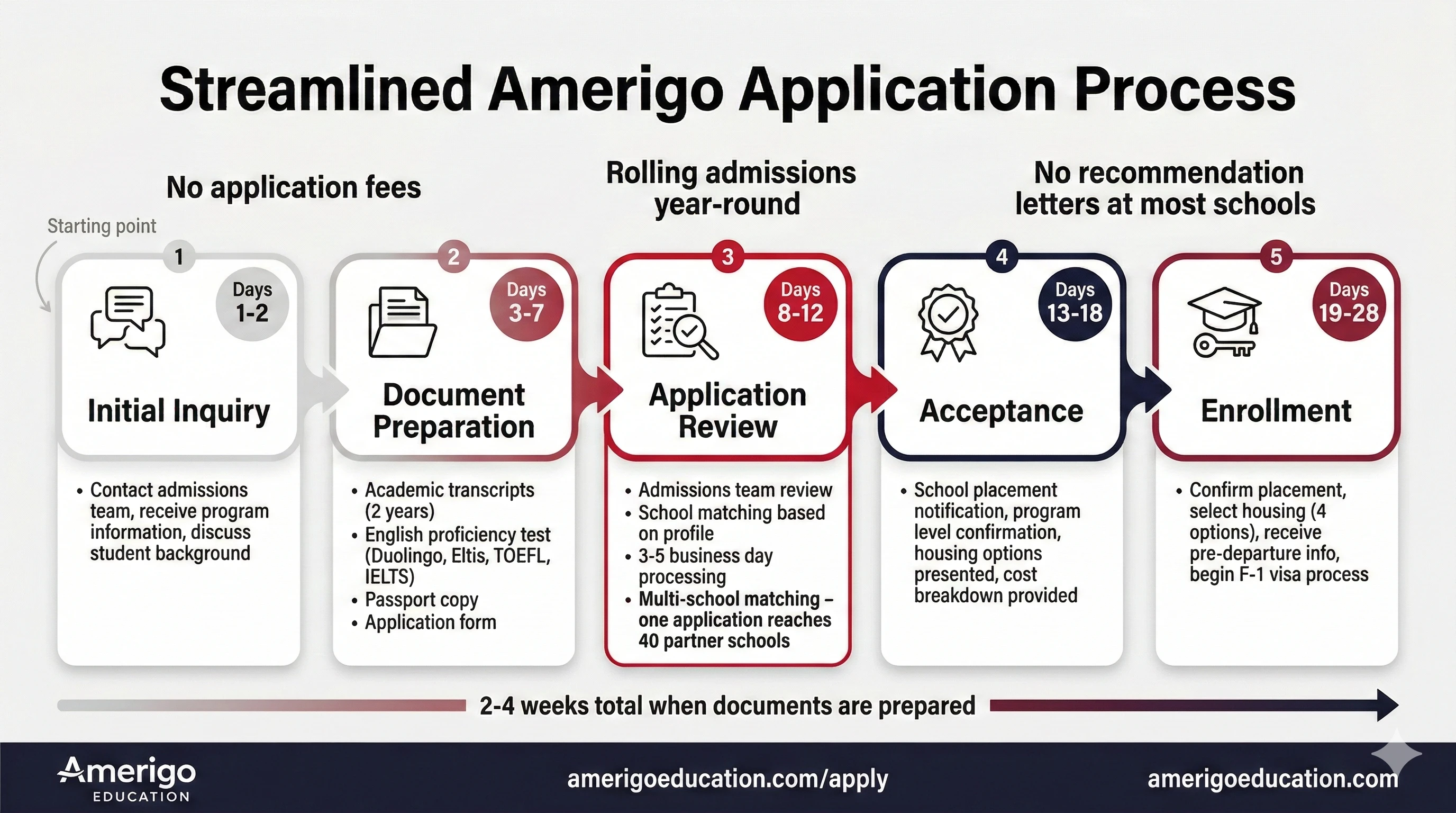
The application timeline typically spans 2-4 weeks from initial inquiry to acceptance for families with prepared documentation, moving through five stages.
Stage 1: Initial Inquiry (Days 1-2) - Families contact the admissions team through the website, educational agency referral, or direct communication. Counselors provide program information, discuss student background, and explain requirements. Initial response typically occurs within 24-48 hours.
Stage 2: Document Preparation (Days 3-7) - Families gather required materials including transcripts, English test results, passport copy, and application form. Thorough preparation at this stage prevents delays.
Stage 3: Application Review (Days 8-12) - The admissions team reviews submitted materials and coordinates school placement matching based on academic background, English proficiency level, grade level, and school availability. Complete applications receive review within 3-5 business days. The team may request additional information or clarification during this stage.
Stage 4: Acceptance (Days 13-18) - Families receive acceptance notification with matched school placement, program level confirmation, housing options, and cost breakdown.
Stage 5: Enrollment (Days 19-28) - Families confirm enrollment, select housing, receive pre-departure information, and begin the F-1 visa process through third-party visa partners (billed separately).
| Timeline Stage | Duration | Key Actions |
|---|---|---|
| Initial Inquiry | 1-2 days | Contact admissions, receive information |
| Document Preparation | 4-5 days | Gather transcripts, testing, materials |
| Application Review | 3-5 days | Admissions review, school matching |
| Acceptance | 2-3 days | Review options, select school |
| Enrollment | 5-10 days | Confirm placement, housing, begin visa |
How Do Rolling Admissions Benefit Families?
Rolling admissions at most Signature schools provide enrollment flexibility, allowing families to apply when ready rather than waiting for fixed deadlines. Applications are accepted throughout the year, enabling mid-year enrollment starting January or enrollment for the following academic year.
This approach benefits families whose timelines vary based on current school calendars (semester versus trimester systems), family relocation timelines, English proficiency development requiring additional preparation time, or financial planning requiring flexible scheduling. Families discovering the program in March can still enroll for fall semester, while families ready in October can begin January. The flexibility accommodates the reality that international families often operate on different timelines than US school calendars assume.
5 Rolling Admissions Advantages:
- Year-round applications without fixed deadline constraints
- Mid-year enrollment starting January without waiting for September
- Reduced stress through elimination of deadline pressure
- Faster review with applications processed as received
- Family-controlled timing based on student readiness
What Happens After Acceptance?
Acceptance notification includes matched school placement, program level confirmation (entry-level or Signature with Top 100 Guarantee eligibility), available housing options, program cost breakdown, and next steps. Families receive 7-10 days to review details and make final decisions.
Housing selection follows with four accommodation options: homestay with American families providing cultural immersion at typically lower cost, off-campus residences (the primary model) with single-gender arrangements and 24/7 supervision located in residential neighborhoods, on-campus residence at select schools offering campus-integrated living, or self-provided arrangements for families managing housing independently. Off-campus residences serve as the primary model, enabling access to elite day schools that do not offer boarding facilities. Learn more about accommodation options.
Visa application guidance begins after enrollment confirmation, with coordination through third-party visa service partners to support families through the F-1 student visa application. Families receive I-20 documentation from partner schools, guidance on visa interview preparation, and support organizing required financial documentation. Important: visa services are provided through third-party partners and billed separately from program tuition. Families should also budget for passport fees, F-1 visa fees ($185), health insurance, travel, and personal expenses. Learn more about study abroad costs and what is included.
Frequently Asked Questions
When should families start the application process?
Families targeting fall semester enrollment (August/September) should begin applications by June to allow adequate time for document preparation, application review, acceptance, and visa processing. Families considering spring semester (January) should apply by October. Rolling admissions accommodate later applications when visa processing timelines allow, with some families completing the entire process within 6-8 weeks.
What if transcripts are not in English?
Transcripts in other languages require certified translation. Families can use professional translation services or qualified translators providing certification of accuracy. Expensive official translation agencies are not required, making the process more accessible for families worldwide.
How long does application review take?
Complete applications receive review within 3-5 business days. Incomplete applications may take longer. Submitting thorough, complete documentation from the start ensures faster review and acceptance decisions.
Can students enroll mid-year?
Yes, rolling admissions at most Signature schools allow mid-year enrollment starting in January. Verify mid-year availability with specific partner schools as some have limited mid-year openings. January enrollment works well for students on Southern Hemisphere school calendars ending in December, students who need additional time for English preparation before starting, or families whose relocation timelines do not align with traditional fall enrollment.
What if English test scores are below requirements?
Students with scores below minimum requirements may receive conditional acceptance with additional English language support through customized ELL (English Language Learning) courses matched to their proficiency level. Structured support has enabled 83% of low-B1 English students and 96% of B1 students to achieve Top 100 university admission through academic planning and individualized language development.
How much does the application cost?
There are no application fees for initial submissions. Families pay enrollment deposits after acceptance to confirm placement. Students can apply to multiple partner schools through one process with no extra costs.
Can families visit schools before applying?
Yes, school visits are encouraged when possible, though not required. Families unable to visit can access virtual tours, video conferences with school representatives, and detailed school information through admissions counselors to make informed decisions.
What financial options are available?
Program costs range from $40,000 for entry-level to $75,000-$110,000+ for premium Signature programs. Fees typically include partner school tuition, accommodation management, on-campus support, university counseling, and emergency assistance. Limited merit-based opportunities may exist through specific partner schools. Families should discuss options with admissions counselors during initial consultation to understand total investment.
People Also Read
Study Abroad Preparation Checklist: US High School Guide 2025-2026 Complete preparation guide covering pre-departure planning, document requirements, cultural preparation, and what to expect during first weeks at American high schools.
How to Get Student Visa for US: Complete Guide 2025-2026 Step-by-step F-1 student visa application process including I-20 documentation, visa interview preparation, and required financial documentation.
When to Apply for Study Abroad: Complete Timeline Guide 2026 Strategic timing guide for study abroad applications, visa processing, and enrollment preparation ensuring adequate timeline for all required steps.
About the Author
This application guide was developed by the admissions team at Amerigo Education, with expertise in international student enrollment processes. The team supports enrollment at 40 Niche A+/A rated US and Canadian high schools, serving approximately 1,000 international students annually through streamlined application processes designed for international family needs.
Conclusion
The application process removes common barriers through rolling admissions, flexible English testing, no recommendation letter requirements at most schools, and multi-school applications through one process. The 2-4 week timeline from inquiry to acceptance enables faster enrollment when families have documentation prepared.
For families beginning the study abroad journey, starting with document preparation - requesting transcripts and completing English testing - ensures the smoothest possible experience once the application is submitted. The multi-school approach means families can explore options across 40 partner schools before committing, making the decision about where to study a choice rather than a constraint.
Take the Next Step
Families ready to begin can start the application directly or contact the admissions team to discuss student background, timeline, and school preferences. Most Signature schools offer rolling admissions with flexible English testing year-round.
This article provides general application information for educational purposes only. Requirements may change. Verify current requirements directly before beginning applications. Contact us with questions.