All news
April 17, 2026
Study Abroad 101
How Structured Study Hours Work for International Students
How structured study hours work at US high schools and Amerigo residences: study hall rules, in-residence homework help, ELL integration, and outcomes for international students.
Last Updated: April 2026
Study hall rules are the set of structured expectations and time-block policies that govern dedicated academic work sessions for students outside of class time. According to the Institute of International Education Open Doors (2025), over 1.1 million international students were enrolled in US educational institutions in the most recent reporting year, with high school enrollment growing steadily as families seek supervised academic environments. For international students adapting to a new curriculum and language, structured study hours provide the daily consistency needed to build academic habits from day one.
Amerigo Education partners with 40 Niche A+/A rated schools across the US, Canada, and the UK, supporting 3,500+ students from 55+ countries. The Class of 2025 achieved 97% admission to Top 100 US universities. Structured study hours are one of the core support mechanisms that Amerigo builds into its residential program, pairing mandatory quiet study blocks with in-residence homework help and dedicated common areas for group study with teacher availability.
Key Takeaways
- Structured study hours: Amerigo residential students have dedicated daily study blocks with campus staff available to assist.
- Academic outcomes: The Class of 2025 achieved 97% Top 100 university admission, with 96% of B1 English entrants also reaching Top 100.
- ELL support: In-school customized ELL (English Language Learning) courses help students with English at every proficiency level.
- Monthly reports: Families receive monthly progress reports covering academic performance for all students, residential and homestay.
- Evening study groups: Students can participate in evening study groups in addition to mandatory structured hour blocks.
What Are Study Hall Rules in US High Schools?
Study hall rules in US high schools are a set of behavioral and procedural guidelines that govern supervised academic time outside regular class periods. Students are typically required to work silently or quietly, remain seated, bring assigned work or reading materials, and direct questions only to the supervising adult. These sessions are designed to create distraction-free time for homework completion, test preparation, and independent reading.
Rules vary by school and program. Some schools enforce strict silence policies, while others permit quiet collaboration on group assignments in designated areas. According to the National Association of Secondary School Principals (NASSP, 2024), structured in-school study periods are linked to improved assignment completion rates and reduced after-hours academic stress for students who live away from family.
| Study Hall Component | Typical Rule | Purpose |
|---|---|---|
| Noise level | Silent or low whisper | Focus and concentration |
| Device use | Permitted for school tasks only | Academic work, not social media |
| Movement | Limited, with supervisor permission | Minimize disruption |
| Materials | Assignment or textbook required | Productive use of time |
| Questions | Directed to supervisor only | Maintain order |
How Do Amerigo Residences Structure Study Time?
Amerigo's off-campus residences include structured study hours with campus staff available each evening. Students in Amerigo's residential program have access to dedicated common areas for group study with teacher availability, allowing them to ask subject-specific questions during the session. In-residence homework help is available for all residential students, meaning a student working through a chemistry problem set or an English essay can get support without waiting until the next school day.
Evening study groups give students an additional layer of peer-based learning. These are separate from mandatory study blocks and allow small groups to work through difficult material together under supervision. This combination of structure and peer collaboration reflects research from the American Psychological Association (APA, 2023) showing that consistent study routines significantly improve academic retention for adolescents aged 14 to 18.
- Evening mandatory quiet study blocks in residence common areas
- In-residence homework help from staff
- Dedicated common areas for group study with teacher availability
- Evening study groups for peer-based learning
- Individualized academic planning sessions with Amerigo counselors
- Subject-specific tutoring available (additional costs may apply)
- Access to the on-campus international department office during school hours
What Accommodation Options Come with Study Support?
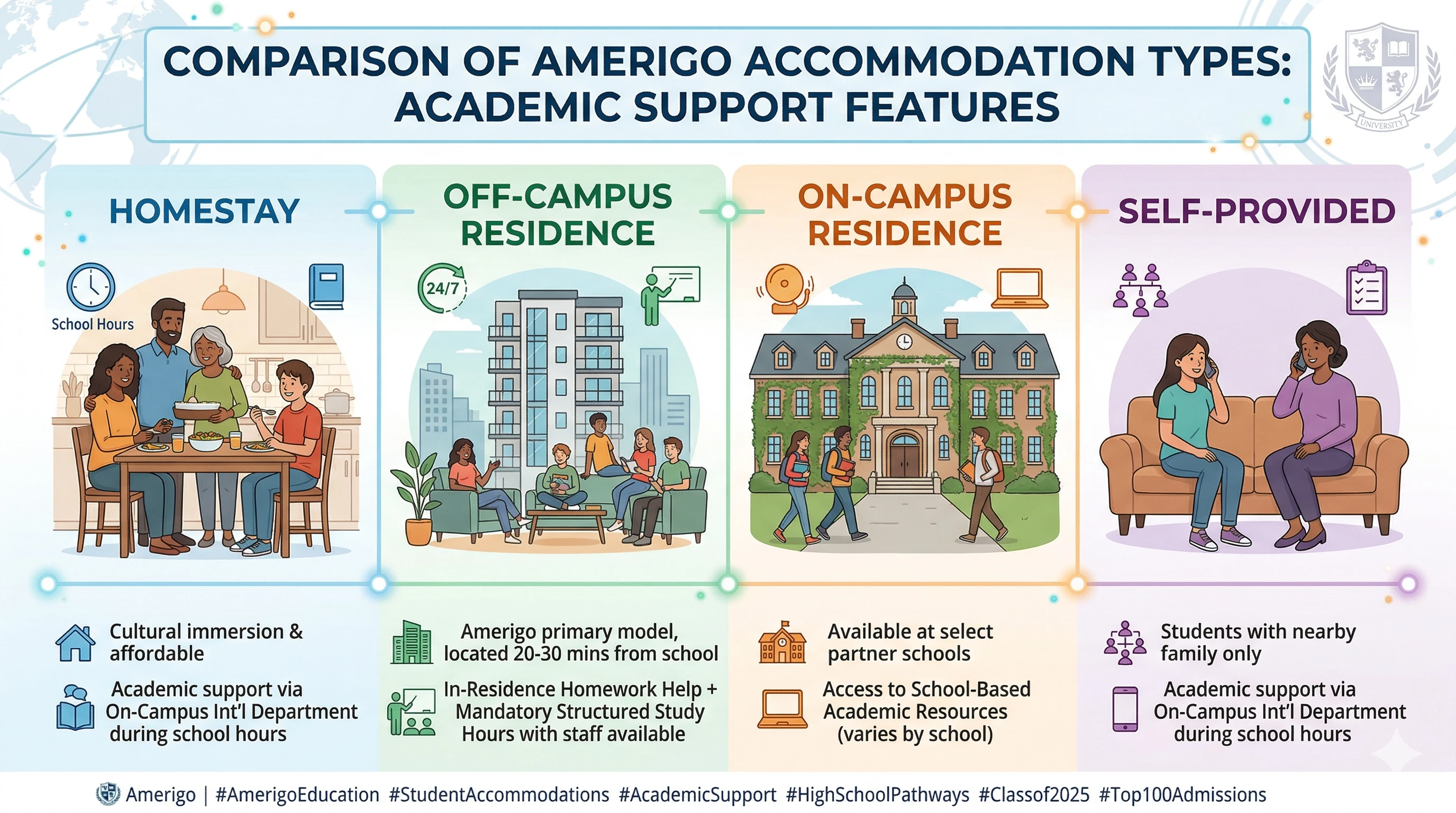
Amerigo offers four accommodation options, each with its own academic support features. Homestay families provide cultural immersion and a more affordable experience, with academic support available through the on-campus international department during school hours. Off-campus residences are located 20 to 30 minutes from partner schools, are single-gender, and have 24/7 staff along with dedicated study areas with teacher availability. On-campus residences are available at select partner schools with limited availability. Self-provided accommodation is available only for students living with nearby family.
Both homestay and residential students are covered by Amerigo's academic monitoring system. Monthly progress reports go to families for all students, regardless of accommodation type. When something requires immediate attention, Amerigo staff reach out in real time rather than waiting for the next scheduled report. For more details on accommodation, visit Amerigo's student accommodations page.
| Accommodation Type | Study Support Feature | Staff Availability |
|---|---|---|
| Homestay | On-campus international department access | School hours |
| Off-campus residence | In-residence homework help + study hours | 24/7 |
| On-campus residence | School-based support (select schools) | 24/7 |
| Self-provided | On-campus international department access | School hours |
How Do Structured Study Hours Affect University Outcomes?
Consistent academic habits formed during structured study periods have a measurable effect on university admission results. The Class of 2025 achieved 100% university acceptance and 97% Top 100 admission. Among students who entered with B1-level English proficiency (roughly conversational but below academic fluency), 96% still achieved Top 100 university admission. For students who entered with low-B1 English, the figure was 83%, showing that structured academic support, including study hall frameworks, helps close the gap between English proficiency and academic achievement.
Amerigo's Top 100 Guarantee formalizes this support through the Top 100 Guarantee. Eligible students who complete two consecutive years of enrollment, maintain a cumulative GPA (Grade Point Average) of 3.2 or above, achieve a TOEFL score of 85 or higher, and complete at least one AP (Advanced Placement), IB (International Baccalaureate), or Honors course are covered for a refund of up to $50,000 USD if they do not gain Top 100 admission. The Guarantee applies to US Signature Schools only.
- Structured study hours build daily academic routines from arrival
- In-residence homework help catches problems before they affect grades
- Monthly reports allow early intervention when performance dips
- Evening study groups strengthen comprehension before major assessments
- Individualized academic planning identifies the right AP or Honors pathway
- ELL courses accelerate English proficiency needed for advanced coursework
- Teacher availability in study common areas provides subject-level guidance
How Do ELL Courses Connect to Study Hall Success?
In-school customized ELL (English Language Learning) courses work alongside structured study hours to build the language skills students need to succeed in mainstream coursework. Students who arrive with B1-level English, roughly able to hold conversations but not yet fluent in academic writing or reading, use ELL courses to build vocabulary, grammar, and reading comprehension specific to their school subjects. These skills become directly applicable during structured study hour blocks when students work through assignments independently.
Amerigo Education provides native-language communication support for families from China, Vietnam, Korea, Mexico, the Taiwan Region, and more, helping parents stay informed about their student's ELL progress and academic standing. This native-language support means families can ask detailed questions about structured study time, course placement, and academic planning in their first language. Refer to Websites to Help ELL Students: Essential Digital Resources for tools students can use during self-directed study sessions.
| English Level at Arrival | ELL Course Placement | Class of 2025 Top 100 Rate |
|---|---|---|
| B1 | Customized in-school ELL | 96% |
| Low-B1 | Intensive ELL track | 83% |
| Above B1 | Mainstream with targeted support | Part of 97% overall |
How Do Parents Stay Informed About Study Progress?
Amerigo sends monthly progress reports to families covering academic performance for all students, whether they live in a residence or a homestay. These reports give parents a clear picture of grades, assignment completion, and teacher feedback. When a concern arises between scheduled reports, Amerigo staff reach out in real time rather than waiting.
Parents also receive school activity calendars and event announcements, which include information about study schedules and academic events. Safety technology, including Life360 or Reach, allows parents to monitor their student's location on a daily basis, adding a further layer of visibility alongside the academic reporting system. See International Student Support Services: Complete Guide 2026 for a full breakdown of Amerigo's parent communication tools.
Frequently Asked Questions
What are typical study hall rules at US high schools?
Study hall rules at US high schools generally require students to work quietly, bring academic materials, avoid social media use on personal devices, and direct questions to a supervisor rather than talking to peers. Some schools permit collaborative work in designated areas. Rules are enforced by a teacher, staff member, or administrator supervising the session. Specific policies vary by school and grade level, so students should review their school's student handbook for exact expectations.
Do Amerigo residential students have mandatory study hours?
Yes. Amerigo's off-campus residences include structured study hours each evening with campus staff available. Students are expected to use this time for homework, reading, and test preparation. The structured block is separate from optional evening study groups, where small groups work through challenging material together. Both mechanisms are designed to support consistent academic performance and help students meet the demands of Niche A+/A rated US and Canadian partner school curricula.
Can homestay students access study support too?
Yes. Homestay students have access to academic support through the on-campus international department office at their partner school during school hours. They can schedule meetings with Amerigo academic counselors, receive individualized academic planning guidance, and access subject-specific tutoring (additional costs may apply). Monthly progress reports are sent to homestay families as well, covering academic performance and flagging any areas that need attention.
What is ELL and how does it help during study hours?
ELL stands for English Language Learning. In-school customized ELL courses are designed to build the vocabulary, grammar, and reading comprehension that international students need to succeed in mainstream subjects. During structured study hours, students apply these ELL-developed skills to complete assignments independently. Students who entered the program at B1 proficiency in the Class of 2025 achieved a 96% Top 100 university admission rate, demonstrating that ELL support, combined with structured study time, produces strong academic outcomes.
How many accommodation options does Amerigo offer?
Amerigo offers four accommodation options: homestay, off-campus residences, on-campus residences at select partner schools, and self-provided accommodation for students with nearby family. Each comes with a different academic support structure. Off-campus residences offer 24/7 staff and in-residence homework help. Homestay students access support through the on-campus international department. Families should discuss which option best fits their student's learning style and support needs with an Amerigo advisor.
Are study groups the same as structured study hours?
No. Structured study hours are mandatory supervised blocks built into the daily residence schedule, requiring students to work quietly on academic tasks. Evening study groups are separate and voluntary, designed for peer collaboration on challenging subjects under staff supervision. Students who attend both benefit from individual focus during the structured block and collaborative problem-solving during study groups, building different academic skills that complement each other.
How do monthly reports help families track study progress?
Monthly reports give families a documented picture of their student's academic performance, including grades, assignment completion rates, and teacher feedback. For families from China, Vietnam, Korea, Mexico, the Taiwan Region, and more, Amerigo provides native-language communication support so parents can fully understand the report content and ask questions. When an issue requires immediate attention, Amerigo contacts families in real time rather than waiting for the next monthly cycle.
What is the Top 100 Guarantee and how does study time relate?
Amerigo's Top 100 Guarantee offers a refund of up to $50,000 USD to eligible students who do not gain admission to a Top 100 US university. To qualify, students must complete two consecutive years of enrollment at a US Signature School, maintain a cumulative GPA of 3.2 or above, achieve TOEFL 85 or higher, and complete at least one AP, IB, or Honors course. Consistent use of structured study hours, in-residence homework help, and individualized academic planning directly supports students in meeting these four requirements.
Can students get subject-specific tutoring during study hours?
Subject-specific tutoring is available as part of Amerigo's support model, though additional costs may apply depending on the subject and frequency of sessions. During structured study hours, students can ask questions of the supervising campus staff. Dedicated common areas for group study with teacher availability also allow for subject-level guidance. For more intensive support, students can schedule tutoring sessions separately through their on-campus international department.
Do structured study hours apply to students at all Amerigo schools?
Structured study hours with campus staff available are a feature of Amerigo's residential program at its partner schools across the US and Canada. Students living in on- and off-campus residences have access to this structure. Brentwood School in the UK operates through Brentwood's established boarding program with university counseling support from Amerigo, and its specific residential policies follow Brentwood's framework. Families considering any campus should confirm the exact daily schedule with an Amerigo advisor.
Conclusion
Study hall rules provide the daily academic framework that international high school students need to build strong habits in an unfamiliar academic environment. Amerigo's residential program structures this support through mandatory evening study blocks, in-residence homework help, dedicated common areas with teacher availability, and evening study groups, all monitored through monthly progress reports to families. The Class of 2025 results, including 97% Top 100 admission and 96% Top 100 admission for B1 English entrants, reflect the cumulative impact of structured academic support over the course of a student's program.
Start Your Application to an Amerigo Partner School
If you are ready to enroll your student in a program that includes structured academic support from arrival, contact Amerigo Education to speak with an advisor about the right school and accommodation fit. When you are ready to move forward, you can apply directly online. Amerigo accepts a single application for multiple partner schools at no extra cost, and most Signature Schools have rolling admissions.
People Also Read
- International Student Support Services: Complete Guide 2026
- Student Support Services Best Practices Guide
- Boarding School vs Day School for International Students: Complete Comparison Guide 2026
About the Author
This guide was written by the Amerigo Education content team, drawing on program data from staff operating the on-campus international department at 40 Niche A+/A rated US, Canadian, and UK partner schools. Learn more about Amerigo Education.
Disclaimer: This article provides general information for educational purposes only. Families should conduct independent research, request current program data from providers, and consult with program representatives regarding specific circumstances. Contact us with questions.