All news
April 12, 2026
Study Abroad 101
How International Students Ask for Recommendation Letters
How international students request strong college recommendation letters: who to ask, when to ask, brag sheets, platform submission, and how Amerigo counselors coordinate the process.
How International Students Ask for Recommendation Letters
Last Updated: April 2026
Asking for a letter of recommendation is the process by which a student formally requests a teacher, counselor, or mentor to write a written endorsement supporting their college application. According to the National Association for College Admission Counseling (NACAC, 2024), recommendation letters remain one of the most cited qualitative factors in US university admissions decisions, particularly for selective institutions. For international students studying in the US on an F-1 (student visa for academic programs), building relationships with teachers who can write a strong letter is an important part of the application process.
Amerigo Education partners with 40 Niche A+/A rated schools across the US, Canada, and the UK, supporting 3,500+ students from 55+ countries. The Class of 2025 achieved 97% admission to Top 100 US universities. Amerigo's on-campus international department counselors help students identify appropriate recommenders, prepare supporting materials, and coordinate submission through platforms such as the Common Application, all while keeping families updated through monthly progress reports.
Key Takeaways
- Recommendation value: NACAC (2024) identifies recommendation letters as a significant qualitative factor at selective US universities.
- Who to ask: US-based teachers who know the student's academic work from junior or senior year are the strongest candidates.
- Timeline: Students should ask at least 6-8 weeks before the earliest application deadline.
- Class of 2025 results: 97% of Amerigo students gained Top 100 university admission, reflecting the quality of academic preparation at partner schools.
- Amerigo partner schools: Most Signature schools do not require recommendation letters for enrollment, but university applications through the Common App typically require one to three.
What Makes a Recommendation Letter Strong?
A strong recommendation letter is specific, evidence-based, and written by someone who has observed the student's academic performance and personal qualities in a classroom or advisory setting. Generic letters that describe a student in broad positive terms carry less weight than letters that cite particular assignments, projects, or growth moments that illustrate real capability. Admissions reviewers at selective universities read hundreds of letters per application cycle and can distinguish between a letter written from genuine knowledge of a student and one written to meet an obligation.
For international students, an ideal letter also addresses language development and intellectual persistence. Admissions reviewers at Top 100 universities understand that non-native English speakers face an additional challenge, and a teacher who can speak to how a student progressed from ELL (English Language Learning) support to independent academic performance tells a meaningful story. According to IIE Open Doors (2025), over 1.1 million international students studied in the US in the 2023-2024 academic year, and selective universities have become experienced at contextualizing international academic records.
Characteristics of a strong recommendation letter include:
- Written by a teacher who taught the student recently, ideally in Grade 11 or 12
- Describes specific classroom contributions or assignments
- Notes intellectual curiosity, persistence, or problem-solving ability
- Addresses language growth or cross-cultural adaptability where relevant
- Compares the student favorably to peers the teacher has taught over time
- Is submitted on official school letterhead or through the Common App recommender system
- Avoids vague praise without supporting examples
- Is free of grammatical errors and written with professional tone
Who Should International Students Ask for a Recommendation?
International students should ask teachers who know them well from academic courses taken in junior or senior year. Subject teachers in core areas such as English, history, science, or mathematics are most commonly preferred by US universities. A school counselor recommendation is typically required in addition to teacher letters through the Common App platform, and the counselor letter serves a different purpose than a teacher letter - it contextualizes the student's overall academic trajectory and explains the school environment rather than focusing on one course.
Students at Amerigo's partner schools benefit from small class sizes and direct faculty contact at Niche A+/A rated institutions, which helps build the kind of teacher relationships that produce strong letters. Students who participate in AP (Advanced Placement) courses or dual enrollment classes have natural opportunities to demonstrate academic depth that recommenders can describe in detail.
Recommended sources for recommendation letters:
- A core subject teacher (English, math, science, history) from Grade 11 or 12
- An AP or Honors course teacher who has seen the student's analytical writing
- A school counselor who knows the student's academic and personal growth
- An ELL instructor who can describe language progression, if relevant
- A faculty advisor for an extracurricular activity with academic components
How Should Students Ask for a Recommendation?
Students should ask for a recommendation in person before sending any platform invitation or formal request. A direct conversation gives the teacher context for the request, allows the student to express interest in having that specific person write the letter, and gives the teacher a natural opportunity to agree or to honestly indicate they may not know the student well enough. Asking in person also signals respect for the teacher's time, which is more likely to generate a thoughtful response than an unexpected digital invitation sent without prior notice.
After receiving a verbal agreement, students should follow up in writing with a summary document that includes key accomplishments, course highlights, extracurricular involvement, and the universities being applied to. Amerigo's on-campus international department advisors often help students draft these summary materials, called a "brag sheet" or student resume, to share with recommenders. Giving recommenders everything they need to write a specific, detailed letter increases the quality of the final recommendation.
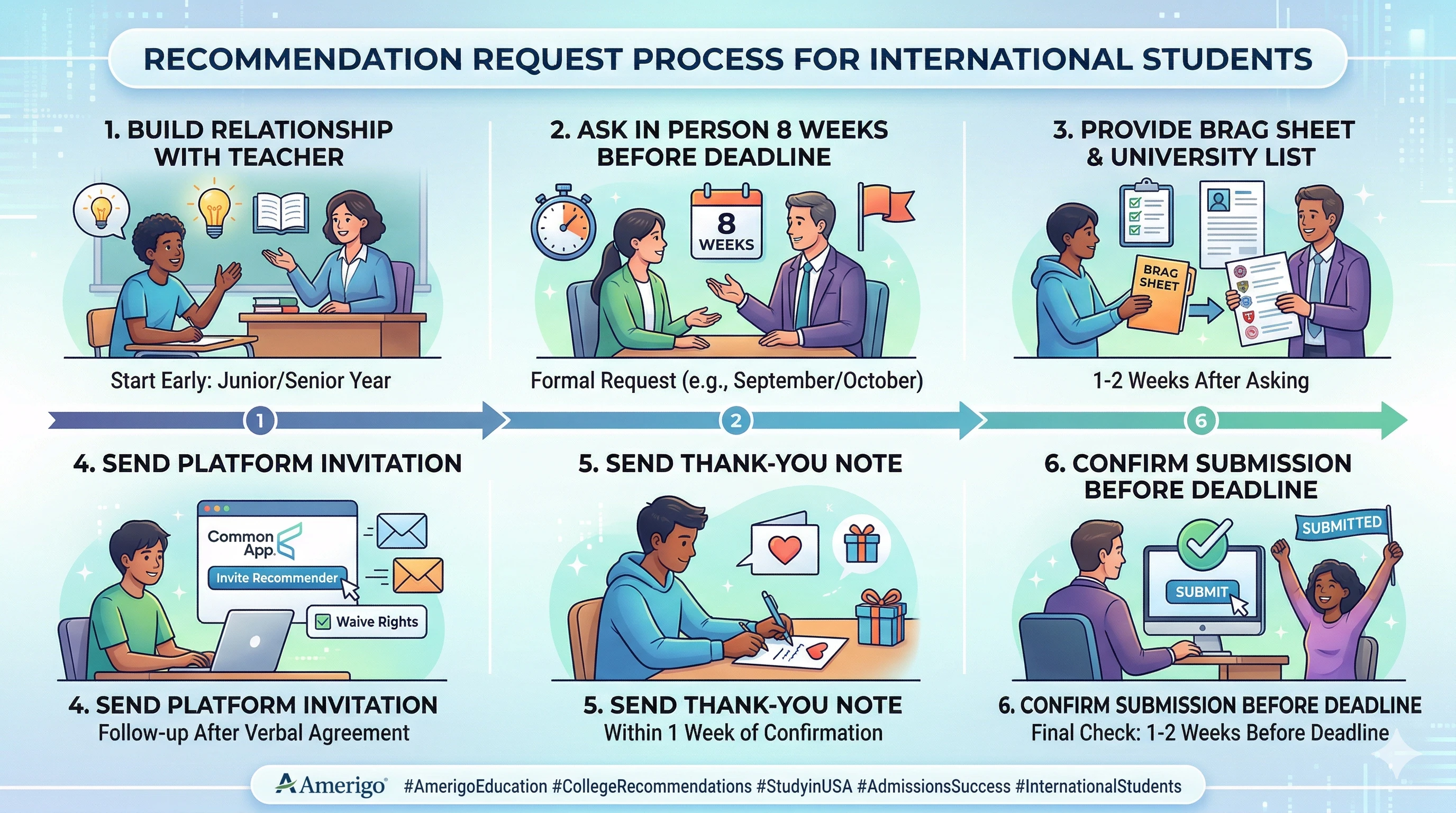
Steps for asking a teacher for a recommendation:
- Choose your recommender based on relationship strength and course relevance
- Request a brief conversation during office hours or after class
- Explain why you are asking that specific teacher, referencing a shared experience
- Give the teacher at least 6-8 weeks before the earliest deadline
- Provide a written summary of your accomplishments and application goals
- Include your list of schools and deadlines in the summary document
- Send the formal invitation through the Common App or the relevant platform
- Waive your right to view the letter (strongly advisable)
- Follow up politely one week before the deadline if no confirmation has been received
- Send a thank-you note after the letter is submitted
What Should Students Include in the Brag Sheet?
The brag sheet is a one-to-two page document that students give their recommenders to help them write a detailed, accurate letter. It outlines the student's academic achievements, class contributions, extracurricular activities, personal background, and application plans. A well-prepared brag sheet saves the teacher time and increases the chance that the letter includes concrete, memorable details that appear nowhere else in the application, such as a specific class discussion, a project outcome, or a moment of persistence that the teacher witnessed firsthand.
For international students, the brag sheet is also a chance to highlight language and cultural milestones that a teacher may not have fully tracked. A student from China, Vietnam, Korea, Mexico, or the Taiwan Region who has progressed from foundational English to AP-level coursework has a meaningful story to share. Amerigo Education provides native-language communication support for families from China, Vietnam, Korea, Mexico, the Taiwan Region, and more, which can help students articulate their journey clearly when preparing these documents.
Key items to include in the brag sheet:
- Full legal name and preferred name
- List of courses taken with that teacher and grades earned
- Specific class moments, projects, or discussions the student remembers
- Extracurricular activities and any leadership roles
- Awards, academic honors, or recognition received
- Language background and any ELL program participation
- Personal challenge or growth moment the student is proud of
- University list and application deadlines
- Intended field of study or career direction
- Any GPA or test score context useful for framing the letter
How Do Platform Submissions Work for Recommendation Letters?
Most US university applications process recommendation letters through the Common Application recommender system, Scoir, or a university's own application portal. Once a student enters a recommender's email address on the platform, that person receives an invitation to create an account and submit their letter directly. The student cannot access or view the submitted letter after waiving review rights, which is why selecting the right recommenders and providing them with thorough supporting materials before sending the invitation is more important than following up after submission.
Students applying through the Common App should confirm that their school counselor has been assigned as their counselor in the platform's school forms section. At Amerigo's Signature campuses, school counselors coordinate directly with the on-campus international department to ensure all application components align. Families who want to track overall progress can expect monthly reports from Amerigo staff, with real-time outreach if any deadline or document issue requires immediate attention.
What Are Common Mistakes When Requesting Recommendations?
The most common mistakes international students make when requesting recommendations include asking too late, selecting teachers who do not know them well, and failing to provide supporting materials. These errors often result in generic letters that do not add meaningful context to the rest of the application file, and at selective universities where every part of the application is evaluated together, a weak letter from a teacher who barely knows the student can undercut an otherwise strong academic record.
A second frequent mistake is asking too many people. Two to three strong letters from teachers who know the student well are more effective than four to five letters from recommenders who provide only surface-level praise. Students should also confirm with each university whether additional letters beyond the required number are welcomed or discouraged.
Common mistakes and how to avoid them:
- Asking a teacher less than four weeks before the deadline
- Selecting a teacher from freshman year who has had no recent contact with the student
- Not providing a brag sheet, leaving the recommender without supporting details
- Asking a teacher to write for too many schools in the same cycle
- Sending the platform invitation before having an in-person conversation
- Forgetting to follow up if no confirmation is received before the deadline
- Not thanking the recommender after submission
Frequently Asked Questions
How many recommendation letters do US universities require?
Most US universities require one school counselor letter and one to two teacher letters. Selective institutions often request two teacher letters plus the counselor form. International students applying through the Common Application should check the "Additional Information" section on each school's profile, as requirements vary. Submitting more letters than requested is generally not encouraged unless the university explicitly invites additional materials.
When is the right time to ask for a recommendation?
Students should ask for a recommendation at least 6-8 weeks before the earliest application deadline. For Early Decision or Early Action deadlines in November, this means asking at the start of the school year in September. Giving recommenders adequate time increases the likelihood of a thoughtful, specific letter rather than a rushed response written at the last minute.
Can a teacher write a recommendation in a language other than English?
Most US universities require all application materials, including recommendation letters, to be submitted in English. If a recommender is more comfortable writing in another language, a certified English translation must accompany the original letter. Students should clarify this requirement with each university and communicate it clearly to the recommender before the letter is drafted.
Should international students waive their right to see the letter?
Yes, international students should waive their right to see the recommendation letter when given the option on the Common App or other platforms. Admissions reviewers place more trust in letters written without the applicant's future access. Most counselors advise waiving this right as a standard practice, and many universities implicitly expect it.
What if a teacher declines to write a recommendation?
If a teacher declines, thank them for their honesty and ask a different teacher. A declined request is not a negative reflection on the student - it may simply mean the teacher does not feel they know the student well enough to write a strong letter. It is better to ask early enough to seek an alternative than to receive a weak letter from an uncomfortable recommender.
Do Amerigo partner schools require recommendation letters for enrollment?
Most Amerigo Signature partner schools do not require recommendation letters for enrollment. This makes the admissions process more accessible for international students who have not yet established relationships with English-speaking teachers. However, when applying to US universities through the Common App after enrollment, students will need to develop those teacher relationships and submit recommendation letters as part of the university application.
How should students thank a teacher after a recommendation is submitted?
Students should send a written thank-you note or email within a few days of confirmation that the letter was submitted. The message should acknowledge the time the teacher invested, reference something specific about the teacher's impact on the student's academic development, and update the teacher on application outcomes once decisions are received. Expressing genuine gratitude also maintains the relationship for future reference needs.
Can a parent or family member write a recommendation?
No, parents, family members, and private tutors hired by the family are not acceptable sources for academic recommendation letters in US university applications. Letters must come from individuals who know the student in an educational context - teachers, school counselors, or in some cases academic program directors. Admissions reviewers can typically identify non-academic sources, and submitting one may raise concerns about the application.
What is the difference between a counselor and a teacher recommendation?
A counselor recommendation covers the student's overall academic record, personal character, and school context. A teacher recommendation focuses specifically on the student's performance in that teacher's course. Most universities require both types because they serve different purposes. The counselor letter provides broad context, while teacher letters provide subject-specific academic evidence of the student's potential.
How do international students build relationships with teachers for recommendations?
International students build strong teacher relationships by participating actively in class discussions, attending office hours, asking substantive questions about course material, and completing assignments at a high level. Students who join academic clubs, ask teachers for feedback on drafts, or take on leadership in group projects give teachers concrete experiences to write about. Starting this relationship-building process in Grade 10 or 11 gives students enough time to develop strong connections before senior year applications begin.
Conclusion
Asking for a strong college recommendation letter requires planning, relationship-building, and clear communication with teachers and counselors well before application deadlines arrive. International students who take time to build genuine connections with faculty at US high schools, prepare thorough supporting materials, and follow proper request procedures are positioned to receive letters that meaningfully strengthen their university applications. The process rewards students who engage consistently with their academic environment from the beginning of their US high school experience.
Build Your University Application Foundation With Amerigo
Amerigo Education supports international students through every stage of the university application process, including recommendation letter preparation, essay advising, and university list building. Contact Amerigo Education to speak with an advisor, or visit our application page to start the enrollment process. Amerigo students at Signature schools receive individualized university counseling that begins well before senior year, giving them time to develop the relationships needed for strong letters of recommendation.
People Also Read
- Do International Students Have an Advantage Applying to US Universities from American High Schools?
- Study Abroad Application Tips: Your Complete Guide for High School Students
- International Student Counselling: Complete Guide 2026
About the Author
This guide was written by the Amerigo Education content team, drawing on program data from staff operating the on-campus international department at 40 Niche A+/A rated US, Canadian, and UK partner schools. Learn more about Amerigo Education.
Disclaimer: This article provides general information for educational purposes only. Families should conduct independent research, request current program data from providers, and consult with program representatives regarding specific circumstances. Contact us with questions.