All news
May 16, 2026
Study Abroad 101
F-1 Visa Appointment Wait Times at Beijing, Seoul, HCMC, Mexico City, and Taipei: 2026
F-1 visa appointment wait times at Beijing, Seoul, HCMC, Mexico City, and Taipei: what families should expect in 2026 and how to plan around peak-season delays.

Last Updated: May 2026
F-1 visa appointment wait times at US consulates measure the days between submitting a visa application and the scheduled interview date. These timelines vary by consulate location, time of year, and application volume - and for families enrolling in US high school programs, they are one of the most operationally critical elements of the enrollment timeline. According to IIE Open Doors (2024), over 1.1 million international students are enrolled at US colleges and universities, with students from China, South Korea, Vietnam, Mexico, and the Taiwan Region representing a significant share of new F-1 (student visa for US academic programs) applications each year.
Amerigo Education partners with 40 Niche A+/A rated schools (independent academic rankings based on school-reported curriculum quality, faculty credentials, student outcomes, and college matriculation data) across the US, Canada, and the UK, supporting 3,500+ students from 55+ countries. The Class of 2025 achieved 97% admission to Top 100 US universities. Amerigo's in-country staff and optional visa support partnership with ZF Visa - Amerigo's third-party visa support partner that provides F-1 (US student visa) application assistance to students at Amerigo's US Signature Schools - a network of partner schools in the United States where Amerigo provides dedicated on-campus international support, including residential accommodation, an on-campus international department, university counseling, and the Top 100 Guarantee - a refund of up to $50,000 USD in senior year tuition fees for US Signature School students who complete two consecutive years of enrollment, maintain a cumulative GPA of 3.2 or higher, achieve a TOEFL score of 85 or above, complete at least one AP, IB, or Honors course, and apply to Top 100 US universities but do not gain admission for eligible students, including DS-160 preparation, interview coaching, and document review. ZF Visa supports F-1 applications only and does not cover UK Student Visa applications to help families from China, South Korea, Vietnam, Mexico, and the Taiwan Region navigate the F-1 application process, including appointment booking during high-volume periods.
This guide covers how F-1 appointment wait times work at the five consulates most relevant to Amerigo families, what seasonal patterns to expect, and how to plan the enrollment timeline around these windows.
Key Takeaways
- Wait times are consulate-specific: Beijing and Ho Chi Minh City historically see the longest F-1 appointment waits, while Seoul and Taipei tend to move faster - though all consulates see summer surges.
- I-20 triggers the clock: SEVIS (Student and Exchange Visitor Information System) registration and I-20 issuance must happen before the F-1 application is submitted - families cannot begin the formal process before enrollment is confirmed.
- 365-day rule: US consulates cannot issue an F-1 visa more than 365 days before the program start date on the I-20.
- Peak season is May-August: Application volumes surge as students prepare for fall enrollment, adding weeks to appointment wait windows at all five consulates.
- Amerigo's optional visa support: ZF Visa, Amerigo's third-party partner, assists with F-1 applications for US programs only - never for UK Student Visa applications.
Why Do F-1 Appointment Wait Times Vary?
F-1 appointment wait times are driven by consulate staffing levels, application volume, and seasonal demand. A consulate serving tens of thousands of student visa applicants annually will process requests more slowly than one serving a smaller pool. According to NACAC (2024), visa timeline is consistently cited by international families as one of the top logistical concerns when planning US high school enrollment.
SEVP requires an active SEVIS record and valid I-20 before the DS-160 form (online nonimmigrant visa application) is submitted. This means families cannot begin timing their consulate appointment until after school acceptance and I-20 issuance - which follows the enrollment deposit.
- Seasonal demand: Summer (May-August) is the peak F-1 season globally. Slots fill weeks earlier than off-peak periods. Families targeting August starts should begin scheduling well in advance.
- Administrative processing: After an approved interview, passport return with the visa stamp takes an additional 3-10 business days depending on the consulate and courier system.
- Visa entry window: SEVP rules limit US entry to 30 days before the program start date on the I-20 - the approved visa does not authorize early arrival.
What Are Beijing F-1 Appointment Wait Times?
The US Embassy in Beijing and its five consulates across China (Shanghai, Guangzhou, Chengdu, Shenyang, and Wuhan) process among the highest volumes of F-1 applications globally. Chinese students represent approximately 50% of Amerigo's enrolled students, making the Beijing consulate network the most operationally significant location for F-1 planning in Amerigo's family base.
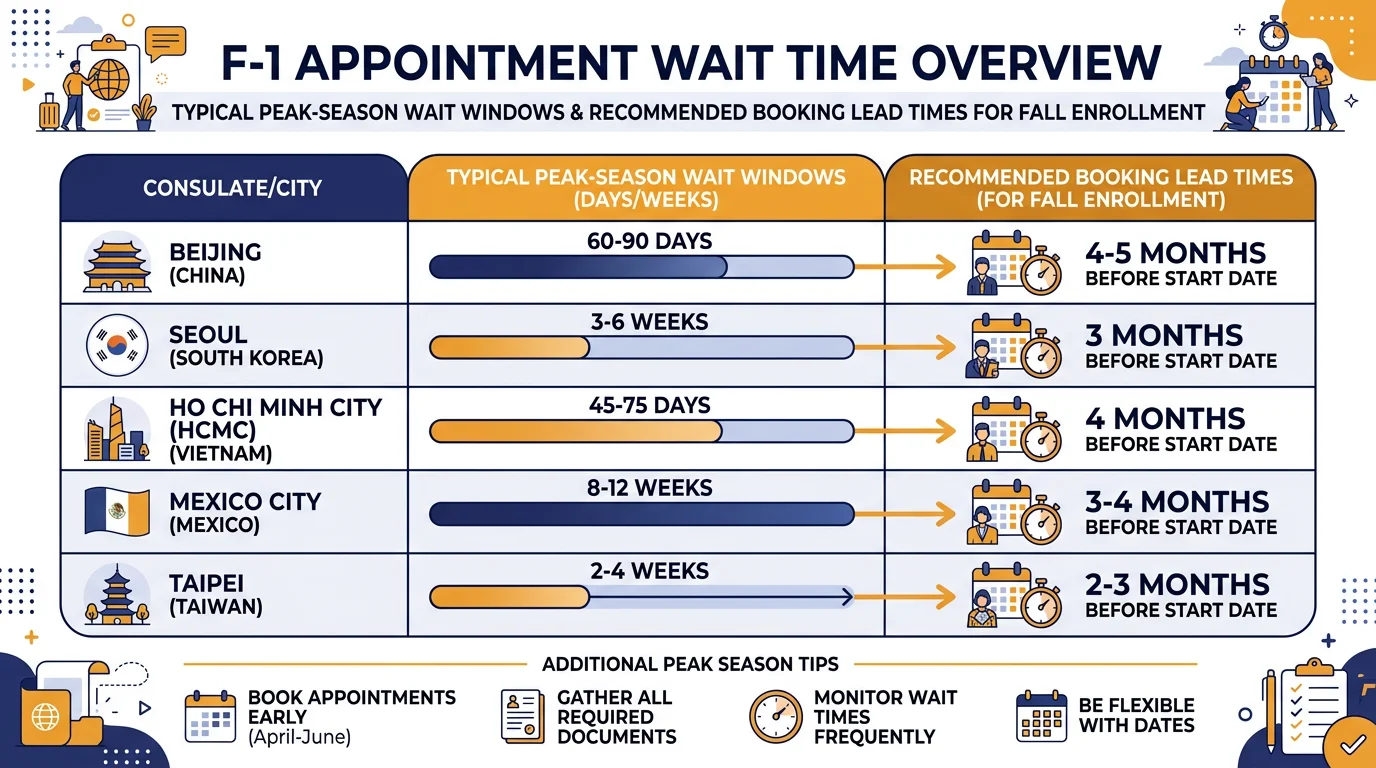
Peak summer wait times at Chinese consulates routinely push appointment slots 6-12 weeks out from the booking date. Families targeting August or September program starts should complete I-20 issuance and book their appointment by April or May at the latest.
- Multiple consulate options: Chinese families can book at any US consulate in China. Shenyang and Chengdu sometimes carry shorter waits than Beijing or Shanghai during peak season.
- WeChat coordination: Amerigo's in-country staff in China communicate with families via WeChat during visa preparation, clarifying document requirements in Mandarin.
- Document checklist: I-20, DS-160 confirmation, SEVIS fee receipt, financial documentation, and school acceptance letter are all required at the interview.
How Long Is Seoul's F-1 Appointment Wait?
The US Embassy in Seoul processes F-1 visa applications for South Korean students, one of Amerigo's primary enrollment markets. South Korean applicants generally experience shorter wait times than applicants at Beijing or Ho Chi Minh City, but summer peaks still compress availability meaningfully.
According to NAIS (2024), Korean families applying to US independent school programs who begin visa preparation at least 9 months before their target start date achieve significantly higher enrollment consistency. Wait times in Seoul during peak season typically add 3-6 weeks to the appointment booking window.
- Interview waiver: Some repeat F-1 applicants in South Korea may qualify for the Interview Waiver Program. First-time applicants under 18 are generally required to attend in person - confirm current requirements at travel.state.gov.
- Processing time: Post-interview passport return in Seoul typically runs 3-5 business days under normal conditions.
What F-1 Wait Times Apply in HCMC and Mexico City?
Ho Chi Minh City and Mexico City are two of Amerigo's most active enrollment markets outside East Asia. Both consulates handle substantial F-1 volumes but operate in different seasonal contexts.
The US Consulate General in Ho Chi Minh City serves Vietnam's F-1 student population. Peak summer wait times at HCMC can extend to 8-14 weeks, making early planning critical for families targeting August program starts. Amerigo's in-country staff in Vietnam communicate with families in Vietnamese ahead of key enrollment milestones.
The US Embassy in Mexico City and its consulate network serve Mexican F-1 applicants. Wait times in Mexico City tend to be somewhat shorter than Beijing or HCMC during peak season, typically 3-8 weeks, though this varies year to year. Families should plan booking windows 2-4 months ahead of intended departure for fall starts.
- HCMC documents: I-20, DS-160, SEVIS fee receipt, financial proof, and acceptance letter are required. Vietnamese-language support is available through Amerigo's in-country team.
- Mexico City network: Applicants can use any US consulate in Mexico - Guadalajara and Monterrey sometimes offer shorter wait windows than Mexico City during peak periods.
What Is the Taipei F-1 Appointment Wait?
F-1 visa applications from students in the Taiwan Region are processed through AIT (the US government's designated visa-processing office in Taipei), which handles US nonimmigrant visa applications under the same standards as formal US embassies. The full F-1 interview requirement applies for first-time student applicants through AIT.
Wait times at AIT Taipei are generally more manageable than at high-volume consulates, but summer peaks still affect availability. Students from the Taiwan Region targeting August or September program starts should aim to book by June at the latest to avoid compressed timelines.
- Same standards: AIT operates under standard US government visa procedures. Document requirements and interview format are identical to those at US embassies worldwide.
- Language support: Amerigo's in-country staff provide native-language communication support for families from the Taiwan Region, helping coordinate documentation timelines before the AIT appointment.
- Document checklist: I-20, DS-160, SEVIS fee receipt, financial documentation, and passport valid for at least 6 months beyond the intended stay are all required.
How Should Families Plan Around F-1 Wait Times?
Building the F-1 application timeline backward from the program start date is the most reliable method for avoiding visa-related delays. For a September 2026 program start, families should aim to have the I-20 issued by April, appointment booked by May at high-volume consulates, and all documents prepared before the interview date.
Families who begin the F-1 process immediately after receiving the I-20 give themselves the widest booking window. Amerigo's optional visa support through ZF Visa assists eligible families with F-1 preparation for US programs. The on-campus international department - a dedicated team at each US Signature School consisting of a Director of Campus Operations, Academic Director, Senior Campus Coordinators, Campus Coordinators, and an ELL teacher, who provide daily academic support, residential supervision, university counseling, and welfare oversight for enrolled international students supports students after arrival. Families can compare school options at find-your-school before finalizing enrollment.
- Step 1 - enrollment deposit: Confirm school placement to trigger I-20 issuance.
- Step 2 - SEVIS fee: Pay the I-901 fee immediately after receiving the I-20 and keep the confirmation receipt.
- Step 3 - DS-160: Complete the online visa application and save the confirmation barcode.
- Step 4 - book appointment: Book the consulate appointment as soon as the DS-160 is submitted - do not wait.
Frequently Asked Questions
When should families start the F-1 visa process?
Families should begin immediately after the school issues the I-20. For fall enrollment, completing enrollment by March or April allows sufficient time at high-volume consulates. At Beijing and Ho Chi Minh City, booking appointments 3-4 months before the program start date is a reasonable minimum. Families working through Amerigo's optional visa support partner ZF Visa receive guidance on timing specific to their consulate.
Can families choose which consulate to use for the F-1 interview?
Generally, F-1 applicants apply at a US embassy or consulate in their country of residence. In China, families can choose among six locations - Beijing, Shanghai, Guangzhou, Chengdu, Shenyang, and Wuhan. Mexican families can use any consulate in Mexico. For HCMC, the Consulate General handles Vietnamese applicants. Confirming current booking rules at travel.state.gov before scheduling is recommended as policies may change.
What documents are needed for an F-1 interview?
Required documents include: valid passport (6 months beyond the program stay), I-20 issued by the school, DS-160 confirmation page, SEVIS I-901 fee receipt, proof of financial support, and school acceptance letter. For minor applicants, parents may be required to attend. Document requirements can vary by consulate - confirm the specific checklist with the consulate's official page well before the appointment date.
What is the SEVIS fee and when is it paid?
The SEVIS (Student and Exchange Visitor Information System) fee is a mandatory payment required before the F-1 visa interview. It is paid via the SEVP portal at fmjfee.com after receiving the I-20. The standard fee is $350 USD. Payment must be confirmed at least three business days before the consulate interview to register in consular systems. Keep the receipt - it is required at the interview and must be presented to the visa officer.
What happens if F-1 approval is delayed beyond the start date?
Families should contact the school's DSO (Designated School Official) immediately. The DSO can issue an updated I-20 with a revised start date if the delay results from visa processing, not applicant eligibility issues. Most Amerigo partner schools work with families to adjust program start dates rather than cancel enrollment when the delay stems from consulate processing timelines outside the student's control.
Can students enter the US before the program start date?
F-1 visa holders may enter the US no more than 30 days before the program start date on the I-20. Entering earlier is not permitted under SEVP rules, and the port of entry officer verifies the I-20 start date against the travel date. Families should book flights to arrive within this window. Amerigo's Know Before You Go Guide addresses arrival timing to help students avoid entry complications at the port.
Does Amerigo provide direct F-1 visa services?
Amerigo does not provide visa services directly. Families manage the F-1 application through their home country's US consulate. Amerigo's optional add-on with ZF Visa provides third-party support for F-1 (US) applications only - not UK Student Visa applications. Families who manage the process independently can use travel.state.gov and studyinthestates.dhs.gov as primary resources.
Are summer wait times longer at all five consulates?
Yes - all five consulates see peak demand from May through August as students prepare for fall program starts. The longest surges occur at Beijing and Ho Chi Minh City, where application volumes are highest. Seoul and Taipei see moderate increases. Families should build a 3-4 month buffer between I-20 issuance and the target program start date when applying through any of these consulates during peak season.
Conclusion
F-1 appointment wait times at Beijing, Seoul, Ho Chi Minh City, Mexico City, and Taipei vary by season and consulate volume, with Beijing and HCMC typically requiring the longest lead times during peak summer periods. Families targeting fall enrollment should complete I-20 issuance and begin appointment booking by April or May to preserve the widest scheduling window.
Start Your F-1 Planning With Amerigo
To learn more about studying in America and the enrollment and visa timeline at an Amerigo partner school, contact us to speak with a program advisor, or apply now to begin the enrollment process.
People Also Read
- F-1 Visa Changes 2026: What International High School Students Need to Know
- F-1 Visa to Arrival Timeline for Students 2026
- What Documents Are Needed for Student Visa? Complete F-1 Checklist 2026
About the Author
This guide was written by the Amerigo Education content team, drawing on program data from staff operating the on-campus international department at 40 Niche A+/A rated US, Canadian, and UK partner schools. Learn more about Amerigo Education.
Disclaimer: This article provides general information for educational purposes only. Families should conduct independent research, request current program data from providers, and consult with program representatives regarding specific circumstances. Contact us with questions.