All news
May 3, 2026
Study Abroad 101
F-1 Reinstatement After a Status Violation: A High School Student's Guide
F-1 reinstatement restores status after a violation. Learn Form I-539 steps, timeline, DSO requirements, and travel restrictions for high school students.

F-1 Reinstatement After a Status Violation: A High School Student's Guide
Last Updated: May 2026
F-1 reinstatement is the USCIS (U.S. Citizenship and Immigration Services) process that allows international students to restore valid F-1 status after an unauthorized enrollment interruption, policy breach, or failure to maintain program requirements. According to SEVP, students who fall out of F-1 status are prohibited from continuing to study in the US until reinstatement is approved or they depart and re-enter on a new visa. High school students on F-1 visas face the same reinstatement requirements as university-level students, with violations arising most commonly from enrollment gaps, expired I-20 forms, and unauthorized school transfers.
Amerigo Education partners with 40 Niche A+/A rated schools (independent academic rankings based on school-reported curriculum quality, faculty credentials, student outcomes, and college matriculation data) across the US, Canada, and the UK, supporting 3,500+ students from 55+ countries. The Class of 2025 achieved 97% admission to Top 100 US universities. For students enrolled at US Signature Schools, Amerigo's on-campus international department - a dedicated team at each US Signature School consisting of a Director of Campus Operations, Academic Director, Senior Campus Coordinators, Campus Coordinators, and an ELL teacher, who provide daily academic support, residential supervision, university counseling, and welfare oversight for enrolled international students monitors F-1 status compliance, assists with DSO (Designated School Official) communications, and coordinates with the school's international student office when status issues arise.
This guide covers the most common causes of F-1 status violations for high school students, the reinstatement application process, timeline expectations, travel restrictions during processing, and how proactive school support reduces the risk of violations before they occur.
Key Takeaways
- Status violation triggers: A student loses F-1 status by failing to maintain full-time enrollment, transferring without DSO authorization, working without USCIS approval, or allowing the I-20 form to expire without renewal.
- Reinstatement path: Students must file Form I-539 with USCIS as soon as reasonably possible after the violation - delays weaken the application and reduce the likelihood of approval.
- Travel restriction: Students with a pending Form I-539 cannot travel outside the US - departure automatically terminates the reinstatement application and requires re-entry on a new F-1 visa.
- Processing time: USCIS processing for Form I-539 reinstatement requests typically ranges from 3-6 months; premium processing is not available.
- Prevention: Maintaining continuous full-time enrollment, communicating early with the DSO, and keeping SEVIS (Student and Exchange Visitor Information System) records current prevents most high school violations.
What Is F-1 Reinstatement?
F-1 reinstatement restores a student's legal status after a violation has caused it to lapse. A student is "out of status" when their F-1 activity no longer matches the terms of their I-20 form - for example, dropping below full-time enrollment without authorization or failing to transfer SEVIS records when changing schools.
Reinstatement is not an automatic process. Students must demonstrate to USCIS that the violation was due to circumstances beyond their control or that denial would result in extreme hardship. According to NAIS (2024), private secondary schools enrolling international F-1 students have significantly expanded DSO training and compliance infrastructure over the past five years in response to growing enrollment volume. The SEVIS record must be active and accurate before any reinstatement application is submitted.
Students cannot self-approve reinstatement - the application requires a DSO recommendation, complete supporting documentation, and formal USCIS approval before status is considered restored.
What Causes F-1 Status Violations?
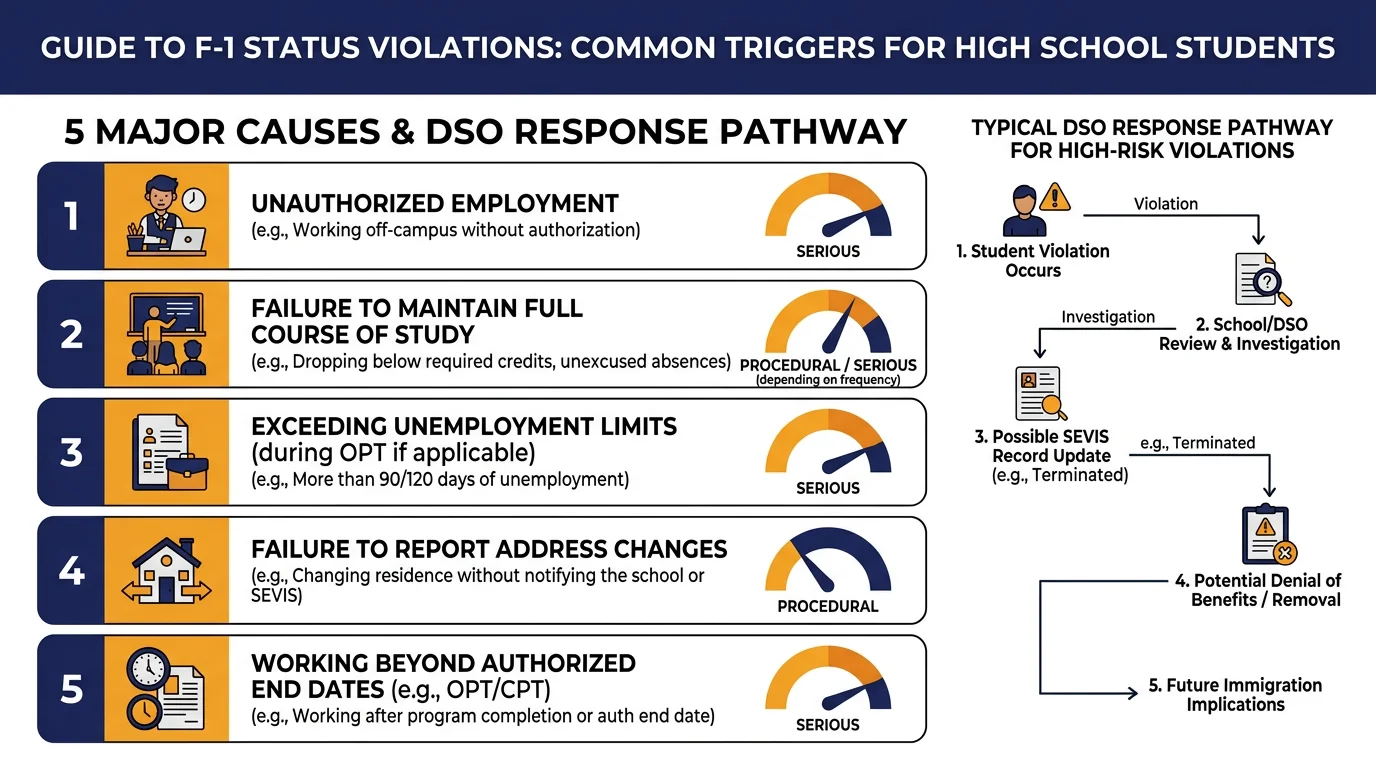
Most high school F-1 violations fall into predictable categories. Understanding the triggers helps students and families identify risk factors before they create a formal status problem.
Common causes:
- Enrollment below full-time: Missing required credits per semester without a DSO-authorized reduced course load (RCL) authorization from the school.
- Unauthorized school transfer: Moving to a new school without a SEVIS transfer release from the current DSO completed before the transfer date.
- Unauthorized employment: Accepting paid work of any kind - including informal or off-campus arrangements - without USCIS work authorization.
- Expired I-20: Failing to renew the I-20 form before the program end date listed on the document.
- Unreported address change: Not updating the SEVIS system within 10 days of a change of residential address.
According to IIE Open Doors (2024), high school international students represent a growing share of US F-1 holders, making early compliance education increasingly important for families and enrollment providers alike.
How Do You Apply for Reinstatement?
The reinstatement process begins with the student's DSO at the enrolled school. Before filing with USCIS, the DSO must create a new SEVIS record and issue a new I-20 with a reinstatement recommendation. Students then file Form I-539 with supporting documentation and the required USCIS filing fee.
Students at Amerigo's US Signature Schools - a network of partner schools in the United States where Amerigo provides dedicated on-campus international support, including residential accommodation, an on-campus international department, university counseling, and the Top 100 Guarantee - a refund of up to $50,000 USD in senior year tuition fees for US Signature School students who complete two consecutive years of enrollment, maintain a cumulative GPA of 3.2 or higher, achieve a TOEFL score of 85 or above, complete at least one AP, IB, or Honors course, and apply to Top 100 US universities but do not gain admission for eligible students can contact the on-campus international department for guidance on the correct sequence of steps before filing. Incorrect filing order - such as submitting Form I-539 before the new I-20 is issued - typically results in rejection.
Required application components:
- Form I-539: Completed and signed reinstatement application filed directly with USCIS.
- DSO recommendation letter: Written statement from the DSO explaining the violation circumstances and recommending reinstatement.
- New I-20 form: Issued by the DSO with current program dates and the reinstatement notation.
- Evidence of enrollment: Proof the student is currently enrolled full-time at the program school.
- Filing fee: Confirmed at the USCIS website before submission, as fees are updated periodically.
What Are the Risks During Reinstatement?
Students who file for reinstatement remain in a legal interim period until USCIS approves the application. Several restrictions apply during this time that families must understand before initiating the process.
The most significant restriction is international travel. A student who departs the US while a Form I-539 is pending abandons the reinstatement application automatically. Re-entry then requires a new F-1 visa, a new I-20, and a new embassy interview. Families planning summer travel or emergency return trips must consult the DSO before making any travel arrangements.
According to IIE Open Doors (2024), students who fall out of F-1 status and delay corrective action face compounding immigration consequences that can affect re-entry eligibility for years. Early action on reinstatement applications is critical to protecting future enrollment options.
How Long Does Reinstatement Take?
USCIS processing times for Form I-539 reinstatement petitions typically range from 3 to 6 months, though times fluctuate based on application volume. Premium processing is not available for reinstatement requests, so families cannot pay to accelerate the timeline.
During this period, students remain enrolled and continue attending classes. Schools are not required to remove a student from enrollment while a reinstatement application is pending, provided the student is otherwise meeting school requirements. Any additional violation of F-1 conditions during a pending reinstatement - including unauthorized employment or departure - will significantly complicate the outcome and may result in denial.
For families exploring enrollment options with strong institutional F-1 compliance support, the find a school tool identifies Amerigo partner schools by location and program type.
How Can Schools Prevent Status Issues?
The most effective approach to F-1 reinstatement is avoiding the need for it altogether. Schools with dedicated on-campus international staff are better positioned to catch potential violations before they become formal SEVIS issues.
At US Signature Schools, Amerigo's on-campus international department monitors enrollment status, tracks I-20 renewal timelines, coordinates SEVIS updates when students transfer between partner schools, and alerts families when documentation gaps are identified. Campus coordinators provide guidance on address update requirements, reduced course load authorizations, and the correct procedure for any planned absences.
Families receive monthly progress reports, school activity calendars and event announcements through StudyStudyGo - Amerigo's parent communication platform that delivers monthly progress reports, school activity calendars, and event announcements to families of enrolled students at US Signature Schools. When a status-related issue requires immediate attention, the campus team contacts families directly - using native-language communication for families from China, Vietnam, Korea, Mexico, and the Taiwan Region. The study in America page outlines available US Signature School locations and the institutional compliance support included in each program.
Frequently Asked Questions
Can a student continue school while applying for reinstatement?
Yes, students may continue attending classes while a Form I-539 reinstatement application is pending with USCIS. Schools are generally permitted to maintain enrollment during this period. However, students should not assume their status is fully restored until USCIS issues an approval notice. Any additional violation of F-1 conditions during the pending period - including unauthorized travel or employment - can result in denial of the application.
What happens if USCIS denies reinstatement?
If USCIS denies a reinstatement application, the student must leave the US. Depending on how long the student was out of status before and during the application, a re-entry bar of 3-10 years may apply. The student would need to apply for a new F-1 visa from outside the US and restart the enrollment process. Families facing denial should consult an immigration attorney before any travel, as consequences depend on the length of unlawful presence.
Can a high school student apply for reinstatement without a lawyer?
Technically, students can file Form I-539 without legal counsel - the application is a USCIS form submitted directly. However, immigration attorneys or qualified DSOs are strongly recommended because errors in documentation, timing, or the DSO support letter can result in rejection. High school students at Amerigo US Signature Schools should contact their DSO as the first step before consulting outside counsel, as the DSO recommendation is required regardless of whether a lawyer is involved.
Is there a deadline for filing a reinstatement application?
USCIS guidance indicates reinstatement applications should be filed as soon as reasonably possible after the violation. While there is no fixed statutory deadline, delays weaken the application by making it harder to demonstrate the violation was recent and unintentional. Applications filed months or years after a known violation are reviewed more critically by USCIS adjudicators. Students who discover a status issue should contact their DSO immediately rather than waiting to see if the issue resolves on its own.
Does a status violation affect university admissions?
F-1 status violations that remain unresolved at the time of application may be disclosed in immigration sections of university forms. However, a successfully completed reinstatement typically has no direct effect on university admissions decisions. Academic performance during enrollment matters far more. Students should focus on maintaining GPA and completing coursework rather than treating a resolved status violation as a permanent mark on their academic or immigration record.
What is the difference between reinstatement and a new visa?
Reinstatement through Form I-539 restores F-1 status from within the US without requiring a new visa application or embassy interview. It is for students who are currently inside the US and have fallen out of status. A new visa application, by contrast, requires the student to depart, apply at a US embassy or consulate abroad, and re-enter. Reinstatement is generally less disruptive when the student can remain in the US but is not available after departure.
What should parents do if they suspect a status issue?
Parents who suspect a potential status issue should contact the DSO at the enrolled school immediately - before taking any action that might complicate the situation. Common warning signs include notification of an expired I-20, a term missed without prior authorization, or a SEVP alert that a SEVIS record has been terminated. Taking immediate action through official channels produces significantly better outcomes than waiting for USCIS to identify the issue through routine monitoring.
What role does the DSO play in reinstatement?
The DSO is the school staff member authorized to manage SEVIS records for F-1 students. In a reinstatement case, the DSO must issue a new I-20 with reinstatement endorsement and write a supporting letter to USCIS explaining the circumstances. Without the DSO's documentation, a reinstatement application cannot proceed. At Amerigo US Signature Schools, the on-campus international department coordinates with the school's DSO to ensure families receive timely guidance on all required steps and documentation.
How does reinstatement affect a student's graduation timeline?
If reinstatement processing takes 3-6 months, the student may fall behind on course prerequisites during that period. However, since students remain enrolled and attending during a pending reinstatement, disruption to the graduation timeline is limited unless the application is denied. Students should work with academic advisors at their school to identify which credits count toward graduation requirements during the reinstatement period and whether any scheduling adjustments are needed for the following semester.
Can a transfer trigger a status violation?
Yes - transferring from one US high school to another without the proper SEVIS transfer release is one of the most common causes of F-1 status violations among international students. The transferring DSO must release the SEVIS record before the transfer date, and the receiving school must check the student into SEVIS within 15 days of the program start date. Families planning to transfer between schools should begin the DSO coordination process in advance to avoid any gap in status.
Conclusion
F-1 reinstatement through Form I-539 restores status for students who have experienced a qualifying violation, but the process requires a DSO recommendation, complete documentation, and USCIS approval that typically takes 3-6 months during which international travel is prohibited. Preventing violations through proactive school-based monitoring, current SEVIS records, and early DSO communication is significantly less disruptive than managing the reinstatement process after a violation occurs.
Contact an Amerigo Enrollment Advisor
To learn more about studying in America at an Amerigo partner school with dedicated on-campus international department support, contact us to speak with a program advisor, or apply now to take the first step toward enrollment.
People Also Read
- How International Students Maintain F-1 Status in the US
- What Is a DSO? How Designated School Officials Support F-1 Students
- F-1 Visa Changes 2026: What International High School Students Need to Know
About the Author
This guide was written by the Amerigo Education content team, drawing on program data from staff operating the on-campus international department at 40 Niche A+/A rated US, Canadian, and UK partner schools. Learn more about Amerigo Education.
Disclaimer: This article provides general information for educational purposes only. Families should conduct independent research, request current program data from providers, and consult with program representatives regarding specific circumstances. Contact us with questions.