All news
March 19, 2026
Study Abroad 101
Where Does Your Child Go During School Breaks? Holiday Logistics for International Students
What happens to international high school students during winter break, spring break, and summer? Complete holiday logistics guide for families with students in the US.

Where Does Your Child Go During School Breaks? Holiday Logistics for International Students
Last Updated: March 2026
A school break logistics plan is a structured arrangement covering where an international student stays, how they travel, and who supervises them during periods when classes are not in session. According to IIE Open Doors data, over 60,000 international students attended US secondary schools in the most recent reporting year. For families in China, Vietnam, Korea, Mexico, the Taiwan Region, and dozens of other countries, the question of what physically happens to a 15- or 16-year-old during a two-week winter break or a 10-week summer is one of the most pressing concerns in the enrollment decision.
Amerigo Education operates on-campus international departments at 40 Niche A+/A rated partner schools across the US, Canada, and UK, supporting 3,500+ students from 55+ countries. The Class of 2025 achieved 97% Top 100 university admission. On-campus staff coordinate break logistics, communicate with families through monthly progress reports in their native language, and provide 24/7 emergency assistance at all US and Canadian partner schools.
Key Takeaways
- Three major breaks require planning: Winter break (2-3 weeks, December-January), spring break (1-2 weeks, March-April), and summer break (10-12 weeks, June-August) each require separate housing, travel, and supervision arrangements.
- Housing options depend on accommodation type: Students in homestay, on- and off-campus supervised residences, or self-provided accommodation face different break logistics based on whether their housing remains available during non-school periods.
- F-1 visa travel is permitted during breaks: Students can travel home and return to the US as long as their visa and I-20 are valid, with a current travel signature from a designated school official.
- Summer is the longest and most expensive break: Most families bring their child home for the full 10-12 weeks, though some students use part of the summer for college visits or academic enrichment programs.
- On-campus international departments coordinate logistics: Amerigo Education staff help families plan travel timelines, arrange airport transfers, and confirm housing during breaks through native-language communication.
What Are the Three School Break Periods?
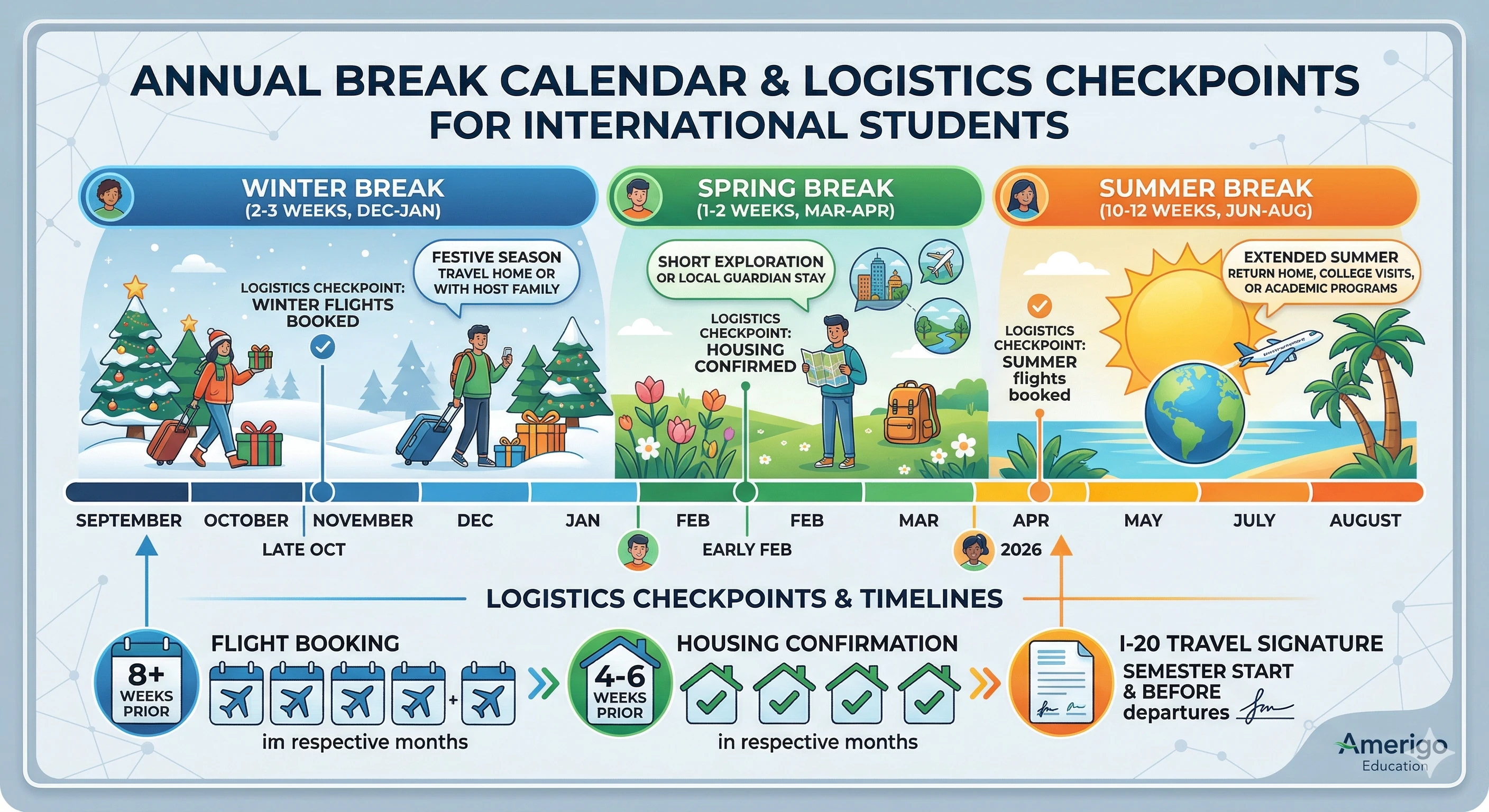
US high schools schedule three primary break periods each academic year: winter break lasting 2-3 weeks in December and January, spring break lasting 1-2 weeks in March or April, and summer break lasting 10-12 weeks from June through August. Each break requires a different level of logistical planning based on its length, the student's accommodation type, and whether the family wants the student to travel home or remain in the US.
The timing and duration of each break vary slightly between schools and regions. Schools in northern states sometimes schedule longer winter breaks due to weather, while year-round calendar schools may distribute breaks differently. Families should obtain the exact academic calendar from their child's school during enrollment so they can plan flights and housing well in advance. On-campus international departments at Amerigo Education partner schools share break dates and planning deadlines at the start of each semester.
Where Do Students Stay During Winter Break?
Winter break is the first extended closure most international students face, lasting 2-3 weeks from mid-December through early January. Homestay students often remain with their host family during this period, sharing holiday traditions and maintaining a stable living environment. Residential students in on- or off-campus supervised residences typically need to arrange alternative housing because many residences close during winter break.
Students who travel home for winter break must budget for round-trip international flights during the busiest and most expensive travel period of the year. Booking six to eight weeks in advance is standard practice for securing reasonable fares on routes to East Asia, Southeast Asia, and Latin America. Students who cannot travel home may stay with a designated local guardian, a family friend in the US, or participate in a school-organized winter activity trip. On-campus staff send families housing confirmation deadlines and travel planning reminders before each winter break.
- Confirm whether your child's residence or homestay remains open during winter break
- Book round-trip flights at least six to eight weeks before the break begins
- Verify that your child's I-20 has a current travel signature from a designated school official
- Arrange airport transportation for both departure and return
- Confirm local guardian or host family availability if the student is not traveling home
- Notify the on-campus international department of your child's break plans
- Pack weather-appropriate clothing for both the US winter and the home country climate
How Does Spring Break Differ from Winter?
Spring break is shorter than winter break - typically 1-2 weeks in March or April - making international travel home less practical for many families. The shorter duration, combined with high airfare costs and jet lag recovery time, means most international students remain in the US during spring break. Homestay students generally stay with their host families, while residential students need a confirmed plan before the residence closes.
Families who want their child to remain in the US during spring break have several options beyond homestay. Some schools organize supervised group trips to nearby cities or cultural destinations. Students with a local guardian or approved family friend in the area can stay with them. A smaller number of programs offer break housing at an additional cost for residential students who have no other local arrangement. The on-campus international department can help families identify which options are available at their specific partner school.
What Happens During the 10-Week Summer?
Summer break is the longest school closure, lasting 10-12 weeks from June through August. Most international high school families bring their child home for the majority of this period. Residences close for the summer at nearly all US boarding and day school programs. Homestay arrangements also typically pause during summer unless the family and host family agree to an extended stay.
Some students use part of the summer for activities that strengthen their university applications before traveling home. College campus visits allow students to tour potential universities in person. Pre-college summer programs at US universities offer academic credit and a preview of the college experience. Summer academic enrichment courses in subjects like SAT preparation, advanced science, or creative writing maintain academic momentum. Families should confirm that any summer program activity complies with F-1 visa regulations and that the student's I-20 status remains active throughout.
- Book summer return flights by mid-April to secure reasonable pricing on long-haul routes
- Research pre-college summer programs if the student wants to stay in the US for part of the break
- Schedule college campus visits during June or July for students entering Grade 11 or 12
- Confirm storage arrangements for personal belongings if the residence closes for summer
- Request an updated travel signature on the I-20 before departure if the current one expires during summer
- Plan the return travel date to allow at least two to three days before classes resume for jet lag adjustment
How Does Accommodation Type Affect Breaks?
The type of accommodation a student uses during the school year directly determines what break logistics the family must arrange. Amerigo Education offers three accommodation types: homestay, on- and off-campus supervised residences, and self-provided housing. Each model creates different break planning requirements based on whether the housing continues during non-school periods.
Homestay students have the most flexible break situation because many host families welcome the student during shorter breaks. Residential students face the most structured planning requirement because supervised residences typically close during breaks, meaning alternative housing must be confirmed weeks in advance. Students in self-provided housing - living with a parent or family member already in the US - generally maintain their housing year-round, though families still need to coordinate supervision during periods when school staff are not present.
What Visa Rules Apply to Break Travel?
F-1 visa students can travel internationally during school breaks and return to the US as long as their visa and I-20 document remain valid. The most critical requirement is a current travel signature on the I-20, which must be signed by a designated school official (DSO) and is valid for 12 months. Students should request this signature before every international trip, even if the previous signature has not expired, to avoid complications at the US port of entry.
When re-entering the US after a break trip, students should carry their original I-20 with the valid travel signature, a valid passport with the F-1 visa stamp, proof of current enrollment at their school, and financial documentation showing the ability to cover educational expenses. Students from countries that require transit visas for layover connections should verify those requirements separately. On-campus international department staff at Amerigo Education partner schools assist families with travel documentation checklists before each break departure.
- Request a travel signature on the I-20 from the designated school official at least two weeks before departure
- Carry the original I-20 document (not a copy) when traveling internationally
- Bring a valid passport with at least six months of remaining validity
- Carry proof of current enrollment such as a class schedule or enrollment verification letter
- Check whether layover countries require a transit visa for your child's nationality
- Keep financial documentation accessible in case a customs officer requests it at re-entry
- Store digital copies of all documents in a secure cloud account as backup
- Contact the on-campus international department immediately if any document issue arises during travel
How Should Families Budget for Break Travel?
International families should budget for two to three round-trip flights per academic year, depending on whether the student travels home for all three breaks or stays in the US during spring break. Flight costs vary widely by route, season, and booking window. December and June departures are the most expensive periods for routes between the US and East Asia, Southeast Asia, and Latin America.
Beyond airfare, break budgets should account for airport transfers, unaccompanied minor fees if the student is under 15 or the airline requires them, luggage fees for seasonal clothing, travel insurance, and any break housing costs if the student stays in the US. Families who plan ahead and book flights during lower-demand windows - such as departing a day or two after the official break start date rather than on the first available day - can reduce costs meaningfully. Visa services through third-party partners like ZF Visa are billed separately from program tuition and should be factored into the annual budget.
Frequently Asked Questions
Can an F-1 student travel home during winter break and return to the US?
Yes. F-1 students can travel home and re-enter the US during school breaks as long as their visa and I-20 remain valid. Students need a current travel signature on their I-20, which must be signed by a designated school official within the past 12 months. Carrying the original I-20, valid passport, and proof of enrollment when re-entering the US is standard practice for international high school students.
What happens to residential students when the residence closes for breaks?
When on- or off-campus supervised residences close for scheduled breaks, students must arrange alternative housing. Options include returning home, staying with a local guardian or family friend, or enrolling in a school-organized break housing program if available. Programs with on-campus international departments typically notify families about closure dates and housing deadlines several weeks in advance so arrangements can be finalized before the break begins.
Do homestay students stay with their host family during breaks?
Many homestay students remain with their host family during shorter breaks like spring break and portions of winter break. The specific arrangement depends on the agreement between the family, the host family, and the program. Some host families welcome students for all breaks, while others limit hosting to the academic calendar. Families should clarify break hosting expectations before the school year begins.
How far in advance should families book break travel?
Families should book international flights at least six to eight weeks before each break begins. Holiday travel periods - particularly winter break in December and summer departure in May or June - see the highest airfare prices and limited availability on popular international routes. Booking early also allows time to arrange airport transfers, confirm housing at the destination, and handle any visa documentation updates before departure.
What if my child cannot travel home during a short break?
Students who cannot return home during spring break or shorter holiday periods have several options. Homestay students may remain with their host family. Residential students can stay with a designated local guardian, a family friend in the US, or participate in a school-organized trip. The on-campus international department can help coordinate alternatives when travel home is not practical for breaks lasting fewer than two weeks.
Are there additional costs for break housing?
Break housing costs vary by program and accommodation type. Some programs include short break housing in tuition, while others charge separately for winter or spring break residence. Summer break housing is rarely included because most students return home for the full 10 to 12 weeks. Families should request a complete cost breakdown that includes break housing fees during the enrollment process to avoid unexpected expenses during the year.
How does Amerigo Education help with break logistics?
Amerigo Education's on-campus international departments coordinate break logistics including travel reminders, housing deadline notices, and airport transportation arrangements. Staff communicate with families through monthly progress reports and direct outreach before each break period. Native-language support is available for families from China, Vietnam, Korea, Mexico, the Taiwan Region, and more, reducing communication barriers during the planning process.
Can international students do summer programs during the break?
Many international students use part of the summer break for academic enrichment programs, college campus visits, or pre-college summer courses at US universities. These activities can strengthen university applications while keeping the student in the US for a portion of the break. Students should confirm that any summer program activity complies with F-1 visa regulations and that their I-20 status remains active throughout the duration of the program.
What safety measures exist for students during school breaks?
Amerigo Education provides 24/7 emergency assistance at all US and Canadian partner schools, including during break transition periods. Safety technology such as Life360 or Reach allows staff and families to monitor student location during travel. Students traveling as unaccompanied minors on flights can be enrolled in airline escort services. Local guardians and host families are vetted through the program's screening process before any placement is confirmed.
Does the school help arrange flights for students?
Most schools do not book flights directly for students, but on-campus international departments provide guidance on booking timelines, recommended airports, and airline unaccompanied minor services. Some programs coordinate group airport transfers at the start and end of each break period. Families are responsible for purchasing tickets and confirming itineraries, and staff can assist with logistics questions through native-language communication channels.
Conclusion
International high school students face three distinct break periods each academic year, each requiring separate planning for housing, travel, and supervision. The student's accommodation type - homestay, residential, or self-provided - determines which logistics the family must arrange independently and which the program coordinates. Families who plan flights early, confirm housing before deadlines, and maintain current visa documentation reduce the stress associated with each break transition.
Start Planning Your Child's Break Logistics
Families evaluating international high school programs can explore US partner schools, view Canadian options, or learn about Brentwood School in the UK. Apply now to begin the enrollment process, or contact us for guidance on accommodation types, break logistics, and how on-campus international departments support families throughout the academic year.
People Also Read
- Homestay vs Residence for High School International Students: How to Choose the Right Accommodation
- What Parents Should Expect: The Emotional Phases of Your Child's First Year Abroad
- Reverse Culture Shock for International Students: A Complete Guide to Winter Breaks, Summer Returns, and Family Expectations
About the Author
This guide was written by the Amerigo Education content team, drawing on program data from staff operating the on-campus international department at Amerigo Education's partner schools across the US, Canada, and UK. Learn more about Amerigo Education.
Disclaimer: This article provides general information for educational purposes only. Families should conduct independent research, request current program data from providers, and consult with program representatives regarding specific circumstances. Contact us with questions.