All news
March 27, 2026
Study Abroad 101
How US Classrooms Differ from Home: What International Students Don't Expect
How do US high school classrooms differ from schools in China, India, Vietnam, and Korea? Teaching styles, participation grades, and academic expectations explained.
How US Classrooms Differ from Home: What International Students Don't Expect
Last Updated: March 2026
Academic culture shock is the disorientation international students experience when the way learning happens in a new country conflicts with the educational norms they grew up with. According to the National Center for Education Statistics, 89% of US high school teachers report using discussion-based instruction as a primary teaching method, and 78% include student participation as a graded component of their courses. For students arriving from education systems in China, India, Vietnam, Korea, and the Taiwan Region, where teacher-led lectures and exam-based assessment dominate, these differences create a classroom experience that feels fundamentally unfamiliar from the first day of school.
Amerigo Education partners with 40 Niche A+/A rated schools across the US, Canada, and UK, supporting 3,500+ students from 55+ countries through this exact transition. The Class of 2025 achieved 97% admission to Top 100 US universities. On-campus international departments at each partner school provide academic coaching specifically designed to help students adapt to US classroom culture, from building discussion skills to understanding academic integrity expectations.
Key Takeaways
- Participation is graded, not optional: US high school courses typically weight class participation at 10% to 20% of the overall grade, requiring students to speak, ask questions, and engage visibly in every class session.
- Discussion replaces lecture as the primary method: US teachers act as facilitators who guide conversation rather than authority figures who deliver information for students to memorize.
- Group projects are a core assessment format: Collaborative assignments appear in nearly every subject, and students receive grades for both group outcomes and individual contribution.
- Academic integrity carries serious consequences: Honor codes, plagiarism detection software, and zero-tolerance policies for copying mean international students must understand exactly what counts as cheating in the US context.
- Asking questions is expected, not disruptive: US teachers interpret student questions as engagement, and students who remain silent may be perceived as unprepared or disinterested rather than respectful.
Why Is Participation Graded in US Classrooms?
In most education systems across Asia and parts of Europe, student performance is measured almost entirely through written examinations. A student who listens silently, takes notes, and scores well on the final exam earns top marks. In US high schools, that same student would lose 10% to 20% of their grade before any exam is administered. Participation grades reflect a fundamentally different educational philosophy: the belief that learning happens through the process of articulating ideas, not only through absorbing them.
US teachers track participation through daily observations, participation rubrics, and classroom interaction logs. A participation grade typically includes speaking during discussions, asking and answering questions, contributing to small group activities, and engaging with in-class exercises. Students from China, Vietnam, Korea, and the Taiwan Region report that participation grading is the single most surprising difference they encounter. The adjustment period is real but manageable. Amerigo Education's on-campus academic advisors work with international students to build confidence in verbal participation through structured practice sessions, peer discussion groups, and one-on-one coaching.
How Does Discussion-Based Learning Work?
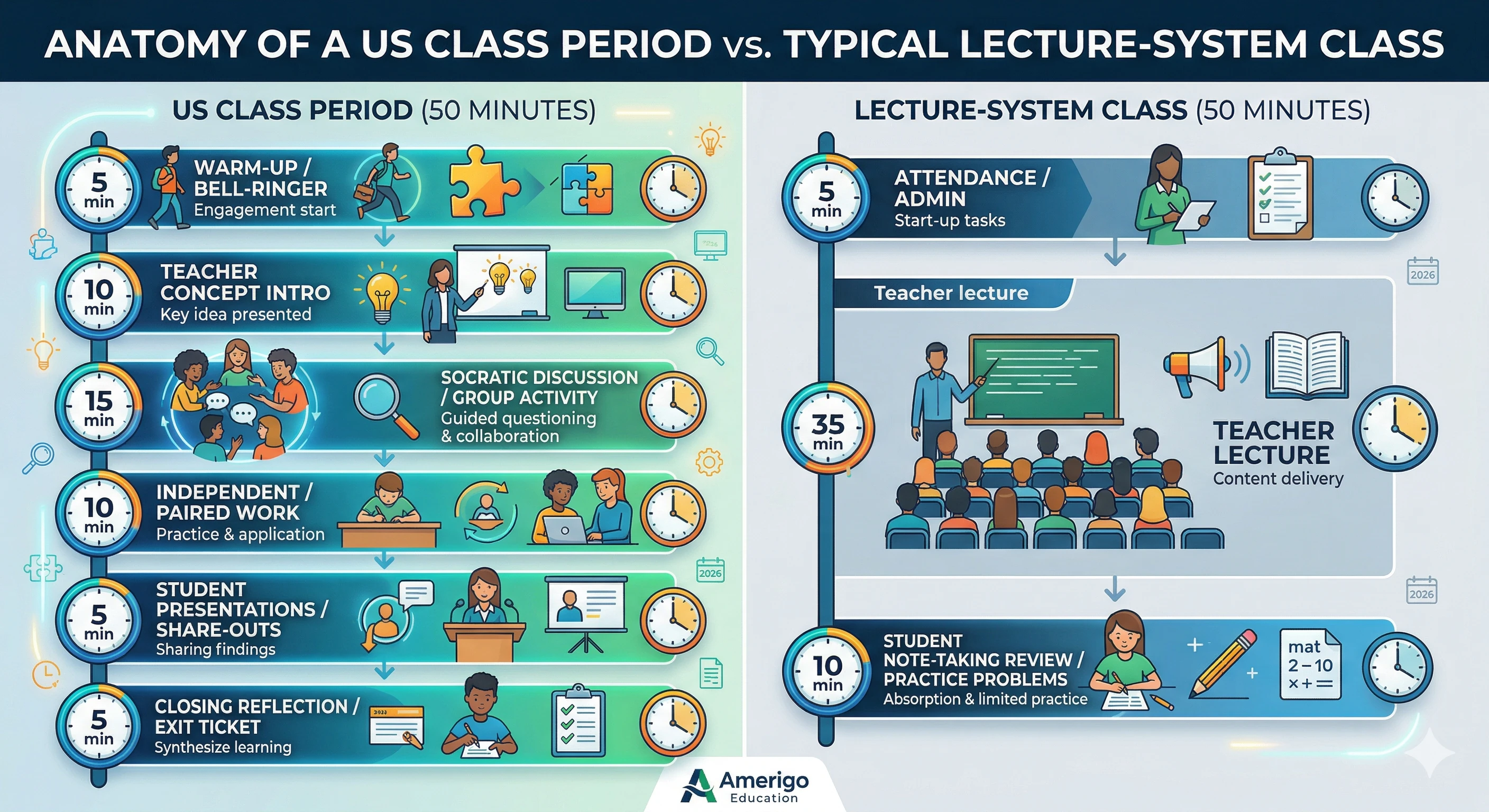
Discussion-based learning means the teacher poses questions, introduces problems, or presents a text, and students construct understanding through conversation rather than receiving pre-formed answers. A US English class studying a novel might spend an entire 50-minute period with students debating a character's motivations, supporting their arguments with textual evidence, and responding to classmates' interpretations. The teacher guides the discussion but does not provide a definitive answer. This is the Socratic method in practice: learning through questioning rather than lecturing.
For students from education systems where the teacher speaks for 80% or more of class time, this shift can feel disorienting. In a US classroom, silence is not golden. A student who does not speak during a discussion is not demonstrating respect or discipline; they are missing a graded learning opportunity. According to NCES survey data, US high school students spend an average of 35% to 45% of instructional time in discussion or interactive activities, compared to 10% to 15% in teacher-led lecture format.
What Are Group Projects and How Are They Graded?
Group projects are collaborative assignments where three to five students work together to research a topic, create a product, and present their findings to the class. In the US, group projects are not occasional extras. They are a core assessment method that appears in English, history, science, math, and elective courses throughout every semester. A typical US high school student completes six to ten graded group projects per academic year.
The grading structure for group projects usually includes two components: a group grade for the final product and an individual grade for each student's contribution. Teachers use peer evaluation forms, individual reflection essays, and contribution logs to assess whether each student participated meaningfully. International students who are accustomed to individual competition sometimes struggle with this format. Sharing work, dividing responsibilities, and relying on classmates for part of a grade requires trust and communication skills that develop over time.
- Teacher assigns a multi-week project with defined roles (researcher, writer, presenter, project manager)
- Students divide tasks, set internal deadlines, and meet outside of class to coordinate
- Each student completes individual components and contributes to the group deliverable
- The group presents their project to the class, with each member speaking
- Teacher grades the group product and each student's individual contribution separately
- Students complete peer evaluations rating each group member's effort and reliability
- Final grade combines group score (50-60%) and individual contribution score (40-50%)
Why Do US Teachers Expect Students to Ask Questions?
In many education systems, asking a question during class signals that the student did not understand the material, which can feel like admitting failure in front of peers. In US classrooms, the meaning is reversed. Asking questions signals engagement, curiosity, and critical thinking. Teachers interpret a student who asks "Why does this formula work?" or "What if we approached this differently?" as demonstrating exactly the intellectual behavior they want to develop.
US teachers also call on students randomly, a practice known as cold calling. A teacher might ask any student at any moment to summarize a reading, answer a question, or share an opinion. This is not punitive. It is a participation technique designed to keep every student actively engaged rather than allowing a few confident speakers to dominate. For international students who expect to speak only when they raise their hand or are certain of the correct answer, cold calling creates significant initial anxiety. Schools with on-campus international departments prepare students for this by practicing discussion techniques in smaller, supportive settings before they encounter cold calling in a full classroom.
How Serious Is Academic Integrity in the US?
Academic integrity is treated with a level of institutional seriousness in US high schools that surprises many international students. Most US schools operate under an honor code that students sign at the start of the academic year, pledging not to cheat, plagiarize, or assist others in academic dishonesty. Schools use plagiarism detection software such as Turnitin on written assignments, and teachers are trained to identify copied work, paraphrasing without attribution, and unauthorized collaboration.
The consequences are severe by international standards. A first offense for plagiarism or cheating typically results in a zero on the assignment and a notation in the student's disciplinary file. Repeated violations can lead to suspension, which appears on the student's transcript and must be disclosed on university applications. For international students on F-1 visas, a suspension can also raise questions about continued enrollment status. The cultural challenge is that what counts as "cheating" differs across education systems. In some systems, sharing homework answers with a friend is normal study behavior. In the US, submitting identical homework is an honor code violation. Students must learn to distinguish between permitted collaboration and prohibited copying, which varies by teacher and by assignment.
- Plagiarism: Submitting any text, ideas, or data from another source without proper citation, including paraphrasing without attribution
- Unauthorized collaboration: Working together on assignments designated as individual work, even if both students contributed original content
- Copying: Sharing or receiving answers on homework, quizzes, or exams
- Self-plagiarism: Submitting the same work for two different classes without teacher permission
- Contract cheating: Having someone else complete an assignment on your behalf
- Fabrication: Inventing data, sources, or citations in research assignments or lab reports
What Role Do Presentations Play in US Grades?
Oral presentations are a graded requirement in virtually every US high school subject. A student in a typical US high school gives three to six formal presentations per semester, ranging from five-minute book reports to 15-minute research project presentations with visual aids. Presentations are graded on content accuracy, organization, delivery (including eye contact, voice projection, and pacing), visual materials, and the ability to answer audience questions.
For international students whose previous education involved little or no public speaking, this represents a significant skill gap that affects multiple course grades simultaneously. The anxiety is compounded by presenting in a second language, where vocabulary limitations and accent awareness add pressure beyond the content itself. Amerigo Education partner schools address this through structured presentation practice in ELL courses, peer rehearsal sessions, and teacher feedback before graded presentations. Students who arrive with no public speaking experience in English typically report feeling comfortable with classroom presentations by their second semester, after completing four to six graded presentations with increasing complexity.
How Do US Science Classes Differ from Asian Systems?
US science education prioritizes the scientific method as a process over the memorization of scientific facts. In a US high school chemistry class, students spend one to two periods per week in a laboratory setting, designing experiments, recording observations, analyzing results, and writing formal lab reports. Lab work typically accounts for 20% to 30% of the overall science grade, making it a major grading category that does not exist in many Asian secondary school science programs.
According to NCES data, 94% of US high schools with science programs maintain dedicated laboratory facilities, and 71% of science teachers report conducting labs at least weekly. The lab report itself is a distinct academic genre that international students must learn: it follows a structured format (hypothesis, materials, procedure, data, analysis, conclusion) and is graded on scientific reasoning, not just correct answers. Students who excel at solving physics equations on paper may initially struggle with the hands-on, process-oriented nature of US science labs.
Frequently Asked Questions
Why do US teachers call on students randomly in class?
Random calling, sometimes called cold calling, is a standard US teaching technique designed to keep all students engaged with the material. Teachers use it to check comprehension across the entire class rather than relying on the same volunteers. International students from lecture-based systems often find this uncomfortable initially, but it becomes routine within a few weeks. The goal is participation, not embarrassment, and teachers generally do not penalize students who are still developing English fluency.
How much of my grade depends on class participation?
Participation typically accounts for 10% to 20% of a student's overall grade in US high school courses. This includes speaking during class discussions, asking questions, contributing to group work, and engaging with in-class activities. The exact percentage varies by teacher and subject. Students from systems where grades depend entirely on exams should expect participation to be tracked and graded from the first week of class.
What is the Socratic method and how is it used?
The Socratic method is a teaching approach where the teacher asks a series of open-ended questions to guide students toward understanding a concept rather than stating the answer directly. In US high schools, this is common in English, history, and social studies classes. Students are expected to form and defend opinions, analyze texts, and build on each other's responses. There is often no single correct answer, which differs from exam-based systems that reward memorization of specific facts.
Can I get in trouble for copying from a classmate?
Yes. US high schools enforce strict academic integrity policies that classify copying homework, sharing test answers, and submitting work that is not your own as cheating. Consequences range from receiving a zero on the assignment to suspension or expulsion for repeated violations. Many schools use honor codes that students sign at the beginning of the year. International students should understand that collaboration rules vary by assignment, and when in doubt, ask the teacher whether working together is permitted.
Why do US teachers assign so many group projects?
Group projects are a core assessment method in US education because they develop collaboration, communication, and leadership skills that universities and employers value. A typical US high school student completes multiple group projects per semester across different subjects. Each group member usually receives both a group grade and an individual contribution grade. International students accustomed to individual assessment may find this adjustment significant, but group work skills directly strengthen university applications.
Is it disrespectful to disagree with a US teacher?
No. In US classrooms, respectful disagreement with a teacher is considered a sign of critical thinking and engagement. Teachers actively encourage students to challenge ideas, present alternative viewpoints, and support their positions with evidence. This is a fundamental cultural difference from education systems where questioning a teacher is seen as disrespectful. The key word is respectful: students are expected to disagree with the idea, not attack the person, and to provide reasoning for their position.
What are office hours and should I use them?
Office hours are scheduled times when teachers are available outside of class for individual help, questions, or extra support. Most US high school teachers hold office hours before or after school, during lunch, or during a free period. International students should use office hours regularly because teachers view students who seek help as motivated and engaged. Attending office hours also builds the teacher-student relationship, which matters when teachers write recommendation letters for university applications. Students can also schedule meetings with Amerigo academic counselors for additional academic support, and Amerigo residences offer structured study hours where campus staff are available to help with homework and assignments.
How do US science classes differ from science in Asia?
US science classes place heavy emphasis on laboratory work, hands-on experiments, and the scientific method as a process. Students design experiments, collect data, write lab reports, and present findings rather than primarily memorizing formulas and solving calculation problems. Lab work often accounts for 20% to 30% of the science grade. In biology, chemistry, and physics, students spend one to two class periods per week in a laboratory setting, which is significantly more hands-on time than most Asian secondary school science programs.
Will I have to give presentations in front of the class?
Yes. Oral presentations are a standard assessment method in US high schools across nearly every subject. Students present research findings, book analyses, project results, and persuasive arguments to their classmates. Presentations are graded on content, delivery, eye contact, and response to audience questions. Most students give three to six graded presentations per semester. International students who have limited public speaking experience in English can prepare by practicing with on-campus support staff and attending presentation workshops offered through Amerigo Education partner schools.
How can students prepare for US classroom culture before arriving?
Students can prepare by practicing expressing opinions in English, participating in online discussion forums, watching recorded US classroom sessions available on educational platforms, and reading about Socratic questioning techniques. Amerigo Education provides pre-arrival orientation materials that cover US classroom expectations, academic integrity policies, and participation norms. Once enrolled, on-campus international departments offer ongoing academic coaching to help students build confidence with discussion-based learning, group collaboration, and presentation skills.
Conclusion
The way learning happens in US high school classrooms is fundamentally different from lecture-based education systems in China, India, Vietnam, Korea, and the Taiwan Region. Participation grades, discussion-based instruction, group projects, Socratic questioning, oral presentations, lab-based science, and strict academic integrity policies create a classroom environment that rewards active engagement over silent memorization. International students who understand these differences before arriving adapt faster and perform better academically. The adjustment is a process, not an event, and structured support from on-campus international departments accelerates that process significantly.
Prepare Your Child for US Classroom Success
Families ready to help their child navigate the transition to US classroom culture can apply now through a single application covering 40 partner schools, or contact us to learn how on-campus academic support helps international students thrive in discussion-based learning environments. Amerigo Education offers $50,000 USD in scholarships for qualifying students, with accommodation options including homestay, on- and off-campus supervised residences, and self-provided housing. Monthly reports keep families informed, and native-language support is available in Chinese, Vietnamese, Korean, Spanish, and more, with 24/7 emergency assistance at every location. Explore US partner schools, view Canadian options, or learn about schools in the UK.
People Also Read
- What Does a Typical Day Look Like at a US High School?
- How to Overcome Culture Shock: A Guide for International High School Students Ages 14-18
- Can I Study in the USA with Low English?
About the Author
This guide was written by the Amerigo Education content team, drawing on program data from staff operating the on-campus international department at Amerigo Education's partner schools across the US, Canada, and UK. Learn more about Amerigo Education.
Disclaimer: This article provides general information for educational purposes only. Families should conduct independent research, request current program data from providers, and consult with program representatives regarding specific circumstances. Contact us with questions.