All news
April 25, 2026
Study Abroad 101
What Legal Rights Do International Students Have at US High Schools?
International students at US high schools are protected by FERPA, Title VI, and due process laws. What F-1 families need to know about their legal rights.
What Legal Rights Do International Students Have at US High Schools?
Last Updated: April 2026
International student rights in US schools are shaped by a combination of federal laws, visa regulations, and school policies that apply regardless of citizenship status. According to IIE Open Doors (2025), over 1.1 million international students enrolled in US institutions annually, with a growing segment at the secondary level - making a clear understanding of legal protections essential for families planning F-1 (student visa for academic programs) enrollment.
Amerigo Education, founded in 2016 and backed by Avathon Capital, partners with 40 Niche A+/A rated schools across the US, Canada, and the UK, serving international students aged 14-18 - 3,500+ students from 55+ countries. The Class of 2025 achieved 97% admission to Top 100 US universities. Amerigo's on-campus international department at each US Signature School monitors visa compliance and supports student welfare throughout enrollment.
This guide covers US federal protections for F-1 students at US Signature Schools - privacy rights, disability accommodations, school discipline due process, and language access requirements. FEIA Canada and Brentwood School Essex students are covered by Canadian and UK legal frameworks respectively, which have separate protections not discussed here.
Key Takeaways
- FERPA protections: The Family Educational Rights and Privacy Act grants all enrolled students rights to access, review, and correct their educational records, regardless of citizenship.
- Non-discrimination: Title VI of the Civil Rights Act prohibits national-origin discrimination in any school receiving federal funding - protecting all international students.
- Disability access: Section 504 of the Rehabilitation Act requires schools to provide reasonable accommodations for qualifying students, including F-1 visa holders.
- Due process: Schools must provide notice and a hearing opportunity before imposing suspensions or expulsions on any student, including international students.
- Language access: Federal guidance requires schools receiving federal funding to address language barriers for students and parents with limited English proficiency.
What Federal Laws Protect F-1 Students in School?
International students at US high schools are covered by the same core federal education laws as domestic students. These protections apply from the first day of enrollment and do not require permanent residency or citizenship.
Federal civil rights statutes - Title VI, Title IX, and Section 504 - apply to schools that receive federal financial assistance. This primarily covers public schools and private schools participating in specific federal programs. Most private independent schools do not receive federal financial assistance directly, and at those schools, equivalent protections against discrimination and for accommodations typically come from school policy, state law, and the enrollment contract. Families should review the non-discrimination and accommodations policies in their school's student handbook.
- Title VI: Prohibits differential treatment based on national origin - schools cannot apply different rules to international students because of their background.
- Section 504: Qualifying disabilities must be accommodated with a written plan, regardless of visa status.
- FERPA: Schools cannot share student records with third parties without written consent.
What Privacy Rights Do F-1 Students Have at School?
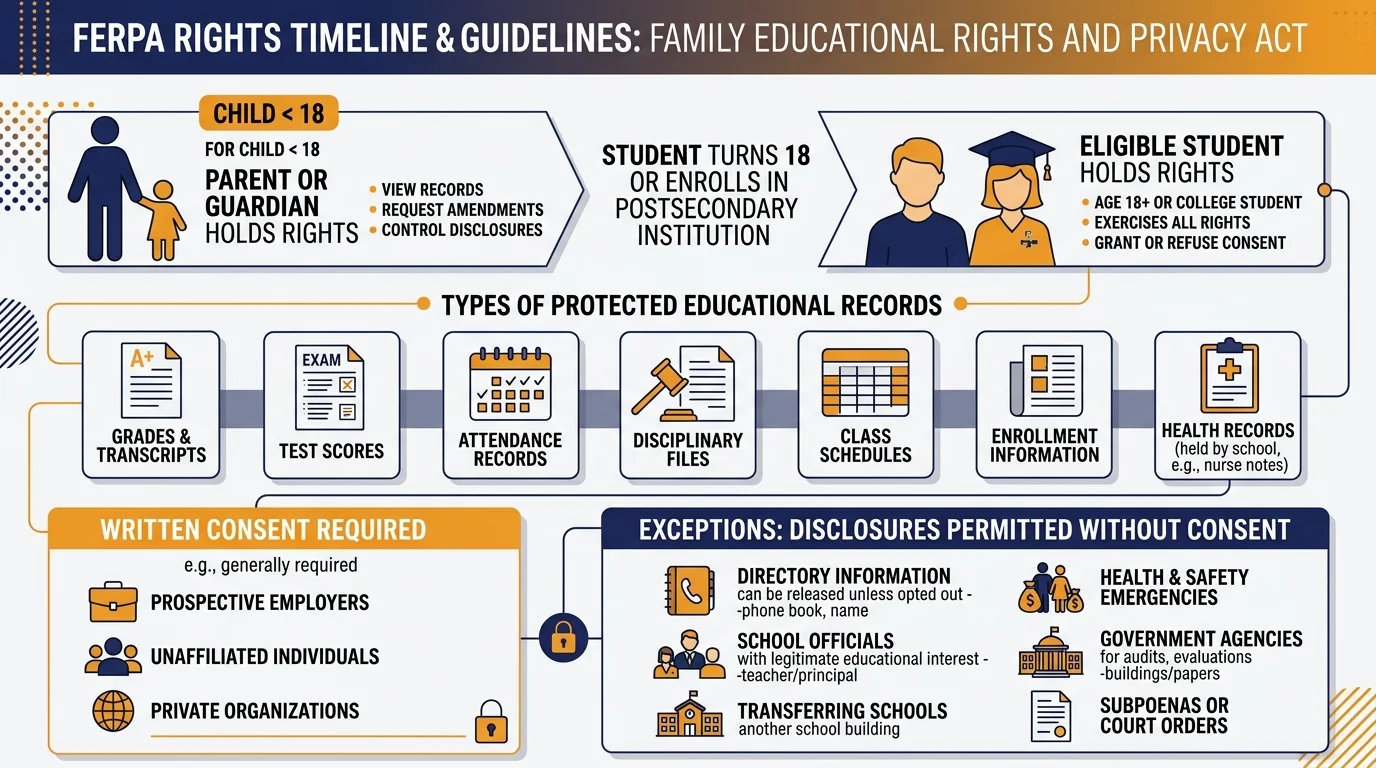
FERPA (Family Educational Rights and Privacy Act) gives enrolled students and their parents the right to inspect, review, and request corrections to all educational records held by the school. This includes academic transcripts, disciplinary files, attendance records, and any SEVIS (Student and Exchange Visitor Information System) related documentation the school generates.
Schools may not share student records with outside parties - including employers, other institutions, or family members beyond the eligible parent - without written consent. When the student turns 18, all FERPA rights transfer from the parent to the student.
- Access rights: Students or parents may request access to any education record; schools must respond within 45 days.
- Correction rights: Families may request amendments to records they believe are inaccurate or misleading; the school must respond in writing.
- Disclosure limits: Schools cannot release records without consent except to school officials with a legitimate educational interest or when legally required.
Can F-1 Students Access Disability Accommodations?
Yes. Section 504 of the Rehabilitation Act prohibits schools receiving federal funding from denying accommodations to students with qualifying disabilities. This protection applies to F-1 students equally. A qualifying impairment is one that substantially limits a major life activity such as reading, concentrating, or communicating.
To receive support, families should bring existing evaluation documentation from their home country. The school's student support team reviews documentation and may conduct additional assessments. A 504 Plan is then developed outlining specific accommodations. Amerigo's student accommodations support staff can guide families through this process at US Signature Schools.
- Eligibility: A documented impairment that substantially limits a major life activity - such as ADHD (Attention Deficit Hyperactivity Disorder), anxiety, or a processing difference.
- Evaluation: Schools arrange assessments, often at no additional cost to the family.
- 504 Plan: A written document specifying accommodations - such as extended test time or reduced-distraction settings.
- Annual review: Plans are reviewed at least once per year to ensure appropriateness.
What Due Process Rights Apply in School Discipline?
The US Supreme Court established in Goss v. Lopez (1975) that students at public schools have constitutional due process rights before significant disciplinary action - because public schools are state actors subject to the 14th Amendment. Private schools are not bound by constitutional due process in the same way, but most private schools commit to equivalent procedures through their student handbook. For short-term suspensions under 10 days, most schools require notice of the charges and an opportunity to respond. For longer suspensions or expulsions, advance written notice and a formal hearing are standard across most school types.
F-1 students face an additional consideration: any formal change to enrollment status - expulsion, withdrawal, or a reduction below full-time course load - must be reported to the DSO (Designated School Official) and may affect SEVIS status. Short-term suspensions typically do not affect enrollment status because the student remains enrolled with the school during the suspension period. According to SEVP, students who lose active SEVIS status may need to reapply for a new visa before re-entering the US. Amerigo's on-campus international department alerts families immediately to any visa compliance risk.
- Short suspension: Oral or written notice of charges plus a brief opportunity to explain - can be the same day.
- Long suspension or expulsion: Formal written notice in advance, hearing rights, and opportunity to present evidence.
- SEVIS impact: Any suspension affecting full-time enrollment must be reported to the DSO within the required SEVIS reporting window.
How Does Language Access Work for International Families?
Federal guidance from the US Department of Education Office for Civil Rights requires schools receiving federal funding to provide meaningful language access for parents with limited English proficiency (LEP). Schools must ensure that significant communications - including discipline notices, grade reports, and special education referrals - are provided in a language parents can understand, either through translation or interpretation services.
Implementation varies between schools. Families should ask about language access practices before enrollment. Amerigo Education provides native-language communication support for families from China, Vietnam, Korea, Mexico, and the Taiwan Region through in-country staff who communicate in the family's native language throughout enrollment.
- Key communications: Discipline notices, 504 Plan meetings, and progress reports must be accessible to LEP parents.
- ELL (English Language Learning) placement: Schools must assess English proficiency on arrival and provide appropriate language instruction.
- Interpreter access: For formal proceedings such as discipline hearings or 504 evaluations, schools should arrange interpretation support.
Frequently Asked Questions
Do international students have the same rights as US students at school?
International students enrolled at US high schools are protected by the same core federal education laws as domestic students. Title VI, Title IX, Section 504, and FERPA apply regardless of citizenship or visa status. F-1 students have additional obligations tied to visa compliance - such as maintaining full-time enrollment - but within the school environment, their legal rights and protections are equal to those of US-resident students in federally funded institutions.
Can a US high school expel an international student without a hearing?
No. Supreme Court precedent established in Goss v. Lopez (1975) requires schools to provide notice and an opportunity to be heard before imposing any significant disciplinary action. For expulsions, schools must provide advance written notice, specific charges, and a process that allows the student to respond and present evidence. The exact format varies by school and may or may not include a formal in-person hearing. Schools must also follow their own published disciplinary procedures, typically outlined in the student handbook provided at enrollment.
What happens to F-1 visa status if a student is suspended?
A short-term suspension that does not affect full-time enrollment status typically does not trigger SEVIS action. However, any suspension that results in a student dropping below the minimum full-time course load must be reported to the DSO, who may need to update the SEVIS record. Families should contact the school's international department immediately when any disciplinary proceeding begins. Amerigo's on-campus international department monitors these situations directly and advises families on visa implications.
Are F-1 students protected from discrimination based on nationality?
Yes. Title VI of the Civil Rights Act explicitly prohibits discrimination based on national origin in schools receiving federal funding. International students cannot be subjected to different rules, exclusion from activities, or differential treatment because of their country of origin or cultural background. Title IX provides additional protections against sex-based discrimination. Schools are legally required to investigate formal discrimination complaints and take corrective action when violations are found.
Can parents of international students access school records?
Yes. Under FERPA, parents of enrolled minor students have the right to inspect and review all educational records held by the school within 45 days of a written request. This includes academic records, disciplinary files, and attendance data. The right transfers to the student once they turn 18. Amerigo shares monthly progress reports, school activity calendars and event announcements directly with parents so families stay informed between formal record requests.
What accommodations can F-1 students request for learning differences?
F-1 students with documented learning differences or disabilities may qualify for a Section 504 Plan. Common accommodations include extended time on tests, reduced-distraction testing environments, modified homework formats, and access to note-taking support. Families should provide any existing evaluation records from their home country, which the school's student support team can consider during the assessment. Schools arrange evaluations and must document any approved accommodations in a written plan reviewed at least annually.
Are schools required to communicate with parents in their home language?
Federal guidance requires schools receiving federal funding to provide meaningful access for parents with limited English proficiency. Key communications - including discipline notices, grade reports, and referrals for special education assessments - should be provided in a language parents understand. Amerigo Education provides native-language communication support for families from China, Vietnam, Korea, Mexico, and the Taiwan Region. Amerigo's in-country staff relay key school communications to parents in their native language throughout the enrollment period.
What rights do students have if their visa application is denied?
Visa decisions are not subject to formal appeal, but students may reapply at any time and should address the specific concerns raised during the interview. The DSO can provide updated enrollment documentation or a clarification letter to support a reapplication. Families who want additional support through the reapplication process may access ZF Visa, a third-party visa service partner that Amerigo refers families to, as an optional add-on.
Can international students participate in school clubs and sports?
International students have the right to participate in clubs, arts programs, and extracurricular activities on the same basis as domestic students. Varsity sports eligibility varies by state athletic association rules - some states require a minimum enrollment period before students can compete in interscholastic competition. Families should confirm specific varsity eligibility rules with the school before enrollment if sports participation is a priority, as requirements differ between states and school types.
What should families do if they believe a student's rights were violated?
Families should document the concern in writing and raise it with the school principal or student services office. If unresolved, a formal complaint may be filed with the US Department of Education's Office for Civil Rights, which investigates Title VI, Title IX, and Section 504 violations. The process is available to all students regardless of visa status, and Amerigo's on-campus department can help families navigate formal complaint channels.
Conclusion
International students at US high schools are protected by federal law across four key areas: privacy, non-discrimination, disability access, and disciplinary due process. F-1 status adds compliance obligations related to enrollment and SEVIS reporting, but does not reduce the core legal rights students hold within the school environment. Families who understand these protections are better positioned to advocate effectively if issues arise during enrollment.
Learn More About Studying at a US High School
To learn more about studying in America at an Amerigo partner school, contact us to speak with a program advisor, or apply now to take the first step toward enrollment.
People Also Read
- How International Students Maintain F-1 Status in the US
- Is America Still Safe for International Students in 2026? What Parents Need to Know
- US Academic Integrity and School Rules: Guide for International Students
About the Author
This guide was written by the Amerigo Education content team, drawing on program data from staff operating the on-campus international department at 40 Niche A+/A rated US, Canadian, and UK partner schools. Learn more about Amerigo Education.
Disclaimer: This article provides general information for educational purposes only. Families should conduct independent research, request current program data from providers, and consult with program representatives regarding specific circumstances. Contact us with questions.