All news
March 31, 2026
Study Abroad 101
US Academic Integrity and School Rules: Guide for International Students
What are the academic integrity rules, attendance policies, and school conduct expectations at US high schools? Essential guide for international students in 2026.
US Academic Integrity and School Rules: Guide for International Students
Last Updated: March 2026
Academic integrity violations are one of the most common reasons international students face disciplinary action at US high schools. According to the International Center for Academic Integrity, surveys consistently show that students from education systems where memorization and collaborative work are emphasized often find US standards on original work and proper citation unfamiliar during their first semester. The National Center for Education Statistics reports that US high schools enforce attendance through state truancy laws that apply to all enrolled minors, including international students on F-1 visas. Understanding these rules before arriving is not optional preparation. It is essential to maintaining enrollment, visa status, and a competitive university application.
Amerigo Education partners with 40 Niche A+/A rated schools across the US, Canada, and UK, supporting 3,500+ students from 55+ countries. The Class of 2025 achieved 97% admission to Top 100 US universities. The on-campus international department at each partner school provides structured orientation on academic integrity, attendance policies, and behavioral expectations during the first weeks of enrollment, helping students navigate rules that may differ significantly from those in their home country.
Key Takeaways
- Plagiarism carries severe consequences: Copying text without citation, paraphrasing without attribution, or submitting AI-generated work without disclosure can result in a zero on the assignment, course failure, suspension, or expulsion at US high schools.
- Attendance is legally required: State truancy laws mandate school attendance for all minors, and schools report excessive unexcused absences to local authorities. International students must treat attendance as non-negotiable.
- Disciplinary records follow students to university: The Common Application asks about suspensions and expulsions. Academic dishonesty on a student's record can damage university admission prospects.
- Rules apply equally to all students: International students receive the same expectations as domestic students. Schools provide orientation and support, but do not lower standards based on nationality.
- On-campus support prevents problems: Amerigo Education's on-campus international department explains rules during orientation, monitors compliance through monthly progress reports, and intervenes early when concerns arise.
What Is Academic Integrity in US Schools?
Academic integrity in US high schools means that every piece of work a student submits must be their own original effort, properly attributed when drawing on outside sources. This standard is enforced more strictly in the US than in many other education systems worldwide. In some countries, memorizing and reproducing textbook passages demonstrates mastery. In the US, submitting text that matches a source without quotation marks and a citation is classified as plagiarism regardless of intent. The distinction between intentional and accidental plagiarism does not eliminate consequences. It only affects their severity.
Most US high schools operate under an honor code that students sign at the beginning of the academic year. This document outlines what constitutes academic dishonesty and the consequences for each type of violation. Schools use plagiarism detection software such as Turnitin to scan student submissions against databases of published work, internet content, and previously submitted student papers. A high similarity score triggers a review by the teacher, and confirmed violations are reported to the school's academic integrity committee or dean of students.
How Do Attendance Policies Work?
Every US state has compulsory attendance laws that require minors to attend school. These laws apply to international students on F-1 visas with the same force as they apply to US citizens. Schools track attendance by class period, not just by day, meaning a student marked absent from one class is recorded even if they attended all other classes that day. Most schools distinguish between excused absences (illness with documentation, family emergencies, religious observances) and unexcused absences (skipping class without an approved reason).
Accumulating unexcused absences triggers a progressive intervention system. After three to five unexcused absences, schools typically contact the student's family and schedule a meeting with the school counselor. After seven to ten unexcused absences, schools may file a truancy report with local authorities. For international students, chronic absenteeism can also affect F-1 visa status, as SEVIS regulations require students to maintain full-time enrollment and regular attendance at their SEVP-certified school. Amerigo Education's on-campus staff monitors attendance daily and communicates with families through monthly progress reports when patterns of absence or tardiness emerge.
- Attendance is tracked by individual class period, not just by school day
- Excused absences require documentation such as a doctor's note or parent communication
- Three to five unexcused absences typically trigger a family notification and counselor meeting
- Seven to ten unexcused absences may result in a truancy report filed with local authorities
- Chronic absenteeism can jeopardize F-1 visa status under SEVIS regulations
- Tardiness accumulates separately, and multiple tardies often convert to an unexcused absence
- Some schools reduce course grades for excessive absences, even when academic work is completed
- Monthly progress reports from Amerigo Education's on-campus department flag attendance concerns early
What Are the Dress Code and Device Rules?
Dress code policies at US high schools range from strict uniform requirements to general guidelines with specific restrictions. Many private high schools partnered with Amerigo Education require uniforms or a defined dress code that specifies acceptable clothing items, colors, and styles. Schools without uniforms typically prohibit clothing with offensive language or imagery, excessively revealing outfits, and non-religious headwear during class. Students receive the dress code during orientation and are expected to comply beginning on the first day of classes. Violations are handled through progressive consequences starting with a request to change clothing and escalating to detention for repeated non-compliance.
Phone and personal device policies have become increasingly strict across US high schools. A growing number of schools require students to place phones in designated storage at the beginning of each class, whether in a backpack, a locker, or a wall-mounted pouch at the classroom door. Using a phone during instructional time without teacher permission typically results in the device being confiscated for the remainder of the class period or the full school day. Repeat violations can lead to the phone being held by administration for multiple days or a parent being required to retrieve it in person. Laptops and tablets are generally permitted only when a teacher assigns a specific digital task.
What Behavioral Standards Are Expected?
US high schools expect students to demonstrate respect for teachers, staff, and fellow students through both words and actions. This includes arriving to class on time, participating in discussions when called upon, following teacher instructions promptly, and resolving disagreements through conversation rather than confrontation. Disruptive behavior such as talking over the teacher, refusing to follow directions, or using disrespectful language results in immediate consequences that escalate with repetition. International students sometimes find the expectation for active class participation surprising, as some education systems emphasize listening quietly rather than speaking up during lessons.
Behavioral expectations extend beyond the classroom to hallways, cafeterias, school events, and any school-sponsored activity. Bullying, harassment, and discrimination are taken seriously under both school policy and, in many states, under law. Physical altercations result in immediate suspension regardless of who initiated the conflict. Substance use, including alcohol and tobacco, on school property or at school events leads to suspension or expulsion and may involve law enforcement. For international students on F-1 visas, an expulsion or a legal incident creates complications that extend beyond the school, potentially affecting visa status and future immigration applications.
- Arrive to every class on time with required materials ready
- Address teachers and staff respectfully, using appropriate titles
- Participate actively in class discussions and group work when directed
- Keep hands and personal items to yourself in all school spaces
- Report bullying, harassment, or safety concerns to a trusted adult immediately
- Follow all instructions from teachers, administrators, and on-campus staff
- No substance use of any kind on school property or at school events
- Resolve conflicts through conversation, mediation, or staff intervention rather than physical action
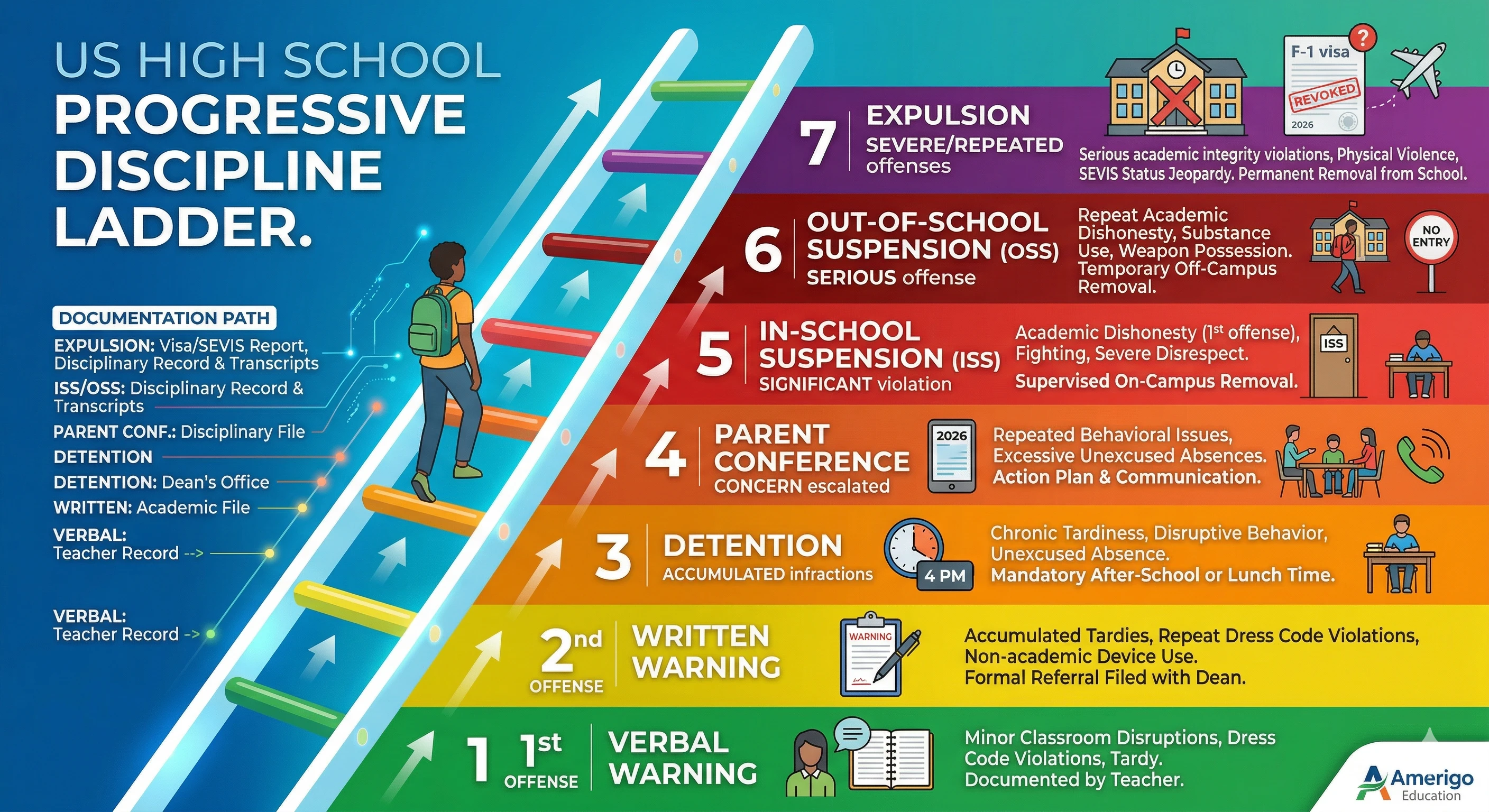
How Does the US Discipline System Work?
US high schools use a progressive discipline system that escalates consequences based on the severity and frequency of violations. The first level for most infractions is a verbal warning documented in the teacher's records. The next level is a written warning or referral to the dean of students, which creates a formal record. Detention requires the student to remain at school for a set period after regular hours, typically 30 to 60 minutes, supervised by a staff member. Detention is common for accumulated tardies, minor dress code violations, and low-level classroom disruptions.
Suspension removes the student from classes for a defined period, typically one to ten school days. In-school suspension keeps the student on campus in a separate room completing assignments independently, while out-of-school suspension requires the student to stay home. Both types appear on the student's disciplinary record. Expulsion is permanent removal from the school and is reserved for the most serious offenses: repeated academic dishonesty, physical violence, weapon possession, or substance use on campus. For F-1 visa holders, expulsion triggers a requirement to transfer to another SEVP-certified school within a limited timeframe or depart the US. Amerigo Education's on-campus staff works to resolve behavioral issues at the warning and detention stages before they reach suspension or expulsion.
How Do Discipline Records Affect Universities?
University admissions committees at US institutions review more than grades and test scores. The Common Application, used by over 1,000 US colleges and universities, includes a specific question asking whether the applicant has ever been found responsible for a disciplinary violation at any school. Students who answer yes are required to provide an explanation. A single detention or minor infraction does not typically require disclosure, but suspensions, expulsions, and academic integrity violations flagged in the student's permanent record do require honest reporting.
Academic dishonesty is particularly damaging because it directly contradicts the qualities universities value most: intellectual curiosity, personal responsibility, and ethical conduct. A suspension for plagiarism on a student's record sends a stronger negative signal than a suspension for a dress code violation, because it calls into question the authenticity of the student's entire academic portfolio. Competitive universities with holistic admissions processes weigh character and integrity alongside GPA and SAT/ACT scores. Students who enroll for at least two consecutive years at an Amerigo Education US Signature partner school and meet GPA and test score thresholds qualify for the Top 100 Guarantee, which provides a $50,000 USD refund if a qualifying student is not admitted to a Top 100 US university. Maintaining a clean disciplinary record is part of the foundation for a successful university application.
- The Common Application asks about disciplinary history directly
- Suspensions and expulsions must be disclosed honestly on university applications
- Academic integrity violations are viewed more negatively than behavioral infractions by admissions committees
- School counselors at Amerigo Education partner schools write recommendation letters that address character and conduct
- A clean disciplinary record supports the student's overall application narrative
- University admissions officers verify disciplinary disclosures with the applicant's high school
How Does Amerigo Help Students Follow Rules?
Amerigo Education's on-campus international department at each partner school provides structured support designed to help international students understand and comply with US school rules from day one. During orientation, staff walk students through the school's honor code, attendance policy, dress code, device policy, and behavioral expectations in detail. This is not a one-time presentation. Staff revisit these topics throughout the first semester, answer questions as situations arise, and provide context for why specific rules exist in the US education system.
Monthly progress reports sent to families cover academic performance, attendance patterns, social adjustment, and any conduct concerns flagged by teachers or administrators. Native-language support is available for families from China, Vietnam, Korea, Mexico, the Taiwan Region, and more, ensuring parents can discuss concerns with staff in their preferred language. When a student does receive a warning or consequence, on-campus staff work with the student to understand what happened, why it matters, and how to avoid repeating the behavior. This early intervention model means that most issues are resolved at the warning stage rather than escalating to suspension or disciplinary action that would appear on university applications. Accommodation options including homestay, on- and off-campus supervised residences, and self-provided housing all include access to the same on-campus support services.
- Structured orientation covers all school rules during the first weeks of enrollment
- Staff explain cultural context behind rules that may differ from the student's home country
- Monthly progress reports flag attendance, academic, and conduct concerns to families
- Native-language communication available in Chinese, Vietnamese, Korean, Spanish, and more
- Early intervention at the warning stage prevents escalation to formal discipline
- SAT/ACT preparation and ELL courses support academic success that reduces pressure to cut corners
- Visa services through ZF Visa (billed separately) assist with maintaining proper F-1 status
- University counseling integrates conduct awareness into application preparation
Frequently Asked Questions
What counts as plagiarism in US high schools?
Plagiarism in US high schools includes copying text from any source without proper citation, paraphrasing without attribution, submitting another student's work as your own, reusing your own previously submitted work without permission, and using AI-generated text without disclosure. Schools use detection software like Turnitin to identify matching content. Even unintentional plagiarism carries academic consequences, so students must learn proper citation formats during their first semester.
Can a student be expelled for cheating?
Yes, expulsion is possible for serious or repeated academic integrity violations at US high schools. A first offense typically results in a zero on the assignment and a warning, while repeated violations can lead to course failure, suspension, or expulsion. The specific consequences depend on the school's honor code and the severity of the violation. Expulsion from a school as an F-1 visa holder requires transferring to another SEVP-certified school or departing the US.
How many absences are allowed per semester?
Most US high schools allow between five and ten unexcused absences per semester before triggering formal intervention. State truancy laws require school attendance for minors, and schools report excessive absences to local authorities. Excused absences for illness, family emergencies, or religious observances generally do not count toward the limit. International students should provide documentation for any absence and communicate with their on-campus advisor in advance when possible.
Do US high schools require uniforms?
Dress code policies vary significantly by school. Many private high schools require uniforms or specific dress codes with approved clothing items. Public and some private schools use general dress codes that restrict certain clothing types rather than requiring a uniform. Common restrictions include prohibitions on clothing with offensive graphics, excessively revealing outfits, and non-school headwear during class. Students receive the dress code policy during orientation and are expected to comply from the first day.
Can students use phones during class?
Most US high schools restrict or prohibit personal phone use during instructional time. Common policies include requiring phones to be stored in backpacks or lockers during class, placing phones in designated pouches at the classroom door, or confiscating phones that are visible during instruction. Some schools allow phone use during lunch and between classes. Repeated violations can result in the device being held by administration for the remainder of the day or longer.
What happens if a student is late to class?
Tardiness policies at US high schools typically follow a graduated consequence system. The first few late arrivals in a marking period may result in a verbal warning and a recorded tardy. Accumulating multiple tardies often converts to an unexcused absence, which affects attendance records. Chronic tardiness can lead to detention, parent conferences, and in serious cases, suspension. International students living on campus or in nearby homestays are expected to arrive on time consistently.
Does a disciplinary record affect college apps?
Yes, many US university applications ask whether the student has received disciplinary action including suspension or expulsion. The Common Application includes a specific question about disciplinary history. A single minor infraction is unlikely to prevent admission, but suspension or expulsion for academic dishonesty is a serious red flag for admissions committees. Students should understand that maintaining a clean disciplinary record is part of building a competitive university application.
How does Amerigo help students learn rules?
Amerigo Education's on-campus international department provides structured orientation during the first weeks of enrollment that covers academic integrity, attendance expectations, behavioral standards, and school-specific policies. Staff members explain rules in context, help students understand cultural differences in academic norms, and serve as a resource when students have questions about what is permitted. Monthly progress reports flag any conduct concerns early so families and staff can address issues before they escalate.
Are the rules different for international students?
Academic integrity rules, attendance requirements, and behavioral expectations apply equally to all students regardless of nationality. International students are not given different standards or additional leniency for rule violations. However, schools experienced with international students recognize that some rules may be unfamiliar and provide additional orientation and explanation during the transition period. The expectation is full compliance once the student has been oriented to the school's policies.
What citation format do US high schools use?
Most US high schools teach and require MLA (Modern Language Association) format for humanities courses and APA (American Psychological Association) format for science courses. Some schools use Chicago style. Teachers specify the required format in assignment guidelines, and students are expected to follow it exactly. Citation includes in-text references and a Works Cited or References page. Schools often provide access to citation tools like EasyBib or Purdue OWL to help students format citations correctly.
Conclusion
US high schools enforce academic integrity, attendance, and behavioral standards strictly, and international students are held to the same expectations as domestic students from the first day of enrollment. Understanding these rules before arrival prevents avoidable disciplinary consequences that can damage university applications and, in serious cases, affect F-1 visa status. The most common issues for international students, including accidental plagiarism, unfamiliarity with citation requirements, and misunderstanding attendance expectations, are all preventable through proper orientation and ongoing support.
Prepare Your Child for US School Rules
Families ready to ensure their child understands and succeeds within US academic standards can apply now through a single application covering 40 partner schools, or contact us to discuss how the on-campus international department supports students through the transition. Explore US partner schools, view Canadian options, or learn about Brentwood School in the UK.
People Also Read
- What Does a Typical Day Look Like at a US High School?
- What Happens If My Child Struggles Academically Abroad? Prevention and Recovery Guide
- How to Overcome Culture Shock: A Guide for International High School Students Ages 14-18
About the Author
This guide was written by the Amerigo Education content team, drawing on program data from staff operating the on-campus international department at Amerigo Education's partner schools across the US, Canada, and UK. Learn more about Amerigo Education.
Disclaimer: This article provides general information for educational purposes only. Families should conduct independent research, request current program data from providers, and consult with program representatives regarding specific circumstances. Contact us with questions.