All news
April 13, 2026
Study Abroad 101
What Amerigo Does When International Students Face an Emergency Abroad
How Amerigo supports international students in emergencies: 24/7 assistance, safety tracking, native-language family outreach, and pre-departure preparation.
What Amerigo Does When International Students Face an Emergency Abroad
Last Updated: April 2026
International student emergency support abroad refers to the protocols and services a school program activates when a student experiences a medical event, accident, mental health crisis, family emergency, or safety incident while enrolled outside their home country. According to IIE Open Doors (2024), more than 1.1 million international students are enrolled at US institutions - a population that requires structured emergency response systems because students are far from their home-country families and support networks. For families sending a child to study in the US, understanding how emergencies are handled before they happen is a core part of program selection.
Amerigo Education partners with 40 Niche A+/A rated schools across the US, Canada, and the UK, supporting 3,500+ students from 55+ countries. The Class of 2025 achieved 97% admission to Top 100 US universities. Amerigo's 360-degree support model includes 24/7 emergency assistance, Life360 or Reach real-time safety tracking at US Signature Schools, and in-country staff who communicate with families in their native language when urgent situations require immediate outreach.
This guide explains how Amerigo's emergency support system works, what happens in different types of emergency scenarios, how families are informed in real time, and what preparation Amerigo provides before students arrive to minimize risk.
Key Takeaways
- 24/7 Emergency Assistance Is Standard: All Amerigo students have access to 24/7 emergency assistance - residential and homestay students alike - as a core feature of the program.
- Life360 or Reach for Real-Time Location: At US Signature Schools, parents can use Life360 or Reach to monitor their student's location in real time from their home country.
- In-Country Staff for Native-Language Outreach: When an emergency requires immediate family communication, Amerigo's in-country staff reach out to families in Chinese, Vietnamese, Korean, Spanish, and other languages - native-language communication is not delayed.
- On-Campus Team Is the First Point of Contact: The on-campus international department at US Signature Schools manages day-to-day student wellbeing - they are the first to identify and respond to a student situation on the ground.
- Pre-Departure Preparation Reduces Risk: Each student completes a pre-departure orientation session to review health documentation, confirm emergency contacts, and set expectations before arrival.
What Counts as an Emergency for Amerigo?
An international student emergency abroad covers a wide range of situations: medical incidents (illness, injury, hospitalization), mental health crises, accidents, natural disasters, family emergencies in the home country, safety concerns (loss of ID or valuables), and visa or legal complications. According to NCES (2024), international students face distinct challenges because they cannot rely on the immediate proximity of family or familiar healthcare systems in a crisis.
Amerigo's on-campus international department at US Signature Schools serves as the first point of contact for student emergencies during school hours and in-residence situations. For incidents outside school hours involving residential students, Amerigo's on- and off-campus residence staff are available 24/7 to respond.
- Medical emergencies: Illness, injury, or hospitalization requiring coordination with local healthcare providers and family notification.
- Mental health situations: Stress, anxiety, or crisis events requiring connection to school counseling resources and Amerigo team follow-up. According to APA (2024), international students face elevated rates of academic stress and cultural adjustment challenges compared to domestic peers - making proactive mental health support a core emergency protocol component.
- Safety incidents: Loss of documents, theft, or safety concerns requiring immediate Amerigo and local authority coordination.
- Family emergencies at home: Student needs to return to their home country urgently, requiring visa, travel, and academic continuity support.
How Does Amerigo Respond to a Medical Emergency?
When a student experiences a medical emergency, the on-campus international department or residence staff activates the emergency response protocol. Staff accompany or arrange transport to the nearest appropriate medical facility, coordinate with the school's emergency procedures, and contact Amerigo's 24/7 emergency assistance line. The student's health insurance information - which families arrange separately, as health insurance is not included in the program fee - is used for hospital admission.
According to SEVP, F-1 (student visa for academic programs) students are required to maintain their student status during medical treatment, and schools must be notified of any extended absences. Amerigo's team coordinates with the school's designated school official to manage any enrollment status implications during a student's medical absence.
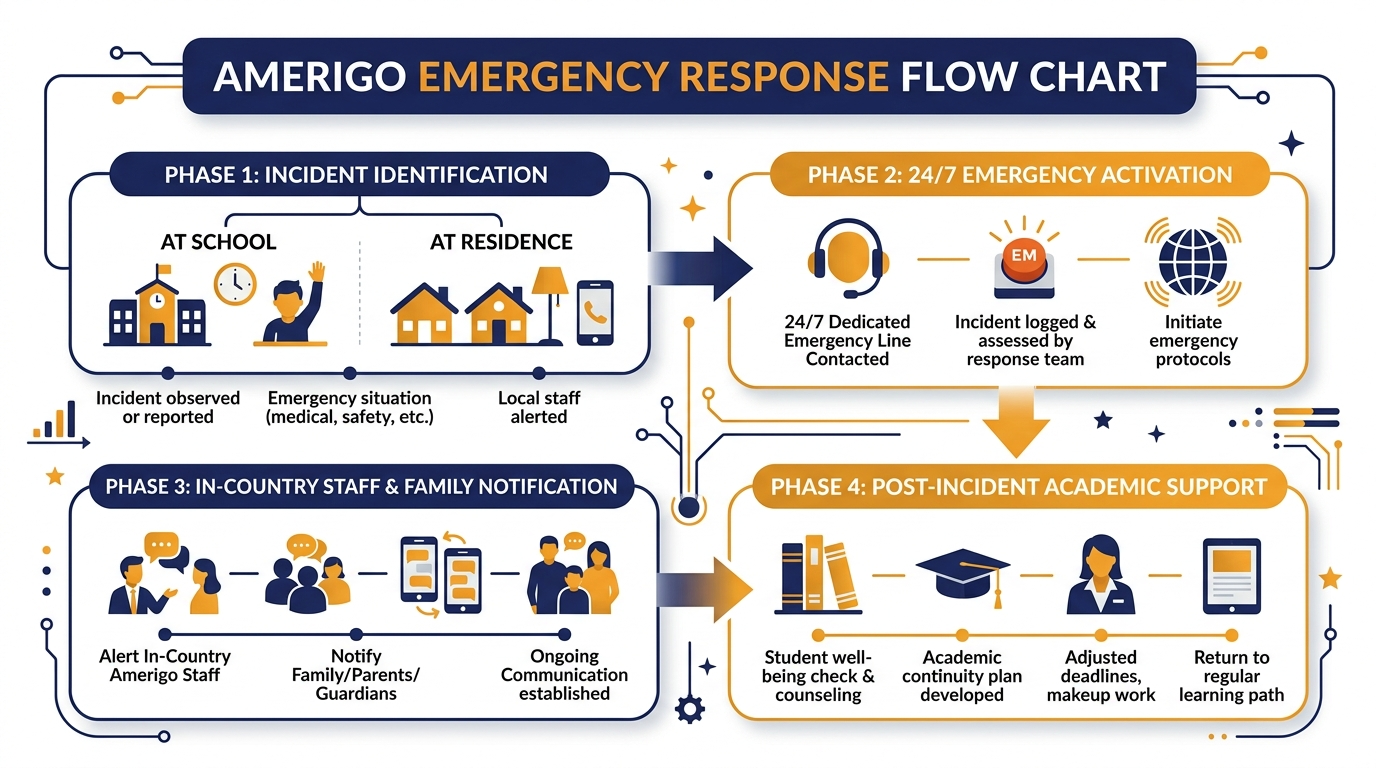
- Immediate response: On-campus or residence staff respond first - they accompany the student to medical care if needed.
- Family notification: Amerigo's in-country staff contact the family in their native language, providing an accurate account of the situation without delay.
- Ongoing updates: Amerigo issues real-time outreach to families for updates that require immediate attention - this is separate from the monthly progress reports, school activity calendars and event announcements that go out on a regular schedule.
- Academic continuity: The on-campus international department coordinates with the school to manage attendance, assignments, and enrollment status during recovery.
How Are Families Informed During an Emergency?
Amerigo's in-country staff provide native-language communication for families from China, Vietnam, Korea, Mexico, and the Taiwan Region. When an emergency requires immediate contact, in-country staff reach out directly to the family - they do not wait for the scheduled monthly update cycle. On-campus staff at US Signature Schools do not provide real-time interpretation; they manage the on-ground response, and in-country staff relay information to families in their native language.
Parents at home can also use Life360 or Reach at US Signature Schools to monitor their student's location in real time. This is a standard feature of the US Signature School program - it is not available at Brentwood or FEIA Canada. For homestay students, the on-campus international department provides academic support and coordinates emergency communication in the same way as residential students.
- Real-time outreach: For emergencies, in-country staff contact families immediately - not through the monthly report cycle.
- Native-language accuracy: Messages are delivered in the family's language to ensure nothing is lost in translation during a high-stress situation.
- Location tracking: Life360 or Reach allows parents to verify their child's location in real time through the app - this provides reassurance during an incident even before a call is made.
What Happens If a Student Needs to Return Home?
If a student needs to return to their home country due to a family emergency, serious illness, or other urgent situation, Amerigo's team coordinates the logistics alongside the student and family. This includes supporting the academic continuity plan with the school - managing course credit, attendance records, and re-enrollment coordination if the student plans to return. The F-1 visa implications of a temporary departure or extended absence are managed in coordination with the school's designated school official.
Students who return home temporarily may need to apply for re-entry to the US. The F-1 visa typically allows re-entry if the student's I-20 is valid and the program remains active. Amerigo's team helps families understand the steps required, and optional visa support is available through ZF Visa, Amerigo's third-party visa partner. Amerigo does not provide visa services directly.
How Does Amerigo Prepare Students Before an Emergency Occurs?
Prevention and preparation are core parts of Amerigo's support model. Each student completes a 1:1 pre-departure call with an Amerigo academic director before arriving in the US. This call covers transcript review, course planning, and confirmation of emergency contacts - including health documentation and family contact details that will be used if a situation arises.
Students also attend pre-departure planning sessions and webinars that cover what to do if they feel unwell, how to contact Amerigo staff, and how safety technology like Life360 or Reach at US Signature Schools works. Amerigo also hosts its own social events for students and their friends separate from school-organized activities, which builds the peer networks that help students identify when a classmate needs support.
- 1:1 pre-departure call: Campus coordinator confirms emergency contact details and reviews health documentation before the student arrives on campus.
- Pre-departure webinars: Students learn the Amerigo emergency contact protocols before they experience any situation where they would need to use them.
- In-school orientation: On arrival, students receive orientation from the on-campus international department covering campus safety, medical resources, and how to access Amerigo support.
- Safety technology setup: Life360 or Reach is set up at US Signature Schools before or shortly after arrival, giving parents real-time access from day one. School contacts are also available through Amerigo's StudyStudyGo platform.
Frequently Asked Questions
What is Amerigo's 24/7 emergency assistance?
Amerigo's 24/7 emergency assistance is a continuous on-call support service available to all enrolled students - residential and homestay. When a student faces an urgent situation outside regular hours, the 24/7 line activates Amerigo's emergency response protocol, connecting the student with staff who coordinate medical, safety, or logistics support. This service is included in the program for all students across US, Canadian, and UK programs.
Does Amerigo provide health insurance for international students?
No. Health insurance is not included in Amerigo's program fee and varies by student. Families are responsible for arranging appropriate health coverage before their student arrives in the US. Amerigo does not recommend specific providers, but families should ensure their policy covers emergency medical care in the United States. Some schools may have a student health fee - families should confirm this with Amerigo's enrollment team.
How are parents notified when something goes wrong?
Amerigo's in-country staff contact families directly in their native language when an urgent situation requires immediate outreach. For families from China, Vietnam, Korea, Mexico, and the Taiwan Region, communication is provided in the family's native language by in-country staff who work remotely. On-campus staff manage the on-ground response; in-country staff relay accurate information to families without delay. Monthly progress reports, school activity calendars and event announcements cover routine updates on a regular schedule.
What safety technology does Amerigo use?
At US Signature Schools, Amerigo uses Life360 or Reach - mobile applications that allow parents in the home country to track their student's real-time location through a smartphone. This technology is a standard feature of the US Signature School program and is set up at or shortly after arrival. Life360 and Reach are not available at Brentwood School or FEIA Canada. Families should confirm device compatibility before departure.
What happens if my child has a mental health crisis?
Amerigo's on-campus international department staff are trained to identify signs of student distress and connect students with the school's counseling resources. For situations requiring more urgent intervention, the 24/7 emergency assistance line activates additional support. Amerigo's in-country staff contact families immediately in these situations. Students also benefit from Amerigo's own social events for students and their friends separate from school-organized activities, which build the peer connections that support emotional wellbeing.
Can a student return home during the school year for a family emergency?
Yes. If a student needs to return home urgently, Amerigo's team coordinates with the school to manage attendance, course credit, and the F-1 visa implications of a temporary departure. Students must coordinate with the school's designated school official before departing to protect their enrollment status. Amerigo's team helps families understand the steps for re-entry. Optional visa support is available through ZF Visa - Amerigo does not provide visa services directly.
Are homestay students covered by the same emergency support as residential students?
Yes. All Amerigo students, including homestay students, have access to 24/7 emergency assistance and the on-campus international department's support. Homestay students receive the same monthly progress reports, school activity calendars and event announcements and are subject to the same emergency communication protocols. The primary difference is the physical response environment: for residential students, on-site staff are present at the residence; for homestay students, the on-campus team coordinates the response.
Does Amerigo's emergency support cover situations at Brentwood in the UK?
Yes, though the model differs. Amerigo's 24/7 emergency assistance is available to all enrolled students including Brentwood. However, Brentwood does not have an on-campus Amerigo international department, Life360/Reach tracking, or on-campus Amerigo staff. Emergency support at Brentwood is handled through Brentwood's own boarding program infrastructure alongside Amerigo's home-country staff, who provide native-language communication support remotely for Brentwood students.
Conclusion
Amerigo's emergency support model combines 24/7 availability, real-time safety tracking at US Signature Schools, native-language family communication, and a pre-departure preparation process that equips students and families before any incident occurs. The on-campus international department at US Signature Schools is the first point of contact in a crisis, with Amerigo's in-country staff ensuring families receive accurate information in their native language without delay.
Learn More About Amerigo's Support Model
To understand how Amerigo supports your student throughout enrollment, contact us to speak with an enrollment advisor about safety, health, and emergency protocols. To explore partner schools and program details, use find your school or apply now to begin the enrollment process.
People Also Read
- What Actually Keeps International Students Safe at US High Schools (Beyond Marketing Promises)
- Is America Still Safe for International Students in 2026? What Parents Need to Know
- Health Insurance for F-1 Students
About the Author
This guide was written by the Amerigo Education content team, drawing on program data from staff operating the on-campus international department at 40 Niche A+/A rated US, Canadian, and UK partner schools. Learn more about Amerigo Education.
Disclaimer: This article provides general information for educational purposes only. Families should conduct independent research, request current program data from providers, and consult with program representatives regarding specific circumstances. Contact us with questions.
_converted.webp)